
Being a price-taker, a perfectly competitive firm cannot receive a producer surplus in
the short run.
The application of economic analysis to human resources issues is called personnel
economics.
If firms are protected by substantial barriers to entry, short-run profits can turn into
long-run profits.
By 2013, spending on federal health care programs such as Medicare and Medicaid had
grown to 6 percent of GDP.

Increases in population shift the market supply curve for labor to the right.
A fundamental assumption in game theory is that players do not interact with each
other.
On a diagram of a production possibility frontier, economic growth is represented by
the slope of the production possibility frontier.

In a decreasing-cost industry, the entry of new firms lowers average cost at each level of
output.
If transactions costs are low, private bargaining will always result in an efficient
solution to the problem of externalities.
If marginal revenue is negative then the revenue lost from receiving a lower price on all
the units that could have been sold at the original price is smaller than the additional
revenue from selling one more unit of the good.
If a firm can produce a product at a lower average cost than its competitors, it stands a
better chance of earning economic profit.

When a firm experiences negative technological change it can produce the same output
with fewer inputs.
One reason college students do not study enough to get high grades is that they are
unrealistic about their future behavior.
There are a limited number of original Picasso paintings. This means that the supply of
original Picasso paintings is perfectly inelastic.

If a firm’s goal is to maximize revenue, it will price its product to correspond to the
unit-elastic segment of its demand curve.
A firm might prefer a commission system of compensation when the nature of the work
is repetitive and monotonous and can be performed by an individual.
The person or firm that pays a tax bears the burden of the tax.
If buyers of a monopolistically competitive product feel the products of different sellers
have little differences between them, then the demand for each seller’s product is
relatively elastic.

If a country is producing efficiently and is on the production possibilities frontier, the
country can produce more of one good without producing less of the other good.
A downward sloping marginal product of labor curve demonstrates the law of
diminishing marginal returns.
An increase in liabilities will reduce a firm’s net worth.

In the United States, corporate profits are taxed at the corporate level and then are taxed
again as personal income in the form of dividend payments.
Suppose the extra cost for a doctor to keep his office open for one extra hour is $200.
Then, the doctor should stay open for the extra hour even if he can generate additional
revenue of $200 for that hour.
Unlike a perfectly competitive firm, a monopolistic competitor does not have a
short-run shut-down point.
In a two-good, two country world, if one country has an absolute advantage in the
production of both goods, it cannot benefit by trading with the other country.

One reason why firms would choose a salary system rather than a commission
compensation system is that their employees might become less concerned about the
quality of their work.
Multinational corporations (MNCs) have direct investments abroad in multiple
countries.
Monopolistic competition differs from oligopoly in that in monopolistic competition
firms act independently while in oligopoly firms act interdependently.

The income effect of a price increase for a Giffen good outweighs the substitution
effect.
The prisoner’s dilemma is used to analyze business situations in which one firm acts
first and then other firms respond.
With perfect price discrimination there is
A) no deadweight loss.
B) no producer surplus.
C) one single price.
D) an increase in consumer surplus.
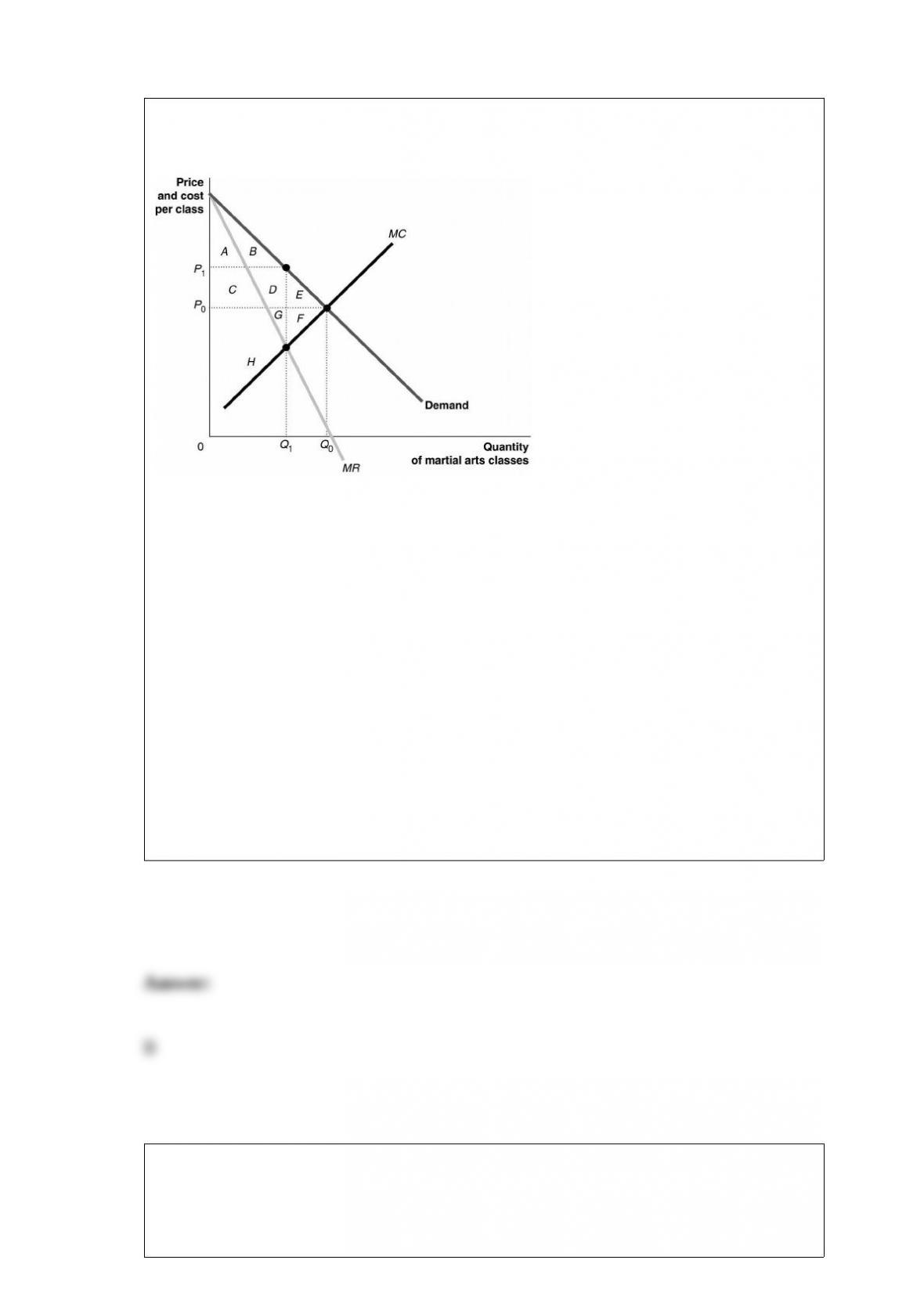
Figure 16-6
Watanabe Sensei operates the only martial arts school in Hartfield. For simplicity,
assume that consumers have identical demand curves and that Sensei knows what this
demand curve is. Figure 16-6 shows this demand curve.
Refer to Figure 16-6. Suppose instead of charging the monopoly price for his classes,
Sensei charges the competitive price. What is the competitive price and what is the
quantity demanded at this price?
A) P0, Q1
B) P0, Q0
C) P1,Q0
D) P1, Q1
Suppose your marginal utility from consuming the 3rd slice of cake is zero, then your
total utility from consuming cake is
A) maximized.
B) decreasing.
C) negative.
D) increasing.
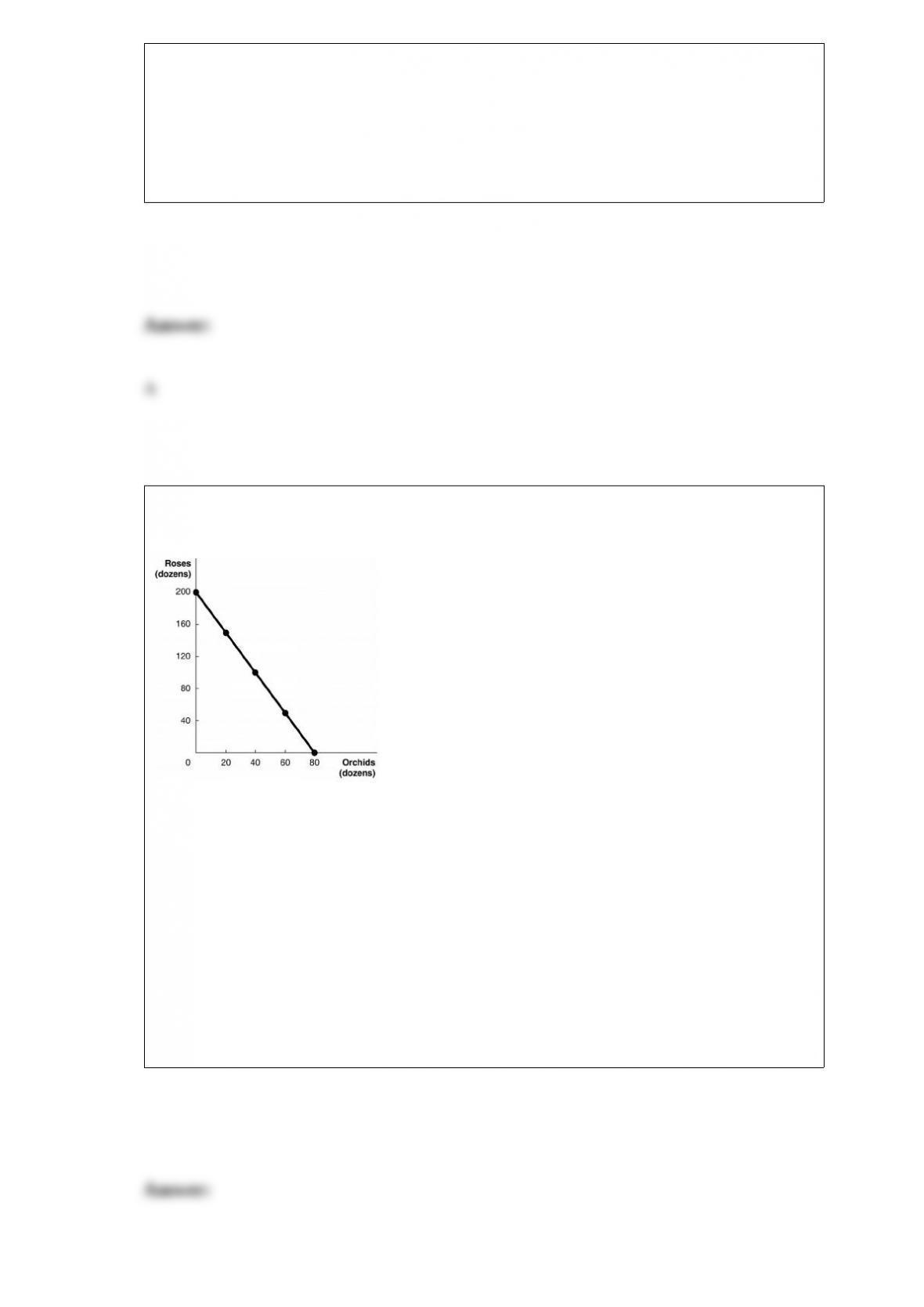
Figure 2-8
Figure 2-8 above shows the production possibilities frontier for Vidalia, a nation that
produces two goods, roses and orchids.
Refer to Figure 2-8. What is the opportunity cost of 100 dozen roses?
A) 0.8 dozen orchids
B) 5 dozen orchids
C) 40 dozen orchids
D) 80 dozen orchids

If the absolute value of the price elasticity of demand for aspirin equals 0.8 then
A) aspirin is a normal good.
B) the demand for aspirin is inelastic.
C) aspirin has few substitutes.
D) the demand for aspirin is elastic.
Frieda is at her local florist to buy a dozen roses. She is willing to pay $75 for the roses,
and buys them for $75. Frieda’s consumer surplus from the purchase is
A) $150.
B) $75.
C) $37.50.
D) $0.
Which of the following statements is true about monopolistically competitive firms?
A) Unlike perfectly competitive firms, monopolistically competitive firms are able to
raise their prices without losing all of their customers.
B) Like perfectly competitive firms, monopolistically competitive firms are not able to
raise prices without losing all of their customers because they face competition from
firms selling similar products.
C) Like perfectly competitive firms, monopolistically competitive firms maximize their
profits by settling price equal to marginal cost.
D) Unlike perfectly competitive firms, monopolistically competitive face perfectly
inelastic demand curves.
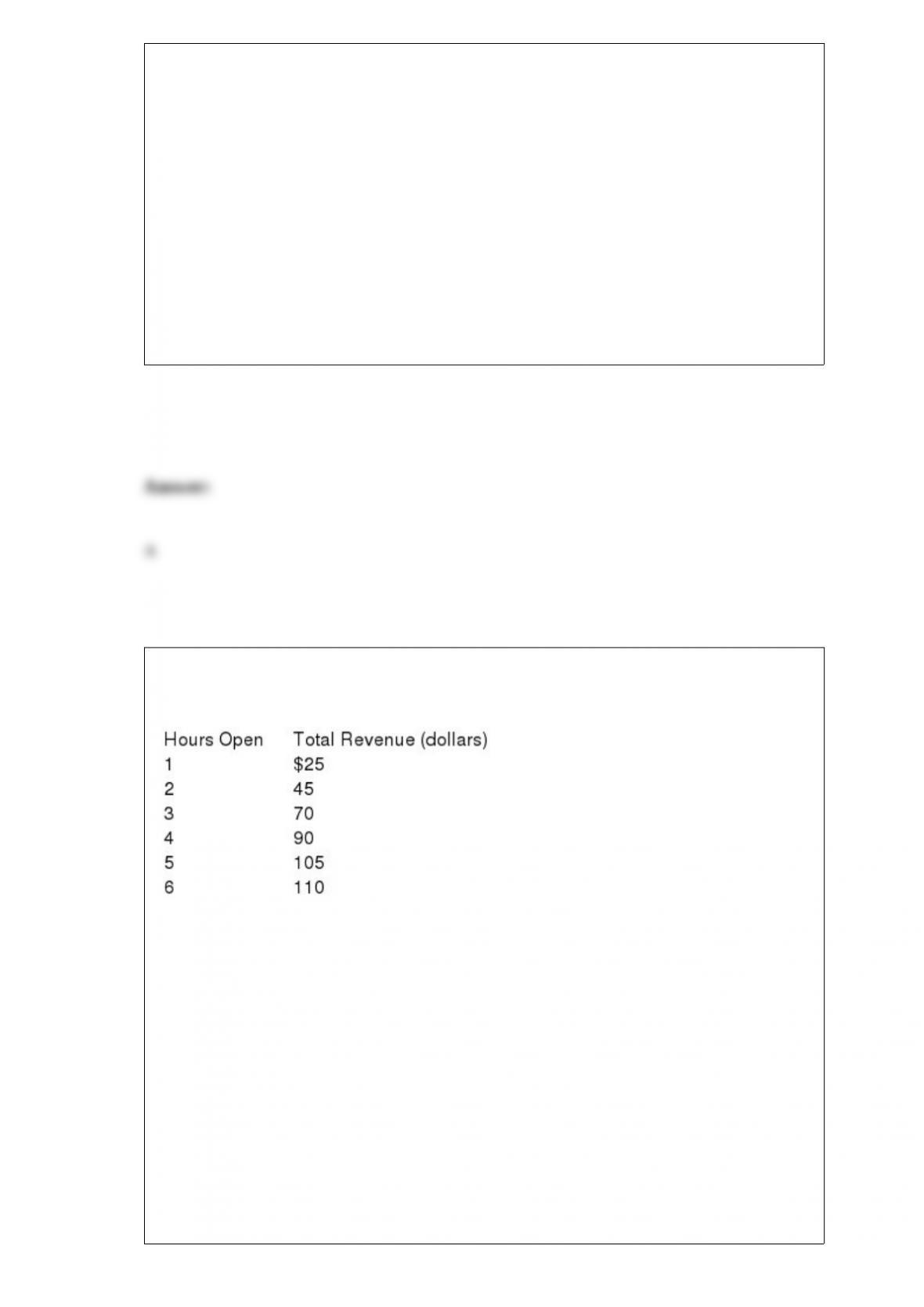
Table 1-2
Thuy Anh runs a small flower shop in the town of Florabunda. She is debating whether
she should extend her hours of operation. Thuy Anh figures that her sales revenue will
depend on the number of hours the flower shop is open as shown in the table above.
She would have to hire a worker for those hours at a wage rate of $16 per hour.
Refer to Table 1-2. What is Thuy Anh’s marginal cost if she decides to stay open for
three hours instead of two hours?
A) $0
B) $16
C) $25

D) $32
E) $45
The income effect of a price change refers to the impact of a change in
A) income on the price of a good.
B) demand when income changes.
C) the quantity demanded when income changes.
D) the price of a good on a consumer’s purchasing power.
An implicit cost is
A) a nonmonetary opportunity cost.
B) a cost unique to sole proprietorships.
C) a cost that involves spending money.
D) a cost unique to corporations.
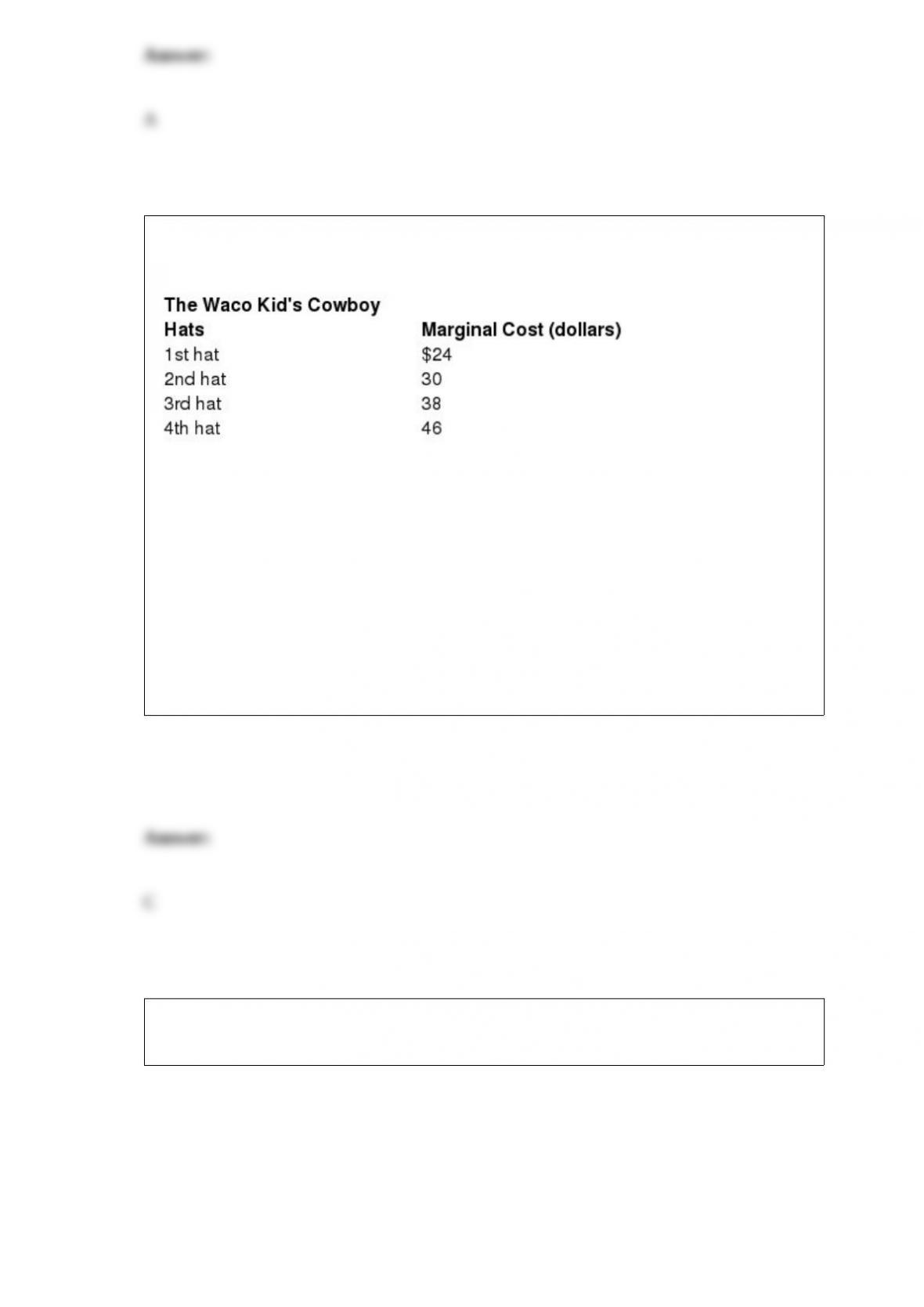
Table 4-3
Refer to Table 4-3. The table above lists the marginal cost of cowboy hats by The Waco
Kid, a firm that specializes in producing western wear. If the price of cowboy hats
increases from $38 to $46
A) consumers will buy no cowboy hats.
B) the marginal cost of producing the third cowboy hat will increase to $46.
C) producer surplus will rise from $22 to $46.
D) there will be a surplus of cowboy hats.
Table 17-7
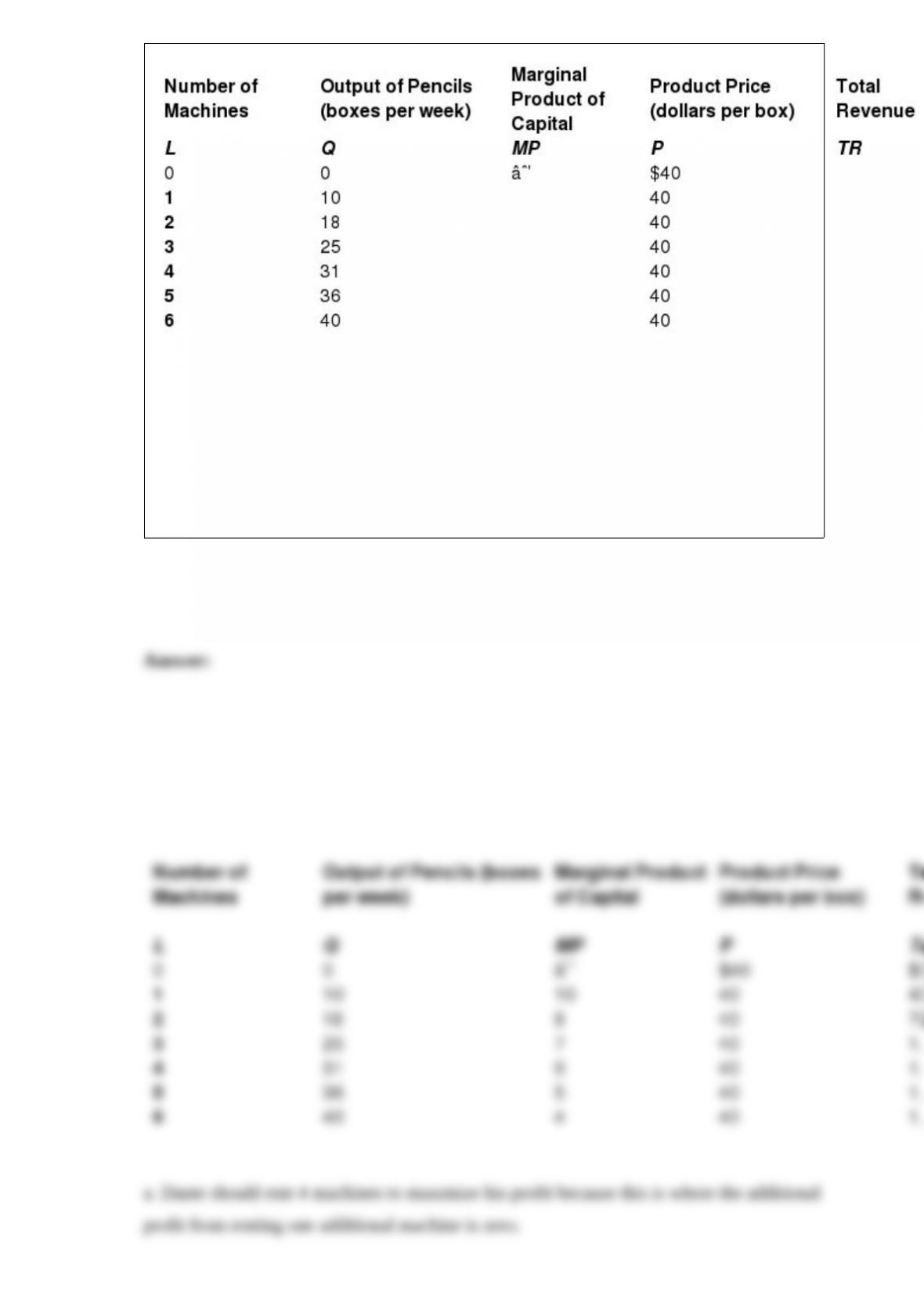
Refer to Table 17-7. Dante owns a pencil factory and faces the situation shown in the
table and the cost of renting a machine is $240 per week.
a. Fill in the blanks in the table and determine the profit-maximizing number of
machines for Dante to rent. Explain why renting this number of machines is profit
maximizing.
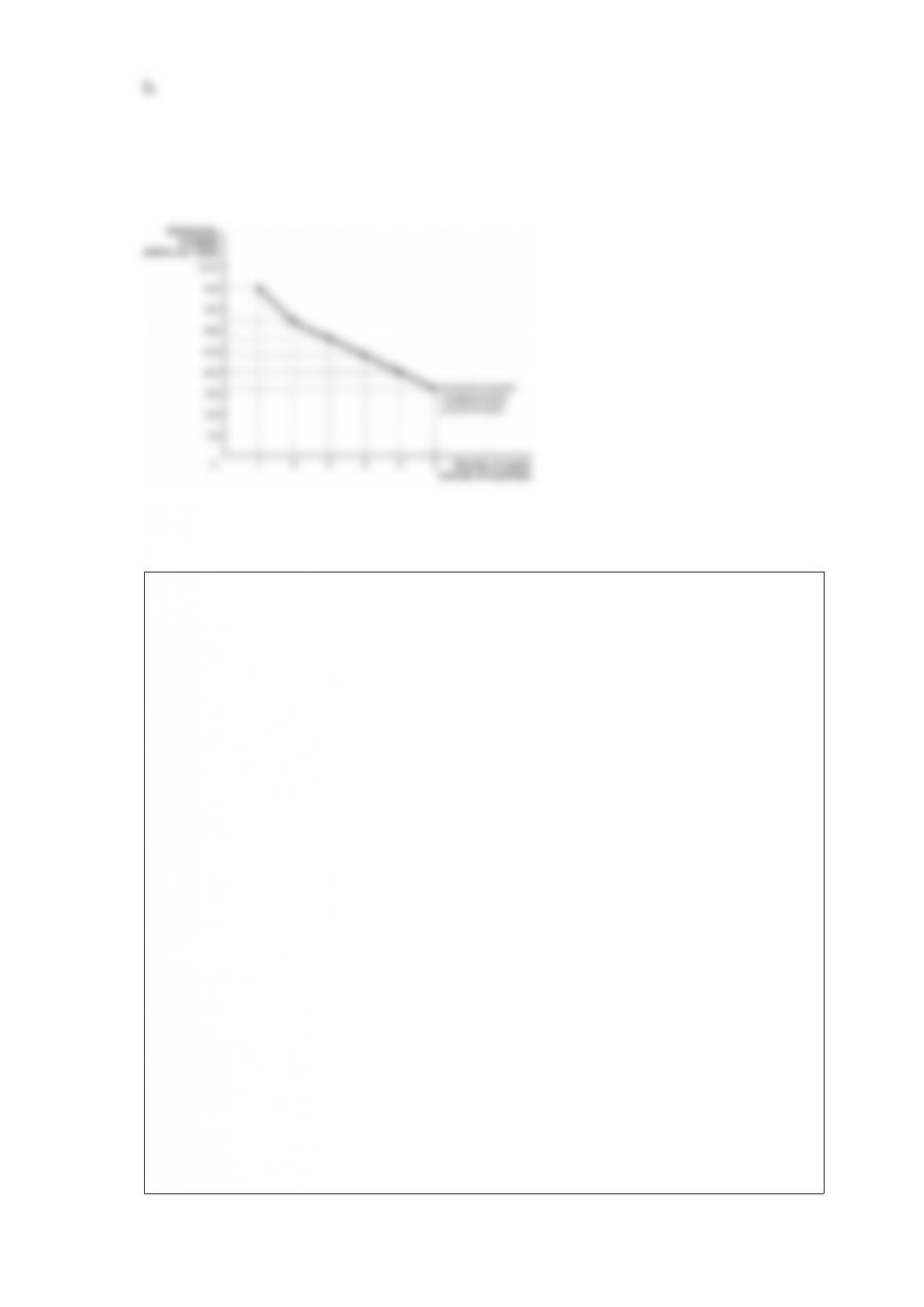
b. Draw Dante’s demand curve for capital.
Article Summary
Brandeis University economist Benjamin Shiller has written a paper which explains
how Netflix could combine demographic data with customers’ Web browsing habits to
more accurately predict how much a customer would be willing to pay for a Netflix
subscription, and how using this method of first-degree price discrimination would
generate higher profits. Shiller explains that the more information a company has about
its customers, the better it is at being able to set prices to increase profits. As he stated
in his paper, “Using all variables to tailor prices, one can yield variable profits 1.39
percent higher than variable profits obtained using non-tailored 2nd degree
price-discrimination. Using demographics alone to tailor prices raises profits by much
less, yielding variable profits only 0.14% higher than variable profits attainable under
2nd degree [price discrimination].”
Source: Brian Fung, “How Netflix could use Big Data to make twice as much money
off you,” Washington Post, September 4, 2013.
Refer to the Article Summary. If Netflix chose to use Shiller’s pricing method
A) consumer surplus would be zero.
B) producer surplus would be zero.
C) deadweight loss would be maximized.
D) consumer surplus, producer surplus, and deadweight loss would all be equal.
Markets promote
A) equity and competition.
B) voluntary exchange and equality.
C) equity and equality.
D) competition and voluntary exchange.
Arnie Ziffel has $20 per week to spend on any combination of pineapples and green tea.
The price of a pineapple is $4 and the price of a bottle of green tea is $2. The table
below shows Arnie’s utility values. Use the table to answer the questions that follow the
table.
a. Complete the table by filling in the blank spaces.
b. Suppose Arnold purchases 4 pineapples and 2 bottles of green tea. Is he consuming
the optimal consumption bundle? If so, explain why. If not, what combination should he
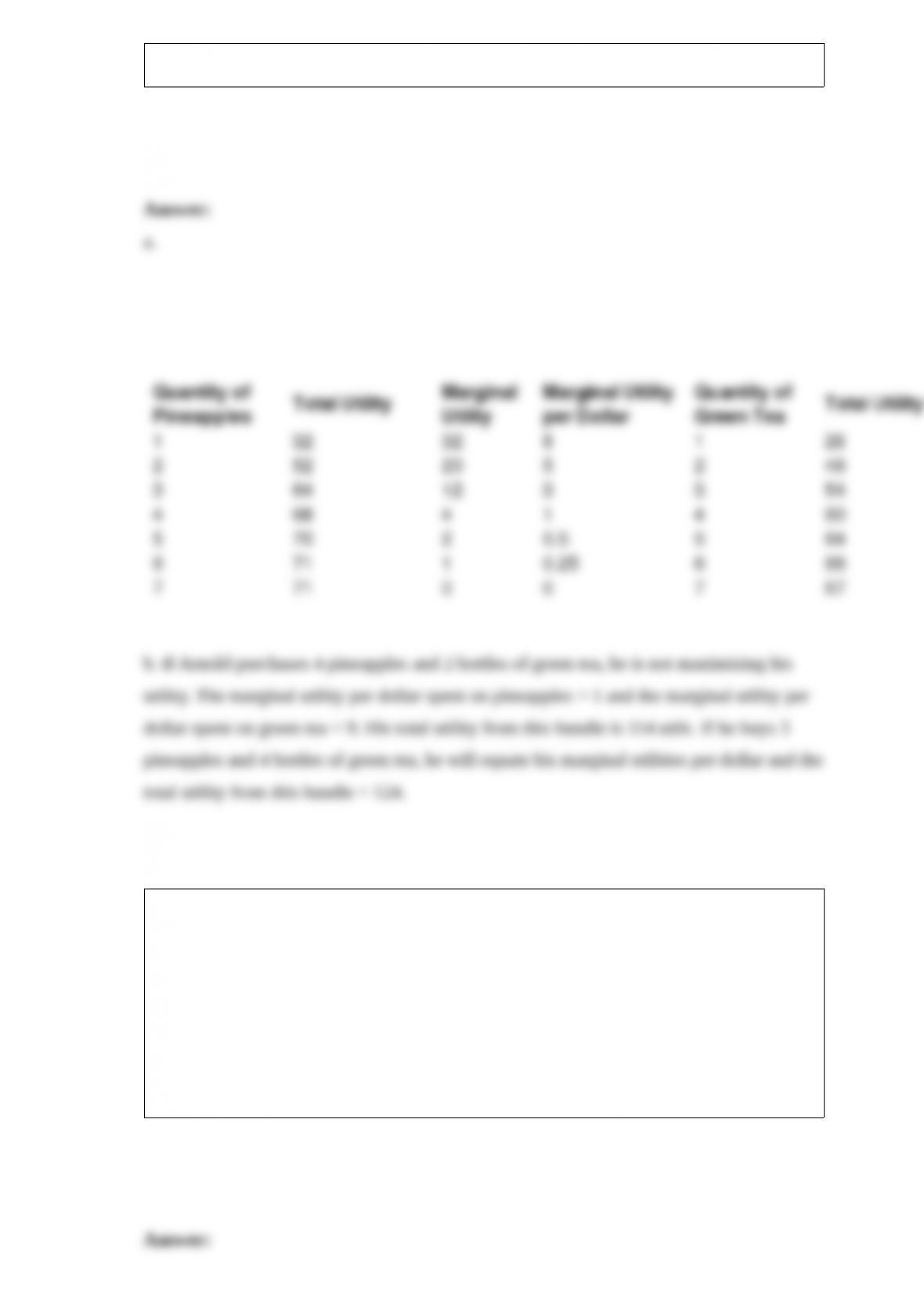
buy and why?
Exports are domestically produced goods and services
A) sold to other countries.
B) sold to the government.
C) sold at home.
D) which are used to produce other goods and services.
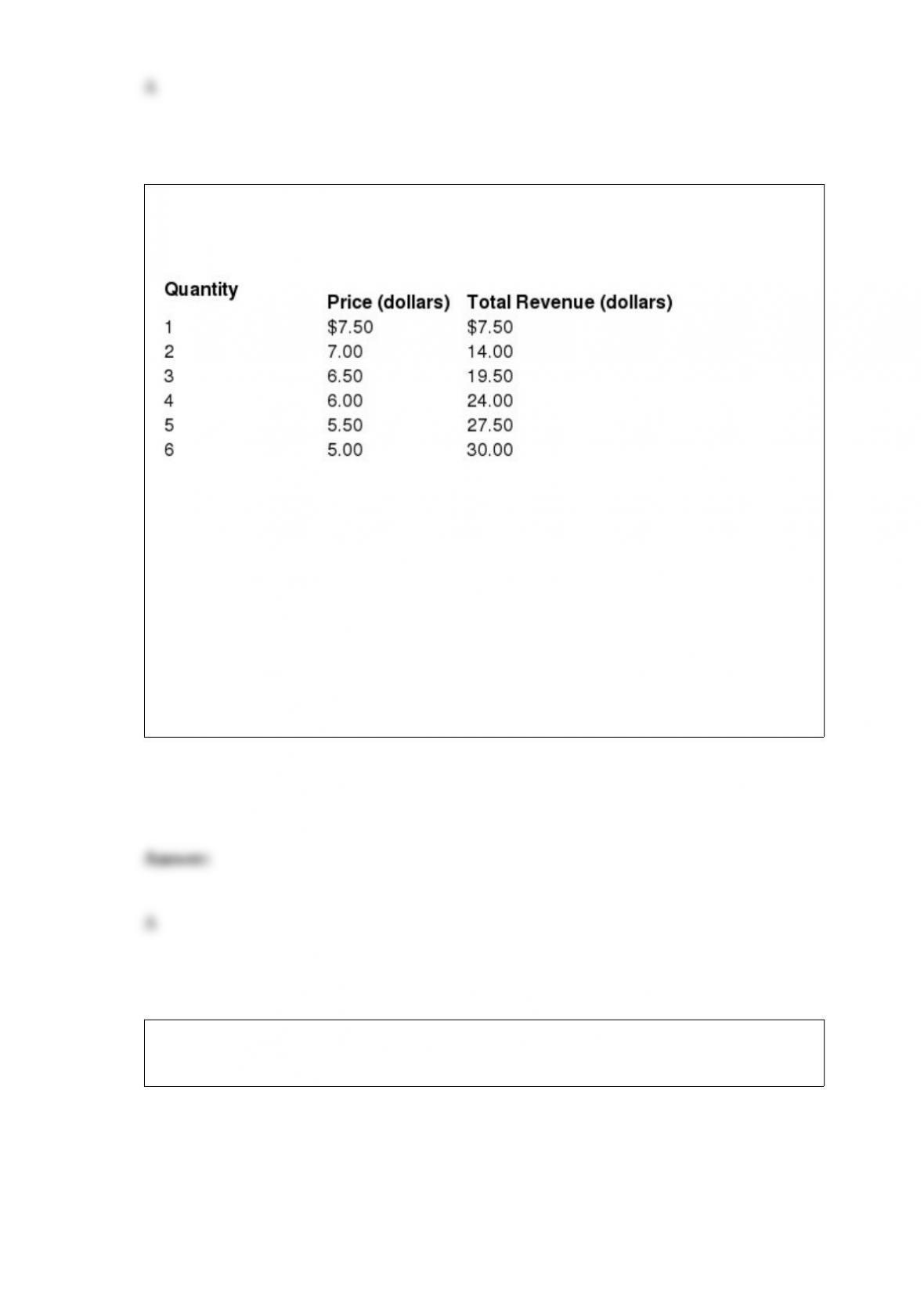
Table 13-1
Refer to Table 13-1. The Table shows
A) an elastic segment of the demand curve.
B) an inelastic segment of the demand curve.
C) a demand curve with an elastic segment of the demand curve from $7.50 to $6.50
followed by an inelastic segment.
D) a demand curve with an inelastic segment of the demand curve from $7.50 to $6.50
followed by an elastic segment.
Table 17-2
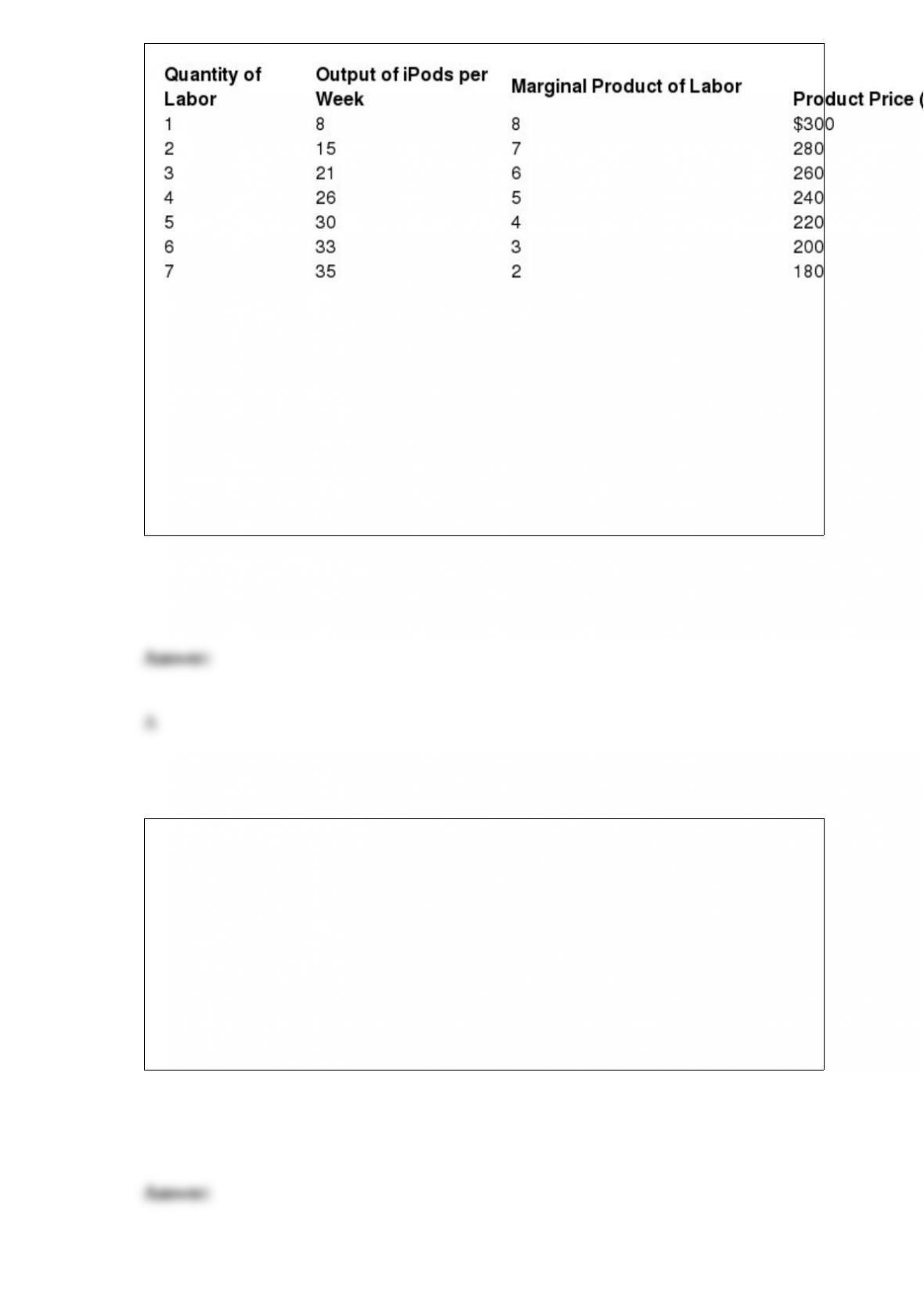
Refer to Table 17-2. What is the profit-maximizing quantity of labor that the firm
should hire?
A) 5 units
B) 4 units
C) 3 units
D) 2 units
If a graph has a line that shows the amount of outsourcing in the last ten years, it is
known as
A) a pie chart.
B) a time-series graph.
C) a demand curve for outsourcing.
D) a supply curve of outsourcing.

Scenario: Donna Bader, Globalization opponent
Donna Bader spent her final year at college studying the effect of various economic
factors on the economy of developing nations. Based on the results of her study, she
concluded that globalization does these countries more harm than good.Which of the
following statements, if true, weakens her argument?
A) The employment rate of developed nations has been declining because of
international outsourcing.
B) With the exposure to new technology and cultural trends, the standard of living in
developing countries has improved.
C) People in high-wage countries often can’t afford hospital care without financial
assistance.
D) Labor market flexibility across the world has seen little improvement over the last
decade.
When Congress passed a law that imposed a tax designed to fund its Social Security
and Medicare programs it wanted employers and workers to share the burden of the tax
equally. Most economists who have studied the incidence of the tax have concluded
A) the tax is not high enough to cover the future costs of Social Security and Medicare.
B) the tax on employers is too high because it reduces the employment of low-skilled
workers.
C) the burden of the tax falls almost entirely on workers.
D) the tax rate should be greater for high income workers than for low income workers.

The process of countries becoming more open to foreign trade and investment is known
as
A) autarky.
B) foreign exchange.
C) globalization.
D) protectionism.
Which of the following is most likely to exert the bargaining power of a buyer?
A) Barnes and Noble purchases books from publishers for sale in its online stores.
B) Wal-Mart, The world’s largest discount store, seeks vendors to supply products made
exclusively for its stores.
C) Ground beef producers seek to purchase cattle from ranchers.
D) Cowgirl Creamery, a small cheese producer, seeks a dairy farm for its organic milk
supplies.

Doctors and lawyers in every state need a license to practice. This is an example of
A) consumer protection laws.
B) consumer advocacy.
C) occupational licensing.
D) ownership of a key input.
The economic analysis of minimum wage involves both normative and positive
analysis. Consider the following consequences of a minimum wage:
a. The minimum wage law causes unemployment.
b. A minimum wage law benefits some groups and hurts others.
c. In some cities such as San Francisco and New York, it would be impossible for
low-skilled workers to live in the city without minimum wage laws.
d. The gains to winners of a minimum wage law should be valued more highly than the
losses to losers because the latter primarily comprises businesses.
Which of the consequences above are positive statements and which are normative
statements?
A) a, b, and c are positive statements and d is a normative statement.
B) a and b are positive statements, c and d are normative statement.
C) Only a is a positive statement, b, c, and d are normative statements.
D) a and c are positive statements, b and d are normative statements.

Consider a downward-sloping demand curve. When the price of an inferior good
increases, the income and substitution effects
A) work in the same direction to increase quantity demanded.
B) work in the same direction to decrease quantity demanded.
C) work in opposite directions and quantity demanded increases.
D) work in opposite directions and quantity demanded decreases.
Which of the following statements about a simple circular flow model is false?
A) Producers are buyers in the factor market and sellers in the product market.
B) Households are neither buyers nor sellers in the input market.
C) Producers are buyers in the factor market.
D) Households are sellers in the product market.
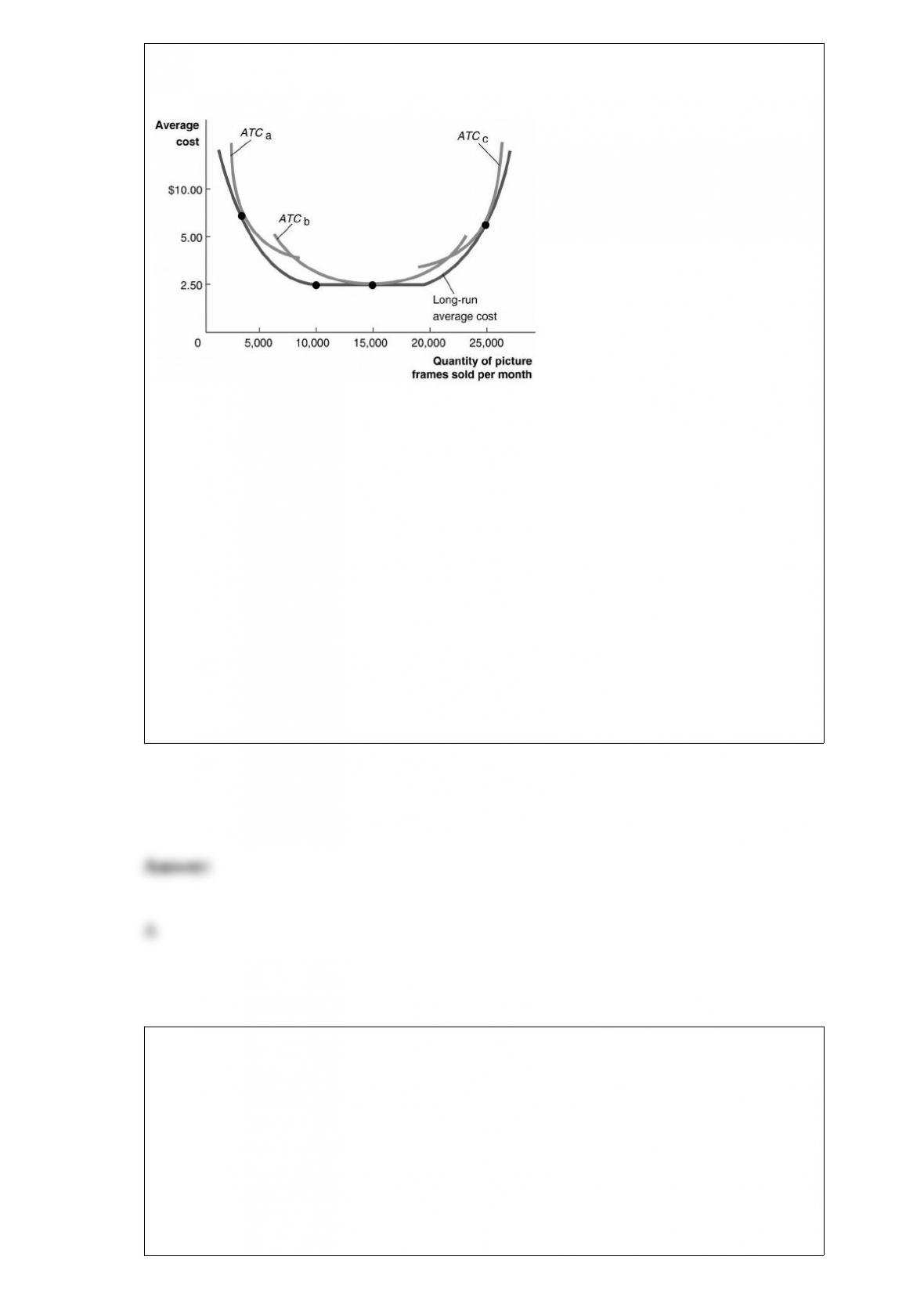
Figure 11-11
Figure 11-11 illustrates the long-run average cost curve for a firm that produces picture
frames. The graph also includes short-run average cost curves for three firm sizes:
ATCa, ATCb and ATCc.
Refer to Figure 11-11. In the short run, if the firm sells fewer than 5,000 picture frames
per month
A) it should produce with the scale of operation associated with ATCa.
B) it should produce with the scale of operation associated with ATCb.
C) it should produce with the scale of operation associated with ATCc.
D) it will experience constant returns to scale.
Scenario 1-1
Suppose a cell phone manufacturer currently sells 20,000 cell phones per week and
makes a profit of $5,000 per week. A manager at the plant observes, “Although the last
3,000 cell phones we produced and sold increased our revenue by $6,000 and our costs
by $6,700, we are still making an overall profit of $5,000 per week so I think we’re on
the right track. We are producing the optimal number of cell phones.”
Refer to Scenario 1-1. Using marginal analysis terminology, what is another economic

term for the incremental cost of producing the last 3,000 cell phones?
A) marginal cost
B) operating cost
C) explicit cost
D) Any of the above terms are correct.
Who won a Nobel Prize in economics for his work in the development of game theory?
A) John von Neuman
B) Oskar Morgenstern
C) John Nash
D) Howard Schultz
Which of the following is an example of a product that is nonexcludable and rivalrous?
A) free concert (with limited seating) in a park
B) national defense
C) automobiles

D) flu vaccinations
If, at a firm’s projected sales level, the marginal cost is $125, the average cost is $150
and the markup is 20 percent, then its selling price is
A) $125.
B) $150.
C) $165.
D) $180.
When considering changes in tax policy, economists usually focus on
A) the average tax rate.
B) the marginal tax rate.
C) people’s willingness to pay taxes.
D) people’s ability to pay taxes.
Today, the United States charged an average tariff rate
A) that is more than its average tariff rate in 1930.
B) which is greater than any other high-income country.
C) of less than 2 percent.
D) that exceeds 50 percent.
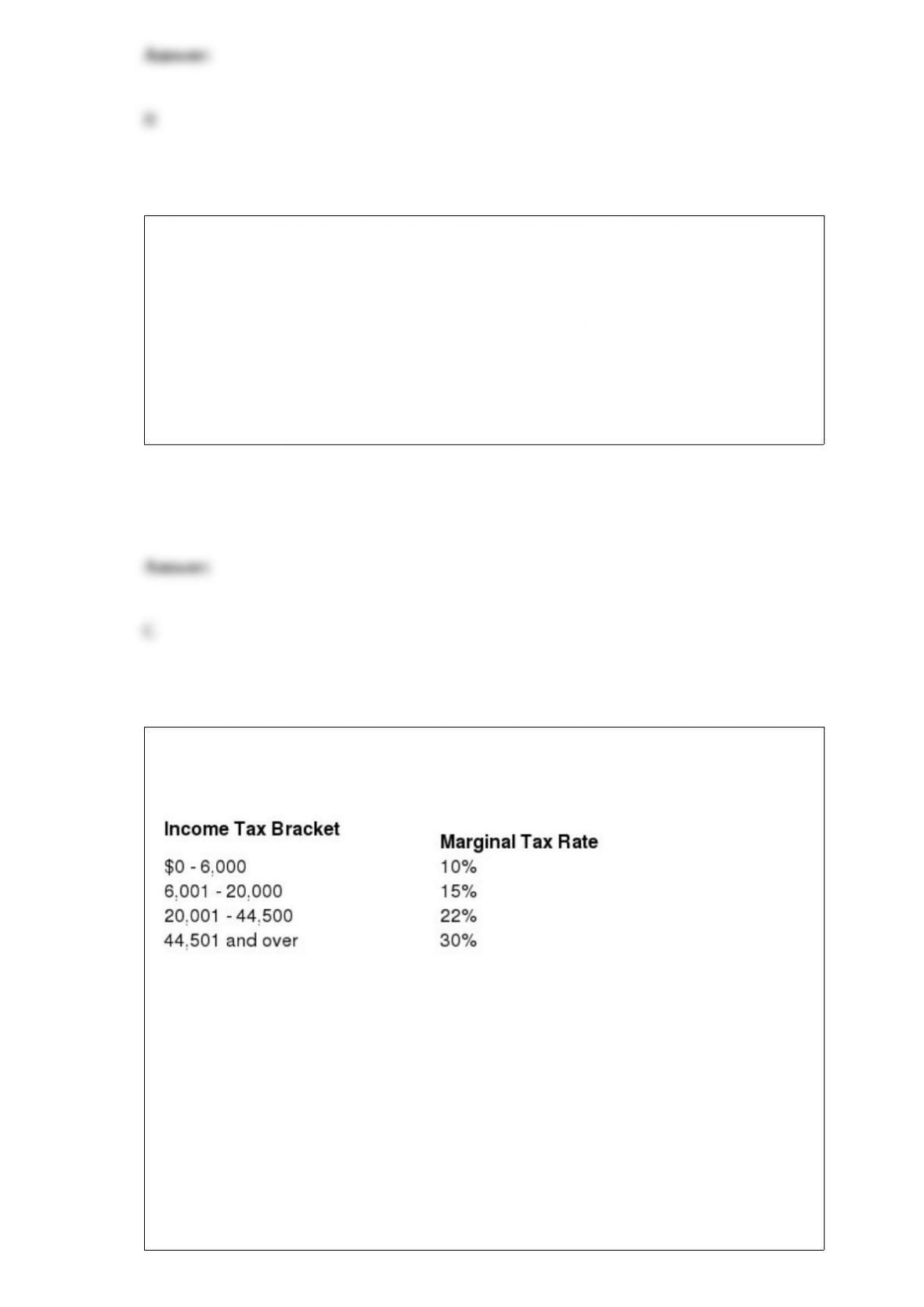
Table 18-9
Table 18-9 shows the income tax brackets and tax rates for single taxpayers in
Monrovia.
Refer to Table 18-9. Calculate the income tax paid by Sylvia, a single taxpayer with an
income of $70,000.
A) $21,000
B) $15,740
C) $15,400

D) $13,475
What does price elasticity of demand measure? When is demand elastic? Inelastic? Unit
elastic?
Explain why the marginal cost of production must increase if the marginal product of a
variable resource is decreasing.

Define the tragedy of the commons. Give three examples of common resources. Briefly
explain why common property resources are subject to overuse.
What is comparative advantage? What is absolute advantage?
Define microeconomics.
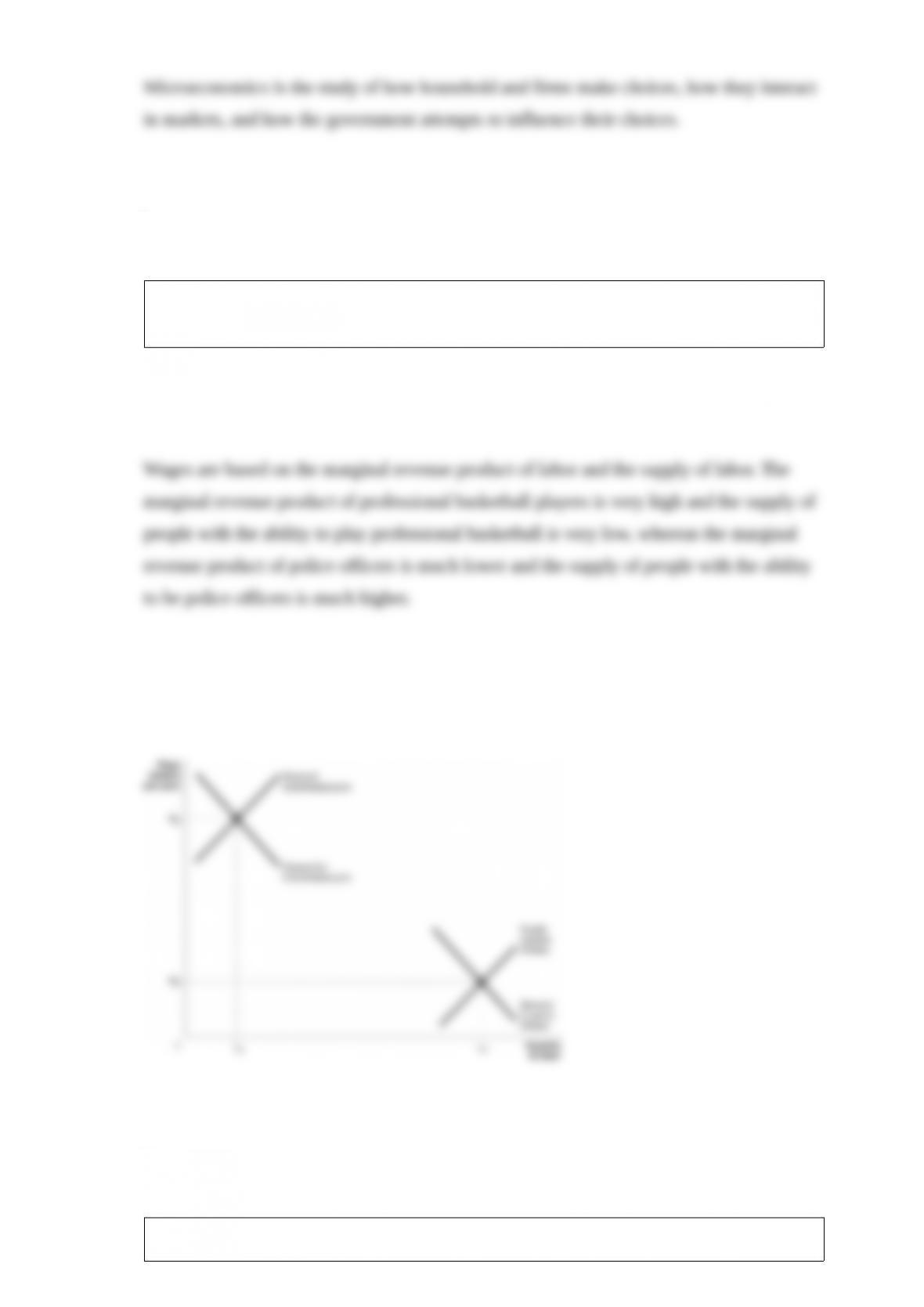
Why do professional basketball players earn more than police officers? Illustrate this
situation graphically.
What is marginal benefit? Which curve is also referred to as a marginal benefit curve?

Explain how the market for opticians is affected as a result of the development of laser
technology which reduces the demand for glasses and contact lenses. In your
explanation be sure to show the connection between the market for glasses and contact
lenses and the market for opticians.
Explain the difference between a cooperative equilibrium and a noncooperative
equilibrium in game theory.

Firms in an oligopoly are said to be interdependent. What does this mean?
Explain why the monopolist has no supply curve?
Using two graphs, illustrate how a positive technological change in the market for
notebook computers could eliminate short-run economic profit for a firm in that market.
On the first graph, use a supply and demand graph to illustrate the positive
technological change. On the second graph, use demand, ATC, MC and MR curves to
illustrate the elimination of economic profit resulting from the positive technological
change. Explain what is taking place in each graph.

If a union successfully negotiates for higher wages and benefits for steel workers, what
impact would this have on the supply and demand in the market for steel, assuming no
other changes take place in this market?

What is an externality? Explain how someone receiving a meningitis vaccination is an
example of an externality in the market for health care.
What is an indifference curve? Why can indifference curves never cross?
What is the law of supply? What does this law imply about the shape of the supply
curve?
What is a public franchise? Are all public franchises natural monopolies?
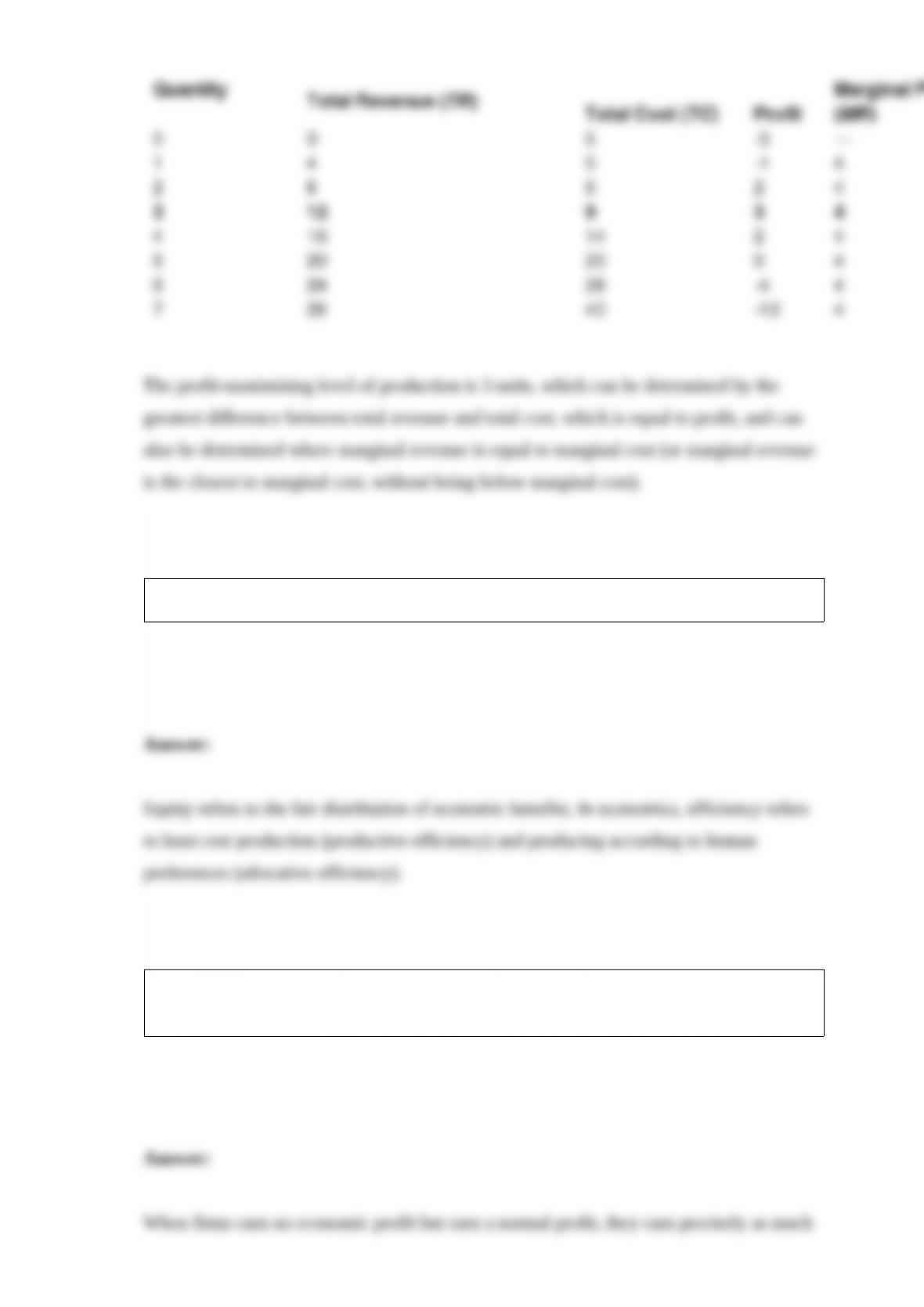
Assuming a market price of $4, fill in the columns in the following table. What is the
profit-maximizing level of production? What are the two ways to determine the
profit-maximizing level of production?
What is equity, and how does it differ from efficiency?
If firms do not earn economic profits in a competitive equilibrium, why would the firms
choose to stay in business?