
In the 1960s, many economists and policymakers believed the trade-off between
inflation and unemployment was permanent.
If banks receive a greater amount of reserves and do not hold all of these reserves as
excess reserves, the money supply expands.
Marketing refers to all the activities necessary for a firm to sell a product to a consumer.
In response to a shortage, the market price of a good will rise; as the price rises, the
demand will decrease and supply will increase until equilibrium is reached.

If average product is decreasing, then marginal product must be negative.
If buyers were required to pay the federal excise tax on gasoline directly to the
government, the demand curve for gasoline would shift up.
When a business is set up as partnership, the owner of the business faces unlimited
liability.
Innovations, including new products and services, in financial markets and institutions
have made the job of defining the money supply easier.

The sales revenue a seller receives from the sale of an additional unit of goods is called
the marginal cost.
Free trade refers to trade between countries without government restrictions.
Expansionary monetary policy lowers interest rates and forces a real appreciation of the
dollar in international currency markets.
In the long run, all of a firm’s inputs are variable.
If an economy is growing at a rate of 2.5% per year, how long will it take the economy
to double in size?
A) 60 years
B) 43 years
C) 36 years
D) 28 years
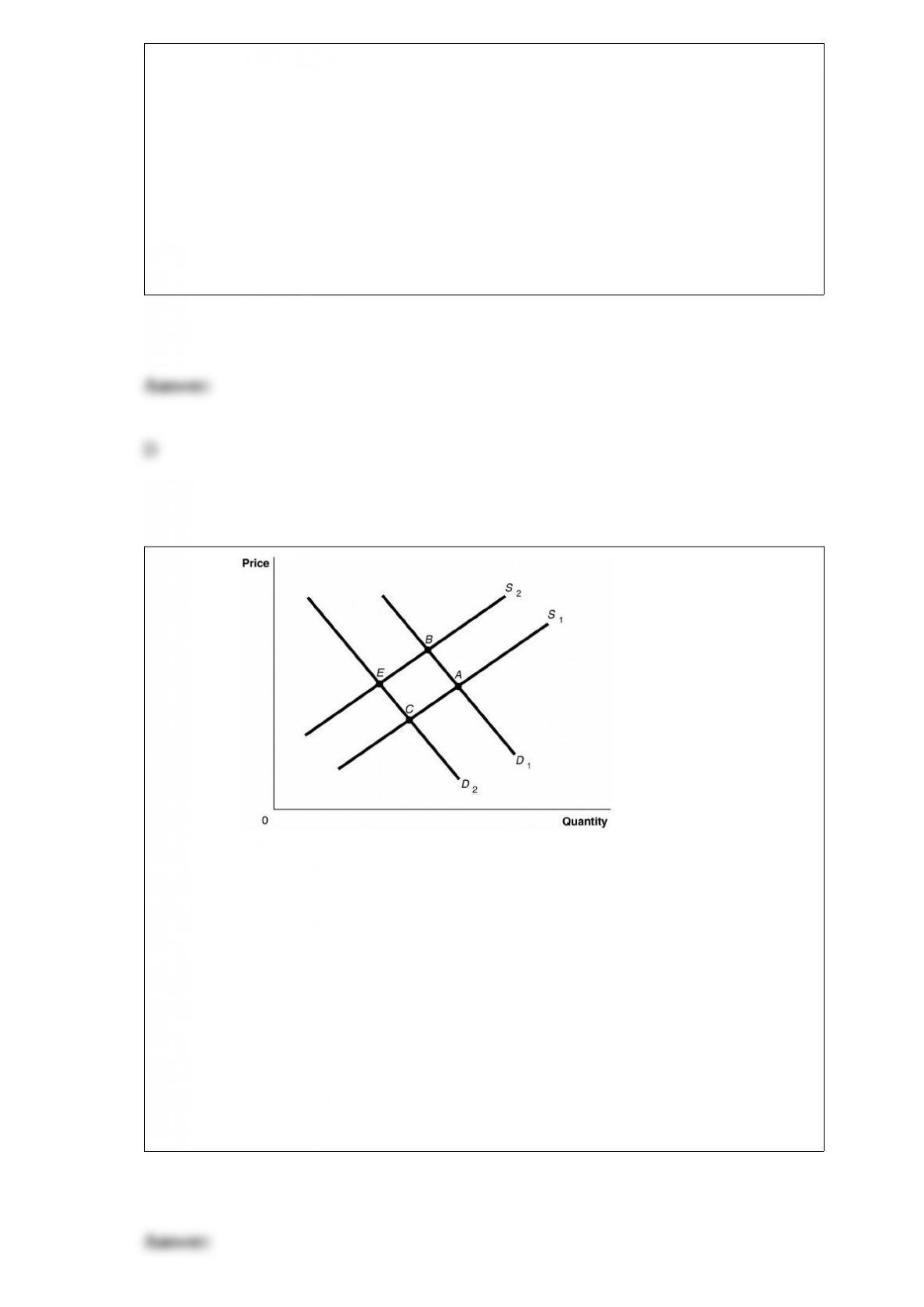
Figure 3-8
The graph in this figure illustrates an initial competitive equilibrium in the market for
motorcycles at the intersection of D1 and S1 (point A). If the price of motorcycle
engines increases, and the wages of motorcycle workers increase, how will the
equilibrium point change?
A) The equilibrium point will move from A to E.
B) The equilibrium point will move from A to B.
C) The equilibrium point will move from A to C.
D) The equilibrium will first move from A to B, then return to A.

The U.S. Congress has given two government entities the authority to police mergers.
These two entities are
A) the antitrust division of the Department of State and the Securities and Exchange
Commission.
B) the Federal Trade Commission and the Internal Revenue Service.
C) the Antitrust Division of the U.S. Department of Justice and the Council of
Economic Advisors.
D) the Federal Trade Commission and the Antitrust Division of the U.S. Department of
Justice.
Which of the following are primarily macroeconomic topics and which are primarily
microeconomic topics? a. gasoline prices
b. unemployment
c. inflation
d. health care costs
e. air pollution
f. economic growth
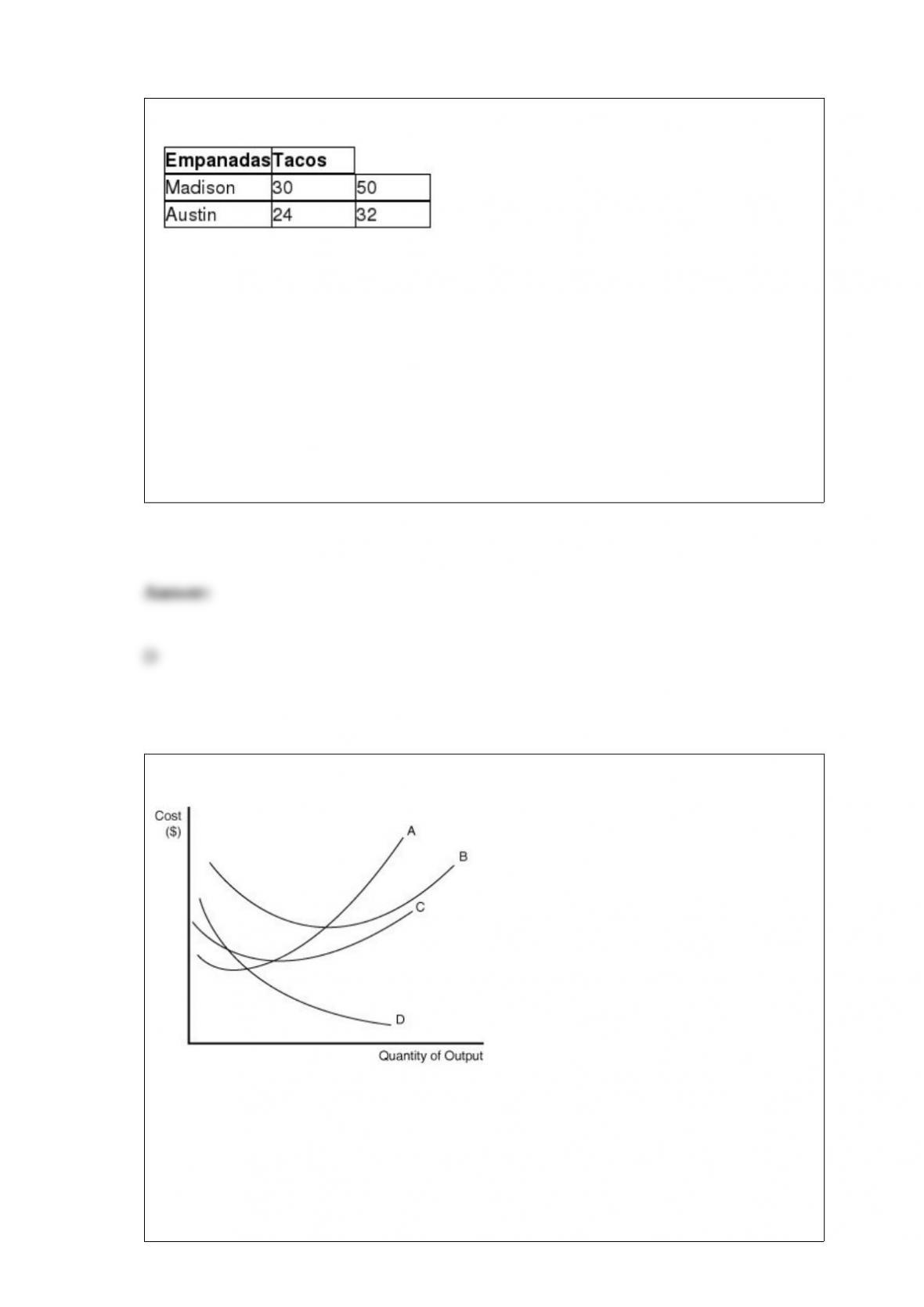
Table 9-5
Madison and Austin own Cafe Ole’. Table 9-5 lists the number of empanadas and tacos
Madison and Austin can each make in one hour. Select the statement that accurately
interprets the data in the table.
A) Madison has a comparative advantage in making empanadas.
B) Austin has a comparative advantage in making tacos.
C) Madison has a comparative advantage in making empanadas and making tacos.
D) Madison has a comparative advantage in making tacos.
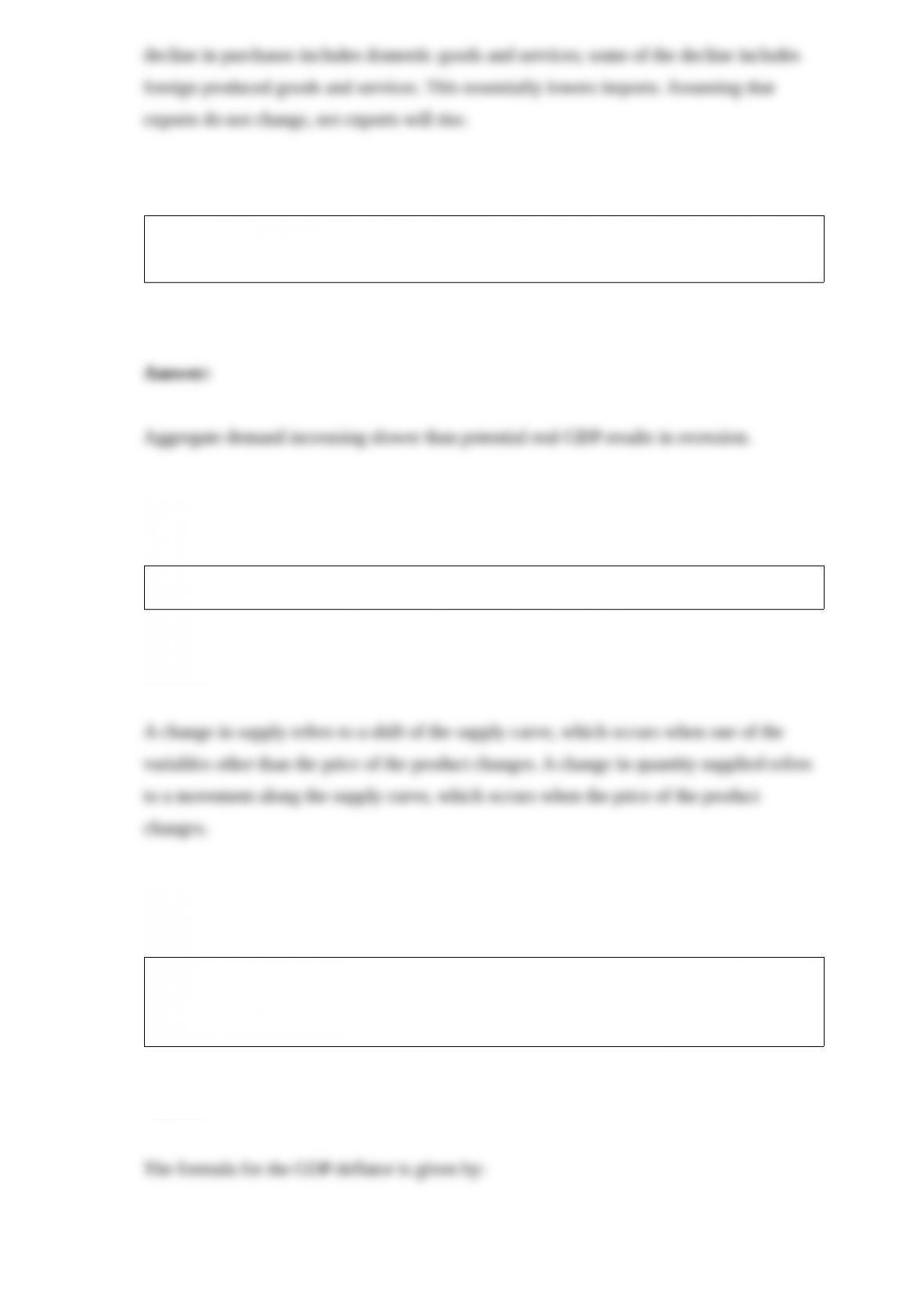
Figure 11-6
Figure 11-6 contains information about the
short run cost structure of a firm. In the figure above which letter represents the
marginal cost curve?
A) A
B) B

C) C
D) D
Suppose the majority of the shares of Ford stock were sold to a Japanese firm.
Assuming all else remains constant, this will
A) increase the balance of the U.S. financial account.
B) increase foreign direct investment in the United States.
C) increase the balance of the U.S. current account.
D) decrease net portfolio investment in the United States.
E) create a capital outflow in the United States.
If in the market for bananas the supply curve has shifted to the right, then
A) the supply of bananas increased.
B) the quantity of bananas supplied has increased.
C) the supply of bananas has decreases.
D) the quantity of bananas supplied has decreased.

Who operates and controls a corporation in its day-to-day activities?
A) the board of directors
B) stockholders
C) employees
D) management
If the marginal cost of producing a television is constant at $200, then a firm should
produce this item
A) only if the marginal benefit it receives is greater than $200 plus an acceptable profit
margin.
B) as long as the marginal benefit it receives is just equal to or greater than $200.
C) as long as its marginal cost does not rise.
D) until the marginal benefit it receives reaches zero.
Transactions costs refer to

A) the implicit costs of production.
B) the costs in time and other resources that parties incur in the process of agreeing to
and carrying out an exchange of goods or services.
C) the raw material cost of production.
D) the cost of transporting goods from one destination to another.
Of the following, the rapid rise in health care costs in the United States can be attributed
to
A) the cost of malpractice insurance.
B) the cost to treat uninsured patients.
C) slow growth in labor productivity in health care.
D) the cost of malpractice lawsuit settlements.
Ceteris paribus, how does a recession in the United States affect U.S. net exports?
In the dynamic aggregate demand and aggregate supply model, what is the result of
aggregate demand increasing slower than potential real GDP?
Explain the differences between a change in supply and a change in quantity supplied.
Use the formula for the GDP deflator to explain how it is affected by an increase in
prices in the economy. If the value of the deflator equals 100, what does that tell you
about that year with respect to the base year?
You are the manager of a theater. At present the theater charges the same admission
price of $8 to all customers, regardless of age. You propose a two-tier pricing scheme:
$5 for children under the age of 12 and $10 for adults. You tell your supervisor that
your proposal is likely to increase revenues. What must be true about the price elasticity
of demand if your proposal is to achieve its goal of raising revenue? Explain your
answer.
Some online penny auctions charge a fee, such as $1, for every bid placed. Why should
these costs of $1 per bid be considered sunk costs? Would it be smart for someone who
has “already invested $5 in bidding costs” to keep bidding to “protect his or her sunk
investments”? Why or why not?

What is meant by the term “long-run competitive equilibrium”?
Why would a firm pay efficiency wages?
Briefly describe monetarism and the monetary growth rule.