1) Other things equal, a reduction in personal and business taxes can be expected to:
A.increase aggregate demand and decrease aggregate supply.
B.increase both aggregate demand and aggregate supply.
C.decrease both aggregate demand and aggregate supply.
D.decrease aggregate demand and increase aggregate supply.
2) the ability of a good or service to satisfy wants is called:
a.utility maximization.
b.opportunity cost.
c.revenue potential.
d.utility.
3)
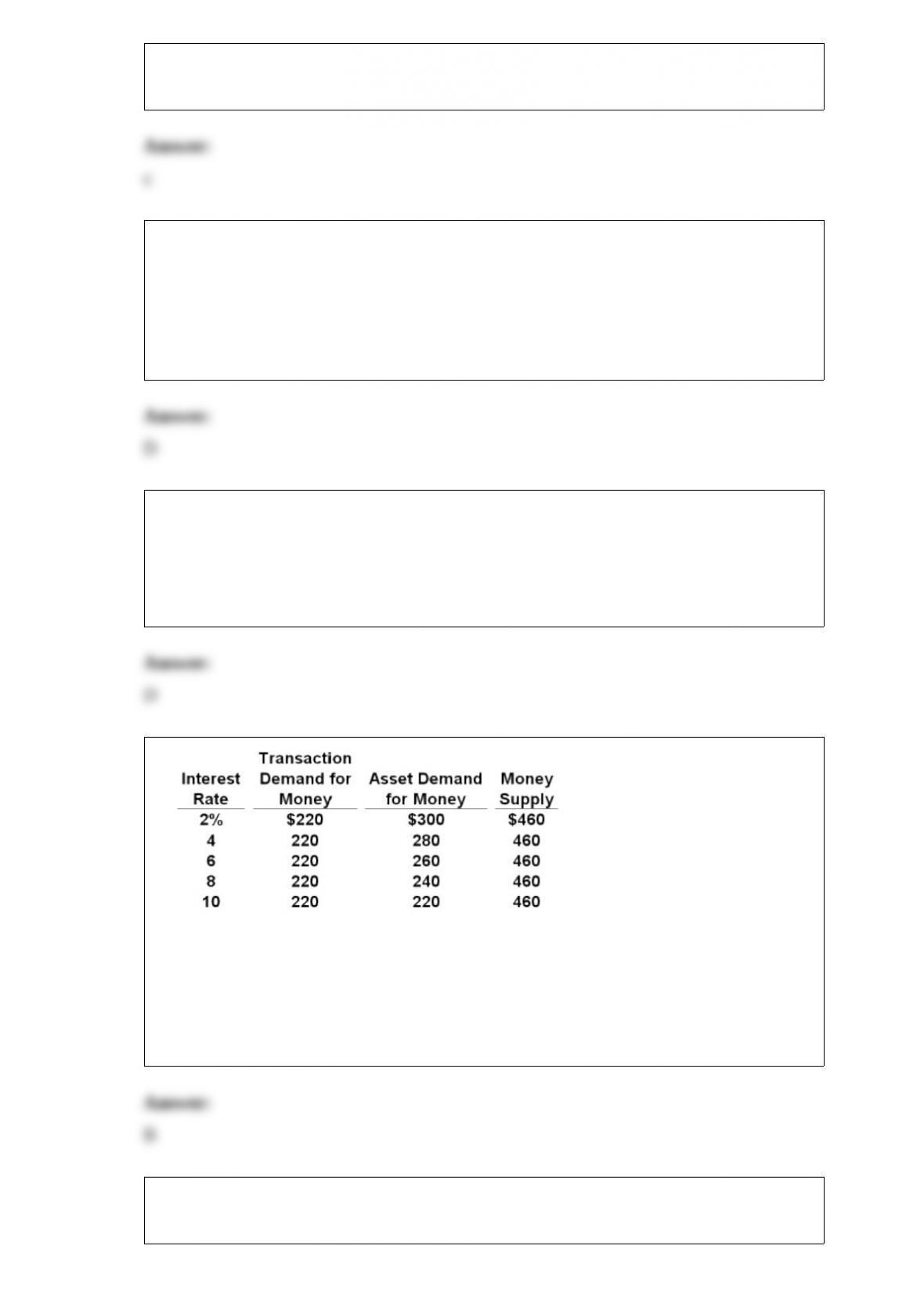
Refer to the above diagram for a private closed economy. At the $200 level of GDP:
A.consumption is $200 and planned investment is $50 so that aggregate expenditures
are $250.
B.consumption is $200 and planned investment is $100 so that aggregate expenditures
are $300.
C.consumption is $250 and actual investment is $50 so that aggregate expenditures are
$300.
D.aggregate expenditures fall short of GDP with the result that GDP will decline.
4) suppose that a person’s nominal income rises from $10,000 to $12,000 and the
consumer price index rises from 100 to 105. the person’s real income will:
a.fall by about 20 percent.
b.fall by about 2 percent.
c.rise by about 15 percent.
d.rise by about 25 percent.
5) When the reserve requirement is increased:
A.required reserves are changed into excess reserves.
B.the excess reserves of member banks are increased.
C.a single commercial bank can no longer lend dollar-for-dollar with its excess
reserves.
D.the excess reserves of member banks are reduced.
6) Capital flight from the DVCs may be caused by:
A.a fear of government privatization efforts.
B.slow domestic inflation.
C.low rates of domestic taxation.
D.risks of severe fluctuations in exchange rates.
7)
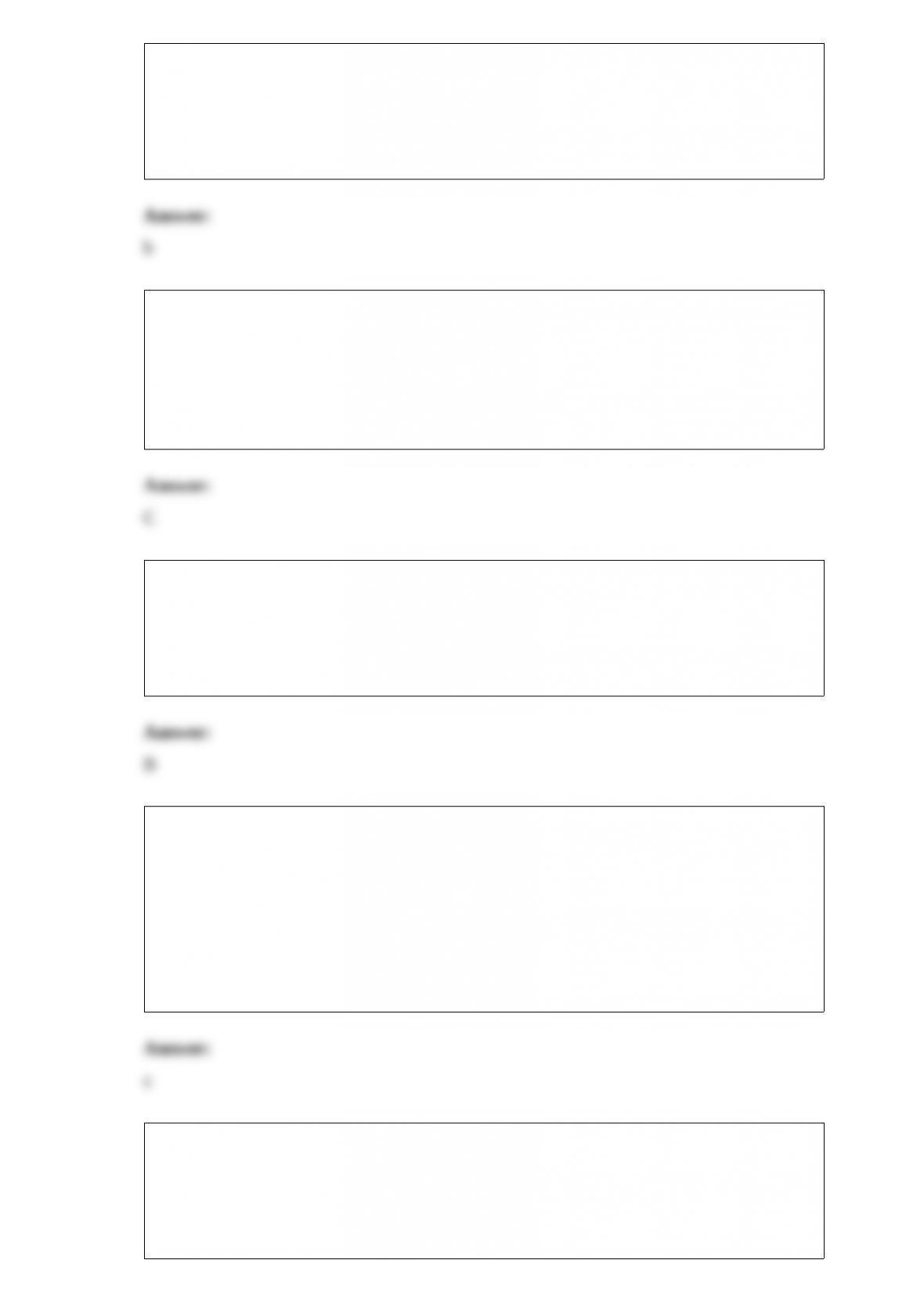
Refer to the above table. An increase in the money supply of $20 billion will cause the
equilibrium interest rate to:
A.fall by 4 percentage points.
B.fall by 2 percentage points.
C.rise by 4 percentage points.
D.rise by 2 percentage points.
8) juan wants to migrate from mexico to the united states, but knows he cannot do so
legally at this time. if he decides to attempt to enter the u.s. illegally, which of the
following costs will he most likely not face?
a.payment to an expediter (“coyote”) to facilitate his entry into the u.s.
b.a green card application fee.
c.the loss of income from his current factory job.
d.all of these are costs he must incur to migrate.
9) An example of a social insurance program is ____________, whereas an example of
public assistance program is _______.
A.Temporary Assistance for Needy Families; unemployment compensation
B.Supplemental Security Income; unemployment compensation
C.Social Security; food stamps
D.Medicaid; Medicare
10) An increase in nominal GDP increases the demand for money because:
A.interest rates will rise.
B.more money is needed to finance a larger volume of transactions.
C.bond prices will fall.
D.the opportunity cost of holding money will decline.
11) the term laissez-faire suggests that:
a.land and other natural resources should be privately owned, but capital should be
publicly owned.
b.land and other natural resources should be publicly owned, but capital equipment
should be privately owned.
c.government should not interfere with the operation of the economy.
d.government action is necessary if the economy is to achieve full employment and full
production.
12) As a percent of GDP, the United States public debt is:
A.the highest among major industrial nations.
B.the lowest among major industrial nations.
C.lower than the public debts of several other major industrial nations.
D.higher than the percentages for Canada, Germany, and Italy.
13) if depreciation (consumption of fixed capital) exceeds domestic investment, we can
conclude that:
a.nominal gdp is rising but real gdp is declining.
b.net investment is negative.
c.the economy is importing more than it exports.
d.the economy’s production capacity is expanding.
14) What percentage of the public debt is held by foreign individuals and institutions?
A.50 percent
B.18 percent
C.42 percent
D.25 percent
15) In comparing monetarism and rational expectations theory we find that:
A.both favor policy rules and for the same reasons.
B.both favor policy rules, but for different reasons.
C.both favor discretionary policies.
D.the former favors discretionary policy, while the latter favors policy rules.
16) Country A limits other nation’s exports to Country A to 1,000 tons of coal annually.
This is an example of a(n):
A.protective tariff.
B.export subsidy.
C.import quota.
D.voluntary export restriction.
17) If the Federal Reserve System buys government securities from commercial banks
and the public:
A.commercial bank reserves will decline.
B.commercial bank reserves will be unaffected.
C.it will be easier to obtain loans at commercial banks.
D.the money supply will contract.
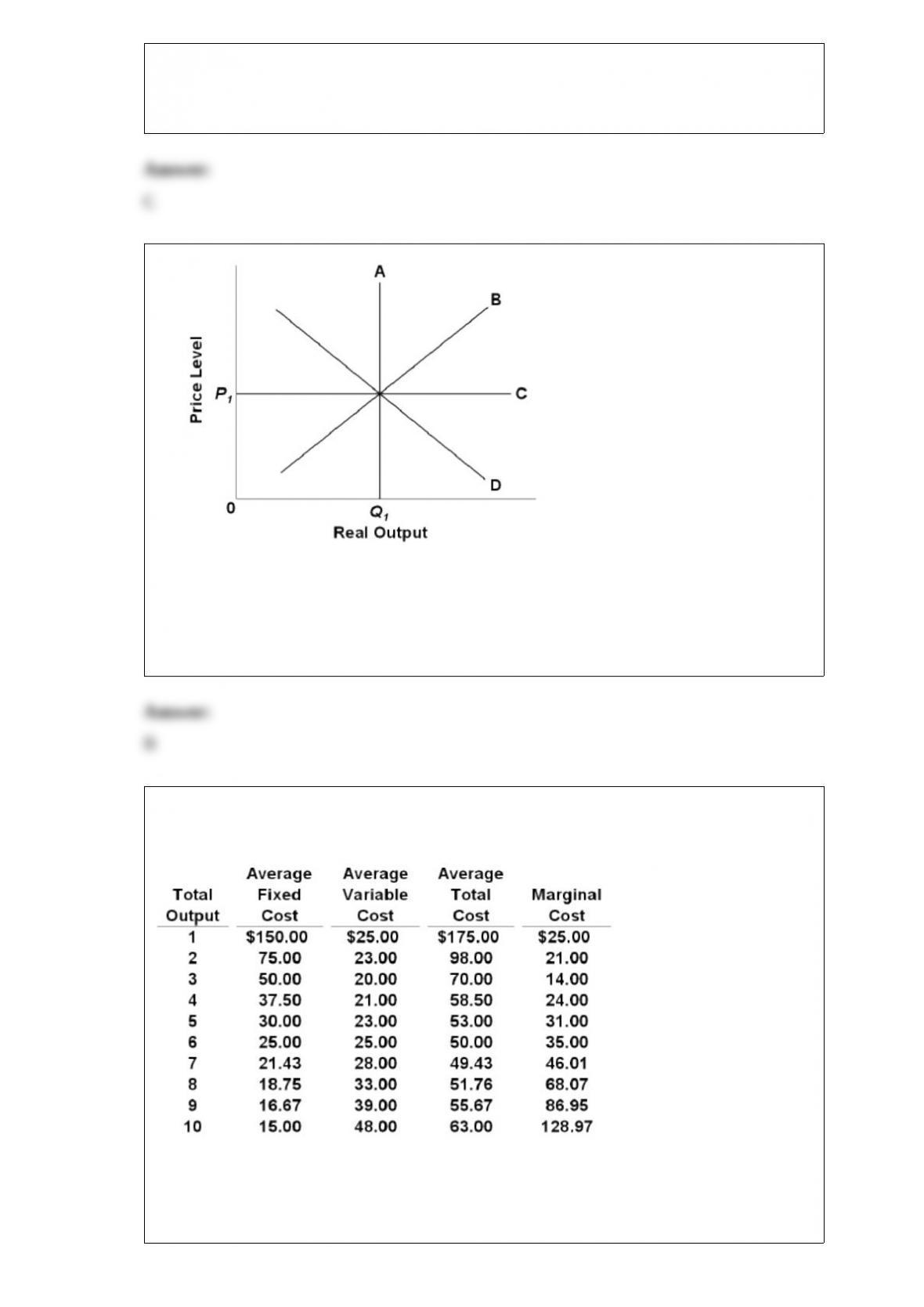
18)
Refer to the above diagram relating to short-run and long-run aggregate supply. The
A.short-run aggregate supply curve is A
B.short-run aggregate supply curve is B
C.long-run aggregate supply curve is B
D.long-run aggregate supply curve is D
19) the following cost data for a firm that is selling in a purely competitive market.
refer to the above data. the marginal cost column reflects:
a.the law of diminishing returns.
b.the law of diminishing marginal utility.
c.diseconomies of scale.

d.economies of scale.