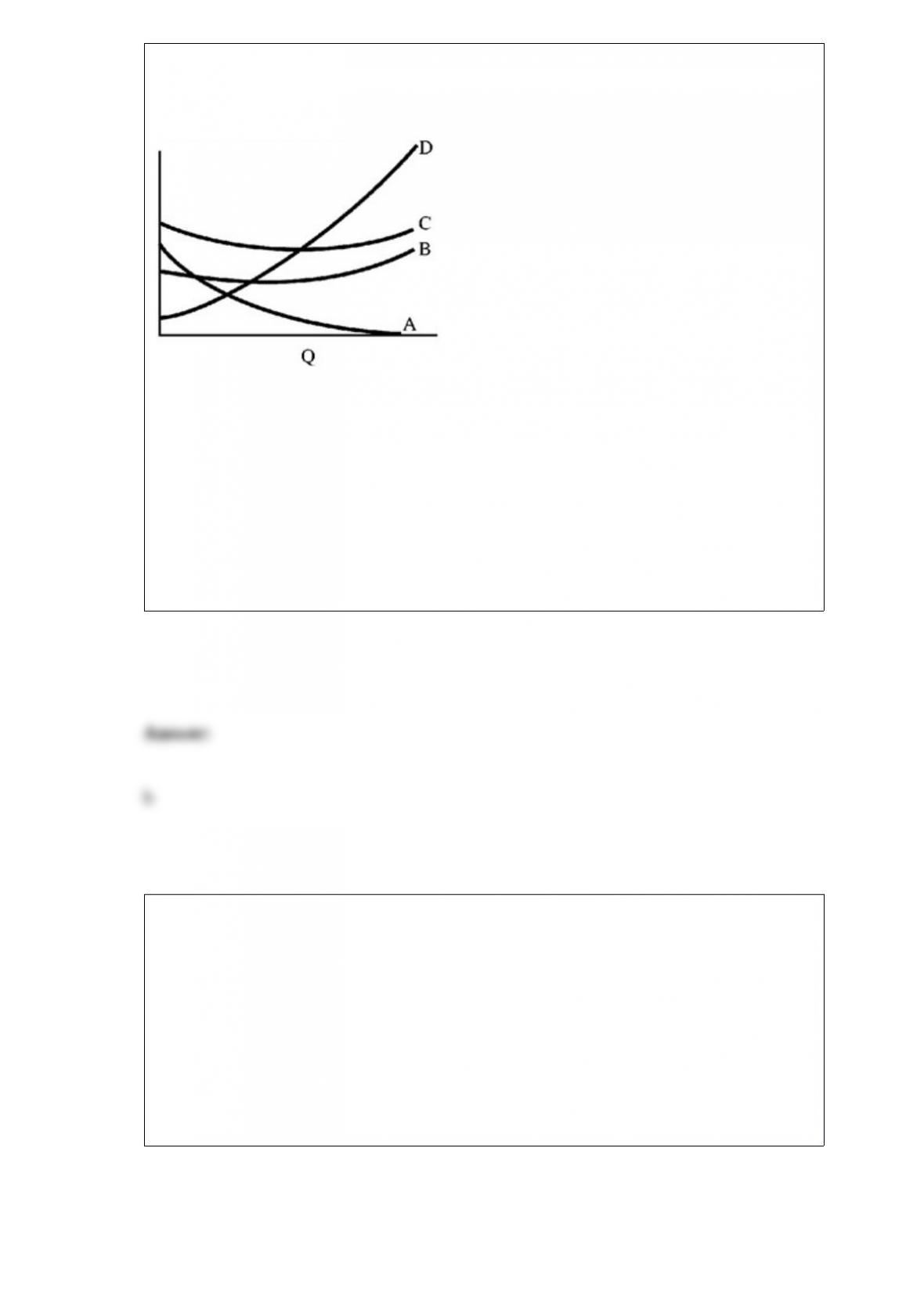
Figure 7-10
In Figure 7-10, the curve labeled C is
a. average fixed cost.
b. average total cost.
c. average variable cost.
d. marginal cost.
Under perfect competition the price of a depletable resource whose cost of extraction is
not changing must rise at
a. the same rate as the increase in GDP.
b. the same rate as the increase in consumer prices.
c. the same rate as the rate of interest.
d. a rate higher than the increase in the rate of interest.

The principle of comparative advantage explains how
a. one nation can take advantage of another one through international trade.
b. two nations may engage in mutually beneficial trade, even though one of them is
more productive than the other.
c. one individual can take advantage of another through international trade.
d. some people are good at producing everything, while others have no comparative
advantages.
e. some nations end up with large trade surpluses.
A ticket to an Eric Clapton concert costs $45. If you have a ticket, you can “scalp” it
(sell it illegally) for $75. To a ticket holder, the opportunity cost of actually attending
the concert is
a. $45.
b. $50.
c. $75.
d. $115.

Suppose that the government imposes an excise tax on widgets. The portion of the tax
borne by the buyer of widgets depends upon
a. elasticity of demand.
b. income of buyers.
c. size of the tax that is imposed.
d. cross elasticity of demand between widgets and floogles.
Free markets coordinate economic activity in such a way as to eliminate the possibility
of inflation or unemployment.
a. True
b. False
Imposing fines on companies that contribute heavily to air and water pollution is an
attempt to bring marginal private costs in line with marginal social costs.
a. True

b. False
Rent controls encourage investment in housing because they bring stability to the
market.
a. True
b. False
If depositors become worried about the safety of their deposit accounts, they may
trigger a
a. deposit surplus.
b. bank run.
c. fiscal policy crisis.
d. required reserve increase.
Inventory reductions are a signal indicating that
a. the economy is close to disaster.
b. the Dow Jones Industrial Average will fall.
c. manufacturers need to increase production.
d. All of the above are true.
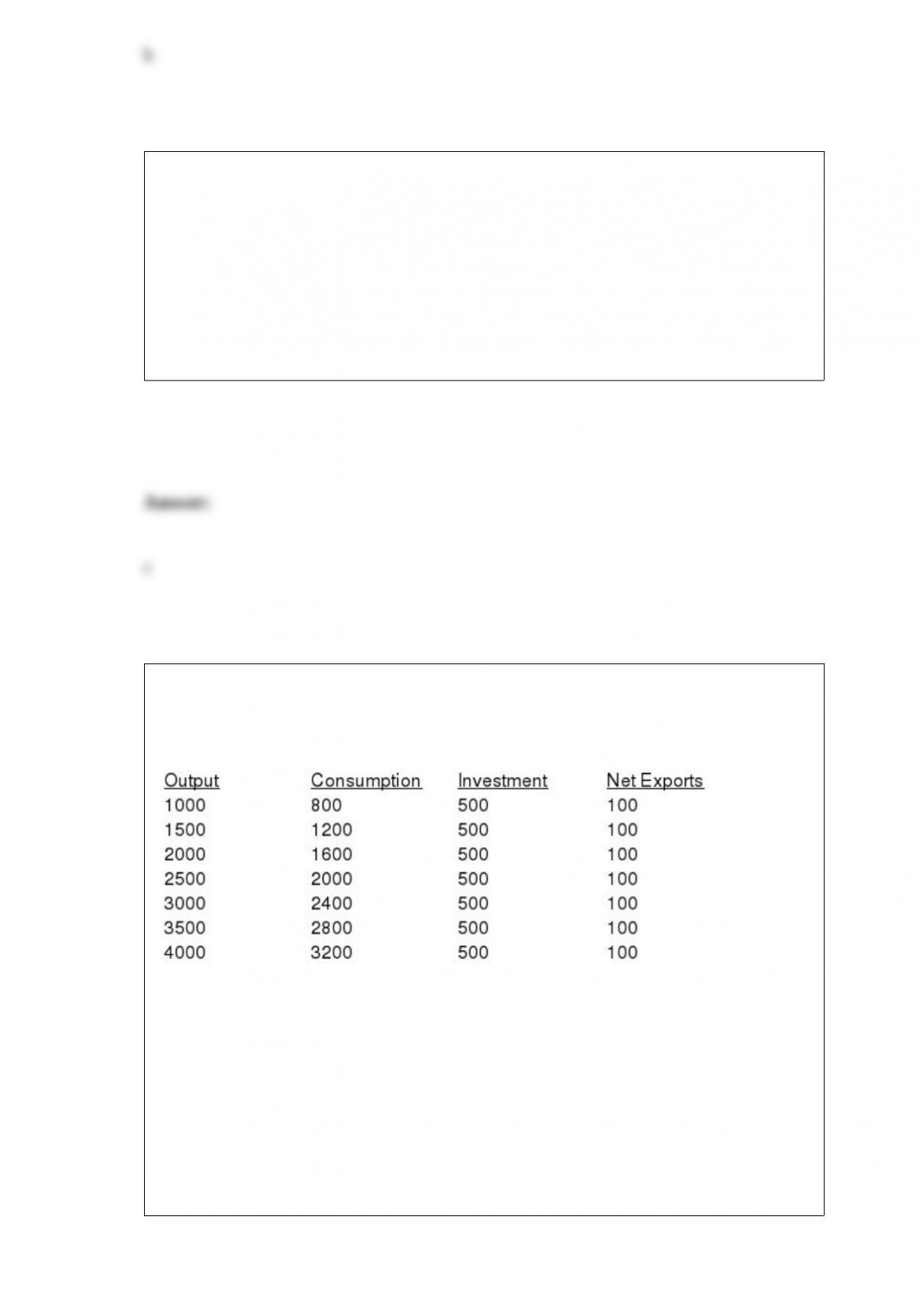
Table 9-1
In Table 9-1, inventories are being depleted as long as output is below
a. 2,000.
b. 2,500.
c. 3,000.
d. 3,500.

The law of diminishing marginal utility guarantees that demand curves will have
positive slopes.
a. True
b. False
If the Fed’s open market operations expand the money supply, one can expect
a. a decrease in excess reserves.
b. bond prices to rise.
c. interest rates to rise.
d. open market sales of T-bills.
Which of the following conclusions about supply-side tax initiatives is accepted by

most economists?
a. Supply-side tax cuts are likely to benefit the poor as much as the rich.
b. Supply-side tax cuts will almost certainly lead to smaller budget deficits.
c. Such tax cuts probably will increase aggregate supply quickly, but an increase in
aggregate demand will come later.
d. Tax reductions aimed at stimulating business investment are likely to have a greater
impact than tax reductions aimed at getting people to work longer hours or save more.
Systemic risks would be most prevalent at larger banks like Bank of America and
Citibank.
a. True
b. False
Economic analysis and policy are made more difficult by
a. having so much data to work with.
b. inadequate and imperfect information.
c. an incomplete consensus on the basic goals of social policy.

d. the lack of public interest and opinion on economic questions.
e. the major economic problems society faces.
Hyperinflations are usually made possible by
a. multinational corporations.
b. highly mobile international capital.
c. governments printing money rapidly.
d. higher and higher tax rates.
There are never any adverse consequences of government attempts to modify the laws
of supply and demand.
a. True
b. False

Statistical studies suggest that the cost of direct controls for any target level of pollution
is
a. much higher than the cost of taxes on emissions.
b. about the same as the cost of taxes on emissions.
c. lower than the cost of taxes on emissions.
d. impossible to compare to the cost of taxes on emissions.
During the twentieth century, the real income of the average American grew by a factor
of more than seven.
a. True
b. False
A firm that does business all over the world is called a(n)
a. multinational corporation.

b. international conglomerate.
c. competitive corporation.
d. government-owned business.
In her calculation of the cost of going to college, an economist would include the
amount of forgone earnings over the years spent at college.
a. True
b. False
American high school students’ test scores, especially in math and science, are higher
than those in OECD countries.
a. True
b. False

The demand for labor is derived from the
a. demand for leisure.
b. supply of labor.
c. demand for final-output goods.
d. supply of final-output goods.
Critics of supply-side policies argue that the effects of tax cuts are too small to be
effective policy.
a. True
b. False
Equilibrium price in international trade is the common price between exporting and
importing countries.
a. True
b. False

To be a natural monopoly, a firm must
a. control an essential natural resource input.
b. be very large.
c. have a continuously falling average cost curve as output rises.
d. have falling average costs over a substantial range of total market demand.
A scatter diagram of money growth rates and inflation rates from 1982 to 2010
indicates
a. a clear direct relationship between money growth and inflation.
b. a clear indirect relationship between money growth and inflation.
c. no clear relationship between money growth rates and inflation.
d. that inflation is always and everywhere a monetary phenomenon.

The slope of an indifference curve at all points reflects
a. the terms by which the consumer can trade off goods in the market.
b. the relative prices of the two goods.
c. the willingness of the consumer to trade one good for another.
d. consumer income relative to the price of a good.
e. the relative price ratio of the two goods.
Perfect competition requires that three conditions be satisfied.
a. True
b. False
There is only a small difference in wages between college graduates and workers who
did not attend college.
a. True
b. False

An inflationary gap will occur when
a. real GDP exceeds nominal GDP.
b. nominal GDP exceeds real GDP.
c. real GDP exceeds potential GDP.
d. potential GDP exceeds real GDP
Investment spending, capital formation, and rapid technological progress are directly
related.
a. True
b. False