1) Pollution is a negative externality, but it is not appropriate to view the problem of
pollution as a common-resource problem.
a.True
b.False
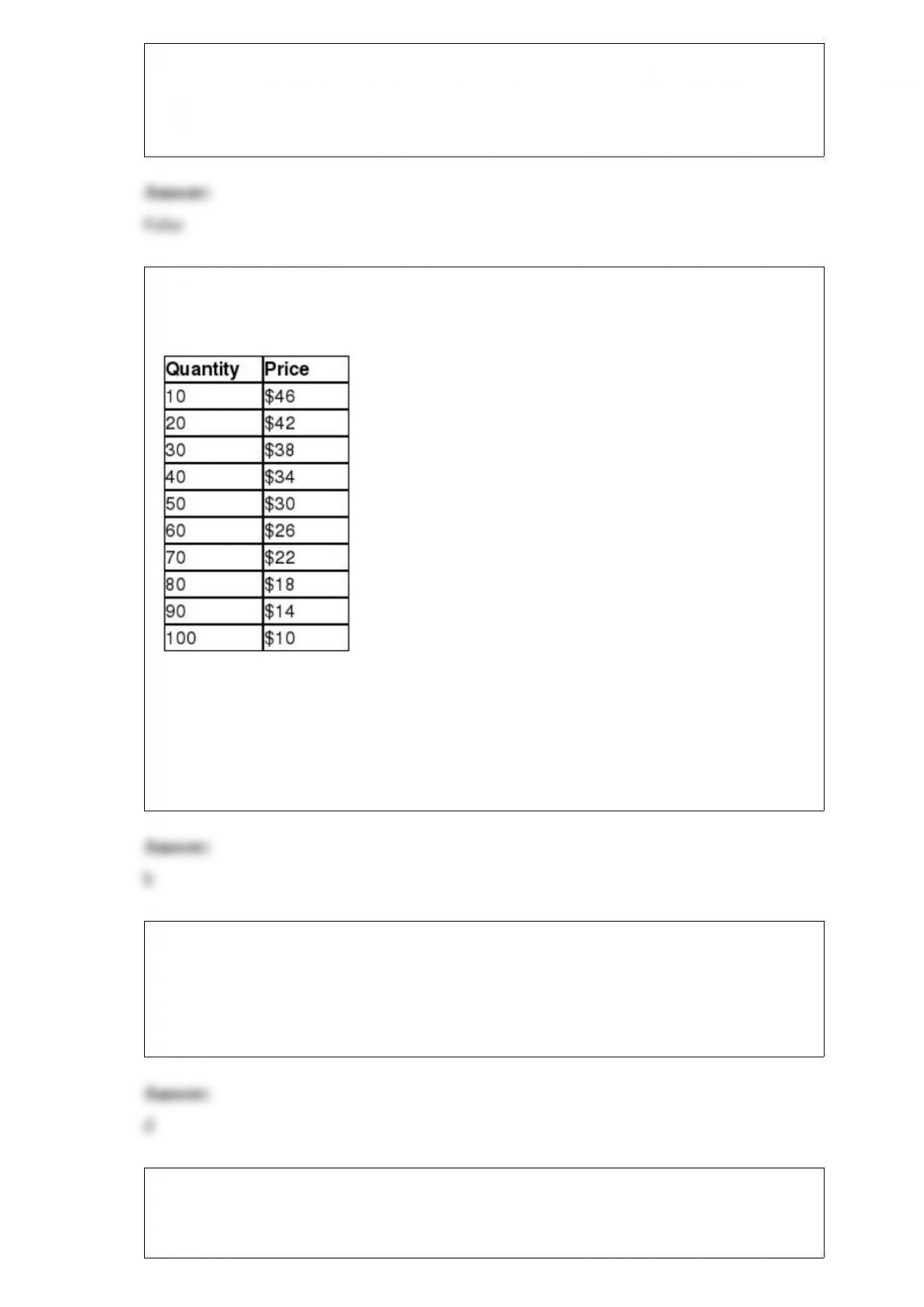
2) Table 15-17
A monopolist faces the following demand curve:
Which of the following statements best describes the relationship between the price and
the marginal revenue associated with values in the table?
a.The price and marginal revenue are the same.
b.The price is greater than or equal to the marginal revenue.
c.The price is less than or equal to the marginal revenue.
d.The relationship cannot be determined from the information given.
3) An example of a private good would be
a.a library book.
b.a rose garden.
c.an internet radio subscription.
d.a sleeping bag.
4) A negative income tax system is designed to
a.provide in-kind benefits to the poor.
b.provide a minimum income to the poor.

c.reduce taxes on the rich when their incomes surpass the maximum income tax
bracket.
d.subsidize food consumption in poor families.
5) Scenario 16-7
Consider the problem facing two firms, YumYum and Bertollini, in the frozen food
market. Each firm has just come up with an idea for a new “frozen meal for two”which
it would sell for $9. Assume that the marginal cost for each new product is a constant
$2, and the only fixed cost is for advertising. Each company knows that if it spends $12
million on advertising it will get 1.5 million consumers to try its new product. YumYum
has done market research which suggests that its product does not have any ‘staying”
power in the market. Even though it could get 1.5 million consumers to buy the product
once, it is unlikely that they will continue to buy the product in the future. Bertollini’s
market research suggests that its product is very good, and consumers who try the
product will continue to be consumers over the ensuing year. On the basis of its market
research, Bertollini estimates that its initial 1.5 million customers will buy one unit of
the product each month in the coming year, for a total of 18 million units.
If Bertollini decides to advertise its product it can expect to
a.earn a profit of $162 million per year.
b.earn a profit of $147 million per year.
c.earn a profit of $114 million per year.
d.earn a profit of $48 million per year.
6) A multilateral approach to free trade has greater potential to increase the gains from
trade than a unilateral approach, because the multilateral approach can reduce trade
restrictions abroad as well as at home.
a.True
b.False
7) The fundamental source of monopoly power is
a.barriers to entry.
b.profit.
c.decreasing average total cost.
d.a product without close substitutes.
8) A decrease in demand is represented by a
a.movement downward and to the right along a demand curve.
b.movement upward and to the left along a demand curve.
c.rightward shift of a demand curve.
d.leftward shift of a demand curve.
9) The smaller the , the
a.steeper the demand curve will be through a given point.
b.flatter the demand curve will be through a given point.
c.more strongly buyers respond to a change in price between any two prices P1and P2.
d.smaller the decrease in equilibrium price when the supply curve shifts rightward from
S1to S2.
10) In a competitive market the current price is $6. The typical firm in the market has
ATC = $5.00 and AVC = $4.50.
a.In the short run firms will shut down, and in the long run firms will leave the market.
b.In the short run firms will continue to operate, but in the long run firms will leave the
market.
c.New firms will likely enter this market to capture some of the economic profits.
d.The firm will earn zero profits in both the short run and long run.
11) Other things equal, when the price of a good falls, the
a.quantity supplied of the good increases.
b.supply decreases.
c.quantity supplied of the good decreases.
d.demand increases.
12) What do clean air in New York City and elephants in Africa have in common?
a.They are both common resources.
b.They are both public goods.
c.They are both club goods.
d.Both are excludable.
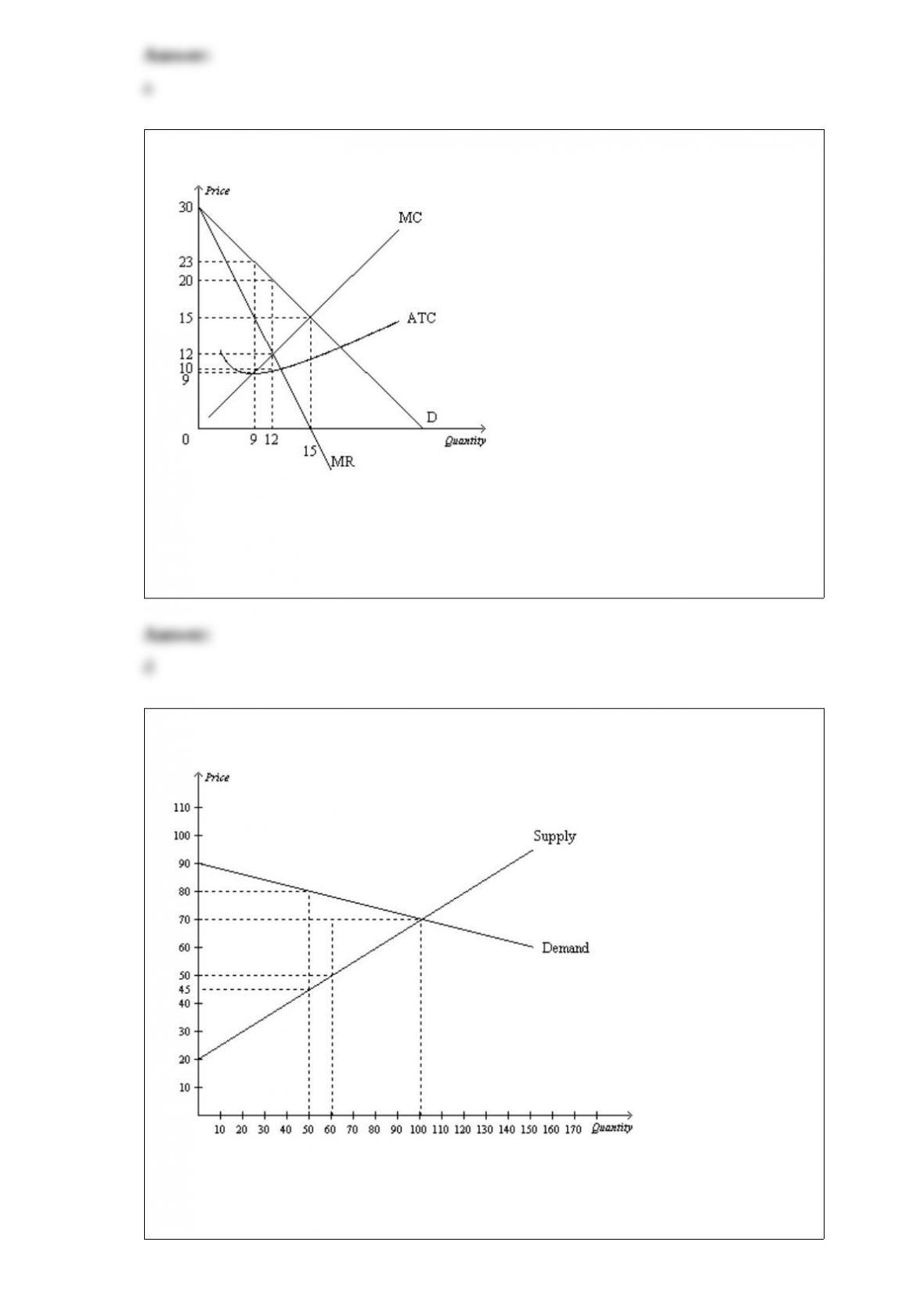
13) Figure 15-7
A profit-maximizing monopolist would earn total revenues of
a. $81.
b. $144.
c. $225.
d. $240.
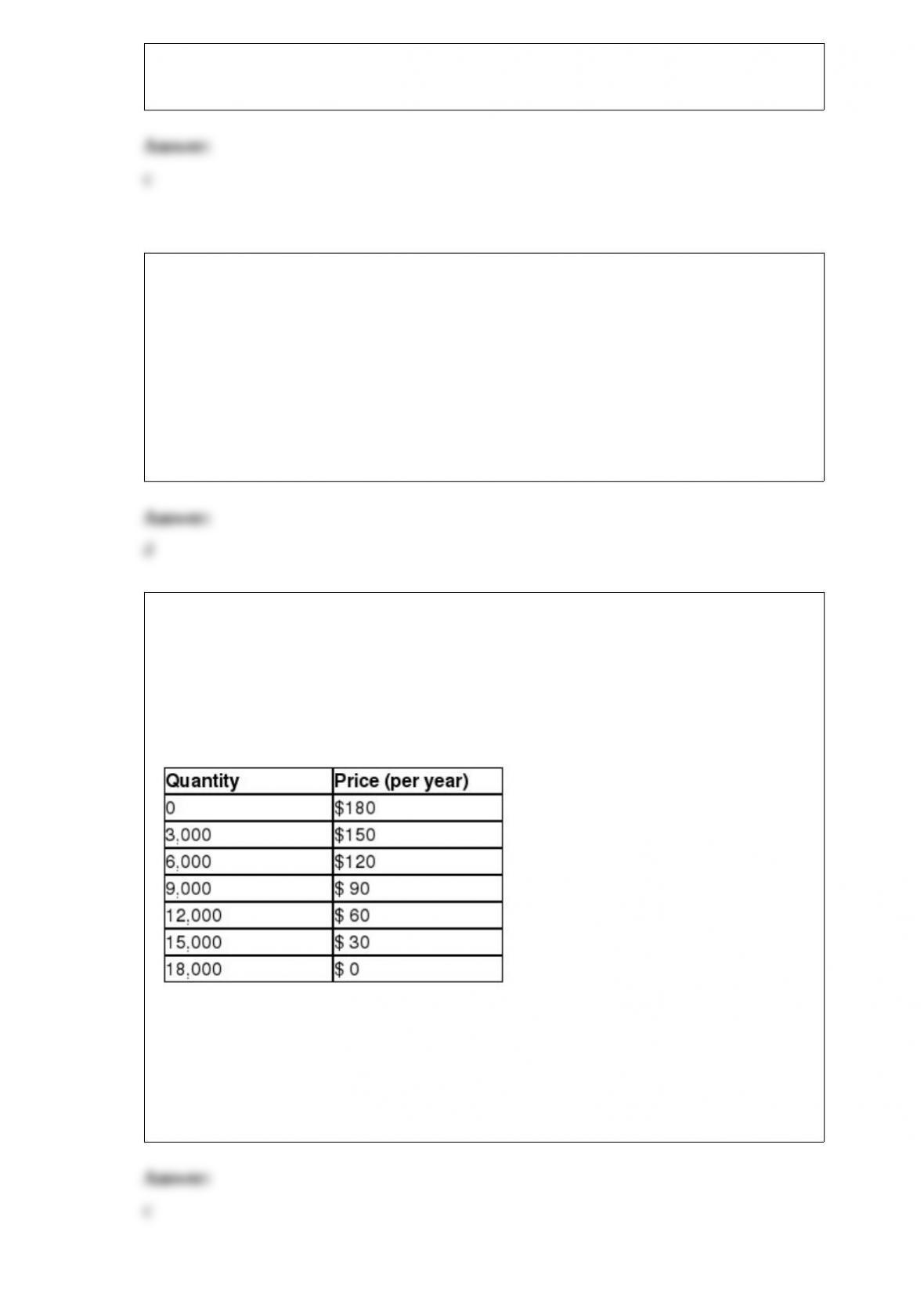
14) Refer to Figure 7-22.
The efficient price is
a.$80, and the efficient quantity is 50.
b.$70, and the efficient quantity is 60.
c.$70, and the efficient quantity is 100.
d.$50, and the efficient quantity is 60.
15) Suppose the voters in a small country are choosing between two options, A and B.
After the voting is complete it is discovered that option A received 100% of the votes
with option B receiving no votes. After the vote, however, the country’s leader decides
that option B is better for the people and implements B rather than A. The voting
system in this country fails which of Arrow’s properties of a desirable voting system?
a.unanimity
b.transitivity
c.independence of irrelevant alternatives
d.No dictators
16) Table 17-5
The information in the table below shows the total demand for premium-channel digital
cable TV subscriptions in a small urban market. Assume that each digital cable TV
operator pays a fixed cost of $200,000 (per year) to provide premium digital channels in
the market area and that the marginal cost of providing the premium channel service to
a household is zero.
Refer to Table 17-5. If there is only one digital cable TV company in this market, what
price would it charge for a premium digital channel subscription to maximize its profit?
a.$30
b.$60
c.$90
d. $150
17) If all taxpayers pay the same percentage of income in taxes, the tax system is
progressive.
a.True
b.False
18) Refer to Figure 9-15. Consumer surplus with trade and without a tariff is
a.A.
b.A + B.
c.A + C + G.
d.A + B + C + D + E + F.
19) Which of the following is not a characteristic of a public good?
a.It is not excludable.
b.It is not diminished or depreciated as additional people consume the good.
c.Its benefits cannot be withheld from anyone.
d.Because it is a free good, there is no opportunity cost.