
In a closed economy with fixed or autonomous (non-income dependent) taxes, the
balanced budget government purchases multiplier is negative.
Answer:
For a given quantity, the total profit of a perfectly competitive firm is equal to the
vertical distance between the firm’s total revenue curve and its total cost curve.
Answer:
“Cost disease” refers to the tendency for high productivity in the service sector to lead
to lower costs in those industries.
Answer:
In response to a surplus the market price of a good will fall; as the price falls, the
quantity demanded will increase and quantity supplies will decrease until equilibrium is
reached.
Answer:

If a country has a comparative advantage in producing a product, it must also have an
absolute advantage in producing that product.
Answer:
If purchasing power parity tells us that if the exchange rate is a pound for a dollar, then
price of a haircut in London should cost the same as a haircut in New York.
Answer:
If the rate of inflation in the United States exceeds the rate of inflation in Great Britain
we would expect the U.S. dollar to depreciate in value against the British pound.
Answer:
One way by which firms differentiate their products is to find a market niche.
Answer:

A person’s wealth is the same as his income.
Answer:
One of the main sources of comparative advantage is natural resources.
Answer:
Firms in different countries that face different input prices may produce the same good
using different combinations of inputs, even though they have access to the same
technology.
Answer:
Maximizing the level of output for a given total cost of production
A) is equivalent to producing the profit maximizing output level.
B) is equivalent to minimizing cost for a given level of output.
C) necessitates using only relatively low-priced inputs.
D) will maximize total revenue.

Answer:
Price elasticity of demand measures
A) how responsive suppliers are to price changes.
B) how responsive sales are to changes in the price of a related good.
C) how responsive quantity demanded is to a change in price.
D) how responsive sales are to a change in buyers’ incomes.
Answer:
One reason why airlines charge business travelers and leisure travelers different prices
is
A) business travelers fly according to schedules that are planned months in advance.
Many leisure travelers buy their tickets at the last minute.
B) business travelers usually travel alone. Leisure travelers often fly with friends and
family members; therefore, they have a more inelastic demand for airline tickets than
business travelers.
C) business travelers fly more often than most leisure travelers. As a result, their
employers are able to bargain with airlines for lower fares than leisure travelers pay.
D) business travelers often have inflexible schedules and have to travel on a particular
day. The opposite is true for leisure travelers.
Answer:

Which of the following is a true statement about the length of recessions and
expansions in the United States economy?
A) After 1950, the length of expansions equaled the length of recessions.
B) After 1950, the length of expansions were much less than the length of recessions.
C) After 1950, the length of expansions were much longer than the length of recessions.
D) After 1950, the length of expansions were brief and almost nonexistent.
Answer:
An example of assets that are included in ________ would be stocks, bonds, and
savings accounts.
A) household wealth
B) household income
C) planned investment
D) consumer purchases
Answer:
Which of the following is an example of a common resource?
A) elephants in the wild

B) lions in a zoo
C) a college education
D) public transportation
Answer:
If workers and firms know that the Federal Reserve is following an expansionary
monetary policy, workers and firms will expect inflation to ________ and will adjust
wages so that the real wage ________.
A) increase; increases
B) increase; remains unchanged
C) decrease; decreases
D) increase; decreases
Answer:
If the federal government’s expenditures are less than its tax revenues, then
A) a budget surplus results.
B) a budget deficit results.
C) the budget is balanced.
D) No conclusion can be drawn here regarding the budget surplus or deficit without
information regarding government purchases versus other outlays.

Answer:
If a dollar a year from now will likely have less purchasing power because of inflation,
then a dollar today ________ a dollar a year from now.
A) is more valuable than
B) is less valuable than
C) has the same value as
D) may be more valuable or less valuable than
Answer:
Which of the following parties is likely to have the most information about the health of
an individual who is trying to purchase a health insurance policy?
A) the company that issues the health insurance policy
B) the individual who is applying for the health insurance policy
C) the employer of the individual who is trying to purchase the health insurance policy
D) All parties in the health insurance market have access to the same level of
information.
Answer:
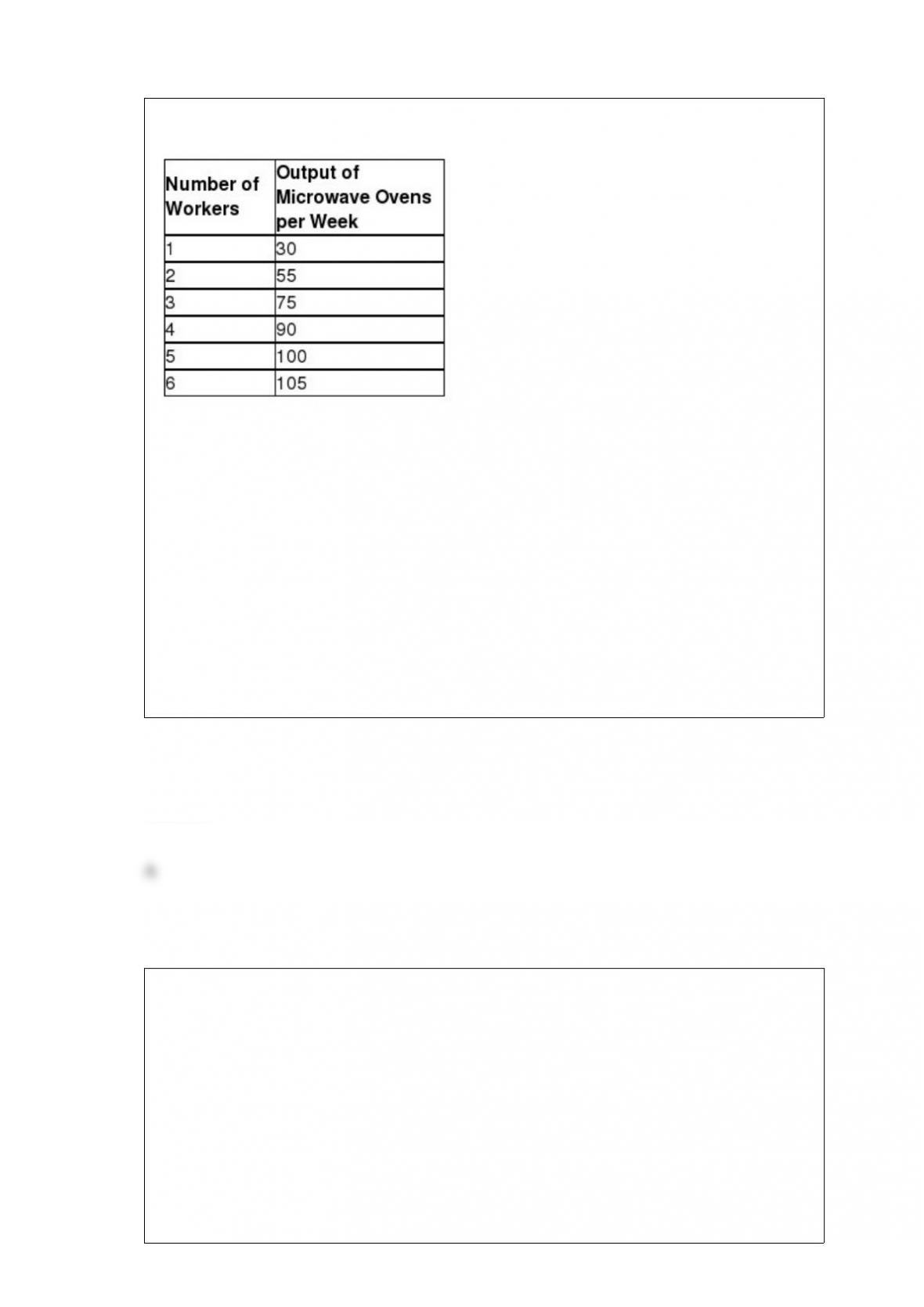
Table 17-3
Hotspur Incorporated, a manufacturer of microwave ovens, is a price taker in its input
and output markets. The firm hires labor at a constant wage rate of $800 per week and
sells microwave ovens at a constant price of $80. Table 17-3 shows the relationship
between the quantity of labor it hires and the quantity of microwave ovens it produces.
What is the amount of revenue added as a result of hiring the fourth worker?
A) $1,200
B) $7,200
C) 15 microwaves
D) 90 microwaves
Answer:
According to the Department of Justice merger guidelines, a proposed merger between
two firms may be challenged if the post-merger Herfindahl-Hirschman Index
A) lies between 1,000 and 1,800 and the merger raises the Index by 50 points.
B) lies between 1,000 and 1,800 and the merger raises the Index by more than 100
points.
C) lies above 1,800 and the merger raises the Index by less than 50 points.
D) lies below 1,000 and the merger raises the Index by 100 points.
Answer:
The Coffee Nook, a small cafe near campus, sells cappuccinos for $2.50 and Russian
tea cakes for $1.00 each. What is the opportunity cost of buying a cappuccino?
A) 2 1/2 Russian tea cakes
B) 2/5 of a Russian tea cake
C) $2.50
D) $1.00
Answer:
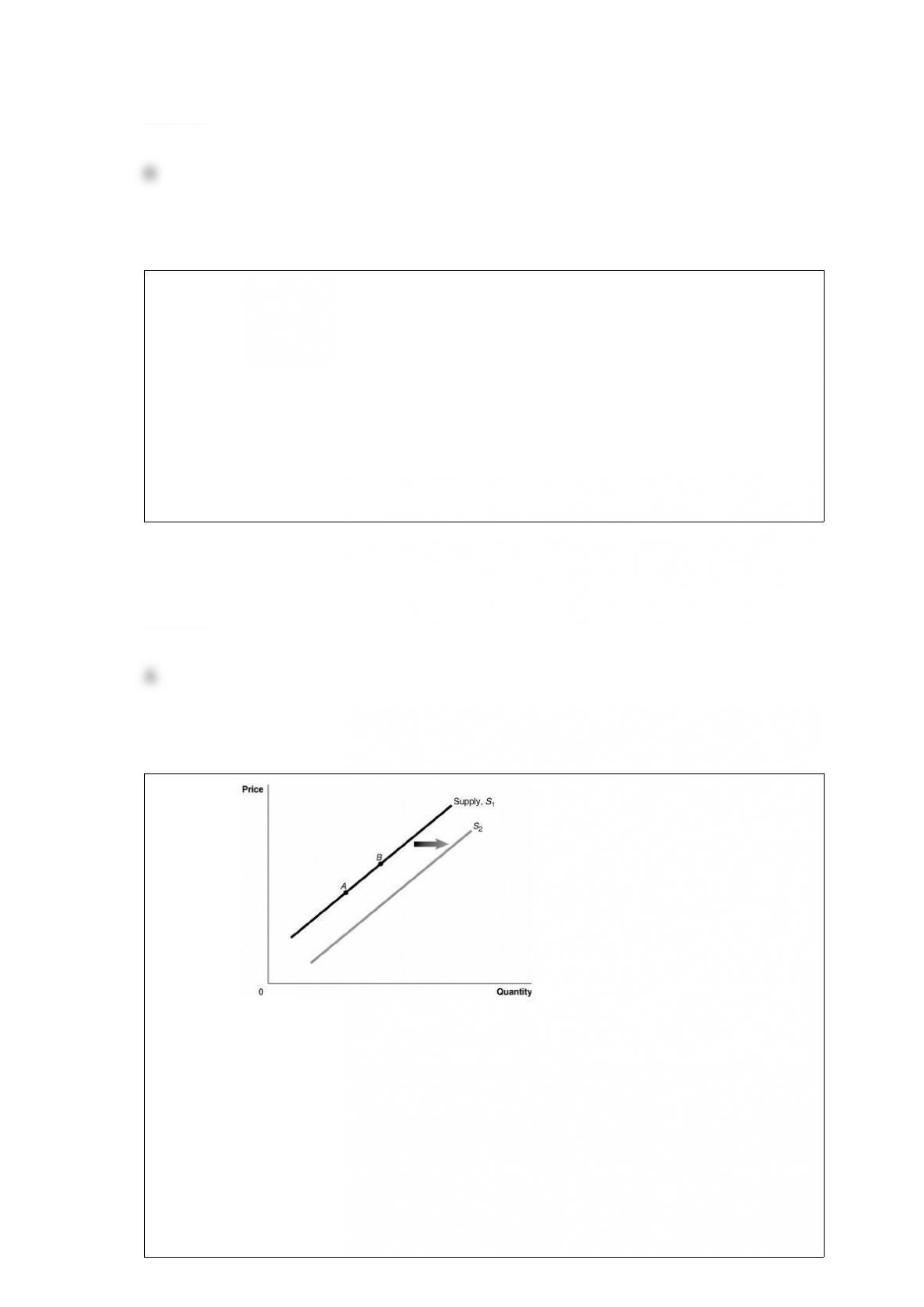
Figure 3-2
An increase in the price of the product would be represented by a movement from
A) A to B.
B) B to A.
C) S1 to S2.
D) S2 to S1.
Answer:
Which of the following is a microeconomics question?
A) How much will be saved and how much will be produced in the entire economy?
B) What will the level of economic growth be in the entire economy?
C) What factors determine the price of carrots?
D) What determines the average price level and inflation?
Answer:
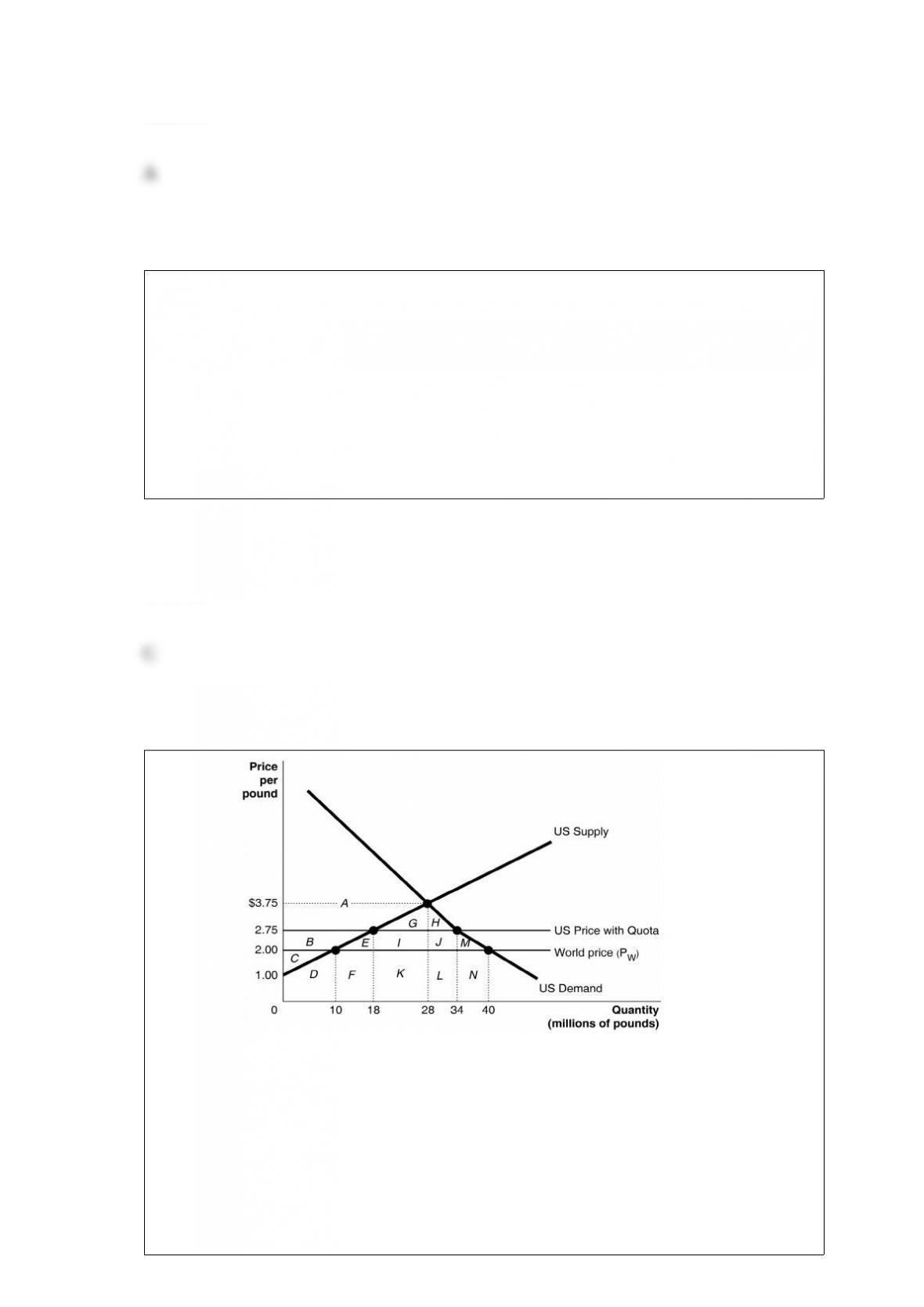
Figure 9-3 Since 1953 the
United States has imposed a quota to limit the imports of peanuts. Figure 9-3 illustrates
the impact of the quota. What is the area that represents revenue to foreign producers
who are granted permission to sell in the U.S. market when there is a quota?
A) I + J
B) E + I + J + M
C) I + J + K+ L

D) G + H + I + J
Answer:
Suppose a frost destroys the tomato crop in California but farmers see an increase in
their revenues. Which of the following best explains this?
A) The decrease in supply led to huge price increases.
B) Tomatoes are necessities.
C) The demand for tomatoes is price inelastic.
D) The cross-price elasticity between tomatoes and most other substitute vegetables is
very low.
Answer:
Consumption spending is $4.5 billion, gross private domestic investment is $3 billion,
and government expenditures are $2 billion. If GDP is $14 billion, which of the
following could be true regarding exports and imports in the economy?
A) Exports are $4.5 billion, and imports are $2 billion.
B) Exports are $6 billion, and imports are $8.5 billion.
C) Exports are $9 billion, and imports are $6 billion.
D) Exports are $15 billion, and imports are $10.5 billion.
Answer:
If the Fed’s policy is contractionary, it will
A) use open market operations to buy Treasury bills.
B) use open market operations to sell Treasury bills.
C) lower the discount rate.
D) lower the reserve requirement.
Answer:
What do economists mean by an efficient tax?
Answer:
The Wilfer Resort Hotel has a spectacular view of a pine forest along a river bank.
Suppose a commercial logger has purchased the pine forest and is planning to clear-cut
the forest in a way that has a negative impact on the resort. Can the two parties arrive at
a Coasian solution and if so, what is it?
Answer:
What is a monopoly? Can a firm be a monopoly if close substitutes for its product
exists?
Answer:
Does the strength of each of the five competitive forces from Michael Porter’s model
remain constant over time? Briefly explain.
Answer:
Last year, the unemployment rate was 4 percent and the inflation rate was 3 percent. If
the natural rate of unemployment is 3 percent, how do you expect inflation to change?
Answer:
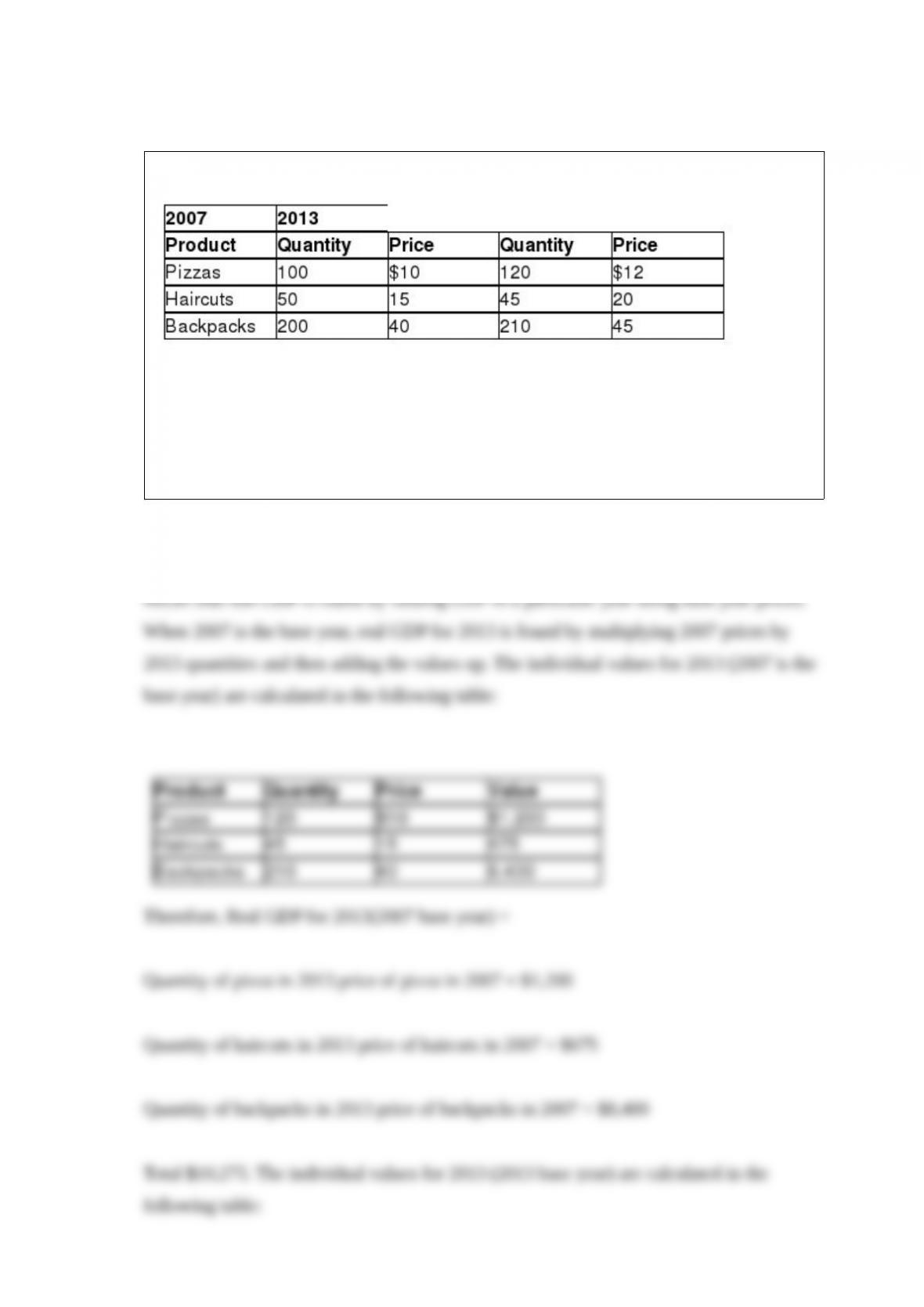
Table 19-24
Suppose that a very simple economy produces three goods: pizzas, haircuts, and
backpacks. Suppose the quantities produced and their corresponding prices for 2007
and 2013 are shown in the table above. Use the information to compute real GDP in the
year 2007 and 2013. Calculate real GDP in 2013 assuming the base year is 2007. Do the
same calculation assuming the base year is 2013. Are the calculations different? Why?
Answer:
What is the difference between retained earnings and dividends?
Answer: