
Critics of affirmative action programs argue that they
a. promote statistical discrimination.
b. impair economic efficiency by preventing firms from freely choosing the most
productive employee for a particular job.
c. are not as efficient as quota systems at hiring women and minorities.
d. All of the above are correct.
“Peak pricing” can often improve economic efficiency.
a. True
b. False
In perfect competition there are differences in the products sold by various firms.
a. True
b. False

In a market economy, the decision regarding allocation of resources is made by
a. automatic forces of supply and demand.
b. authorities in Washington, D.C.
c. planners in state capitals.
d. committees from a variety of economic interest groups.
e. All of the above are correct.
The main idea behind supply-side tax cuts is that
a. tax cuts increase spending, which increases aggregate supply.
b. some tax cuts can increase aggregate supply.
c. people like lower taxes and will spend more if they get them.
d. it is easier to shift aggregate supply than aggregate demand.

Whirlpool Corporation buys steel in sheets to manufacture refrigerators. Whirlpool also
buys a new factory and a metal press to mold the steel. Which purchases are included in
GDP?
a. the steel
b. the steel, the factory, and the metal press
c. the factory and the metal press
d. the steel and the metal press
Deficit spending will not cause much inflation if the economy is operating near full
employment.
a. True
b. False
Despite the monetary expansion of the 1992-2000 period, the inflation rate
a. rose due to adverse supply shocks.
b. rose due to large increases in aggregate demand.
c. fell despite adverse supply shocks.

d. fell due to favorable supply shocks.
To eliminate an inflationary gap, the expenditure schedule should
a. shift upward.
b. shift downward.
c. become flatter.
d. become steeper.
Any factor that shifts the supply curve inward and to the left and does not affect the
demand curve will raise the equilibrium price and reduce the equilibrium quantity.
a. True
b. False

In 1980, in order to stimulate agricultural production, Fidel Castro allowed Cuban
farmers to sell their goods directly to consumers and keep whatever profit they made.
Some farmers were earning $50,000 per year, compared with the average worker
income of $2,400. The workers resented this. Castro denounced the farmers as
“capitalist gangsters” and closed the free markets. Cuban cash income declined five
percent and fresh vegetables were in short supply. This illustrates the economic concept
of the
a. law of comparative advantage.
b. equality-efficiency trade-off.
c. cost disease of the service sector.
d. unemployment-inflation trade-off.
e. All of the above are correct.
The term “human capital” refers to how many people must work to produce a product.
a. True
b. False
A progressive tax is one for which the percentage of each added dollar of income paid

in taxes
a. increases as income increases.
b. remains the same as income increases.
c. decreases as income increases.
d. is zero after a certain maximum income is reached.
Pollution problems
a. have existed for many centuries.
b. are attributable to modern industrialization.
c. can be blamed on the profit system.
d. have worsened in every respect in the past forty years.
Natural monopolies are of theoretical, but not practical interest.
a. True
b. False

Only government restrictions serve as entry barriers.
a. True
b. False
The expenditure schedule includes the consumption function.
a. True
b. False
Figure 4-16

Assume that Figure 4-16 shows the supply of steak. An increase in the price of pork
will change the supply from
a. S1 to S2.
b. S2 to S1.
c. S2 to S3.
d. S1 to S3.
When institutional money managers use their computers to decide on large sales or
purchases in the stock market, they are employing
a. the herd instinct.
b. the bandwagon effect.
c. program trading.
d. stock watering.

Rent seeking is a way of earning profit without adding to the product’s value.
a. True
b. False
Existing loopholes erode the progressivity of the U.S. tax system.
a. True
b. False
The future of the U.S as leader of the economic world:
a. is likely to continue for generations to come
b. will be sustained in the next generation, but not beyond
c. requires U.S. action in several critical economic areas

d. requires a return of manufacturing to the U.S.
If the price level rises, what will happen to aggregate supply?
a. It will shift outward.
b. It will shift inward.
c. Nothing.
d. It will get steeper.
e. It will get flatter.
Assume the required reserve ratio is 20 percent and the FOMC orders an open market
purchase of $100 million in government securities from member banks. If the
oversimplified money multiplier is assumed, then the money supply will
a. increase by $500 million.
b. increase by $100 million.
c. decrease by $100 million.
d. decrease by $500 million.

Total expenditure by a buyer is equal to the
a. slope at any point along the demand curve.
b. price times quantity demanded at any point along the demand curve.
c. elasticity times price at any point along the demand curve.
d. elasticity times quantity demanded at any point along the demand curve.
People who failed to look for a job are classified as
a. unemployed.
b. underemployed.
c. out of the labor force.
d. part time employed.

The essence of the trade-off between equality and efficiency is that
a. taxes and transfers reduce incentives to earn income, thus reducing GNP.
b. people are ideologically opposed to socialistic income redistribution.
c. redistribution violates the “work ethic.”
d. people are prejudiced against blacks and women.
Expansionary monetary policy is essentially finished once the Fed reduces the federal
funds rate to zero.
a. True
b. False
Figure 8-5
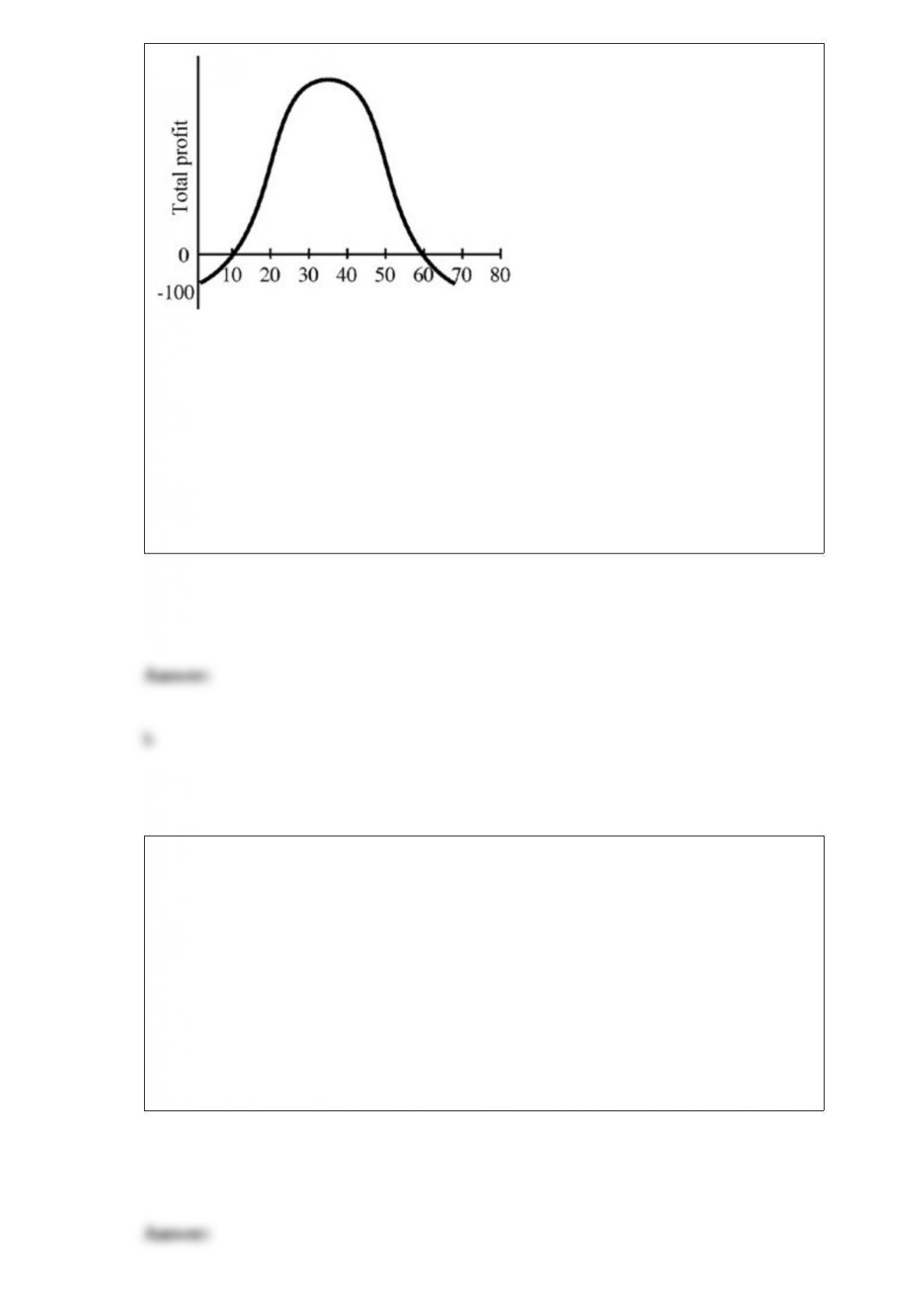
In Figure 8-5, profits are maximized at output of
a. 10.
b. 35.
c. 50.
d. 60.
As a result of a decline in interest rates and a rise in household income, the demand
curve for housing has shifted to the right, but has retained the same slope.
Consequently, the elasticity of demand for housing
a. has declined.
b. has increased.
c. has remained unchanged.
d. cannot be compared.

High opportunity costs go hand in hand with high money costs in a properly
functioning economy.
a. True
b. False
If hot dogs cost $2 this year and $3 next year, then 100 hotdogs will contribute
a. $200 to this year’s nominal GDP and $166 to next year’s nominal GDP.
b. $200 to this year’s real GDP and $300 to next year’s real GDP.
c. the same dollar amount to each year’s nominal GDP because hotdogs are intermediate
goods.
d. $200 to this year’s nominal GDP and $300 to next year’s nominal GDP.
Figure 13-1
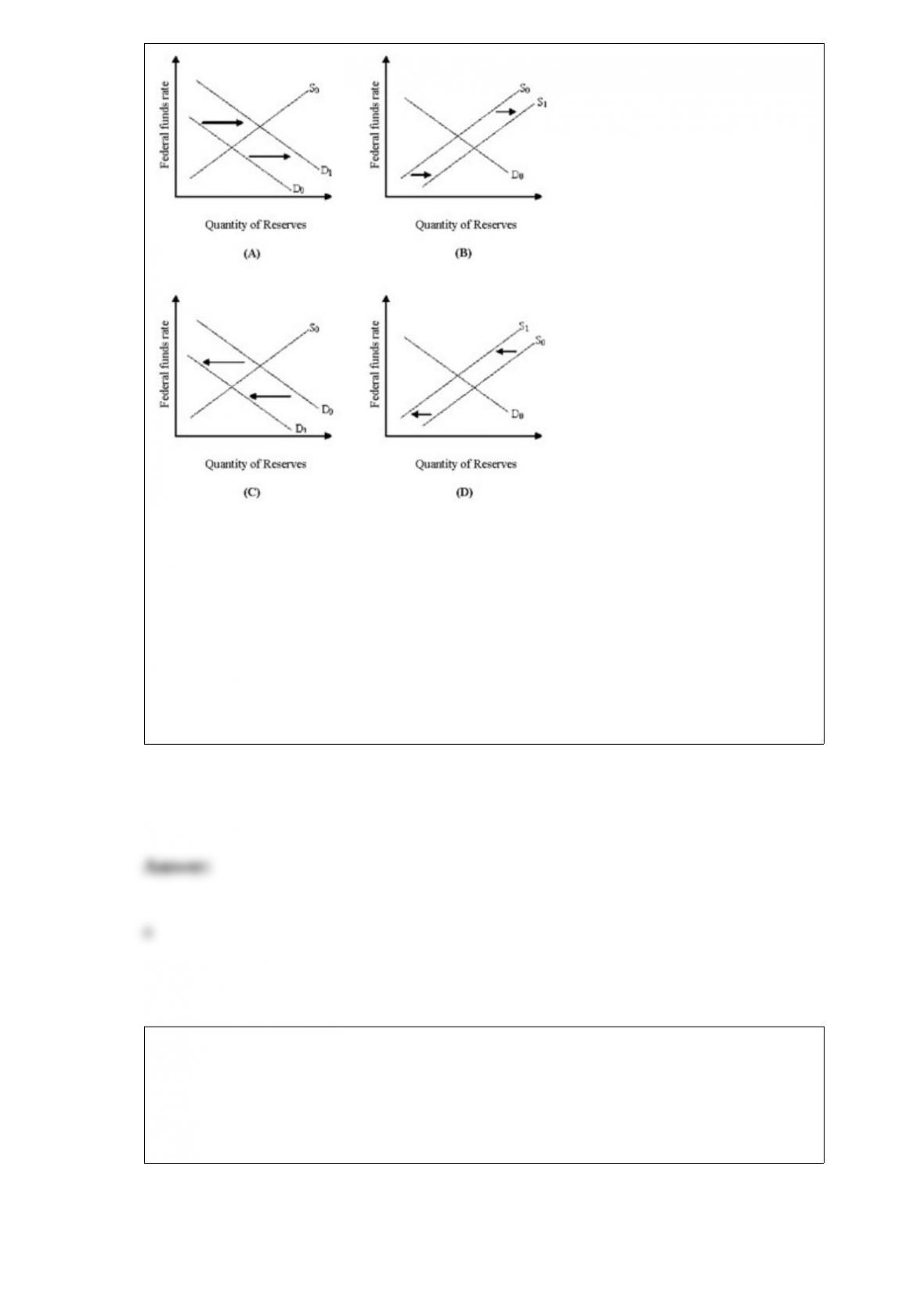
In Figure 13-1, which panel shows the effect of inflation on the interest rate?
a. Panel (A)
b. Panel (B)
c. Panel (C)
d. Panel (D)
The recessionary gap of the 1990s in Japan led to decreases in the price level.
a. True
b. False