
Which of the following would shift a nation’s production possibilities frontier inward?
A) discovering a cheap way to convert sunshine into electricity
B) producing more capital equipment
C) an increase in the unemployment rate
D) a law requiring workers to retire at age 50
What is the difference between labor’s marginal product and marginal revenue product?
A) The marginal product of labor is the increase in output as a result of hiring an
additional worker while the marginal revenue product of labor is the increase in profit
as a result of hiring an additional worker.
B) The marginal revenue product of labor is the dollar value of hiring an additional
worker while the marginal product of labor is the increase in the firm’s physical output
as a result of hiring an additional worker.
C) The marginal product of labor is the additional labor’s contribution to the firm’s total
output while the marginal revenue product is the additional labor’s contribution to the
firm’s total sales revenue.
D) Labor’s marginal product is a measure of labor’s productivity while labor’s marginal
revenue product is a measure of labor’s ability to sell the firm’s products.
The table below shows the demand and cost data facing “Velvet Touches,” a
monopolistically competitive producer of velvet throw pillows.
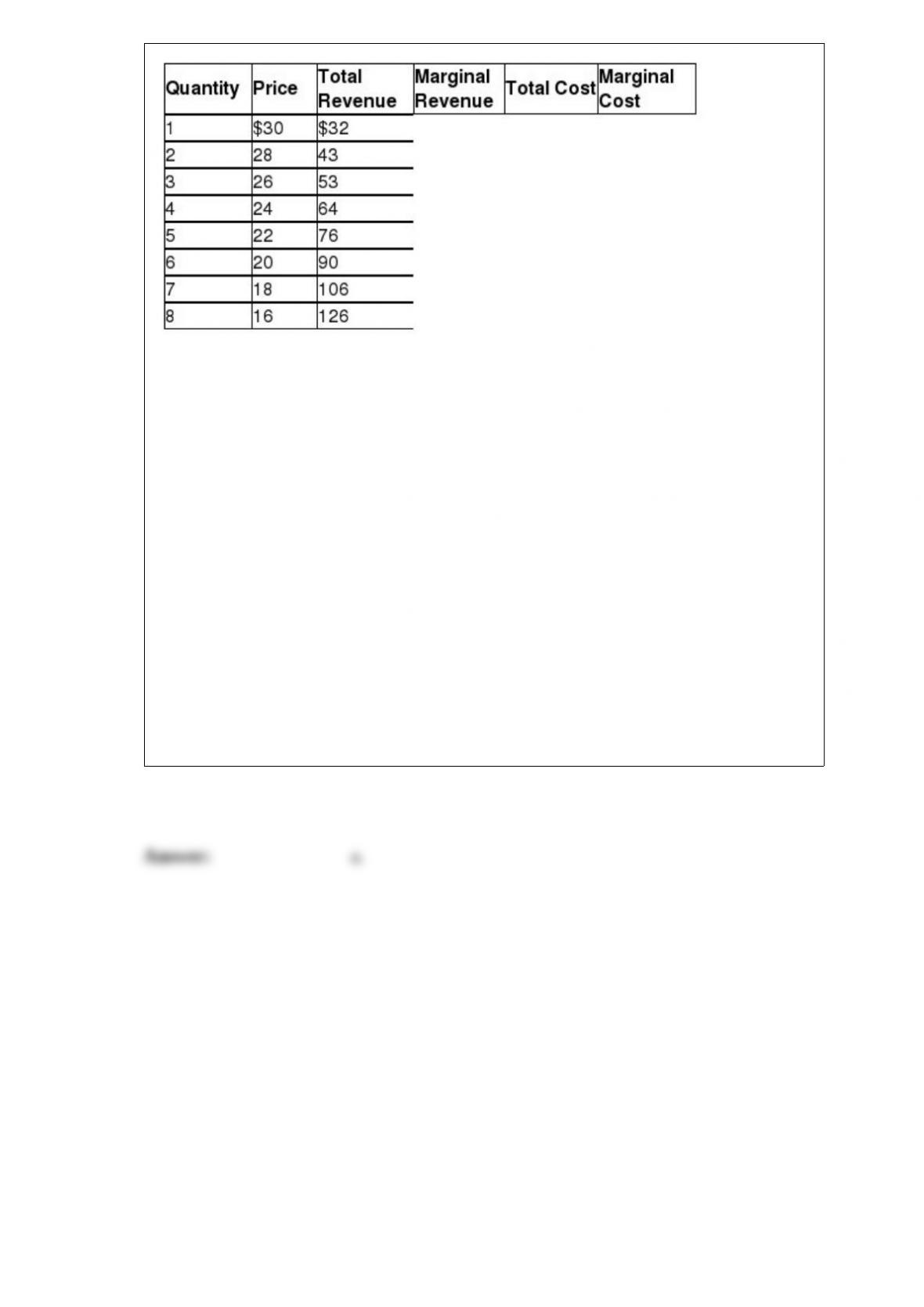
Use the data to answer the following questions.
a. Complete the Total Revenue (TR), Marginal Revenue (MR) and Marginal Cost (MC)
columns above.
b. What are the profit-maximizing price and quantity for Velvet Touches?
c. Is the firm making a profit or a loss? How much is the profit or loss? Show your
work.
d. Is this firm operating in the long run or in the short run? Explain your answer.
e. If the firm’s profit or loss is typical of all firms in the market for throw pillows, what
is likely to happen in the future? Will there be more firms or will some existing firms
leave the industry? Explain your answer.
f. What will happen to the typical firm’s profit or loss after all entry/exit adjustments?
If the demand curve for a firm is downward sloping, its marginal revenue curve
A) will lie above the demand curve.
B) will lie below the demand curve.
C) is the same as the demand curve.
D) is horizontal.

An increase in the sensitivity of private spending (consumption, investment, and net
exports) to changes in the interest rate ________ the government purchases multiplier.
A) will decrease
B) will increase
C) will not change
D) may increase or may decrease
Assume that both the demand curve and the supply curve for MP3 players shift to the
right but the demand curve shifts more than the supply curve. As a result
A) both the equilibrium price and quantity of MP3 players will increase.
B) the equilibrium price of MP3 players will increase; the equilibrium quantity may
increase or decrease.
C) the equilibrium price of MP3 players may increase or decrease; the equilibrium
quantity will increase.
D) the equilibrium price of MP3 players will decrease; the equilibrium quantity may
increase or decrease.
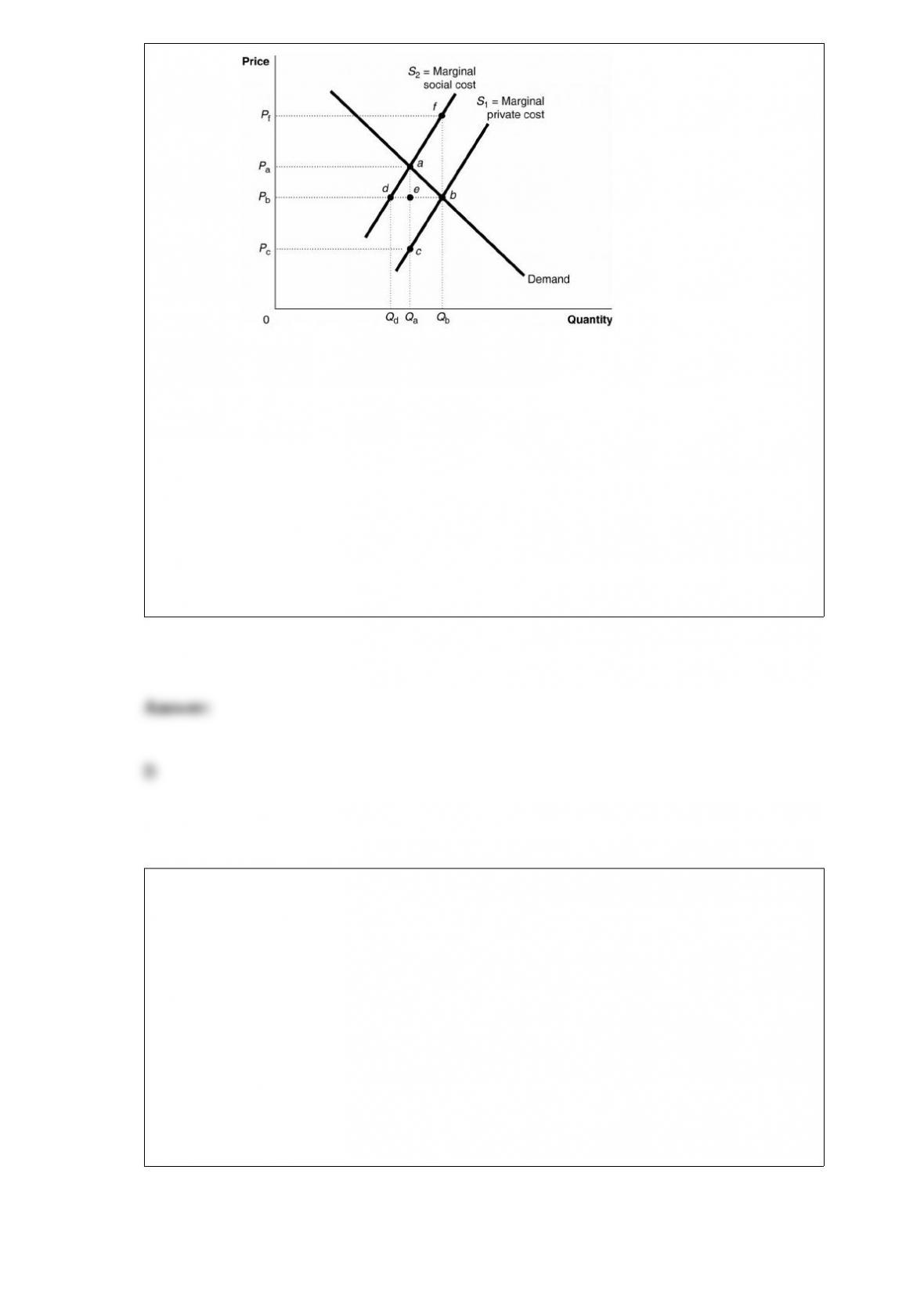
Figure 5-2 Figure 5-2 shows a
market with a negative externality.
The private profit maximizing quantity for the firm is
A) Qa.
B) Q.
C) Q – Qd.
D) Qd.
A monopolistically competitive firm chooses
A) both the quantity of output to produce and the price at which it will sell its output.
B) the price of the product it sells but market forces determine the quantity it will be
able to sell.
C) the quantity of output to produce but the price of the product it sells is determined
collectively by all firms in the industry.
D) the price of the product it sells but the quantity of output to produce is agreed upon
by all firms in the industry.

Marginal cost is
A) the total cost of producing one unit of a good or service.
B) the average cost of producing a good or service.
C) the difference between the lowest price a firm would have been willing to accept and
the price it actually receives.
D) the additional cost to a firm of producing one more unit of a good or service.
The reason that the Fisherman’s Friend restaurant in Stonington, Maine had a monopoly
on selling seafood dinners in that town is most likely due to
A) a government-imposed barrier.
B) occupational licensing.
C) no competitors apparently found the profit level attractive enough to enter the
market.
D) the restaurant owned all the fresh seafood in the state.

Disposable personal income equals personal income
A) minus personal tax payments.
B) plus government transfer payments.
C) minus personal tax payments plus government transfer payments.
D) minus government transfer payments plus personal tax payments.
A market comprised of only two firms is called a
A) competitive market.
B) duopoly.
C) monopoly.
D) monopolistically competitive market.