
When a business is set up as a sole proprietorship, the owner of the business faces
limited liability.
If inflation is higher than expected, this helps borrowers (by reducing the real interest
rate they pay) and hurts lenders (by reducing the real interest rate they receive).
The labor force participation rates of women have rapidly increased since 1948.
The Fed has complete control over the money supply.

Average total cost is equal to average variable cost minus average fixed cost.
If additional units of a good could be produced at a constant opportunity cost, the
production possibility frontier would be linear.
Aggregate expenditure includes consumption spending, planned investment spending,
government purchases, and net exports.
Quantity supplied refers to the amount of a good or service that a firm is willing and
able to supply at a given price.

Of all industrialized nations, real GDP per capita was the highest in Japan in 2012.
A quasi-public good is similar to a public good in that one person’s consumption of the
quasi-public good does not reduce the amount available for everyone else.
An optimal two-part tariff pricing schedule maximizes consumer surplus.
If consumers paid the full price of medical services instead of using health insurance
and third-party payers to cover part of the cost, the quantity of medical services
provided would increase.

Consider a country that produces only two goods: bird feeders and binoculars. Suppose
it is possible for this country to increase its production of bird feeders without
producing fewer binoculars. In this case, its current output combination is inefficient.
Monetarists believe that the quantity of money should be increased at an increasing
rate.
A prisoner’s dilemma leads to a noncooperative equilibrium.
An organization of producers that limits the amount of a good produced is known as a
A) free market organization.
B) guild.
C) collective.
D) co-op.

Evidence shows that many people who delay searching for a job for a year or longer
after they are laid off
A) find it more difficult to find new employment than if they had searched for a new
job soon after they were laid off.
B) find it easier to find new employment than if they had searched for a new job soon
after they were laid off.
C) find that they have little to no chance to find new employment after being
unemployed for so long.
D) find that the extra unemployment benefits they receive during their extended period
of unemployment more than make up for the difficulty in finding a job once they decide
to re-enter the workforce.
A transfer payment is a payment by the government to an individual
A) for a service.
B) for an investment good.
C) for a consumption good.
D) for which the government does not receive a good or service in return.
E) for a debt owed.
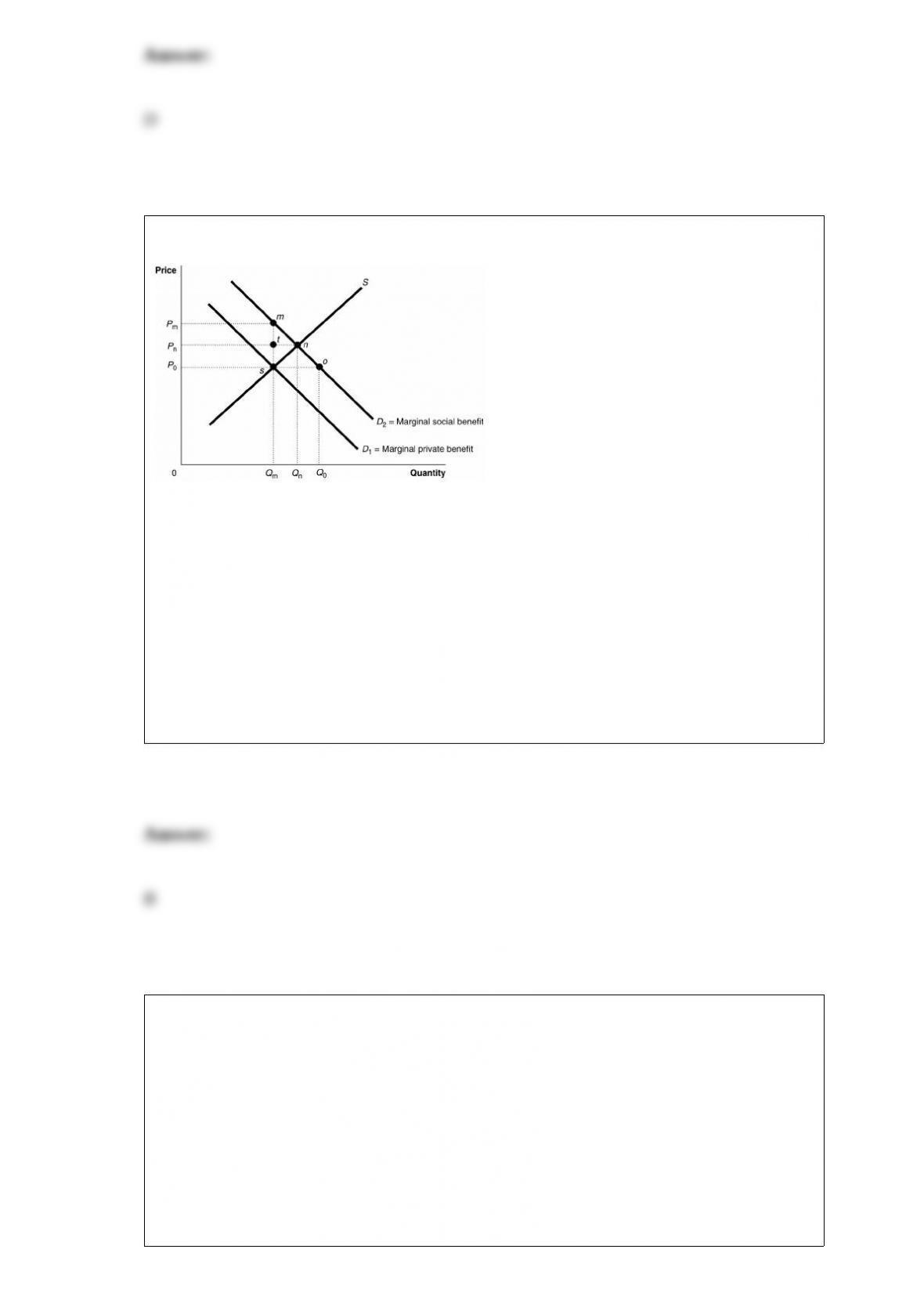
Figure 5-3
The efficient output level is
A) Qm.
B) Q.
C) Qo.
D) Qo– Qm.
Some economists have proposed making the tax treatment of employer-provided health
insurance the same as the tax treatment of individually purchased health insurance and
out-of-pocket health care spending. Such changes would make it more likely that
A) consumers would pay prices closer to the actual costs for routine medical care.
B) employers would provide more generous medical coverage to their employees.
C) insurance deductibles would decrease.

D) the quantity of medical services demanded would increase.
In a closed economy,
A) I = Y – C – G.
B) I = Y + C – G.
C) I = Y – C + G.
D) I = Y + C + G.
If 11 workers can produce a total of 54 units of a product and a 12th worker has a
marginal product of 6 units, then the average product of 12 workers is
A) 60 units.
B) 54 units.
C) 48 units.
D) 5 units.
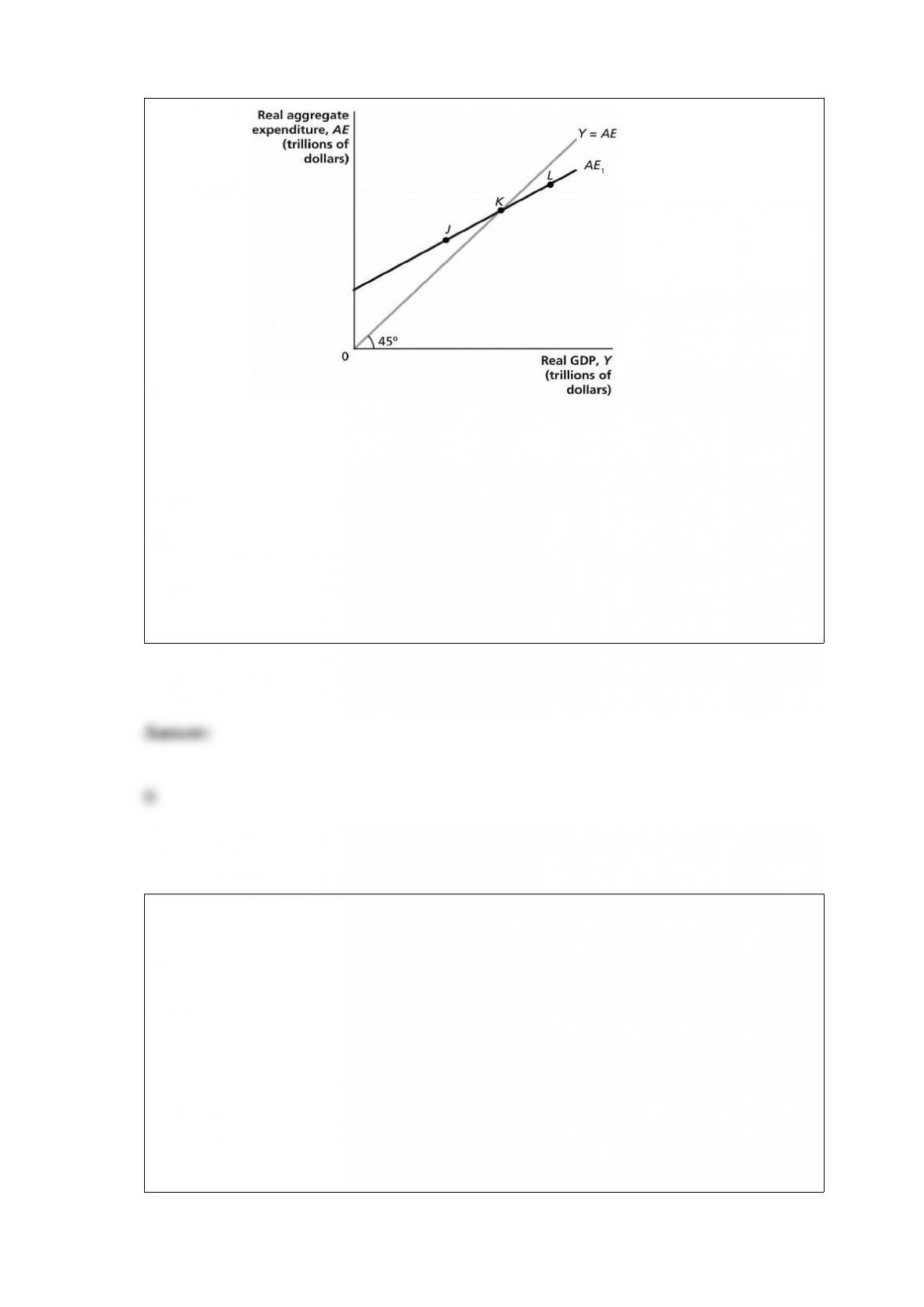
Figure 12-1
If the economy is in equilibrium, it is at a level of aggregate expenditure given by point
A) J.
B) K.
C) L.
D) Points J, K and L all represent equilibrium.
When housing prices ________, as they did beginning in 2006 following the housing
market bubble, consumption spending on furniture, appliances, and home
improvements declined as many households found it ________ to borrow against the
value of their homes.
A) rise; easier
B) rise; harder
C) fall; easier
D) fall; harder

Last year, Sefton purchased 60 pounds of potatoes to feed his family of five when his
household income was $30,000. This year, his household income fell to $20,000 and
Sefton purchased 80 pounds of potatoes. All else constant, Sefton’s income elasticity of
demand for potatoes is
A) negative, so Sefton considers potatoes to be an inferior good.
B) positive, so Sefton considers potatoes to be an inferior good.
C) positive, so Sefton considers potatoes to be a normal good and a necessity.
D) negative, so Sefton considers potatoes to be a normal good.
Monetary policy refers to the actions the Federal Reserve takes to manage
A) the money supply and income tax rates to pursue its economic objectives.
B) the money supply and interest rates to pursue its economic objectives.
C) income tax rates and interest rates to pursue its economic objectives.
D) government spending and income tax rates to pursue its economic objectives.

If a corporate bond with a face value of $2,000 pays yearly coupon payments of $50,
what is the coupon rate?
A) 2.5%
B) 4%
C) 25%
D) 40%
For a given supply curve, how does the elasticity of demand affect the burden of a tax
imposed on a product?
A) The excess burden of the tax will be minimized when the demand is unit-elastic.
B) The excess burden of the tax will be greater when the elasticity of supply is greater
than the elasticity of demand.
C) The excess burden of the tax will be greater when the demand is less elastic than
when it is more elastic.
D) The excess burden of the tax will be greater when the demand is more elastic than
when it is less elastic.
Goods differ on the basis of whether their consumption is rival and excludable. Explain
the terms “rivalry” and “excludability” as they are used to define goods. List the four
categories of goods, and define these categories in terms of rivalry and excludability.

Outline the various actions the government sector could take to promote growth.
How is the impact of expansionary fiscal policy different in an open economy than in a
closed economy?
Why are demand and marginal revenue represented by the same curve for a firm in a
perfectly competitive market, but by separate curves for a firm in a monopolistically
competitive market?
Explain what happens to inflation during the business cycle. Give an intuitive
explanation as to why inflation changes the way it does over the business cycle.
If workers accurately predict the rate of inflation, is there a short-run trade-off between
inflation and unemployment, as predicted by the Phillips curve? Why or why not?
What are two reasons why employees would prefer for their employer pay for their
health insurance rather than receiving increased wages and paying for their own health
insurance?
What is an entrepreneur?
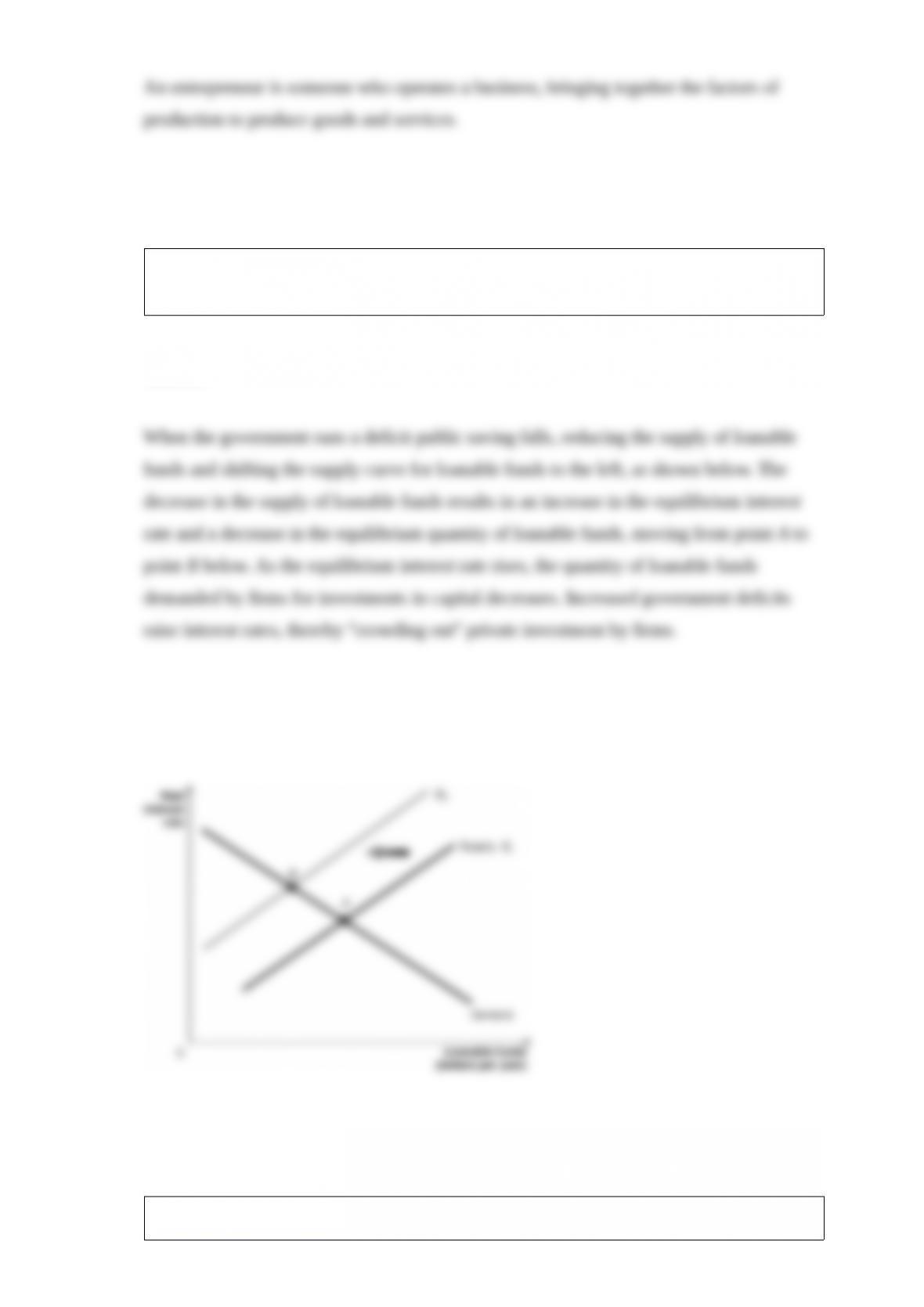
Explain and show graphically how government deficits can “crowd out” private
investment.
What is the difference between physical capital and human capital?