A price floor creates a situation in which one party wins and another party loses, and the
gains for the winner are equal to the losses for the loser.
a. True
b. False
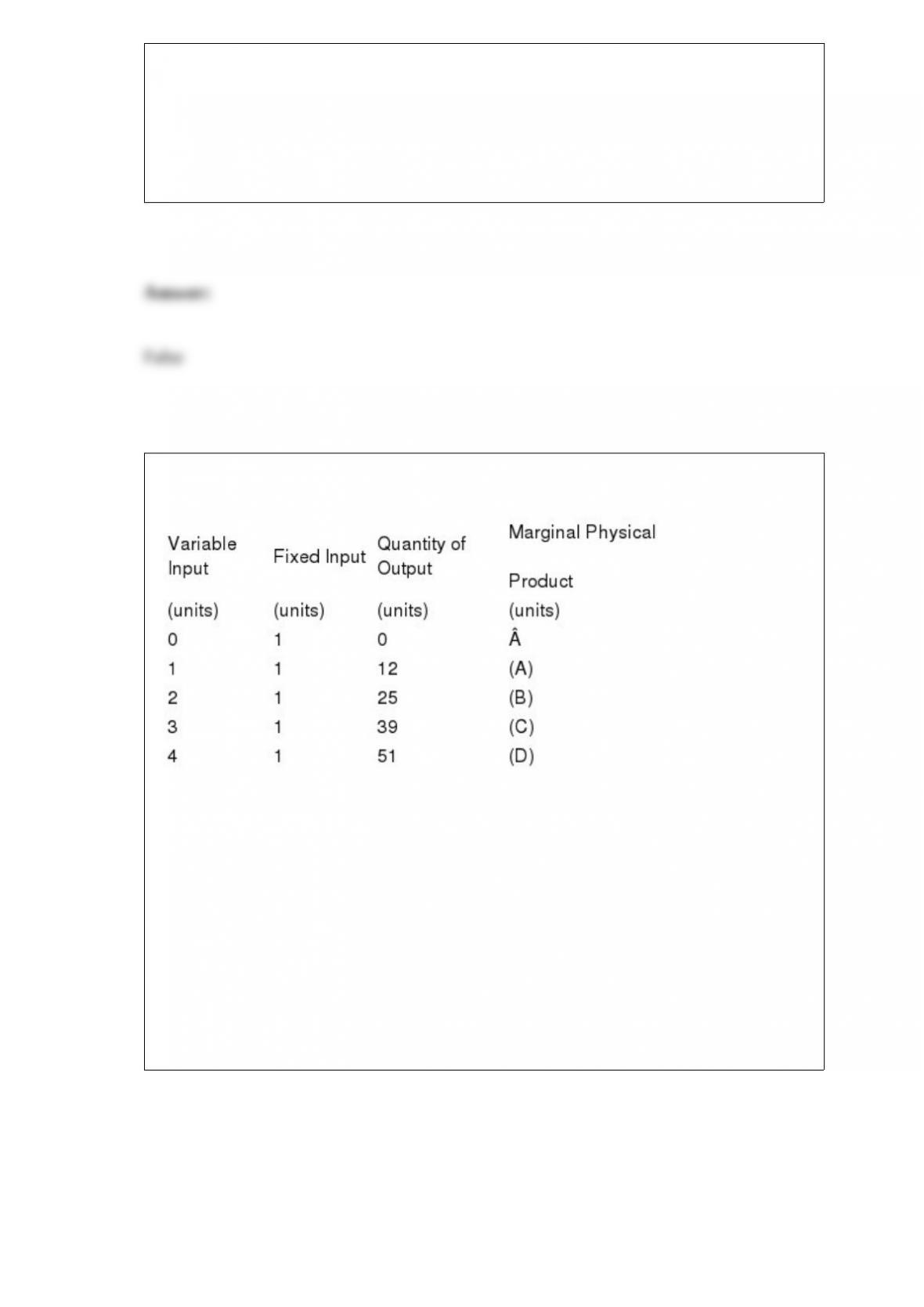
Exhibit 22-12
above. The numbers that go in blanks (A), (B), (C), and (D), respectively, are
a. 12, 13, 14 and 12.
b. 12, 25, 39 and 51.
c. 12, 11, 10 and 9.
d. 12, 14, 13 and 11.
e. none of the above

An “increase in demand” means that
a. the demand curve has shifted to the left.
b. price has declined and consumers want to purchase more of the good.
c. the demand curve has shifted to the right.
d. the price of the good can be expected to decline, assuming supply stays constant.
Which of the following government agricultural policies is not aimed at restricting
supply?
a. price supports
b. acreage allotments
c. market quotas
d. paying farmers not to produce
Exhibit 2-7
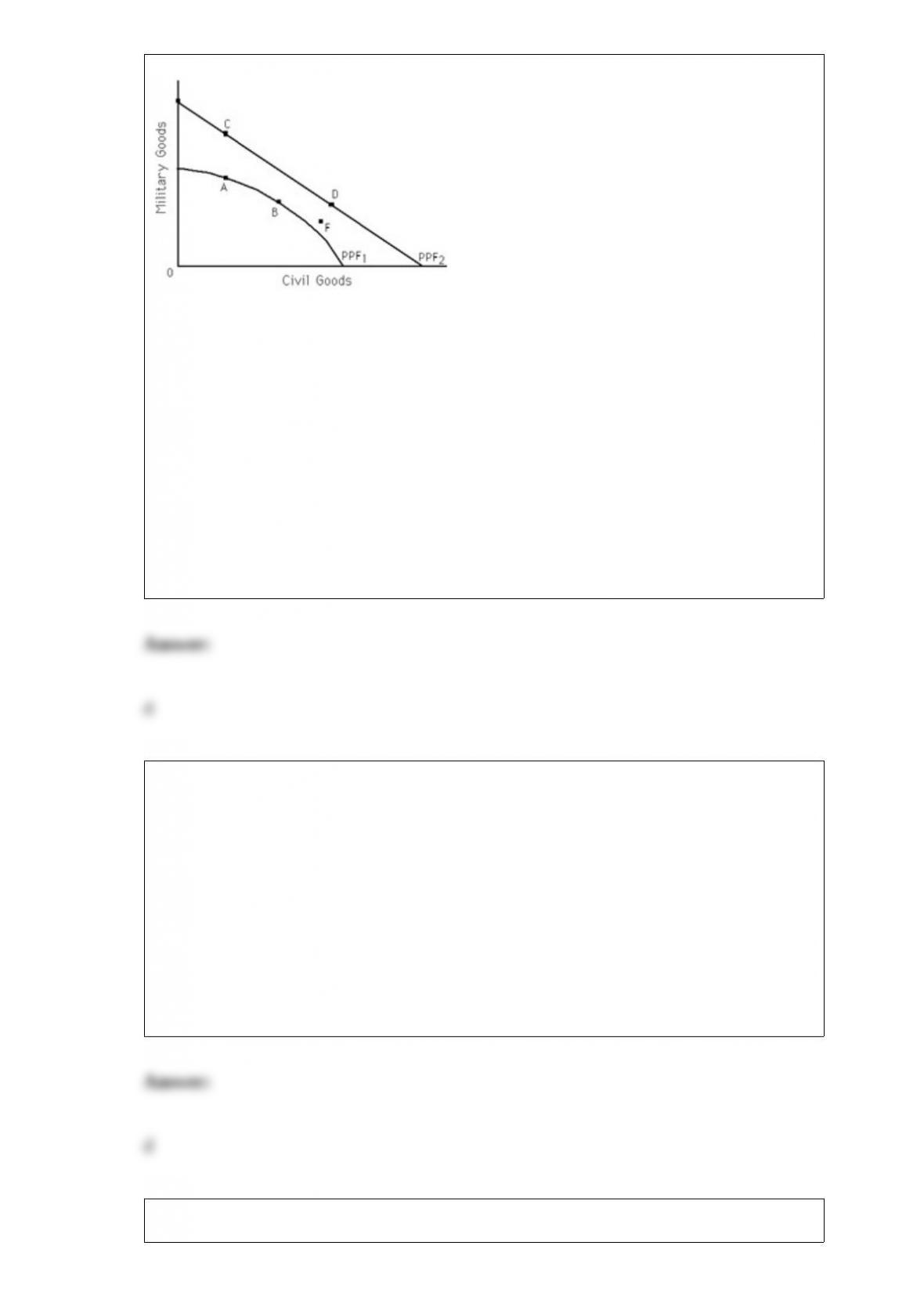
Point F is
a. unattainable if the economy’s PPF is PPF1.
b. inefficient if the economy’s PPF is PPF2.
c. attainable if the economy’s PPF is PPF2.
d. all of the above
e. none of the above
Which of the following statements uses the term ceteris paribus correctly?
a. In economics, there are numerous theories, ceteris paribus.
b. New York City is a major American city, ceteris paribus.
c. The price of pineapples is low in Hawaii, ceteris paribus.
d. The more ice cream you eat, the more weight you will gain, ceteris paribus.
e. none of the above
If scarcity didn’t exist, neither would

a. rationing devices.
b. competition.
c. labor.
d. capital.
e. a and b
In the long run, a firm earns zero economic profit, given the condition that
a. P = MR.
b. P = AVC.
c. P = ATC.
d. (P – MC) = 0.
e. none of the above
Marginal revenue product is equal to marginal revenue multiplied by
a. average physical product.
b. marginal physical product.
c. average total cost.
d. marginal cost.
Buying low and selling high is often referred to as
a. price discrimination.
b. rent-seeking.
c. arbitrage.
d. scarcity.
e. capitalization.