
In a fixed exchange rate system, speculation regarding an expected revaluation or
devaluation of a currency makes it more difficult to maintain the existing exchange rate.
Answer:
The CPI in 2010 was 218, while the CPI in 1980 was 82. If you had $5,000 in 1980, its
equivalent purchasing power in 2008 would be $10,850.
Answer:
On a diagram of a production possibility frontier, economic decline (negative growth) is
represented by the production possibility frontier shifting inward.
Answer:
A tax is efficient if it imposes a large excess burden relative to the tax revenue it raises.
Answer:

At the end of an expansion, wages of workers are usually rising faster than prices.
Answer:
Income inequality increases as the Gini coefficient approaches 1.
Answer:
A natural monopoly is characterized by large fixed costs relative to variable costs.
Answer:
Housing is the largest component of the U.S. CPI market basket.
Answer:

When there is a negative externality, the competitive output is more than the
economically efficient output level.
Answer:
If gold is used as money in an economy, the money supply is easy to control.
Answer:
A surplus occurs when the market price is lower than the equilibrium price.
Answer:
In the short run, if a firm shuts down, it avoids its variable cost but not its fixed cost.
Answer:

A supply shock causes the long-run aggregate supply curve to shift left, decreasing the
price level.
Answer:
To what do economists attribute the rapid growth of labor productivity in the United
States relative to other countries?
A) the flexibility of U.S. labor markets and the efficiency of the U.S. financial system
B) the strict government rules in the United States that regulate a firm’s ability to hire
and fire workers
C) the low rate of job mobility in the United States
D) the high level of unemployment benefits the United States pays relative to other
countries like Canada
Answer:
Suppose $1 billion is available in the budget and Congress is considering allocating the
funds to one of the following three alternatives:
a. subsidies for education
b. research on Alzheimer’s
c. increased border security If voters prefer a to b and b to c, then if preferences are
transitive,
A) they should prefer a to c.
B) they should prefer c to a.
C) they should be indifferent between a and c.
D) it is not always possible to rank voters’ preferences between a and c.
Answer:
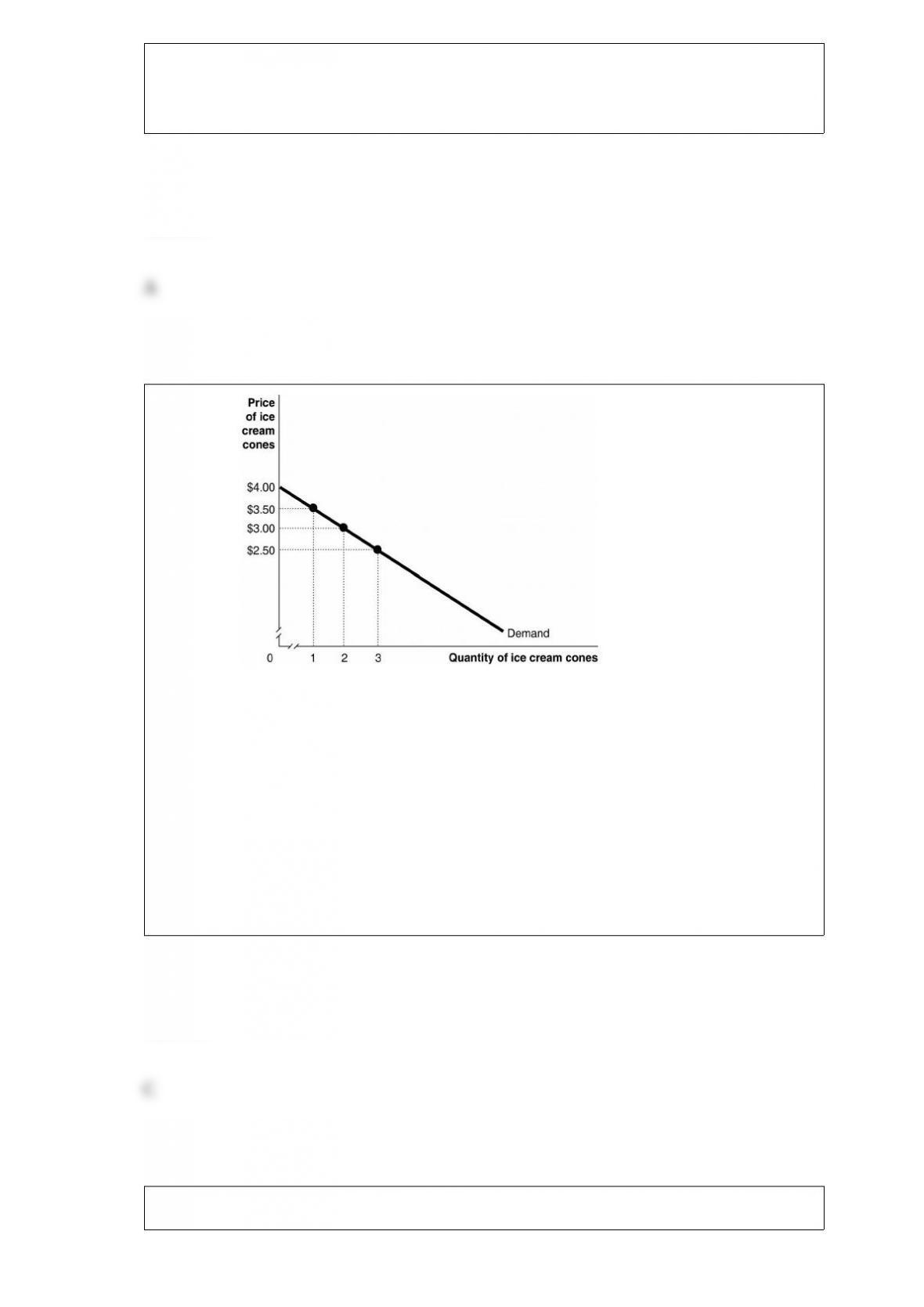
Figure 4-3 Figure 4-3 shows Kendra’s
demand curve for ice-cream cones.
Kendra’s marginal benefit from consuming the second ice cream cone is
A) $6.50
B) $6.00
C) $3.00
D) $2.25
Answer:
Table 14-3

Suppose OPEC has only
two producers, Saudi Arabia and Nigeria. Saudi Arabia has far more oil reserves and is
the lower cost producer compared to Nigeria. The payoff matrix in Table 14-3 shows
the profits earned per day by each country. “Low output” corresponds to producing the
OPEC assigned quota and “high output” corresponds to producing the maximum
capacity beyond the assigned quota. Which of the following statements is true?
A) The Nash equilibrium is a noncooperative, dominant strategy equilibrium.
B) The Nash equilibrium is a cooperative equilibrium.
C) The Nash equilibrium is a collusive equilibrium.
D) There is no Nash equilibrium in this game because each party pursues its dominant
strategy.
Answer:
If relative purchasing power between the United States and Argentina is 3.22 pesos per
dollar, under which circumstances would we say that the dollar is “overvalued”?
A) if the actual exchange rate between the dollar and the Argentinean peso is 3.22 pesos
per dollar
B) if the actual exchange rate between the dollar and the Argentinean peso is 4 pesos
per dollar
C) if the actual exchange rate between the dollar and the Argentinean peso is 0.22 pesos
per dollar
D) if the actual exchange rate between the dollar and the Argentinean peso is 3 pesos
per dollar
Answer:
When the federal government orders firms to use particular methods to reduce
pollution, it is said to be using
A) command-and-control policies.
B) strong-arm tactics.
C) global initiatives.
D) market-based policies.
Answer:
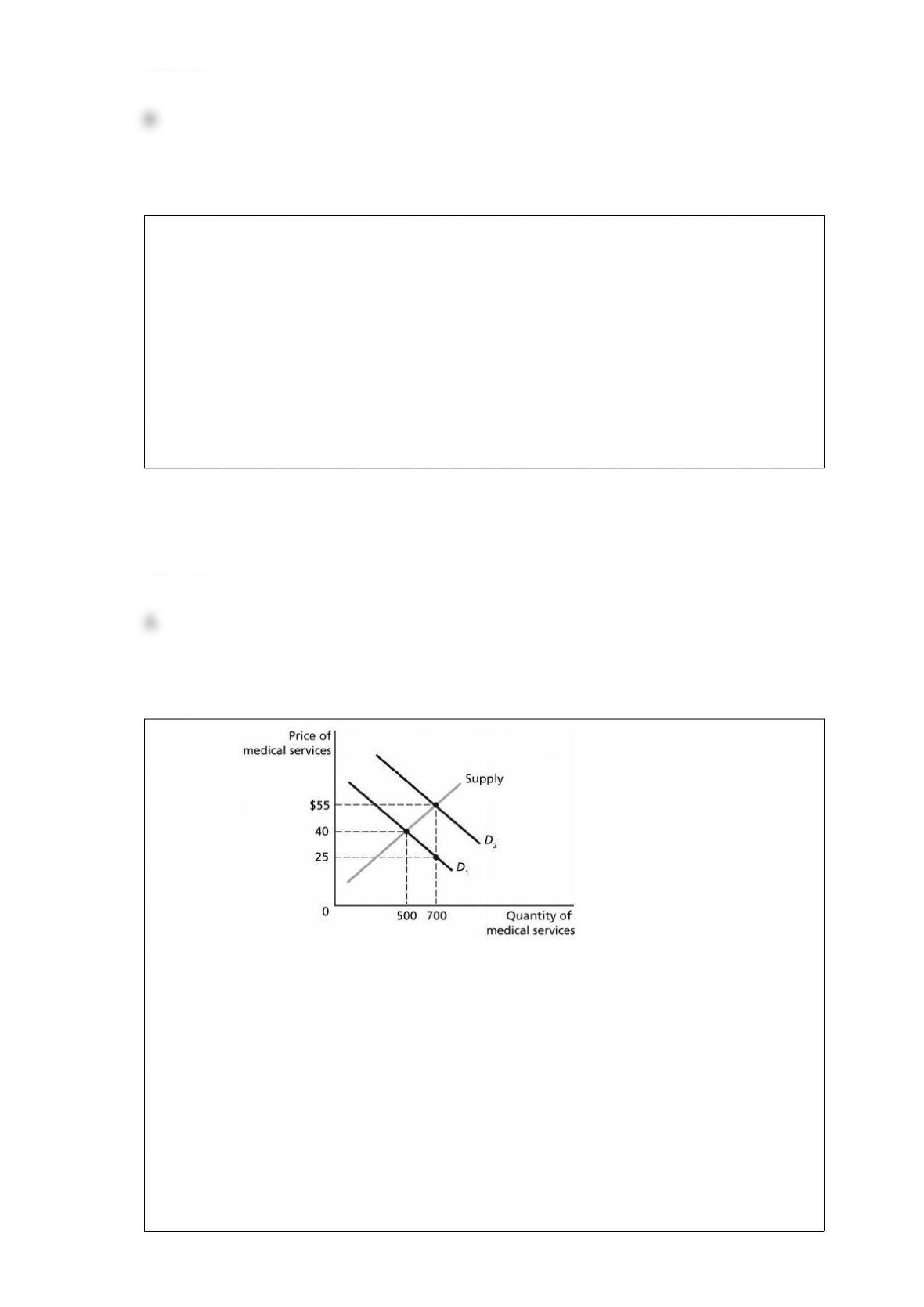
Figure 7-4 Figure 7-4 represents the
market for medical services with and without insurance, and the effect of a third-party
payer system on the demand for medical services.
If consumers paid the full price of medical services, the price they would pay is
A) $25.
B) $40.
C) $55.
D) >$55.

Answer:
Consumer surplus in a market for a product would be equal to the area under the
demand curve if
A) producer surplus was equal to zero.
B) marginal cost was equal to the market price.
C) the product was produced in a perfectly competitive market.
D) the market price was zero.
Answer:
The marginal product of labor is defined as
A) the change in total revenue that results when an additional unit of a labor is hired.
B) the additional labor required to produce one more unit of output.
C) the additional labor cost of producing one more unit of output.
D) the change in output that a firm produces as a result of hiring one more worker.
Answer:
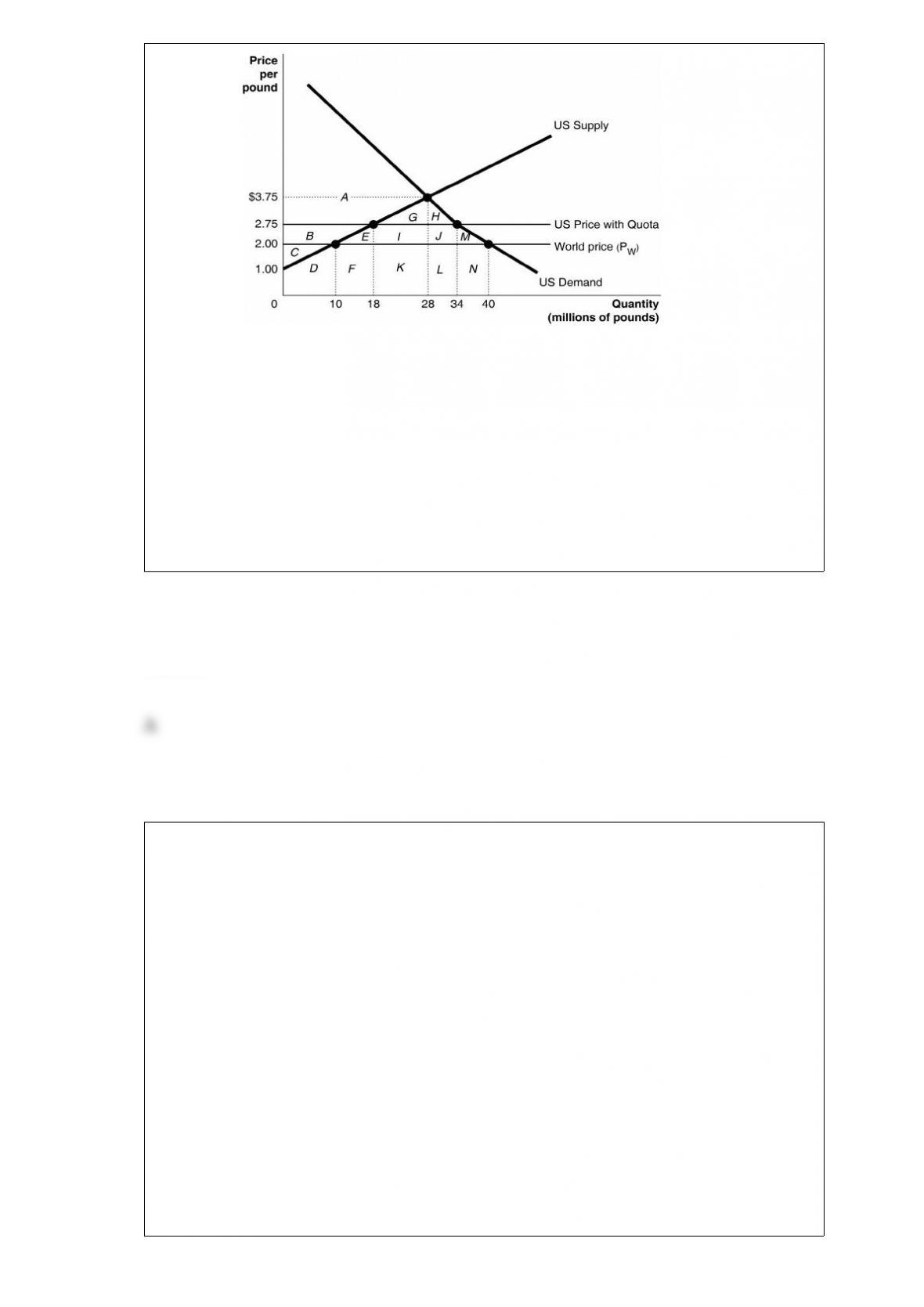
Figure 9-3 Since 1953 the
United States has imposed a quota to limit the imports of peanuts. Figure 9-3 illustrates
the impact of the quota. What is the area of domestic producer surplus without a quota?
A) C
B) C + B
C) A + B + C
D) A + B + C + D
Answer:
Which of the following describes a difference between the marginal product of labor
and the marginal revenue product of labor?
A) The marginal product of labor declines as each additional worker is hired because of
the law of diminishing returns. The marginal revenue product of labor declines as each
additional worker is hired because of diseconomies of scale.
B) The marginal product of labor declines as each additional worker is hired because of
the law of diminishing returns. The marginal revenue product increases as each
additional worker is hired because of increases in the productivity of labor.
C) The marginal product of labor is inelastic. The marginal revenue product of labor is
elastic.
D) The marginal product of labor measures the change in output as additional workers
are hired. The marginal revenue product measures the change in revenue as additional
workers are hired.
Answer:
In a small European country, it is estimated that changing the level of capital from $8
million to $10 million will increase real GDP from $2 million to $3 million. If the
number of hours worked in the labor force does not change, what does this information
tell you about the slope of the per-worker production function in this range?
A) The slope is -2.
B) The slope is 1/2.
C) The slope is 2.
D) The slope is 4.
Answer:
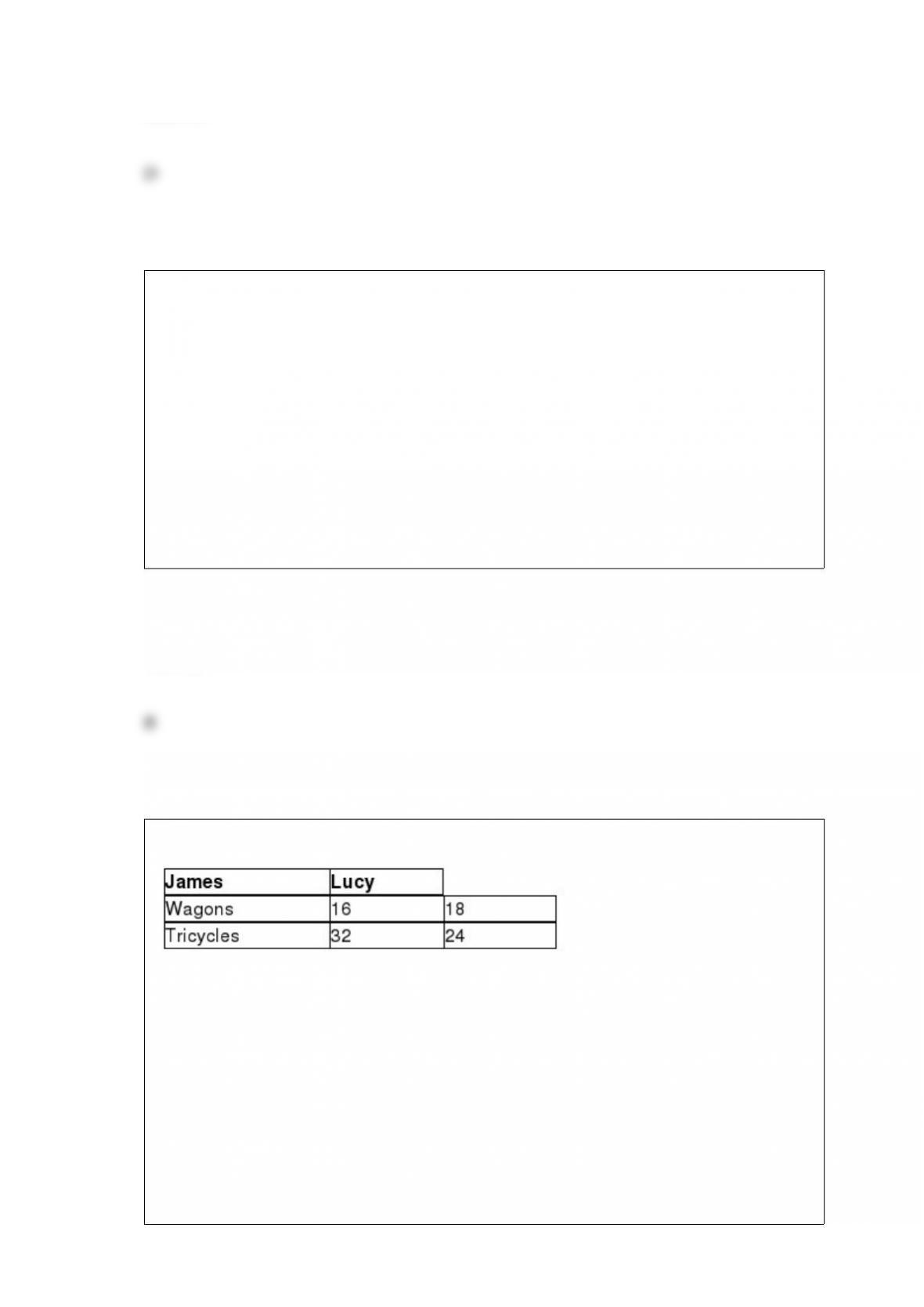
Table 2-6
Table 2-6 shows the output per week of two people, James and Lucy. They can either
devote their time to making bracelets or making necklaces. What is Lucy’s opportunity
cost of making a tricycle?
A) 3/4 of a wagon
B) 3 wagons
C) 1 1/3 tricycles
D) 2 tricycles
Answer:
The popularity of digital cameras has enticed large discount stores like Wal-Mart and
Costco to offer digital photo printing services. How does this affect the digital photo
printing market?
A) The demand curve for digital photo printing services shifts to the right.
B) The demand curve for digital photo printing services shifts to the left.
C) The supply curve for digital photo printing services shifts to the right.
D) The supply curve for digital photo printing services shifts to the left.
Answer:
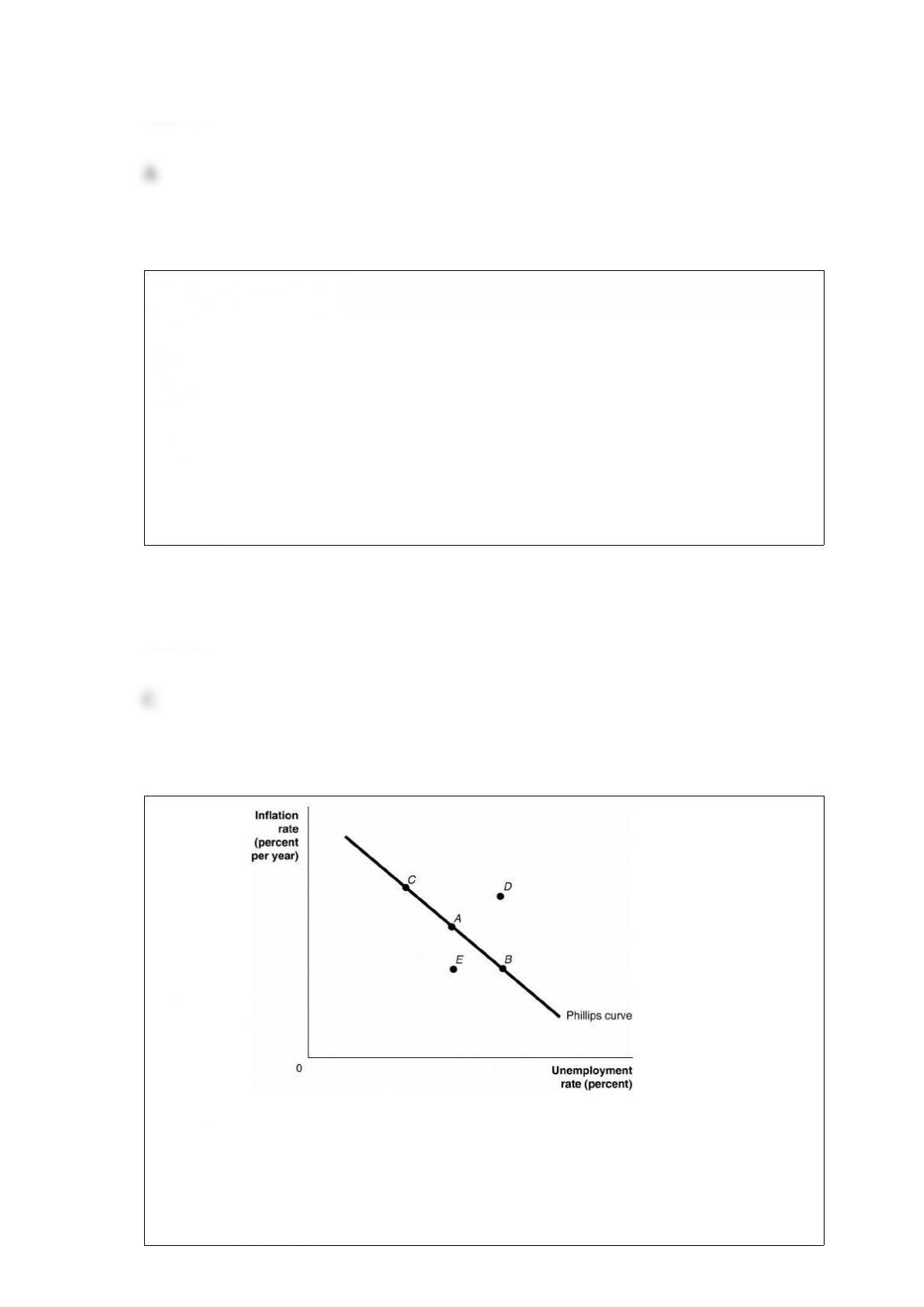
Figure 17-1
Suppose that the economy is currently at point A. If the Federal Reserve engaged in
contractionary monetary policy, where would the economy end up in the short run?
A) It would remain at point A.

B) point B
C) point C
D) point D
E) point E
Answer:
Whenever a firm can charge a price greater than marginal cost
A) the firm must be a monopolist.
B) there is some loss of economic efficiency.
C) consumers have the ability to choose a close substitute.
D) the firm will earn economic profits.
Answer:
With a common currency such as the euro,
A) trade barriers between countries using the currency are increased.
B) individual countries using the currency are no longer able to run independent
monetary policies.
C) the prices of goods across countries using the currency must always be the same,
regardless of consumer preferences for goods across countries.
D) individual countries using the currency are no longer able to run independent fiscal
policies.

Answer:
The selling of a product for a price below its cost of production is called
A) fair competition.
B) dumping.
C) unfair competition.
D) operating at a loss.
Answer:
The price elasticity of supply is usually a positive number because
A) quantity supplied increases in response to income increases.
B) quantity supplied increases in response to price increases.
C) the quantity demanded usually rises when price falls and therefore suppliers would
want to capitalize on this increase in demand.
D) price rises when supply increases.
Answer:

Briefly describe the types of health care systems in Canada, Japan, and the United
Kingdom.
Answer:
What are the four main sources of comparative advantage? Briefly explain each source
and provide examples.
Answer:

What is autarky?
Answer:
Who decides who controls a corporation?
Answer:
Beginning with long-run equilibrium, use the aggregate demand and aggregate supply
model to illustrate what happens in the short run when the economy suffers a negative
supply shock.
Answer:
Why does inflation make nominal GDP a poor measure of the increase in total
production from one year to the next?
Answer:

Draw a graph of “catch-up” that shows where you would expect to see a country with
low saving rates and low levels of health and education. How would you expect real
GDP per capita to grow in a country like this? Explain.
Answer:
The Bureau of Labor Statistics counts as employed people who work part-time, but
would prefer to work full-time. Suppose the people who had part-time jobs, but wanted
full-time jobs, were counted as unemployed. Explain how the unemployment rate and
the labor force participation rate would change.
Answer:
List the five categories of federal government expenditures.
Answer: