
For a perfectly competitive firm, profit maximization (or loss minimization) occurs at
the level of output at which
a. MR = MC.
b. MR = AVC.
c. P = ATC.
d. MR = ATC.
The vertical distance between the AVC and ATC curves is equal to
a. marginal cost.
b. average fixed cost.
c. accounting profit.
d. economic profit.
e. none of the above
Marginal factor cost (MFC) is
a. the additional cost generated by producing an additional unit of output.
b. the additional revenue generated by employing an additional factor unit.
c. the additional cost generated by employing an additional factor unit.

d. total cost from the production of a product divided by the total number of factor units
used.
One reads in the newspaper: “Today the president and Congress enacted a law which
adds new requirements that child care providers must meet before they can offer their
services for sale.” As a result, an economist would predict that
a. the supply of child care services will increase, thus lowering the price of child care
services.
b. the supply of child care services will be unaffected by the stiffer requirements and
therefore the price of child care services will not change.
c. the demand for child care services will fall because people who buy child care
services do not want stiffer requirements placed on child care providers.
d. the supply of child care services will decrease, thus raising the price of child care
services.
e. none of the above
Exhibit 3-3
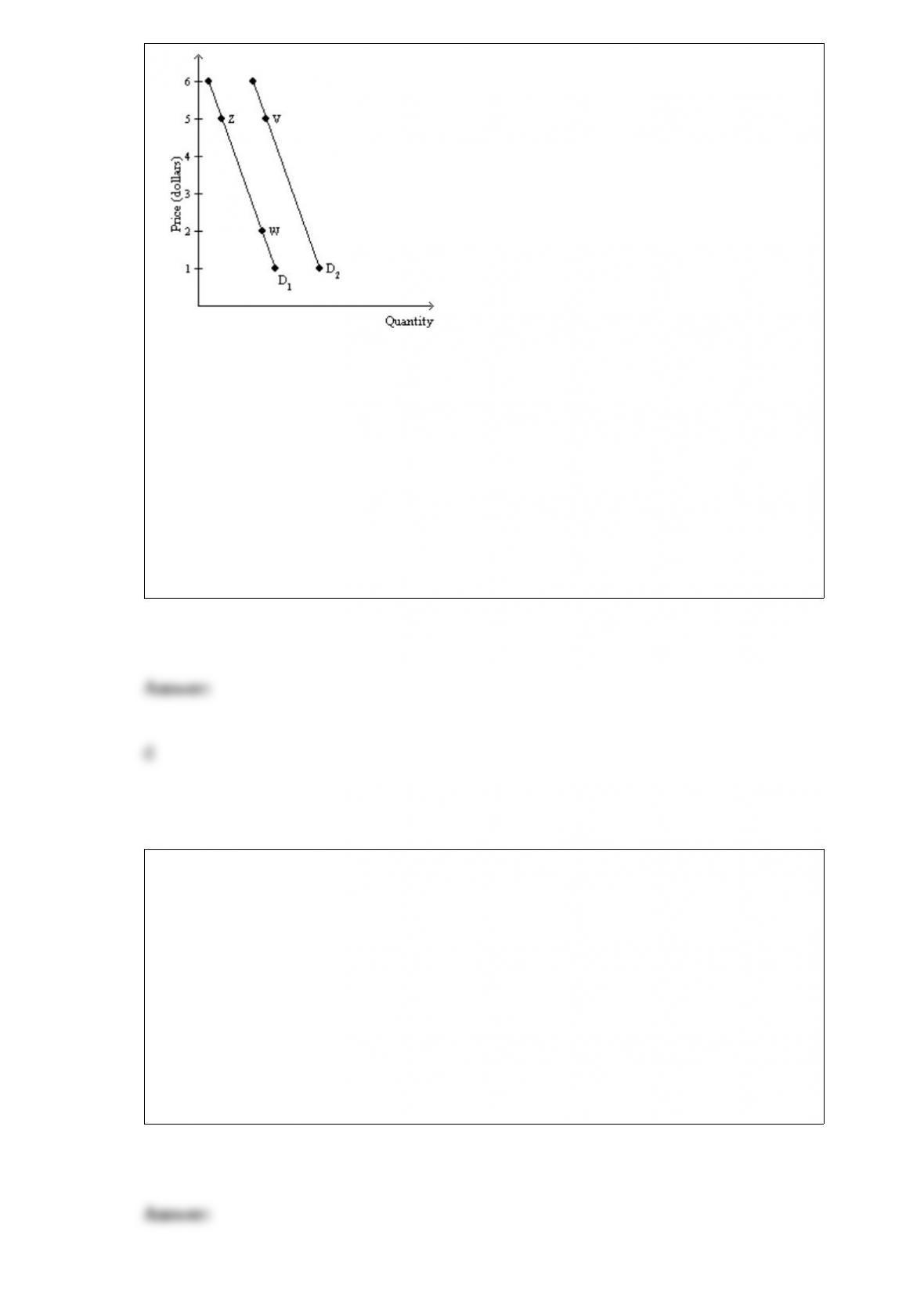
A shift in demand from D1 to D2 can NOT occur from a change in the
a. population.
b. price of a substitute for good Y.
c. average income of good Y buyers.
d. price of good Y.
One of the effects of a price floor (set above equilibrium price) is
a. a surplus.
b. higher-quality goods are produced.
c. more satisfied customers.
d. all of the above
e. none of the above

The condition often used in economics to isolate the relationship between two variables
is
a. causation.
b. abstraction.
c. ceteris paribus.
d. efficiency.
Which of the following statements is false?
a. There are always opportunity costs to making choices.
b. Because of scarcity, choices must be made.
c. Elementary education at public schools is free.
d. When government builds a new highway, taxpayers end up with less of some of the
things they would otherwise have.
The demand curve facing a perfectly competitive firm
a. is downward sloping.

b. is upward sloping.
c. is perfectly horizontal.
d. is perfectly vertical.
e. may be downward or upward sloping, depending upon the type of product offered for
sale.
If the marginal physical product (MPP) of the variable input is constant over a range of
output, then it follows that __________ cost will be constant over the same range of
output.
a. marginal
b. average fixed
c. average total
d. a and b
e. a, b, and c
Which of the following conditions is not necessary for wage rates to be identical in
every labor market in both the short run and the long run?
a. Demand for labor is identical in each market.
b. Nonpecuniary factors in each job are the same.

c. All labor is homogeneous.
d. All labor has zero costs of mobility.
e. All of the above are necessary conditions.
Which of the following statements is true?
a. The more broadly a market is defined, the less likely a firm will be considered a
monopoly.
b. The Celler-Kefauver Antimerger Act was designed to close the merger loophole that
existed in the Clayton Act.
c. The Sherman Act declared illegal acts that constitute restraint of trade.
d. a and b
e. a, b, and c
If people have a positive rate of time preference, a dollar today is worth __________ a
dollar in the future.
a. less than
b. more than
c. the same as

d. Any of the above can be true.
Which of the following points would not be used as an argument in support of the
current international monetary system?
a. It allows nations to pursue independent monetary policies.
b. It results in stable exchange rates.
c. It helps solve trade problems without trade restrictions.
d. It is flexible and can easily adjust to shocks.
e. All of the above could be used as arguments supporting the current system.
Assume that a decreasing-cost industry experiences an increase in demand. In the short
run, this will
a. lead to a price increase.
b. lead to a price decrease.
c. have no influence on price.
d. a or b, depending on the marginal cost curve
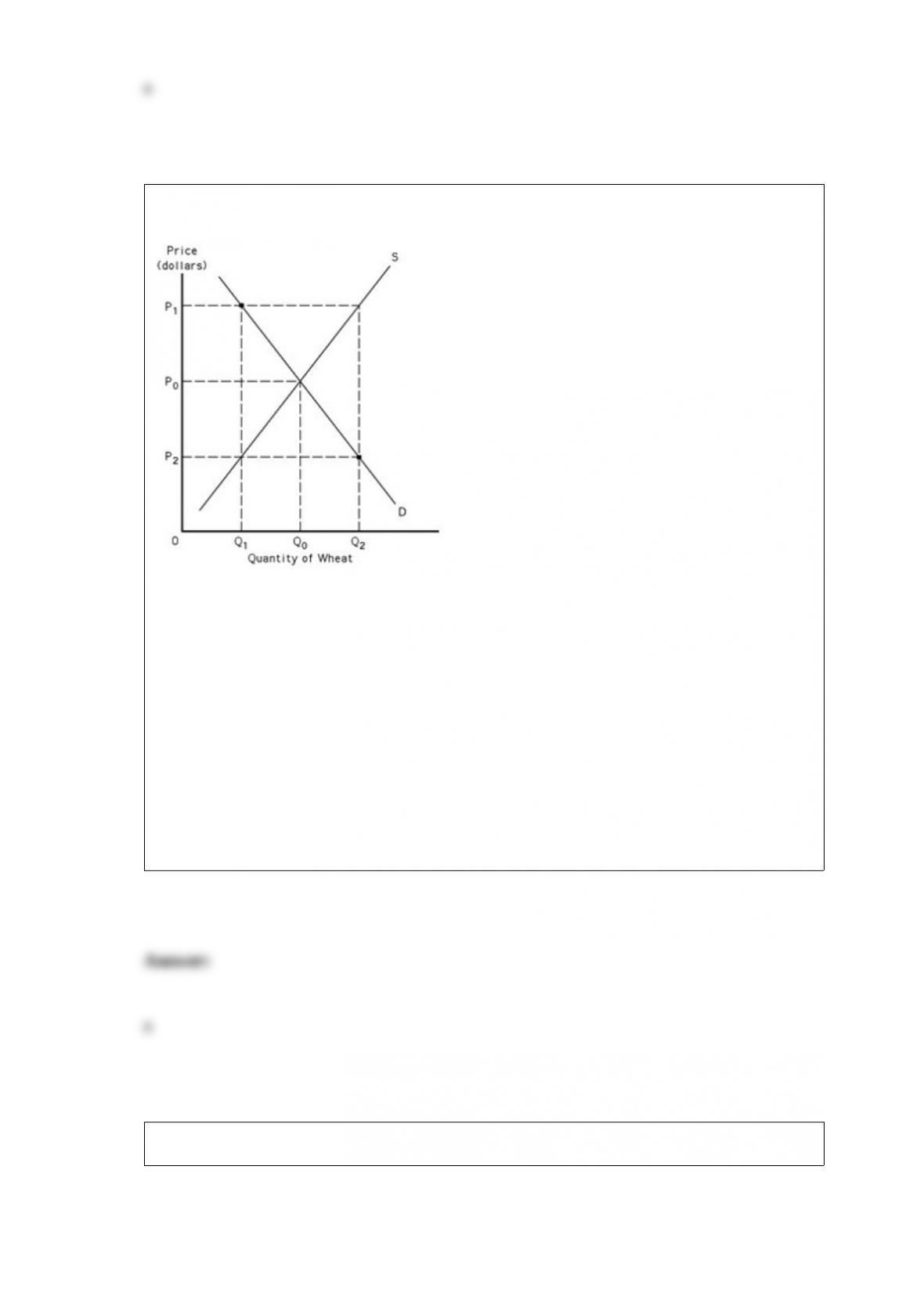
Exhibit 39-2
Given a target price of P1, what is the total deficiency payment made by the
government?
a. (P1 – P2) x Q2
b. (P1 – P0) x Q2
c. P1 x Q1
d. P0 x Q0
Exhibit 3-15
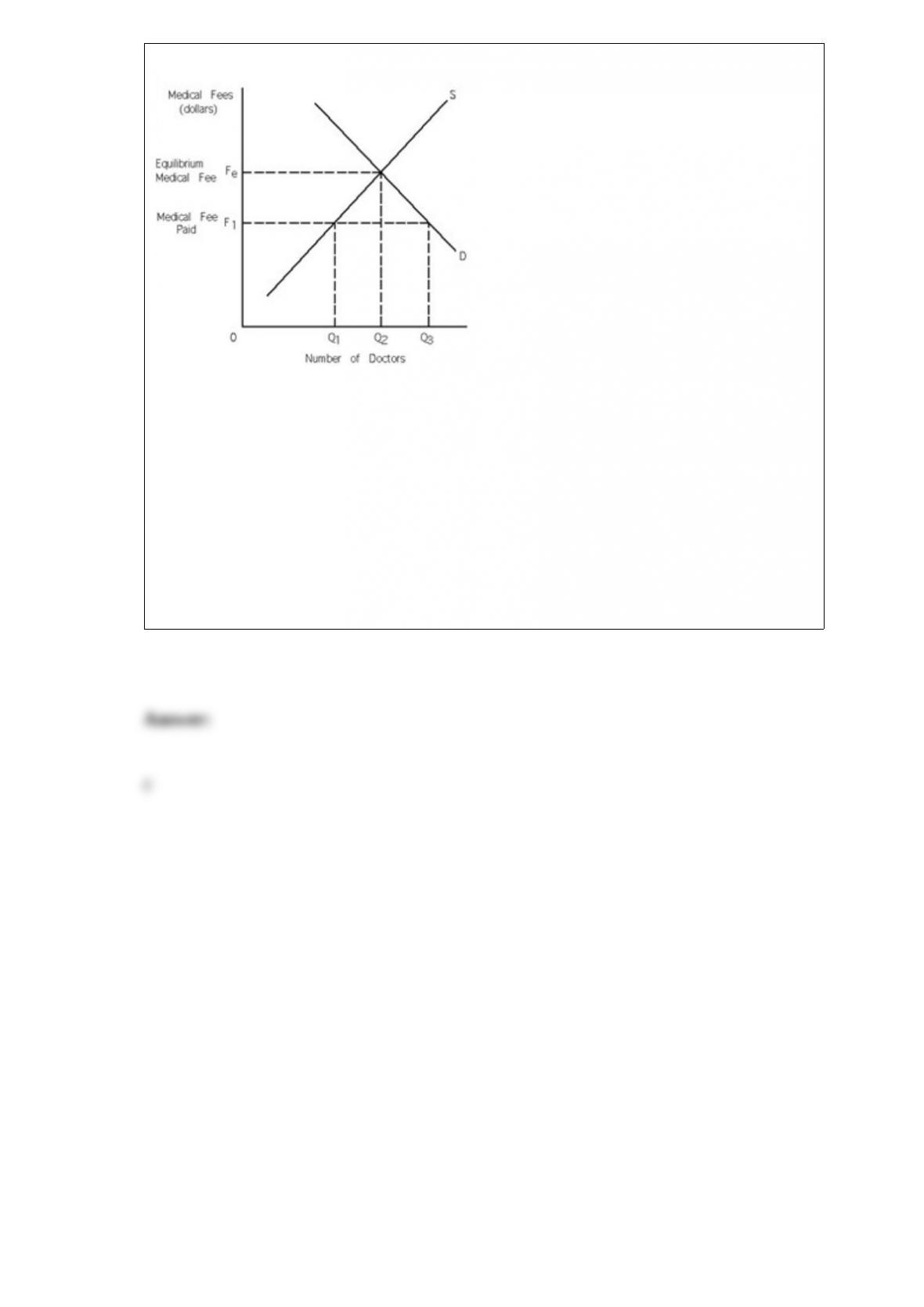
In Exhibit 3-15,
a. Q2 doctors are employed at fee F1.
b. Q3 doctors are employed at fee F1.
c. Q1 doctors are employed at fee F1.
d. the number of doctors employed cannot be determined at any fee.