
The phase of the business cycle in which output is highest relative to its potential level
is the
a. peak.
b. trough.
c. recession.
d. expansion.
e. trend.
The following questions are based on the following information.
On June 1, 2014, the Pennsylvania Turnpike Commission voted to raise tolls by 30
percent.
They anticipated that traffic might initially fall by 5 percent.
The Turnpike Commission estimates that the price elasticity of demand for travel on the
highway is
a. 0.17.
b. 0.30.
c. 0.50.
d. 1.
e. 6.

The following schedule shows the utility Mr. Pomeroy derives from consumption of
various amounts of food per day. Use it to answer the next question.
If the marginal utilities from consuming the first five units of a commodity are 10, 16,
15, 12, and 9, respectively, then the total utility received from consuming 4 units is
a. 12.
b. 27.
c. 41.
d. 53.
e. 62.
Inflation is sometimes called the arbitrary taxbecause
a. we never know when inflation will occur.
b. the rate of inflation is very difficult for economists to predict.
c. the rate of inflation is set by the government.
d. inflation affects the prices of various commodities in unpredictable ways.
e. its rewards and penalties are meted out with little regard for society’s values or goals.

Short-run costs that do not change as output increases or decreases are ________ costs.
a. explicit
b. fixed
c. empirical
d. marginal
e. primary
GDP expressed in constant dollars is called
a. capital accumulation.
b. the net national product.
c. permanent income.
d. real GDP.
e. a price index.

One problem with using historical data to estimate demand is the
a. fact that people do not always buy what they need.
b. large number of interviews that must be conducted to gather information on buyers’
intentions.
c. many variations in price necessary to measure changes in demand.
d. likelihood that the demand curve has shifted over the time period covered by the
data.
e. need to have both price and quantity data to estimate demand.
One reason given for the collapse in the savings and loan industry in the late 1980s and
early 1990s is
a. the lack of government insurance on savings and loan deposits.
b. that savings and loan investments were limited to relatively low-yielding government
bonds.
c. that the savings and loan banks required significant amounts of owner-provided funds
to be profitable.
d. that their reserve requirements were greater than those for commercial banks.
e. that they made risky short-term loans during an era of financial deregulation and lax
regulatory supervision.

The market demand curve for labor
a. derives employment totals from the amounts supplied.
b. shows, for each price, the quantity of labor demanded in the entire market.
c. will be horizontal if the market is perfectly competitive.
d. relates the quantity of labor demanded to the product price.
e. may slope upward due to external diseconomies.
In a market economy, who gets what
a. depends on the amount and kinds of resources individuals own.
b. cannot be resolved without government intervention.
c. is unrelated to the questions of what goods are produced and how.
d. is determined by the production possibilities curve.
e. is an irrelevant and unnecessary concern.

As Eastern European economies embraced capitalistic processes in the 1990s, they
a. dramatically reduced or eliminated price controls.
b. increased government ownership of factories.
c. immediately experienced rapidly increasing levels of output with no inflation.
d. began to rely even more heavily on central planning by government bureaucracies.
e. were able to eliminate poverty virtually overnight.
The importance of the vertical long-run Phillips curve hypothesis is its implication that
a. any increase in the rate of inflation caused by monetary and fiscal policies designed
to reduce unemployment is temporary.
b. price controls can do no good.
c. monetary and fiscal policies designed to reduce unemployment below its natural rate
do so temporarily.
d. to solve the inflation-unemployment problem, labor unions must recognize that their
wage gains are eroded by inflation.
e. expansionary monetary or fiscal policy shifts the long-run Phillips curve to the left.
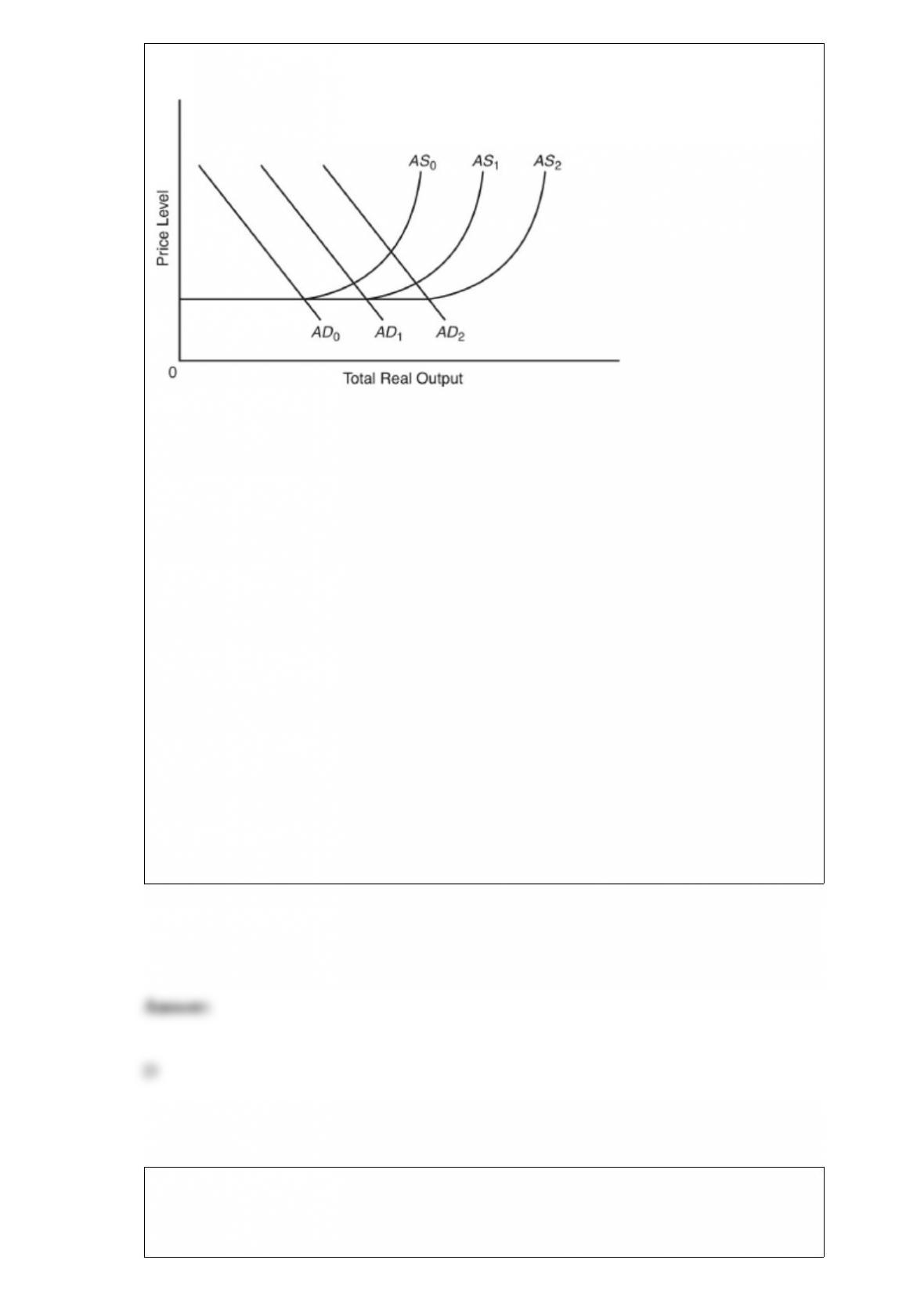
The next question is based on the following figure:
If the economy’s aggregate demand and supply curves are AD1 and AS1, an increase in
the money supply will:
a. lower total real output and raise the price level as aggregate supply shifts from AS1 to
AS0.
b. lower total real output and leave the price level unchanged because AD1 will shift to
AD0.
c. raise total real output but not the price level, for aggregate supply will shift from AS1
to AS2.
d. raise both total real output and the price level as aggregate demand shifts from AD1
to AD2.
e. raise the price level but leave total real output unchanged, as aggregate demand shifts
from AD1 to AD2 and aggregate supply shifts from AS1 to AS0.
An argument supporting tariff or quota protection for an industry is that such protection
a. is necessary to lower domestic rates of inflation by reducing spending.
b. enables a nation to have both the goods and the money.
c. keeps foreigners from benefiting at our expense.
d. helps to equalize production costs between nations to the benefit of all countries.
e. can promote industrial diversification and prevent the nation from becoming too
dependent on a few industries.
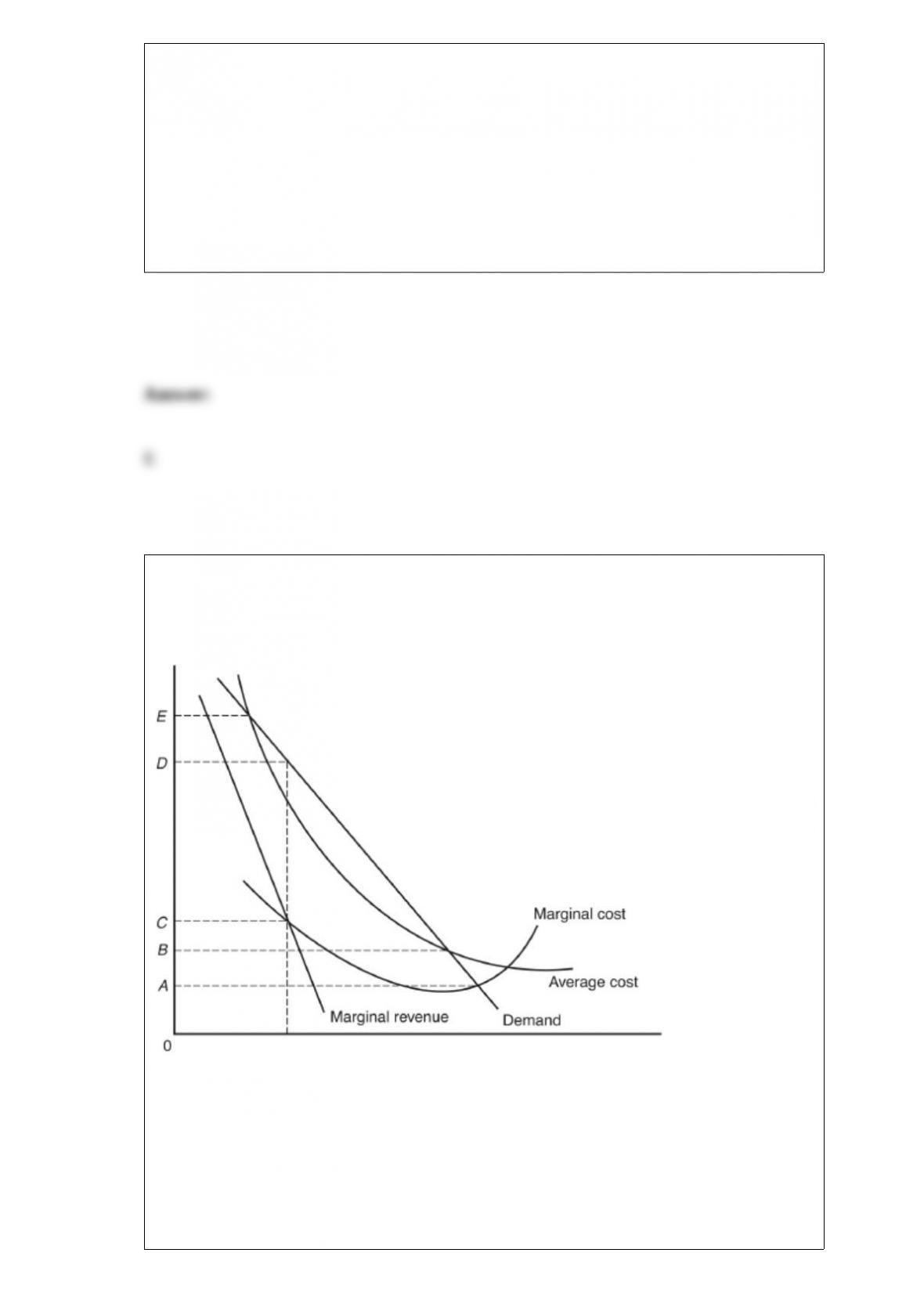
The following questions are based on the following graph showing the demand and cost
curves of a regulated monopolist. Assume the cost curves include provisions for “fair”
rates of return.
This regulated price ensures that the output rate is
a. higher than if the monopolist were unregulated.
b. lower than if the monopolist were unregulated.
c. the same as if the monopolist were unregulated, but the price would be lower.

d. the same as if the industry were perfectly competitive.
e. impossible to determine from the graph.
A court action that minimizes union power is the
a. checkoff.
b. yellow dog contract.
c. lockout.
d. injunction.
e. strike.
Income redistribution programs reflect a belief that
a. the poor are entitled to an income that accurately reflects their productivity.
b. economic resources should be owned and managed by the government.
c. tax structures that are regressive benefit the poor.
d. the more affluent should be taxed to allow others to take more from the nation’s
output than they produce.

e. poverty is necessary for the rich to practice altruism.
The idea that, in the long run, the rate of unemployment is NOT related to the rate of
inflation is based on the concept of the
a. multiplier.
b. division of labor.
c. law of one price.
d. backward-bending supply curve of labor.
e. natural rate of unemployment.
In the United States today, which of the following functions as the central bank?
a. the Federal Reserve System
b. the IMF
c. the Bank of America
d. the treasurer of the United States
e. There is no central bank in the United States.

The market demand and supply curves for basic agricultural products
a. are both very sensitive to changes in the price of food.
b. are both very insensitive to changes in the price of food.
c. differ, with the demand curve very sensitive to, and the supply curve very insensitive
to, changes in the price of food.
d. are both vertical and shift constantly in response to price changes for food.
e. are both perfectly elastic, resulting in stable food prices over time.
In a Keynesian model, a decrease in the money supply
a. causes interest rates to fall.
b. shifts the investment function upward.
c. shifts the C + I + G + (X ” MI) line downward.
d. leads to an increase in the GDP.
e. has no effect on the level of economic activity.

If price elasticity of demand is 1.0, demand for the commodity is
a. of unitary elasticity.
b. price postelastic.
c. price elastic.
d. price inelastic.
e. price preelastic.
The effectiveness of a market economy’s self-regulating mechanisms in stabilizing the
economy is most closely associated with
a. new Keynesians.
b. Marxists.
c. traditional Keynesians.
d. socialists.
e. new classical macroeconomists.
Say’s law suggests that
a. supply creates its own supply.
b. demand creates its own supply.
c. demand creates its own demand.
d. supply creates its own demand.
e. supply creates; demand destroys.
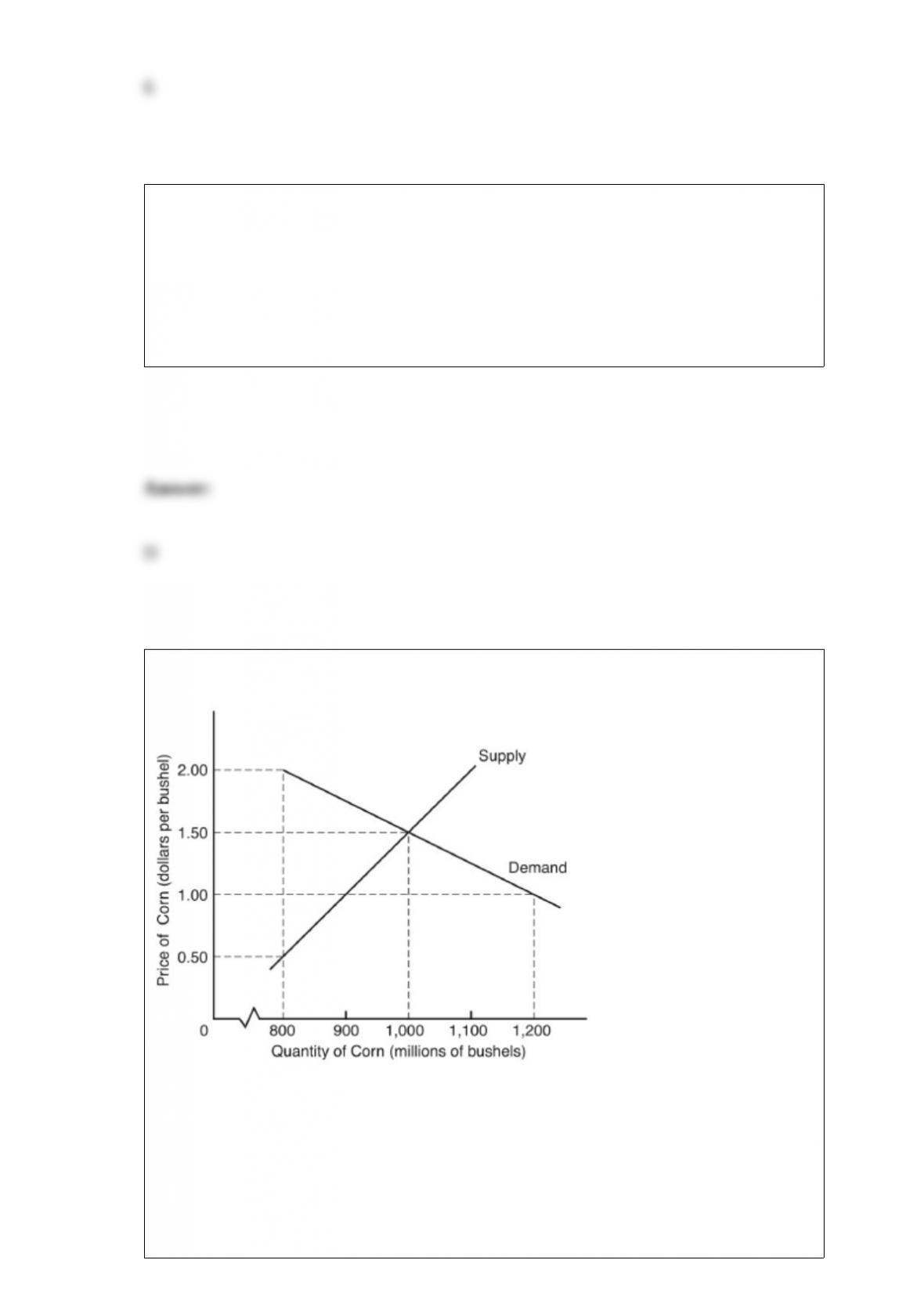
The following questions are based on the following graph showing the market for corn:
If farmers currently produce 800 bushels
a. the actual price is $2.
b. the market is in equilibrium.
c. the actual price is below the equilibrium price and will tend to rise.

d. only increases in demand would encourage the supply to rise above 800 units.
e. the market exhibits a surplus.
Autonomous changes in intended investment
a. are due to changes in GDP.
b. lead to changes in GDP.
c. are inversely related to changes in induced investment.
d. are rarely, if ever, negative.
e. offset changes in the propensity to consume.
The average propensity to consume is the
a. fraction of an extra dollar of GDP that becomes disposable income.
b. share of GDP spent by households and businesses.
c. proportion of an extra dollar of disposable income that is spent on consumption.
d. percentage of disposable income that is consumed.

e. reciprocal of the marginal propensity to consume.
If the actual price of sweatshirts is $10 each, the market is not in equilibrium because
a. all consumers willing to pay $10 for a sweatshirt are unable to buy one.
b. there is excess demand.
c. the rate at which sweatshirts are supplied is greater than the rate at which they are
demanded.
d. the price at which sweatshirts are demanded is less than the price at which they are
supplied.
e. the price is not equal to the quantity.
When the euro was launched in January 1999, its price was $1.18. Eighteen months
later, its price was $0.94. Over this period, the euro
a. appreciated, making EMU member countries’ goods more attractive to consumers in
the United States.
b. appreciated, making EMU member countries’ goods less attractive to consumers in
the United States.
c. depreciated, making EMU member countries’ goods more attractive to consumers in
the United States.

d. depreciated, making EMU member countries’ goods less attractive to consumers in
the United States.
e. neither appreciated nor depreciated. Only EMU prices have changed; the desirability
of the goods is not affected.
Economic analysis is
a. widely understood by all in our society.
b. important for solving problems in developing and socialist societies but of little use
in Western capitalist systems.
c. a set of mathematical rules to ensure a society’s happiness and prosperity.
d. a framework for understanding issues that arise because societies need to make
allocational decisions.
e. a natural science concerned with biological growth and change of the social system.
If the total cost of 100 units is $560 and the marginal cost of the 101st unit is $6
a. total cost will fall.
b. total fixed cost will rise.

c. total variable cost will fall.
d. average total cost will rise.
e. average variable cost will fall.