In the United States, partnership profits are taxed at the business level and then are
taxed again as personal income in the form of dividend payments.
A tax is efficient if it imposes a small excess burden relative to the tax revenue it raises.
Seth’s grandmother gave him a $50 savings bond for his birthday. The bond pays $50 at
maturity, which is in five years. If the interest rate is 5%, the bond has a present value
of $43.19.
A stand of redwood trees is not an example of a factor of production, but the harvested
and processed redwood is a factor of production.

A university must decide if it should stop offering foreign language classes. This
decision involves answering the economic question of “how to produce.”
“A decrease in the price of digital cameras will decrease the demand for camera film.”
This statement is an example of a positive economic statement.
The decisions Apple makes in determining production levels for its iPhone is an
example of a microeconomics topic.
If you purchase a share of stock from your friend who initially purchased the stock
three years ago, your purchase of the stock represents a transaction in the primary
financial market.

Crude oil is not an example of a factor of production, but when crude oil is processed
into gasoline, it is a factor of production.
If the number of firms producing electric cars increases and consumer preference for
electric cars increases, the equilibrium quantity of electric cars will definitely increase.
In the United States in 2011, over 50 percent of people without health insurance were
below the age of 34.
College education tends to result in a positive externality because the recipient receives
the full benefit of the education.

If workers and firms ignore inflation or form their inflation expectations adaptively,
expansionary monetary policy will lower unemployment permanently.
Sheldon Cleaver commented on the difficulty people have in overcoming poverty in the
United States: “Most people whose incomes fall below the poverty line have difficulty
pulling themselves above the line in future years. In this sense, poverty becomes a
vicious cycle. I believe the psychological damage households face when they are
branded with the ‘poverty’ label in our society is a major factor in their remaining in
poverty. Despair is a major reason why the percentage of people with incomes that lie
below the poverty line never falls below 10 percent.” Which of the following correctly
evaluates Cleaver’s statement?
A) Cleaver is correct. Economists often fail to take into account psychological factors
when they analyze poverty and the distribution of income in the United States. Policies
must take such factors into account if we are to make progress in eliminating poverty.
B) Cleaver is correct when he notes that poverty is a chronic problem. The best way to
reduce poverty is to force the poor to become better educated so that they can work
their way out of poverty.
C) Cleaver is correct, but he is looking at the wrong statistic. The official poverty line
understates the true degree of poverty in the United States.
D) Cleaver assumes that all those with incomes below the poverty line in one year
remain in poverty in subsequent years. In fact, research has shown that the number of
people who remain in poverty for many years is much smaller than the number who are
in poverty during any one year.

In the United States from 1981 to 2011, deaths from which of the following increased?
A) cancer
B) kidney disease
C) heart attacks
D) strokes
Currency traders expect the dollar to appreciate. What impact will this have on
equilibrium in the foreign exchange market?
A) The dollar will appreciate, and the equilibrium quantity of dollars will decrease.
B) The dollar will depreciate, and the equilibrium quantity of dollars exchanged will
decrease.
C) The dollar will appreciate, and the equilibrium quantity of dollars will increase.
D) The dollar will appreciate, and the change in the equilibrium quantity of dollars
exchanged cannot be determined.
Table 2-9
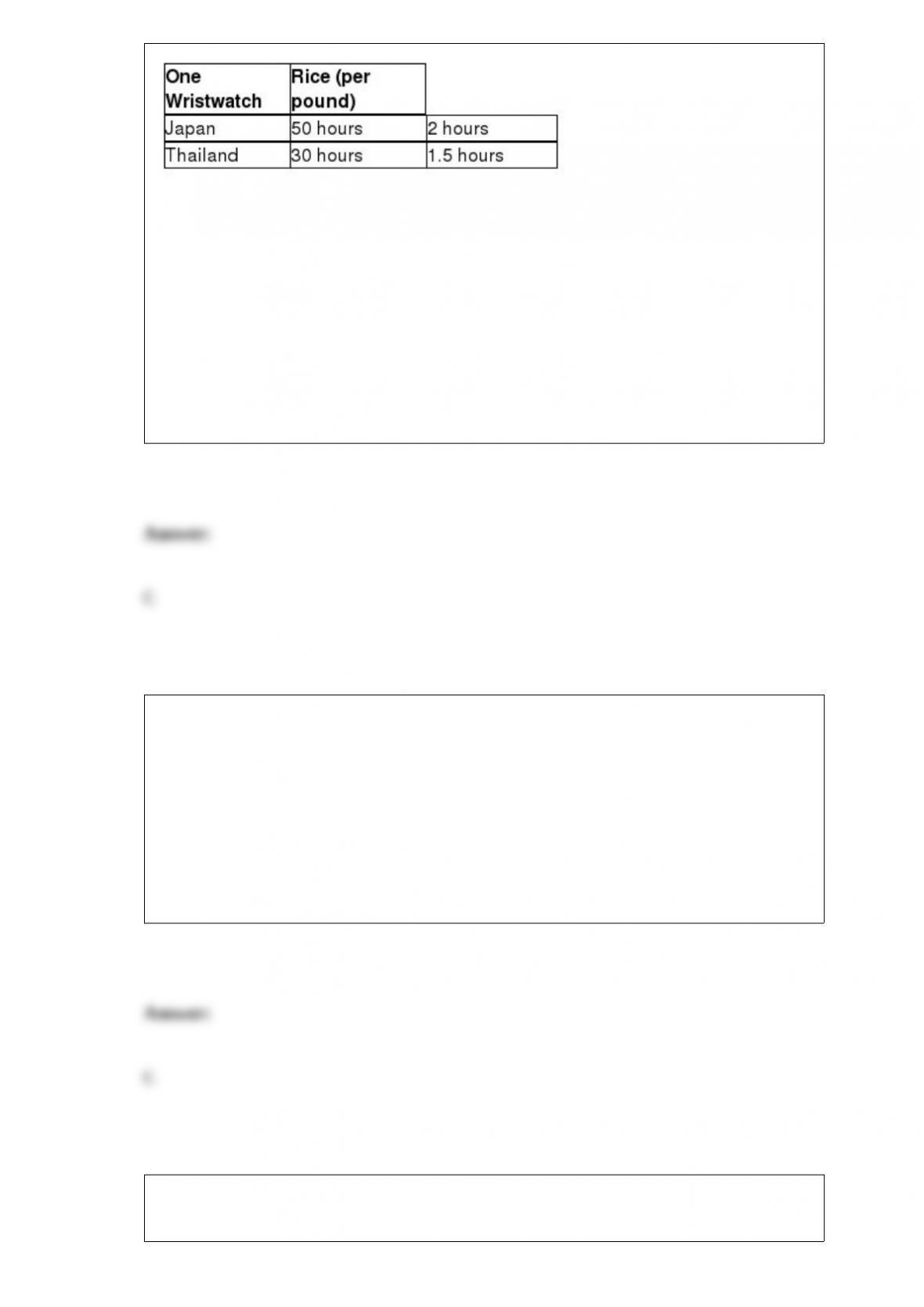
Table 2-9 shows the number of labor hours required to produce a wristwatch and a
pound of rice in Japan and Thailand. Does either Japan or Thailand have an absolute
advantage and if so, in what product?
A) Thailand has an absolute advantage in rice.
B) Japan has an absolute advantage in rice.
C) Thailand has an absolute advantage in both products.
D) Japan has an absolute advantage in wristwatches.
About ________ of pharmaceutical patents are issued to U.S. firms.
A) 10 percent
B) one-half
C) two-thirds
D) 90 percent
Which of the following describes a positive externality?

A) John Henry paints the outside of his house in order to increase its market value just
before he puts the house up for sale.
B) People who do not attend college still benefit from others who receive a college
education.
C) The government imposes a tax on cigarettes in order to discourage smoking among
teenagers.
D) Mary volunteers to drive her neighbor’s children to soccer practice.
An example of a government-imposed barrier to entry gives a firm the exclusive right
to a new product for a period of 20 years from the date the product is invented. This
entry barrier is known as
A) a copyright.
B) a patent.
C) an exclusive marketing agreement.
D) a tariff.
Figure 10-8
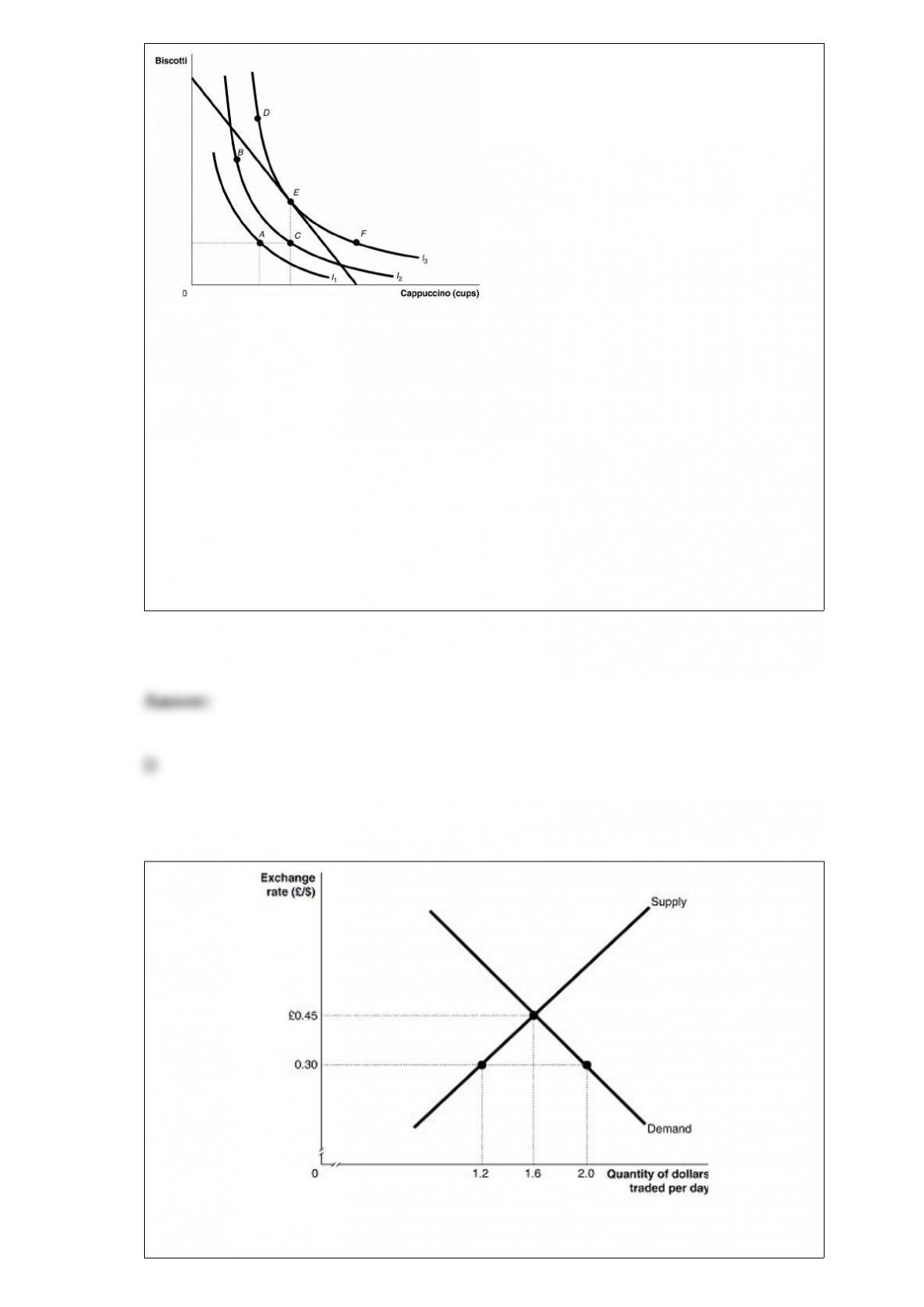
Given the budget constraint in the diagram, which of the following statements is false?
A) The consumer receives the same level of utility from consumption bundles d, e and
f.
B) Consumption bundles and c yield the same level of utility, which is higher than the
utility represented by bundle a.
C) Although the consumer receives the same level of utility from bundles d and e, she
cannot afford to purchase bundle d.
D) The consumer’s optimal bundle could be bundle d, e or f.
Figure 30-12
The graph above, depicts supply and demand for U.S. dollars during a trading day. At a

fixed exchange rate of 0.30 pounds per dollar, the dollar is ________ versus the pound.
A ________ of the dollar would correct the fundamental disequilibrium that exists in
this market.
A) undervalued; devaluation
B) undervalued; revaluation
C) overvalued; revaluation
D) overvalued; devaluation
Protection in the form of tariffs create winners and losers. Winners include ________
and losers include ________.
A) U.S. consumers and taxpayers; foreign firms that rely on U.S. exports
B) firms sheltered from foreign competition; U.S. consumers and taxpayers
C) U.S. firms that rely on exports to foreign countries; foreign manufacturers
D) the U.S. government; firms sheltered from foreign competition
Because the copyright on the L. Frank Baum book The Wonderful Wizard of Oz expired
many years ago, the actual written words from the book are in the public domain.
Publishers who now choose to sell their own versions of the book
A) can claim copyright of Baum’s words if they are the first to publish the book after
the original copyright expired.
B) can claim copyright of Baum’s words no matter how many versions are published,
since the original is in the public domain.
C) cannot claim copyright of Baum’s words since they are in the public domain, but can
claim copyright on any new design or illustrations created for the book.
D) cannot claim copyright of Baum’s words, or on any new design or illustrations
created for the book, since the original written words are in the public domain.
All of the following are ways by which existing firms can deter the entry of new firms
into an industry except
A) continuously producing new and improved products.
B) earning less than maximum profit.
C) advertising products aggressively.
D) threatening to raise prices.
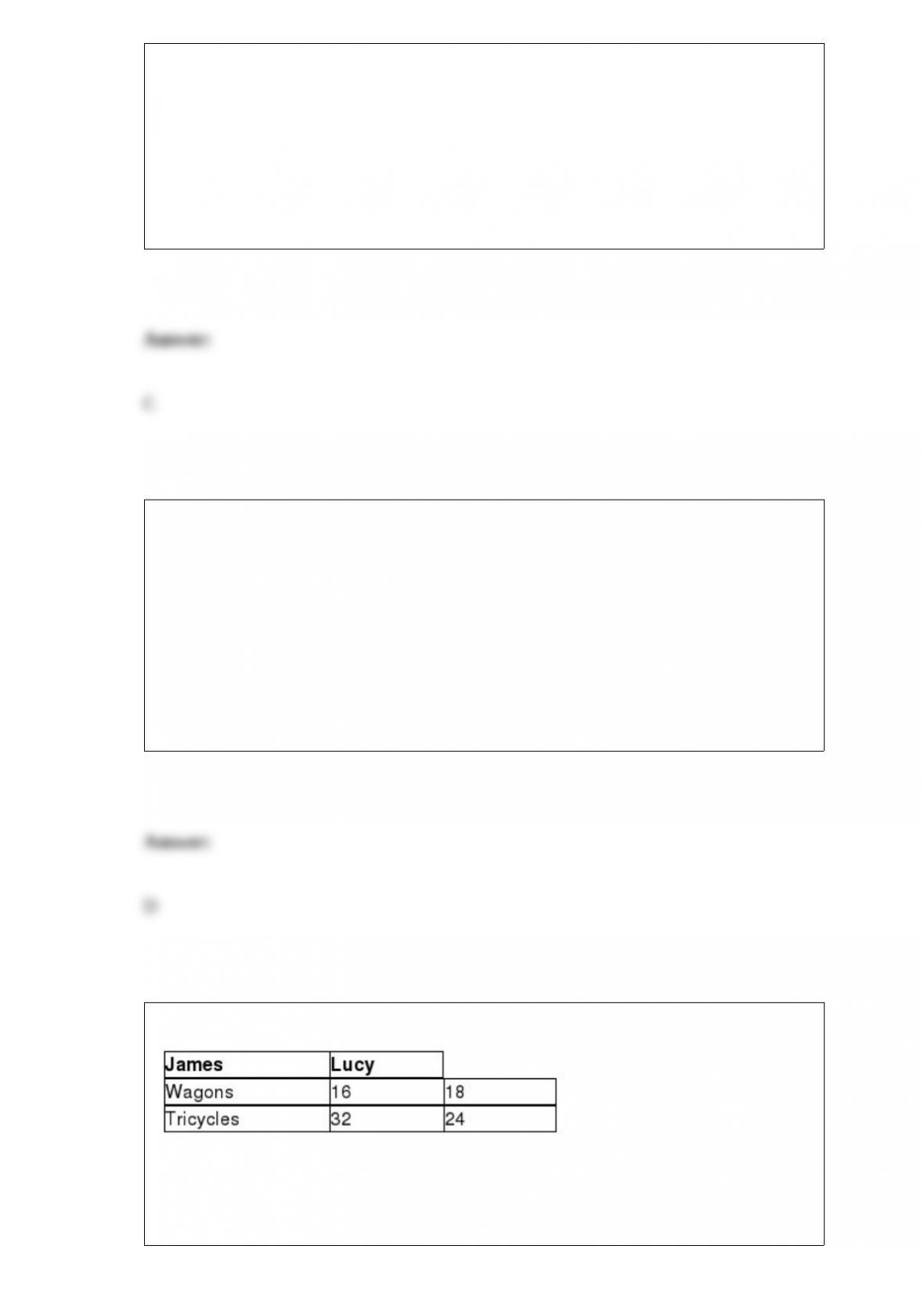
Table 2-6
Table 2-6 shows the output per week of two people, James and Lucy. They can either
devote their time to making bracelets or making necklaces. Which of the following
statements istrue?
A) Lucy has an absolute advantage in making both products.
B) James has an absolute advantage in making both products.
C) Lucy has an absolute advantage in making wagons and James in making tricycles.
D) James has an absolute advantage in making tricycles and Lucy in making wagons.
What is a household? How do households interact with firms in a market?
Can the Federal Reserve achieve both low inflation and low levels of unemployment?
Explain.
What must be true in terms of the income effect, the substitution effect, and the type of
good for the good’s demand curve to be upward sloping?
C = 2,800 + 0.9Y
I = 750
G= 1,200
NX = 150 Given the equations for C, I, G, and NX above, what is the equilibrium level
of GDP (Y)?
The federal budget exhibited a $128.7 billion surplus in 2001 but moved to a deficit of
$157.8 billion in 2002. Some argued the deficit was opened up because of the Bush
2001 tax cuts, but others argued that the deficit grew because of the recession suffered
in 2001. Evaluate the validity of the second argument.
Why are foreign investors more likely to invest in U.S. government bonds than in U.S.
corporate stocks and bonds?
Why might a young, healthy person choose not to buy health insurance?
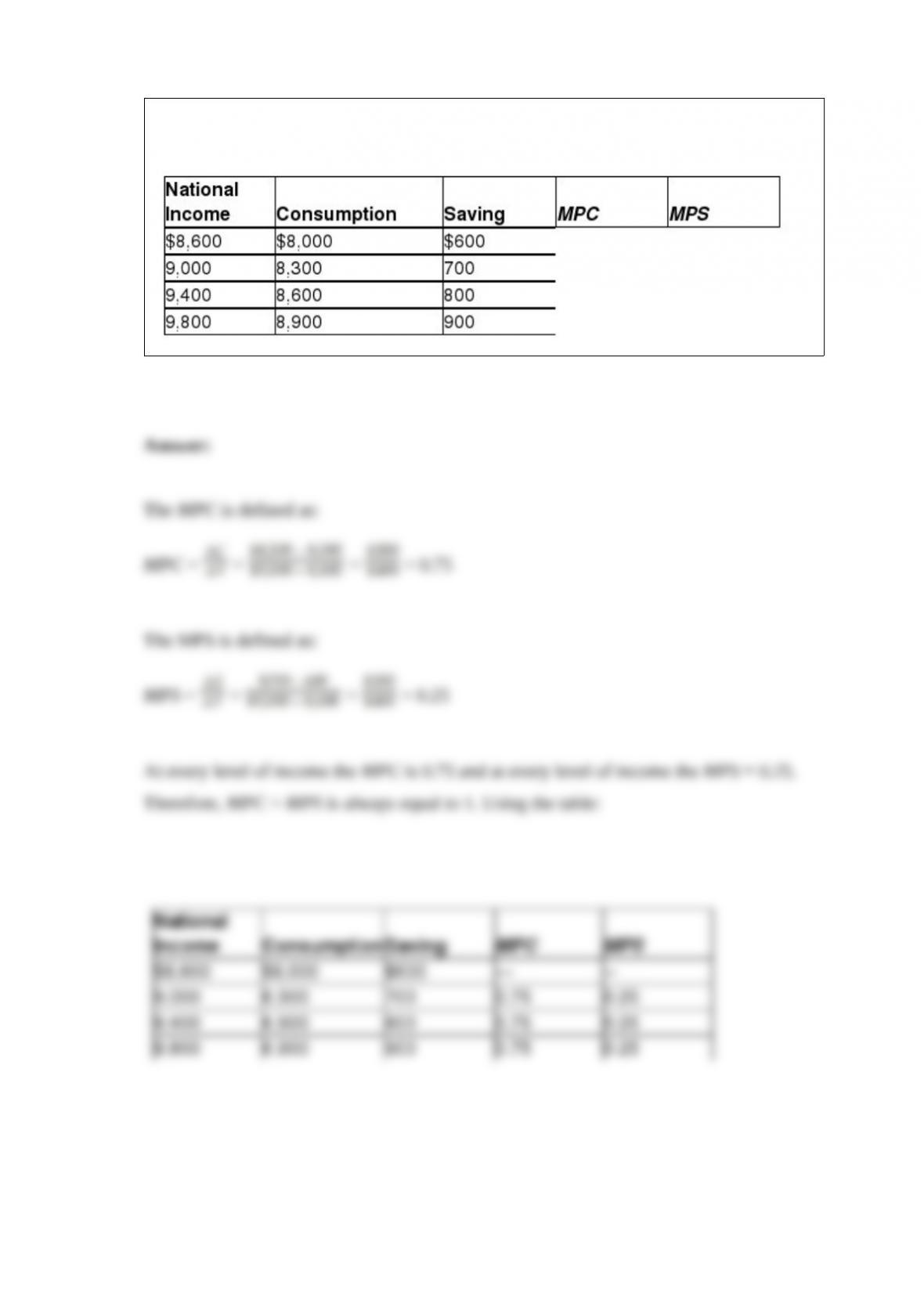
Given Table 23-7 below, fill in the values of the marginal propensity to save (MPS) and
the marginal propensity to consume (MPC). Show that MPC + MPS = 1. Table 23-7