
An increase in an economy’s productive resources will lead the production possibilities
curve to:
A. shift inward.
B. shift outward.
C. become flatter.
D. stay the same.
Suppose you have $200 with which you can buy shares of stock from two companies:
ABC Hot Chocolate Company and XYZ Lemonade. Each company’s stock currently
sells for $100 per share. If the temperature next year is lower than average, the stock
price for ABC will increase by $20, and the stock price for XYZ will not change. If the
temperature next year is higher than average, the stock price for XYZ will increase by
$20, and the stock price for ABC will not change. There is a 50% chance that it will be
colder than average next year, and a 25% chance that it will be warmer than average. If
you purchase one share of ABC stock and one share of XYZ stock, your expected gain
will be _______.
A. $0
B. $10
C. $15
D. $40

If the Boskin Commission’s conclusion is correct, then the CPI ______ the “true”
inflation rate and indexing Social Security benefits to the CPI is ______ the federal
government billions of dollars.
A. understates; costing
B. overstates; costing
C. understates; saving
D. measures; saving
The Federal Reserve can increase the money supply by:
A. reducing reserve requirements.
B. increasing the discount rate.
C. eliminating deposit insurance.
D. conducting open market sales.
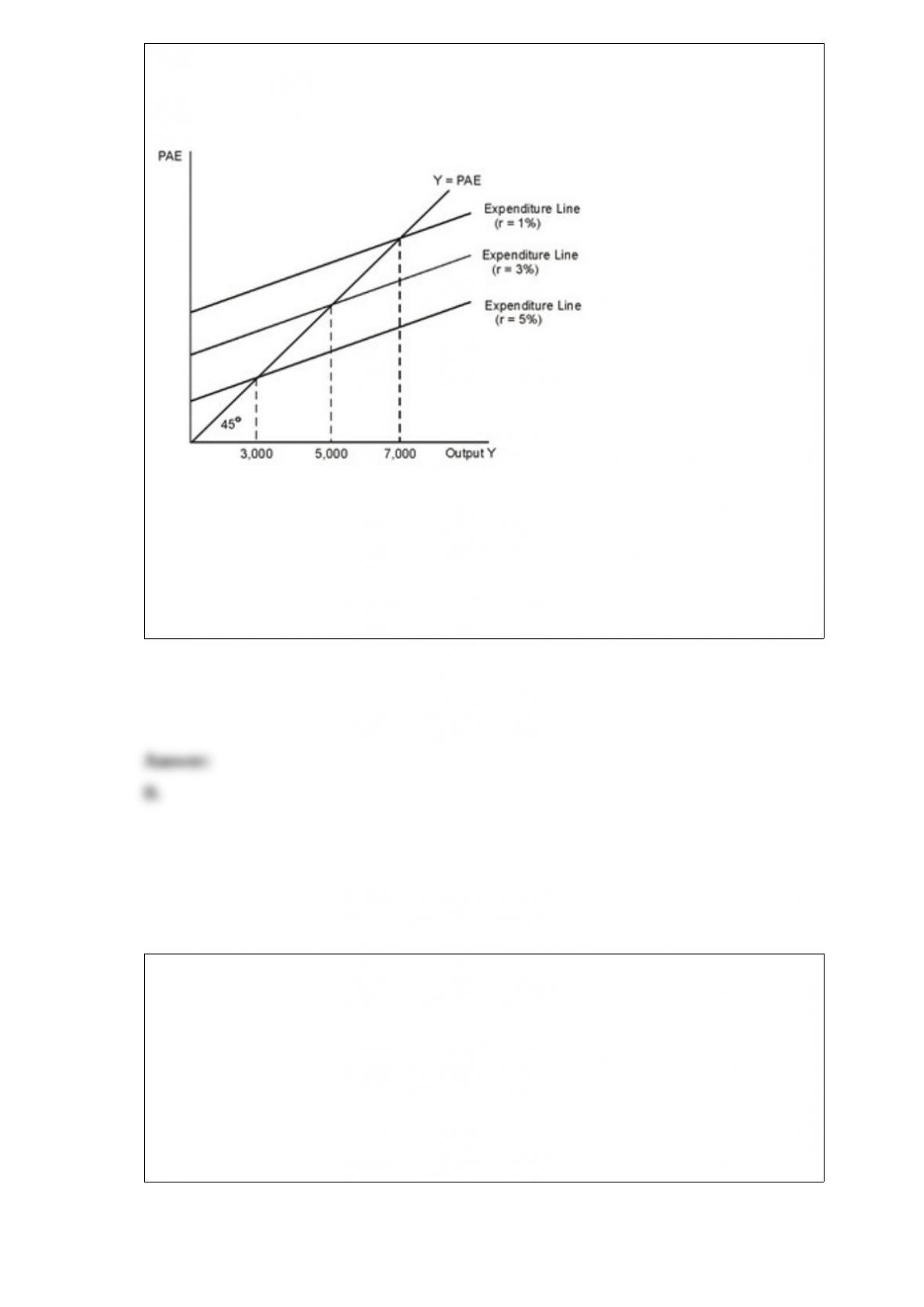
Refer to the figure below. Based on the diagram, if potential output equals 5,000 and the
real interest rate is 5%, then there is ______ gap and the Fed must ______ the real
interest rate so that output will equal potential output.
A. a recessionary; raise
B. a recessionary; reduce
C. no output; not change
D. an expansionary; raise
If workers and employers agree to a three-year wage contract under the expectation of
3% inflation, and inflation turns out to be 5%, then:
A. workers gain and employers gain.
B. workers gain and employers lose.
C. workers lose and employers gain.
D. workers lose and employers lose.

In the United Sates, the average annual rate of growth of real wages was fastest in the
period:
A. 1960-1973.
B. 1960-1995.
C. 1996-2010.
D. 1973-1995.
An arbitrary preference by an employer for one group of workers over another is
termed:
A. customer discrimination.
B. statistical discrimination.
C. employer discrimination.
D. employee discrimination.

Real GDP per person in the United States was $9,864 in 1950. Over the next 48 years, it
grew at a compound annual rate of 2.0%. If, instead, real GDP per person had grown at
an average compound annual rate 2.5%, then real GDP per capita in the United States in
1998 would have been approximately ______ larger.
A. $2,370
B. $6,751
C. $12,530
D. $25,520
In the absence of environmental protection laws, firms pollute because:
A. business owners follow different norms than do environmentalists.
B. controlling emissions costs money, thereby reducing profits.
C. business owners do not believe that pollution is a problem.
D. the cost pollution imposes on society is small relative to the cost of reducing
pollution.

Refer to the figure below.
If Row Resorts keeps its rates high, then Column Cruises would receive the highest
payoff if it:
A. kept its rates high.
B. offered reduced rates.
C. agreed with Row Resorts to reduce their rates at exactly the same time.
D. chose either strategy because it will have the same payoff in either case.
The Principle of Increasing Opportunity Costs states that:
A. productive people do the hardest tasks first.
B. when increasing production, resources with the lowest opportunity costs should be
used first.
C. when increasing production, resources with the lowest opportunity costs should be
used last.
D. opportunity costs increase when too little is produced.

When the nominal exchange rate changes from 4 francs per dollar to 6 francs per dollar,
the dollar has:
A. appreciated.
B. depreciated.
C. become overvalued.
D. become undervalued.
The most appropriate level of government to provide public goods is:
A. local.
B. state.
C. dependent on the specific public good in question.
D. federal.
The interest rate the Federal Reserve charges commercial banks to borrow reserves is
called the ______ rate.
A. Fed funds

B. prime
C. discount
D. Federal
Antony’s Pizza uses the same dough, sauce, and cheese for pizza and calzones. When
the price of pizza is low Antony produces more calzones. For Antony, the supply of
pizza is ______ compared to the supply at a pizza restaurant that does not serve
calzones.
A. less price elastic
B. more price elastic
C. higher
D. lower

The table below shows how total donations, average donations, total labor costs and
average labor costs vary depending on the number of employees State U hires for its
fundraising activities.
The net benefit of hiring fundraisers is largest when ______ employees are hired.
A. 4
B. 3
C. 2
D. 1
Refer to the figure above. Suppose the coffee lobby convinced the legislature to impose
a price control requiring that coffee prices must be at least $2.50, and that the original
demand curve and original supply curve were applicable. The most likely result would
be:
A. a short term excess demand for coffee, followed by an increase in price.
B. excess demand for coffee that would not correct itself because price is set by law.
C. excess supply of coffee that would not correct itself because price is set by law.
D. new equilibrium at a price of $2.50 and a quantity of 50 cups.

A firm pays Pam $40 per hour to assemble personal computers. Each day, Pam can
assemble 4 computers if she works 1 hour, 7 computers if she works 2 hours, 9
computers if she works 3 hours, and 10 computers if she works 4 hours. Pam cannot
work more than 4 hours day. Each computer consists of a motherboard, a hard drive, a
case, a monitor, a keyboard, and a mouse. The total cost of these parts is $600 per
computer. If the firm sells each computer for $625, then how many hours a day should
the firm employ Pam to maximize its net benefit from her employment?
A. 1 hour
B. 2 hours
C. 3 hours
D. 4 hours
The existence of long term leases agreements in rental markets:
A. benefits landlords by keeping occupancy rates high and harms tenants by reducing
their mobility.
B. harms landlords and benefits tenants by preventing landlords from raising the rent
each month.
C. creates an informational advantage for landlords.
D. solves a commitment problem that is inherent in markets with imperfect information.

The longest expansion of the United States economy since 1925 began in:
A. 1991.
B. 1945.
C. 1961.
D. 1982.
Long-run increases in living standards, as measured by real GDP per person, are
primarily the result of increases in:
A. population.
B. the money supply.
C. government budget surpluses.
D. average labor productivity.
Suppose that at Miles’s current level of consumption, his marginal utility from a pizza is

10 utils, and his marginal utility from a pint of ice cream is 16 utils. If the price of a
pizza is $8, and the price of a pint of ice cream is $5, is Miles maximizing his utility?
A. No. He should shift his spending away from ice cream and towards frozen pizza.
B. No. He should buy less frozen pizza and less ice cream.
C. No. He should shift his spending away from frozen pizza and towards ice cream.
D. Yes. He should not change his spending on frozen pizza and ice cream.
M1 differs from M2 in that:
A. M1 includes currency and balances held in checking accounts, which are not
included in M2.
B. M2 includes savings deposits, small-denomination time deposits, and money market
mutual funds that are not included in M1.
C. M1 is a broader measure of the money supply than M2.
D. the assets in M2 are more liquid than the assets in M1.

The most important tool of monetary policy is:
A. reserve requirement ratios.
B. the discount rate.
C. open-market operations.
D. market interest rates.
Those who do not favorprograms aimed at reducing inequality argue that these
programs:
A. increase the crime rates.
B. reduce people’s incentive to work hard.
C. penalize people who are unable to work through no fault of their own.
D. prevent the economy from reaching equilibrium in the labor market.
Suppose the figure below shows the demand curve, marginal revenue curve and
marginal cost curve for a monopolist.
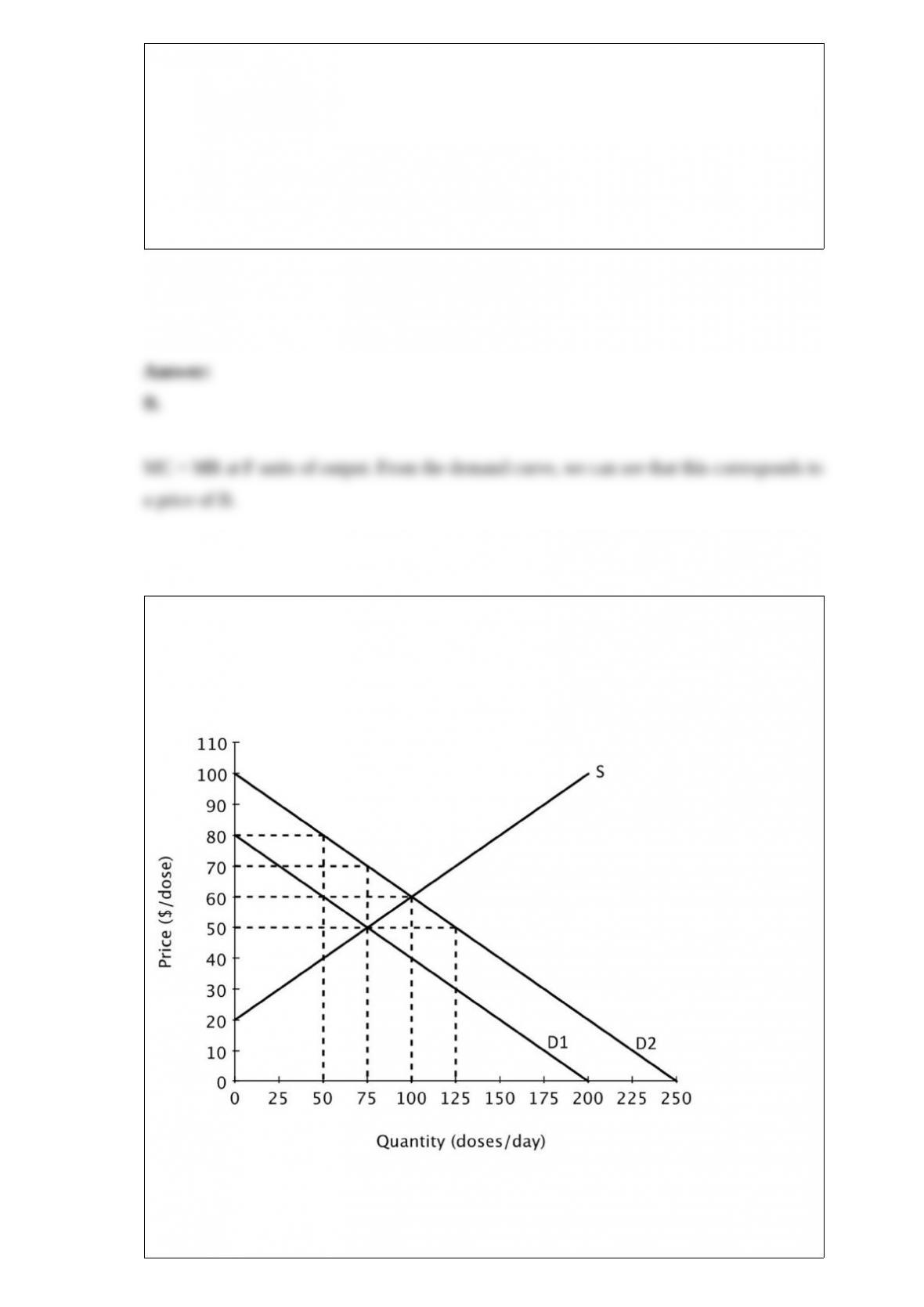
The profit-maximizing price for this monopolist to charge is:
A. A.
B. B.
C. C.
D. E.
Suppose that a vaccine is developed for a highly contagious strain of flu. The likelihood
that anyone will get this flu decreases as more people receive the vaccine. One of the
demand curves below represents the private demand for the vaccine and the other
represents the social demand for the vaccine.
The external benefit of each dose is:
A. $70

B. $50
C. $30
D. $20
If the equilibrium quantity is equal to the socially optimal quantity, one can infer that:
A. the supply curve for the activity is below the socially optimal supply curve.
B. there is no externality associated with this good.
C. there is a positive externality associated with this good.
D. there is a negative externality associated with this good.
The figure below shows the production possibilities curve for the island of Genovia:
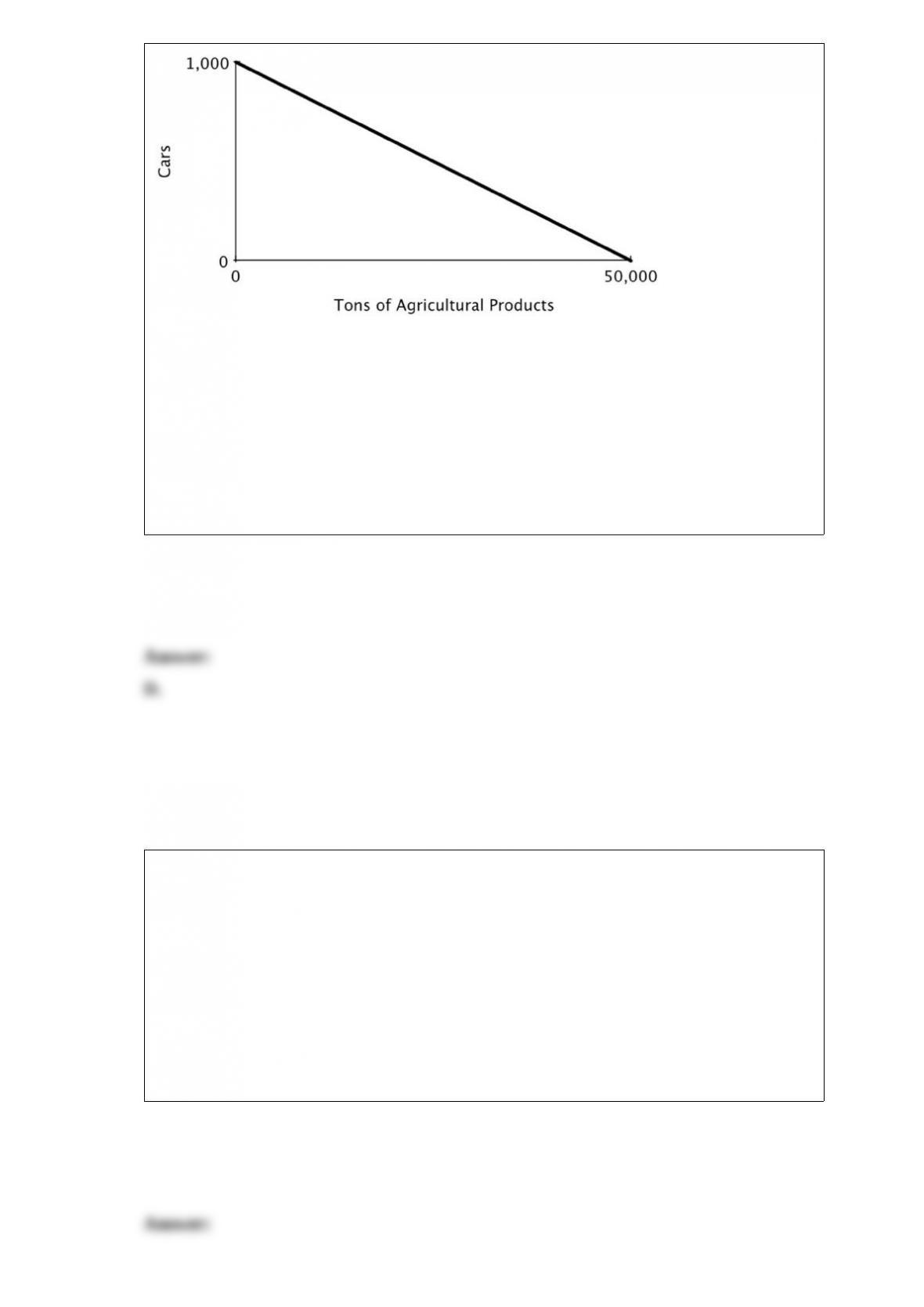
The opportunity cost of producing a car in Genovia is:
A. 5,000 tons of agricultural products.
B. 500 tons of agricultural products.
C. 5 tons of agricultural products.
D. 50 tons of agricultural products.
The textbook notes that the last time a major league batter hit .400 was in 1941. This is
because:
A. the average quality of batters has fallen.
B. the league imposes harsh penalties for steroid use.
C. specialization by pitchers, infielders, and outfielders has made it harder for batters to
hit.
D. baseball diamonds have become larger.

Suppose 30 employee-hours can produce 50 units of output. Assuming the law of
diminishing marginal returns is present, to produce 100 units of output would require:
A. an additional 30 employee-hours.
B. more than 30 additional employee-hours.
C. a total of 60 or fewer employee-hours.
D. fewer than 30 additional employee-hours.
There are ten states in the democratic nation of Fatlandia, and each state has ten
thousand residents. Although incomes vary, each Fatlandian pays a tax equal to the total
cost of all government projects divided by the number of residents in the country.
Currently, two states each have one army base. An army base adds $2 million to a
state’s local economy each year. In addition, in terms of increased security, the annual
marginal benefit to Fatlandia of having an additional army base is shown below. The
total cost of an army base is $8 million per year.
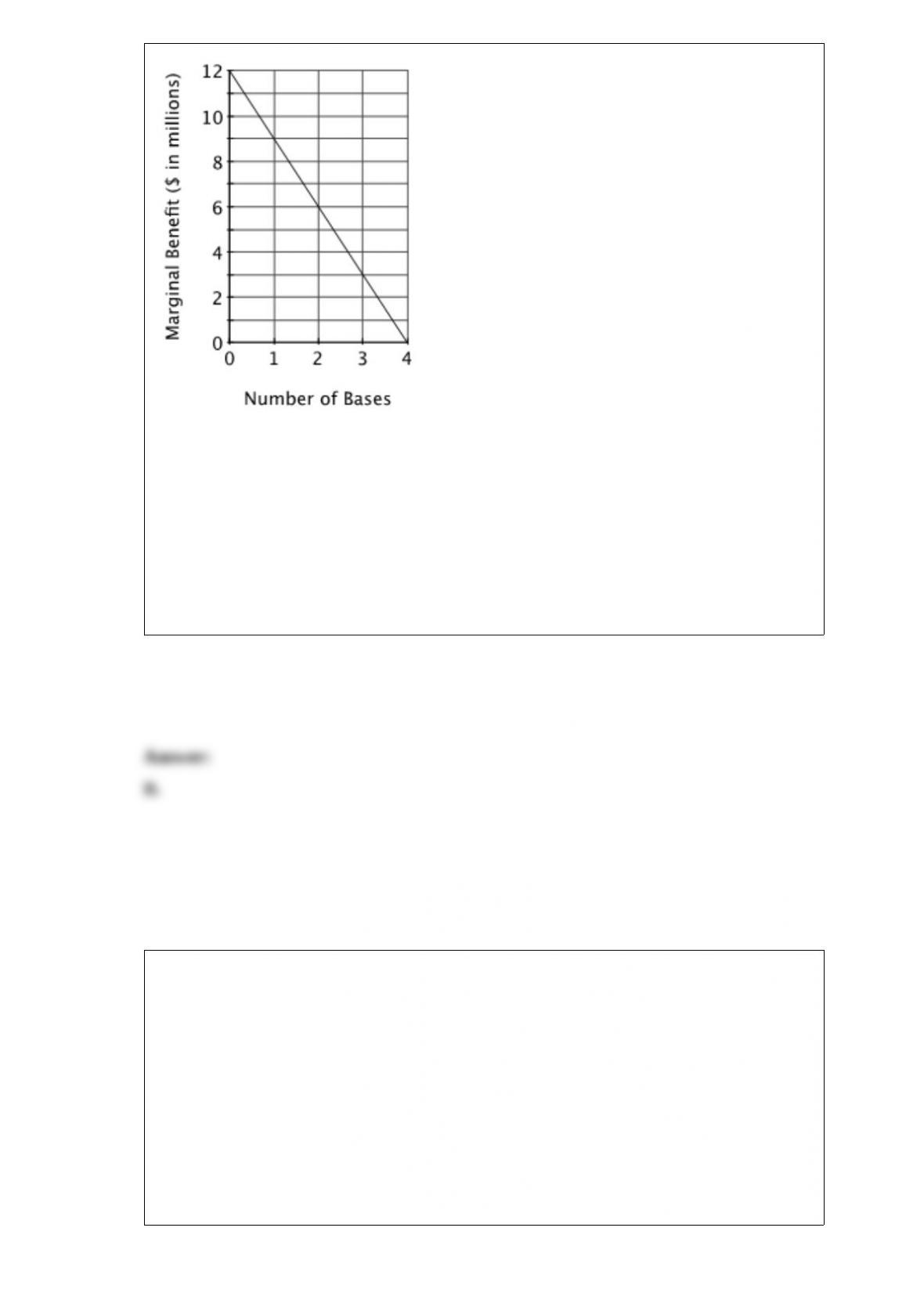
It is socially optimal for Fatlandia to have:
A. one army base.
B. two army bases.
C. three army bases.
D. four army bases.
In Macroland, autonomous consumption equals 100, the marginal propensity to
consume equals 0.75, net taxes are fixed at 40, planned investment is fixed at 50,
government purchases are fixed at 150, and net exports are fixed at 20. Planned
aggregate expenditure equals:
A. 290 + 0.25Y.
B. 320 + 0.25Y.
C. 320 + 0.75Y.
D. 290 + 0.75Y.

Money is:
A. the same as income.
B. all financial assets.
C. any asset used to make purchases.
D. the sum of assets minus debts.