1)
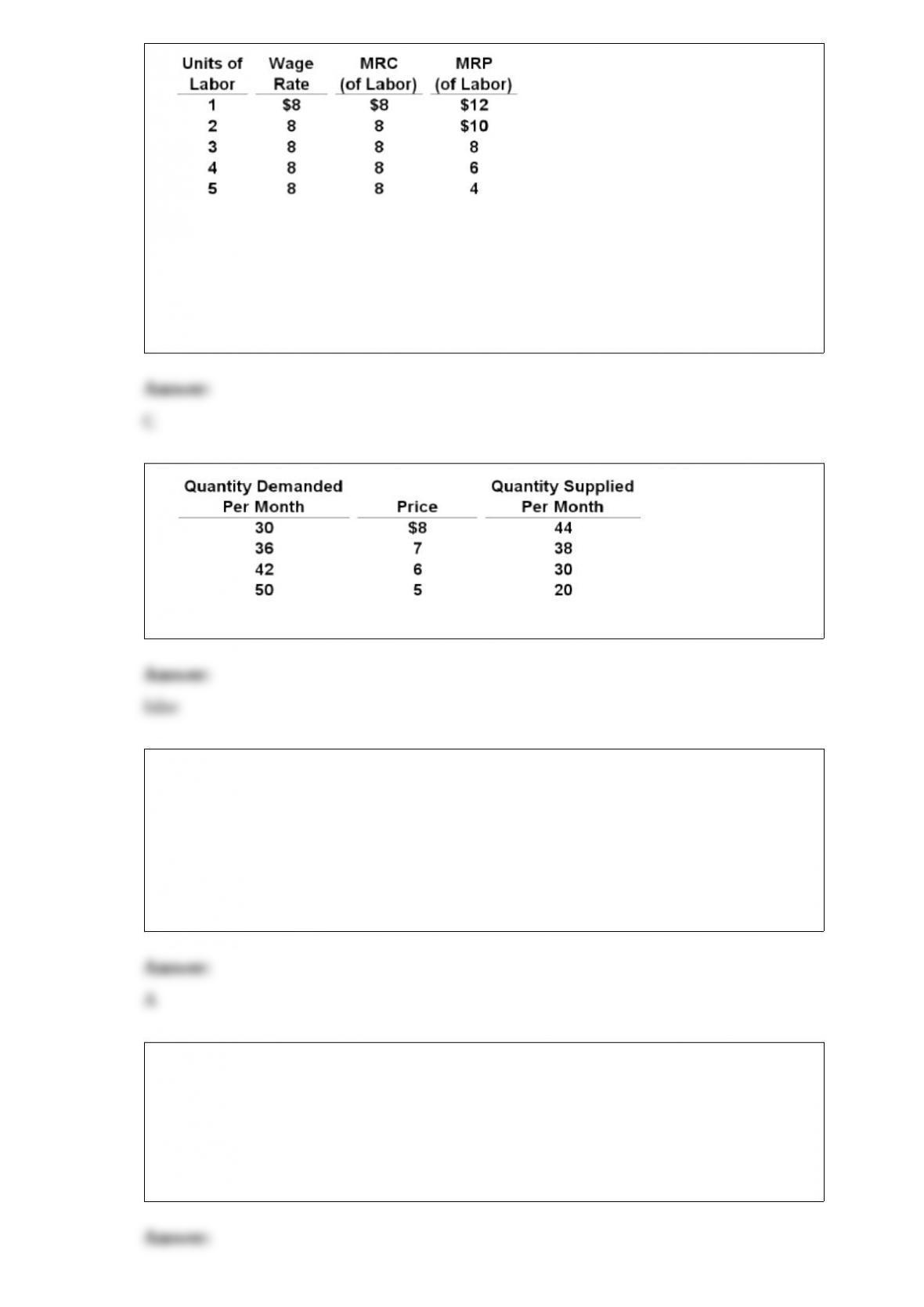
Refer to the above data. At the profit maximizing level of employment, this firm’s, total
labor cost will be:
A.$16.
B.$30.
C.$24.
D.$32.
2)
refer to the above data. the supply of this product is inelastic in the $6-$5 price range.
3) The bank panics of 1930-1933 and the resulting failures of many banks were caused
by:
A.the widespread conversion of checkable deposits to cash by the public.
B.the raising of the reserve requirement by the Board of Governors.
C.a massive inflow of gold bullion to the United States.
D.a massive inflow of cash into bank deposits by citizens who feared their money was
losing its value.
4) other things equal, if the wage rates paid to a firm’s labor inputs were to rise, we
would expect the:
a.afc, avc, atc, and mc curves all to rise.
b.avc, atc, and mc curves all to rise.
c.afc and atc curves to fall.
d.mp curve to fall.

5) the uruguay round of gatt negotiations completed in late 1993:
a.established a free trade zone between the united states and mexico.
b.made the russian ruble convertible into other currencies.
c.created the european union (eu).
d.created international protections for intellectual property such as patents, copyrights,
and trademarks.
6) Which of the following best describes the main problem faced by farms in the long
run?
A.Lagging technology has decreased the productivity of farmers and therefore resulted
in low farm prices and incomes.
B.The highly inelastic nature of agricultural demand has caused small year-to-year
fluctuations in farm output to result in highly unstable farm incomes.
C.The supply of farm products has increased relative to the demand for them, and,
because demand is inelastic, farm prices and incomes have therefore declined.
D.The demand for farm products has increased relative to their supply, but the highly
elastic nature of agricultural demand has caused these shifts to result in declining farm
incomes.
7) the relationship between the size of the negative gdp gap and the unemployment rate
is:
a.direct.
b.inverse.
c.undefined.
d. direct during recession, but inverse during expansion.
8) To reduce the Federal funds rate, the Fed can:
A.buy government bonds from the public.
B.increase the discount rate.
C.increase the prime interest rate.
D.sell government bonds to commercial banks.
9) in a market economy a significant change in consumers’ desire for product x will:
a.alter the profits or losses received by certain firms.
b.cause a reallocation of scarce resources.
c.cause some industries to expand and others to contract.
d.do all of these.
10)
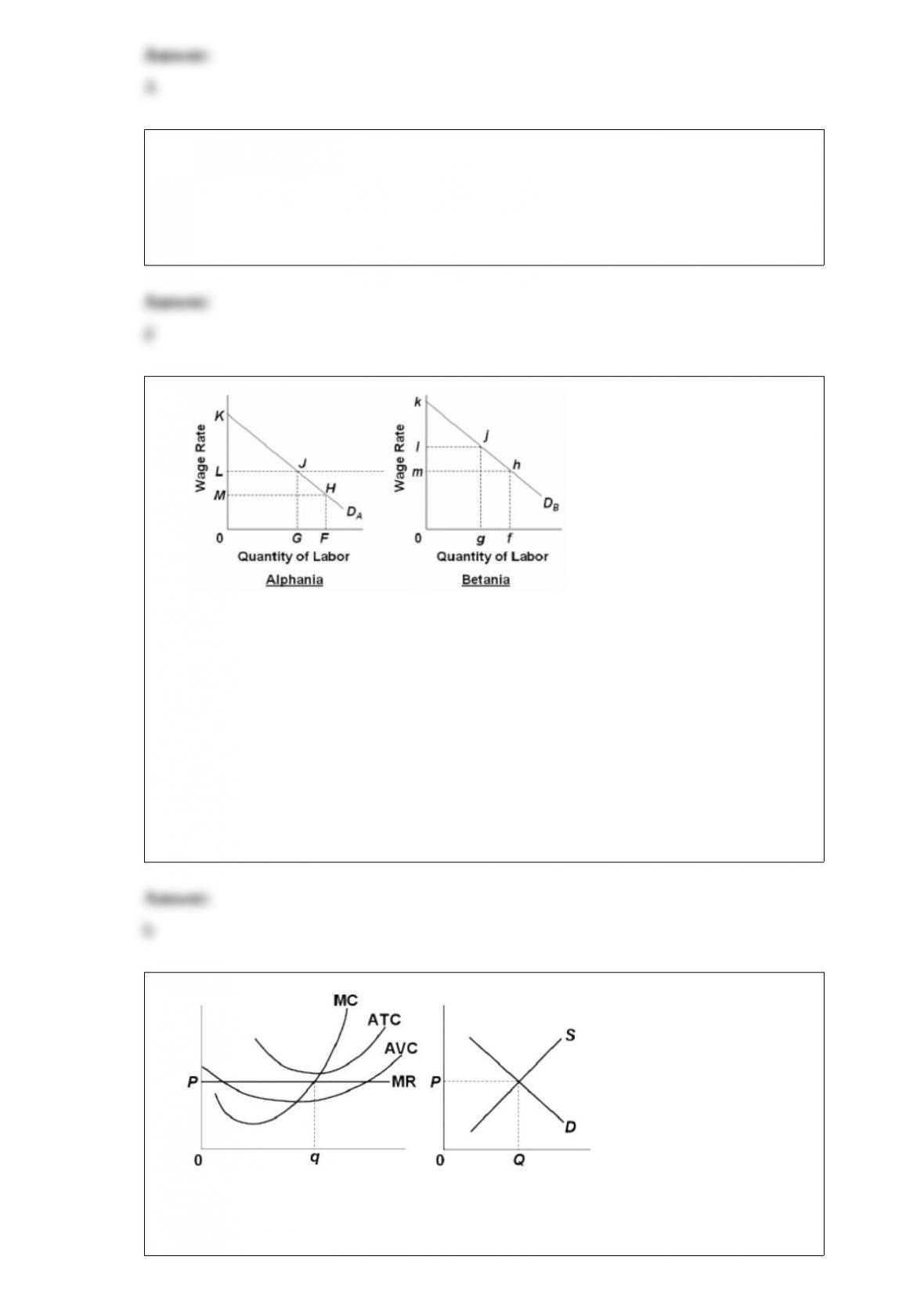
assumptions: (1) the demand for labor in alphania and betania are as shown by da and
db, respectively; (2) alphania’s native labor force is f and that of betania is g; (3) wage l
in alphania is equal to wage m in betania; and (4) full employment exists in both
countries.
refer to the above diagram and assumptions. if migration is costless and unimpeded, the
absolute wage bill will necessarily:
a.increase in alphania if its labor demand curve is elastic.
b.increase in betania if its labor demand curve is elastic.
c.decrease in betania.
d.increase in betania.
11)
refer to the above diagrams, which pertain to a purely competitive firm producing
output q and the industry in which it operates. in the long run we should expect:
a.firms to enter the industry, market supply to rise, and product price to fall.

b.firms to leave the industry, market supply to rise, and product price to fall.
c.firms to leave the industry, market supply to fall, and product price to rise.
d.no change in the number of firms in this industry.