
Tiffany gives $50 to Jeremy for his birthday.This is an example of a(n)
a. involuntary transfer.
b. involuntary-voluntary transfer.
c. voluntary transfer.
d. gift.
e. c and d
If the marginal productivity of labor is falling, it follows that
a. the average productivity of labor is rising.
b. marginal cost is falling.
c. marginal cost is rising.
d. average productivity of labor is falling.
e. c and d
Exhibit 28-12

As the firm increases employment from 2 to 3 workers, its marginal factor cost (MFC)
is
a. $24.
b. $11.
c. $33.
d. $8.
Why does the marginal revenue product (MRP) curve slope downward for a perfectly
competitive firm?
a. Because MRP = MR x MPP.After some point, as more of a factor is employed, the
lower its MPP is; thus MRP declines.
b. Because MRP = MFC x MPP. After some point, as more of a factor is employed, the
lower its MFC is; thus MRP declines.
c. Because MRP = MR x MPP. After some point, MR declines for a product price taker;
thus, MRP declines.
d. Because MRP = MFC x MR. After some point, MFC and MR decline; thus, MRP
declines.

Income elasticity of demand for a normal good is always
a. less than zero.
b. greater than zero.
c. equal to zero.
d. less than one.
The difference between the amount a seller receives for a good and the lowest amount
for which he would sell the good is called
a. producers’ surplus.
b. windfall gain.
c. consumers’ surplus.
d. excess profit.
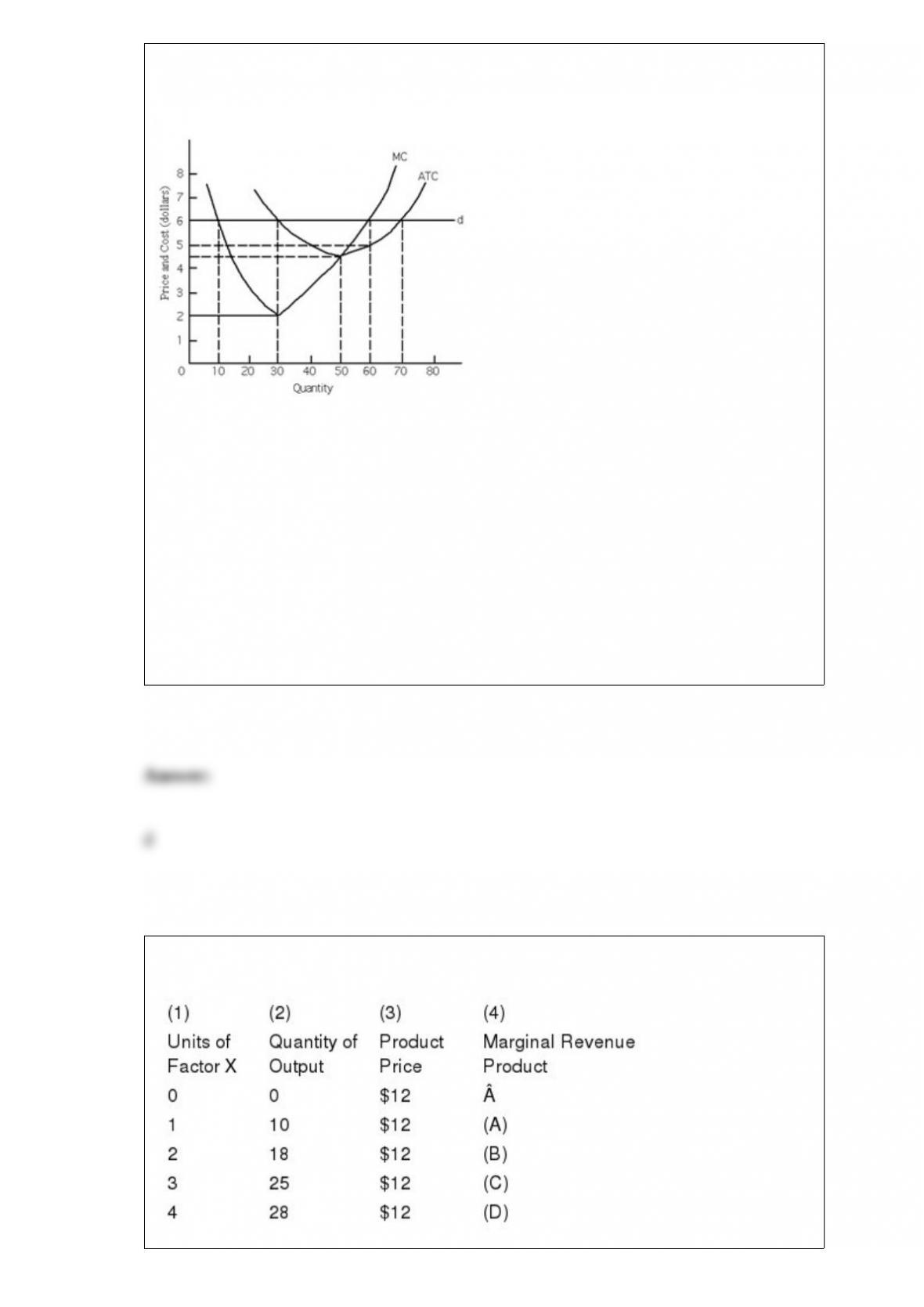
Exhibit 23-7
At the profit-maximizing output level, the firm’s total revenue is
a. $60.00.
b. $225.00.
c. $300.00.
d. $360.00.
e. $420.00.
Exhibit 27-1

The data show that marginal revenue is __________ price, thus we are dealing with
a(n) __________ competitive firm.
a. greater than; perfectly
b. equal to; imperfectly
c. equal to; perfectly
d. less than; perfectly
If variable X rises as a result of variable Y falling, then X and Y have an inverse
relationship.
a. True
b. False
Exhibit 34-8
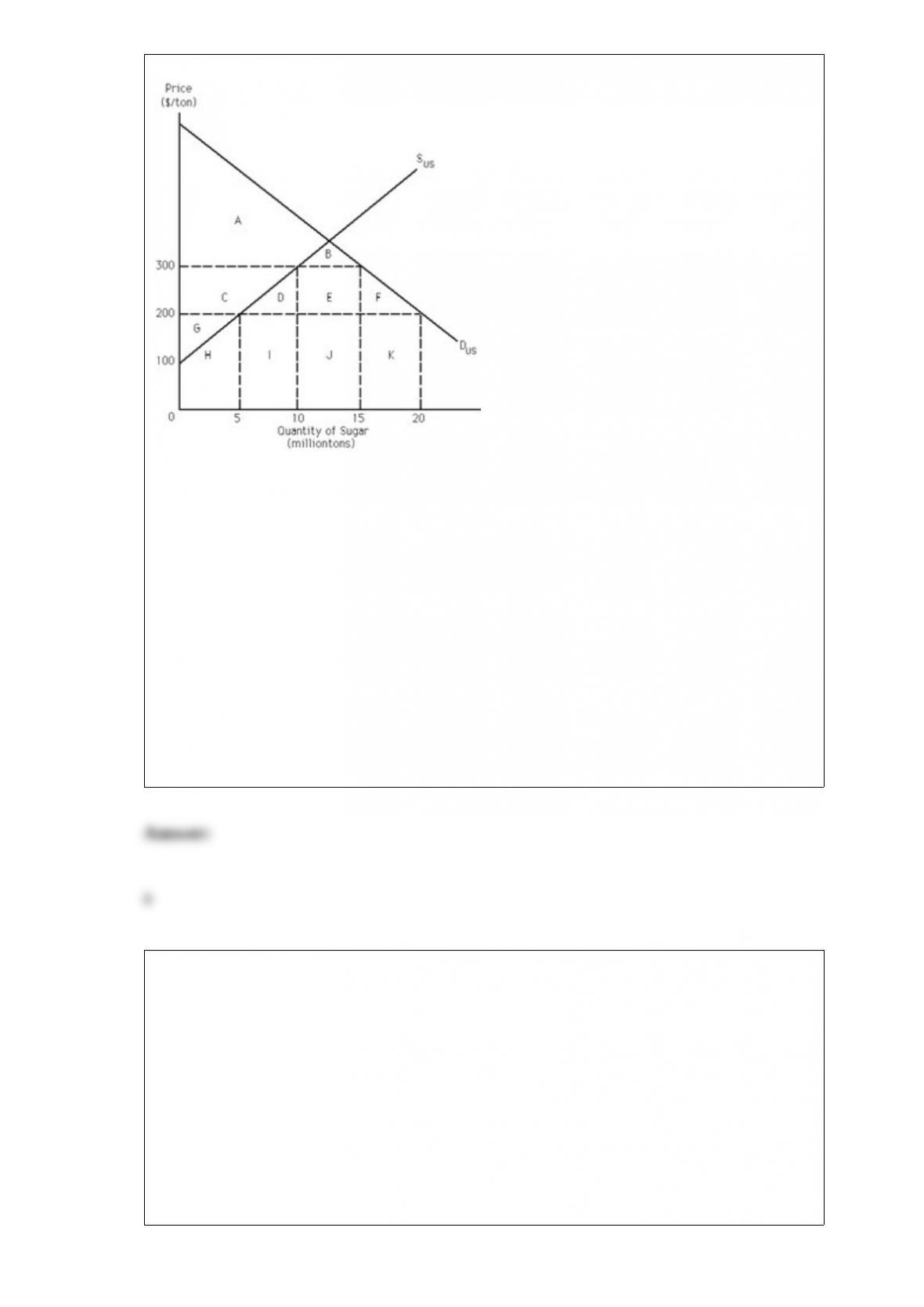
Assume that the current price of sugar in the United States is $300 per ton (which
includes a $100 per ton tariff on sugar imports). The government collects tariff revenues
on sugar imports in the amount of __________ million.
a. $500
b. $1,000
c. $1,500
d. $2,000
e. none of the above
To increase the wages of its members, a labor union might attempt to
a. lower the elasticity of demand for its labor.
b. increase the demand for union labor.
c. increase the supply of union labor.
d. a and b
e. all of the above

There are two goods in the economy, apples and bread. The relative price of apples has
increased. This could be due to
a. an increase in the absolute price of apples, ceteris paribus.
b. a decrease in the absolute price of bread, ceteris paribus.
c. a decrease in the absolute price of apples, ceteris paribus.
d. an increase in the absolute price of bread, ceteris paribus.
e. a and b
If $1 = 96 Japanese yen on Wednesday and on Thursday $1 = 100 Japanese yen, then
the dollar depreciated against the yen between Wednesday and Thursday.
a. True
b. False
Popular online publications that have no close substitutes will be more likely to be able
to charge for those publications than will a local newspaper.a. True
b. False

Public choice refers to
a. the decisions and decision-making processes that individuals go through to solve
public problems.
b. political decisions made in the interest of the public at large.
c. the application of economic principles and tools to public-sector decision making.
d. the process that individuals undergo to decide what goods and services they will
purchase and consume.
e. the process that individuals undergo to decide whether or not they will pursue a
career government service.
The price elasticity of demand for a given good is 2.3. This implies that if price
a. rises by 10 percent, quantity demanded falls 2.3 percent.
b. rises by 2.3 percent, quantity demanded falls 2.3 percent.
c. rises by 20 percent, quantity demanded falls 46 percent.
d. falls by 10 percent, quantity demanded falls 2.3 percent.
e. none of the above
Which of the following is descriptive of rent-seeking?
a. A domestic company hires a lobbyist to go to Washington, D.C. and try to influence
legislators to impose tariffs on Brazilian (imported) goods that compete with the good it
produces.
b. Company X hires an accountant to work for it.
c. Jill pays her apartment rent a few days late each month and usually ends up having to
pay a late fee.
d. This year Bob earned a large profit from the small business he owns and operates.
e. b and d
The demand for seats in 10 a.m. classes at the university is higher than the demand for
seats in 8 a.m. classes. The supply of seats is fixed. If the university prices classes at the
price required to achieve equilibrium at 10 a.m., there will be
a. a shortage at 8 a.m.
b. a surplus at 8 a.m.
c. equilibrium at 8 a.m.
d. disequilibrium at 8 a.m., but we cannot determine which type.
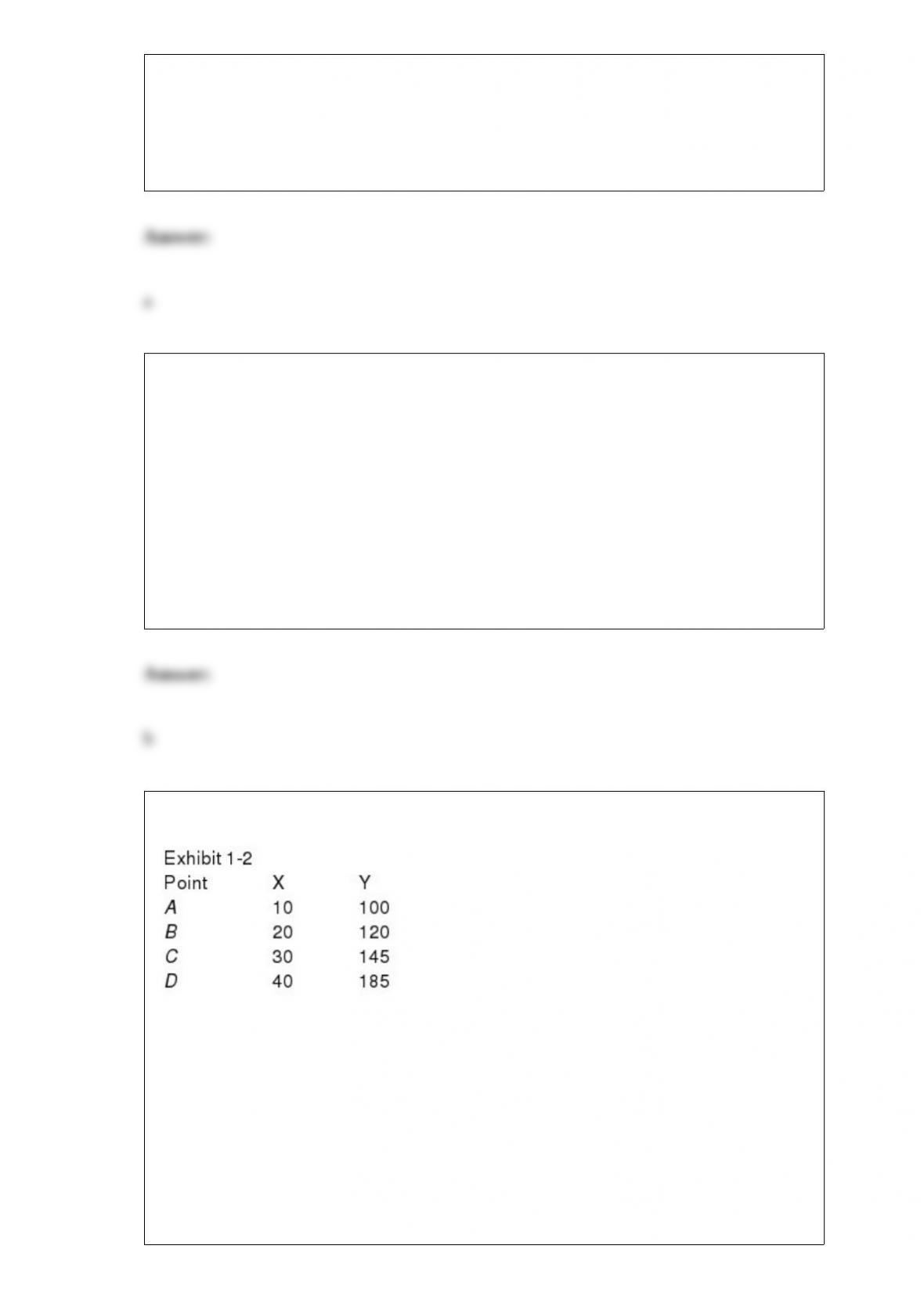
According to the data provided in this table, what is the slope of the line between points
A and B, if these data were graphed with X on the horizontal axis and Y on the vertical
axis?
a. -2.00
b. -0.50
c. 2.00

d. 0.50