
One reason a country does not specialize completely in production is that production of
most goods involves increasing opportunity costs.
Answer:
Empirical evidence shows that the short-run Phillips curve was vertical during the
1950s and 1960s.
Answer:
Paying efficiency wages are a way for a company to cut costs and become more
efficient, and are therefore lower than market wages.
Answer:
Since Poland joined the European Union in 2004, many young and educated Poles have
emigrated to the United Kingdom. As a result, the labor supply curve in the United
Kingdom shifts to the right and the equilibrium wage rises.
Answer:

The income effect of a price increase for a Giffen good outweighs the substitution
effect.
Answer:
Suppose the extra cost to a doctor of keeping his office open on Saturdays is $1,200.
Then, the doctor should stay open on Saturdays if keeping the office open brings in
additional revenue of $1,200 or more.
Answer:
Consumer surplus is the difference between the highest price someone is willing to pay
for a product and the price he actually pays for the product.
Answer:
The purchase of stocks and bonds issued in another country is known as foreign direct
investment.
Answer:

Economic costs include implicit costs but not explicit costs.
Answer:
Expansionary fiscal policy should raise the exchange rate of the dollar.
Answer:
Full-employment GDP is also known as
A) realized GDP.
B) potential GDP.
C) politico-economic GDP.
D) balanced-budget GDP.
Answer:
When the price of tortilla chips rose by 10 percent, the quantity of tortilla chips sold fell
4 percent. This indicates that the demand for tortilla chips is
A) inelastic.
B) elastic.
C) unit-elastic.
D) perfectly inelastic.
Answer:
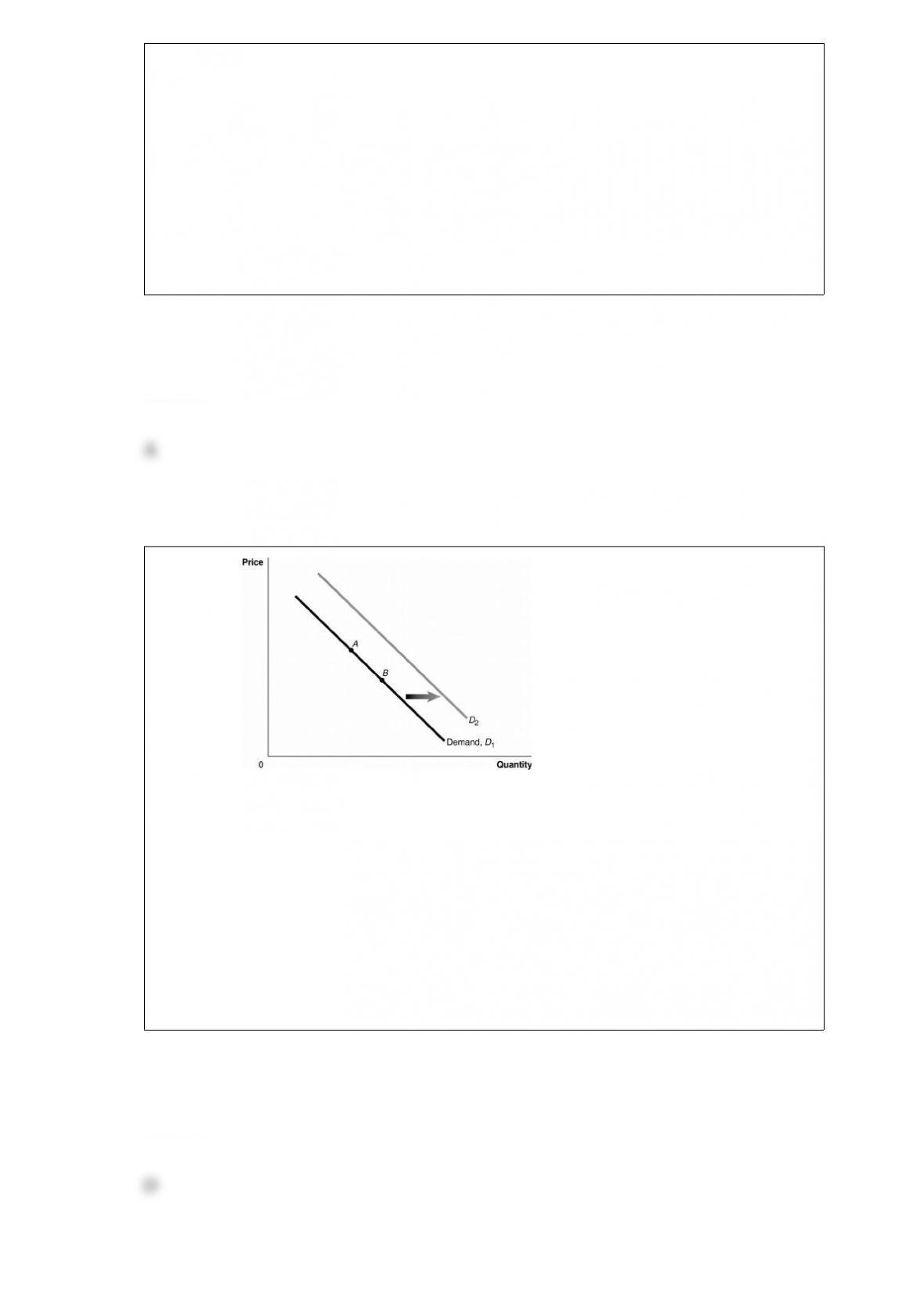
Figure 3-1
A decrease in the price of a substitute good would be represented by a movement from
A) A to B.
B) B to A.
C) D1 to D2.
D) D2 to D1.
Answer:

In the real world we don’t observe countries completely specializing in the production
of goods for which they have a comparative advantage. One reasons for this is
A) comparative advantage works better in theory than in practice.
B) some countries have more resources than other countries.
C) tastes for many traded goods are similar in many countries because of globalization.
D) production of most goods involves increasing opportunity costs.
Answer:
The GDP deflator is equal to
A) real GDP divided by nominal GDP.
B) nominal GDP divided by real GDP, multiplied by 100.
C) nominal GDP divided by real GDP.
D) real GDP divided by nominal GDP, multiplied by 100.
Answer:
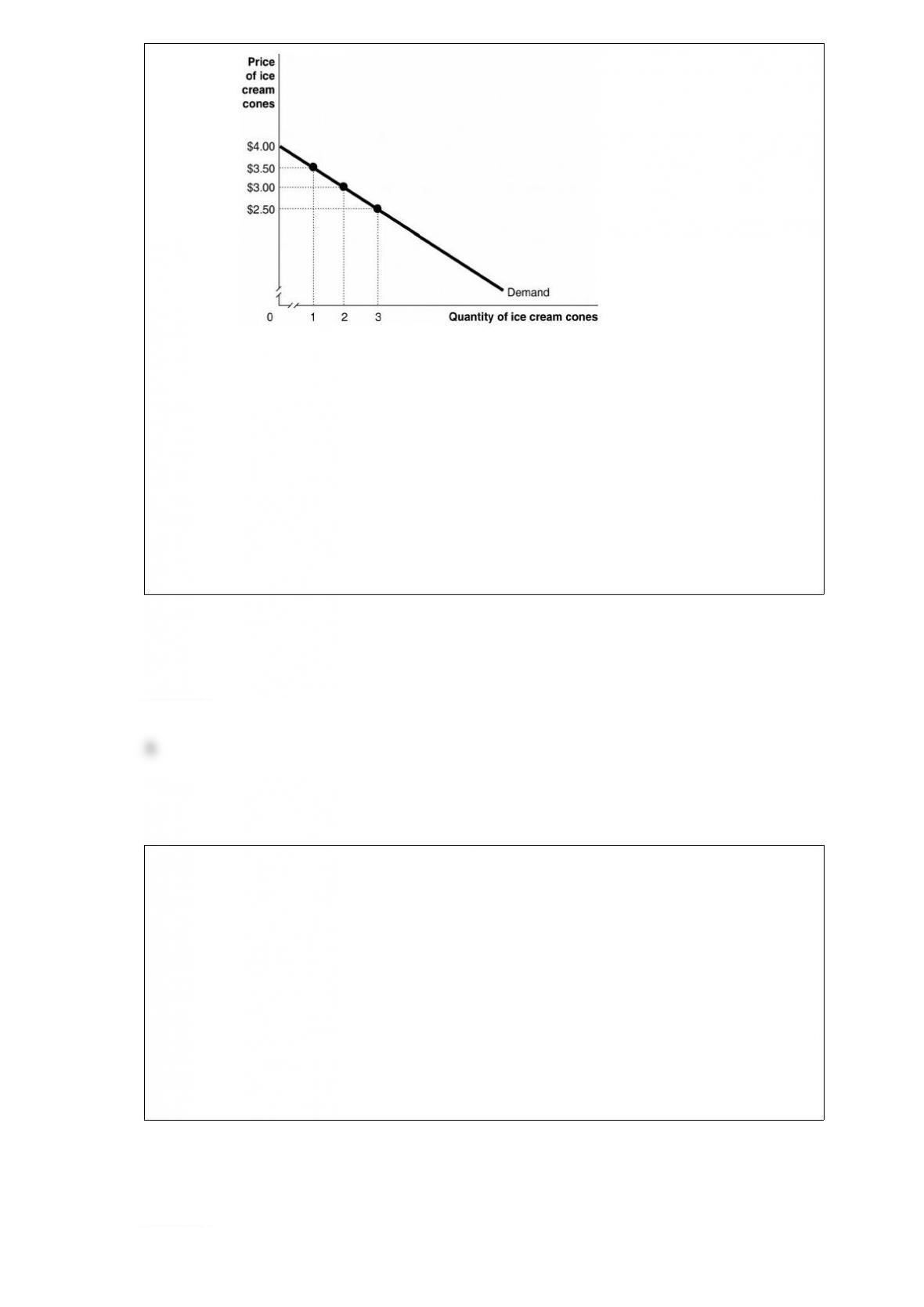
Figure 4-1 Figure 4-1 shows Kendra’s
demand curve for ice-cream cones.
If the market price is $3.50, what is the consumer surplus on the first ice cream cone?
A) $0
B) $0.50
C) $3.50
D) $9.00
Answer:
To decrease the money supply, the Federal Reserve could
A) lower the discount rate.
B) raise income taxes.
C) lower the required reserve ratio.
D) conduct an open market sale of Treasury securities.
E) raise transfer payments.
Answer:
Consider an industry that is made up of nine firms each with a market share (percent of
sales) as follows:
a. Firm A: 30%
b. Firm B: 20%
c. Firms C, D and E: 10% each
d. Firms F, G, H and J: 5% each What is the value of the four-firm concentration ratio
and how is the industry categorized?
A) 50%; monopolistic competition
B) 70%; oligopoly
C) 75%; oligopoly
D) 80%; strongly oligopolistic
Answer:
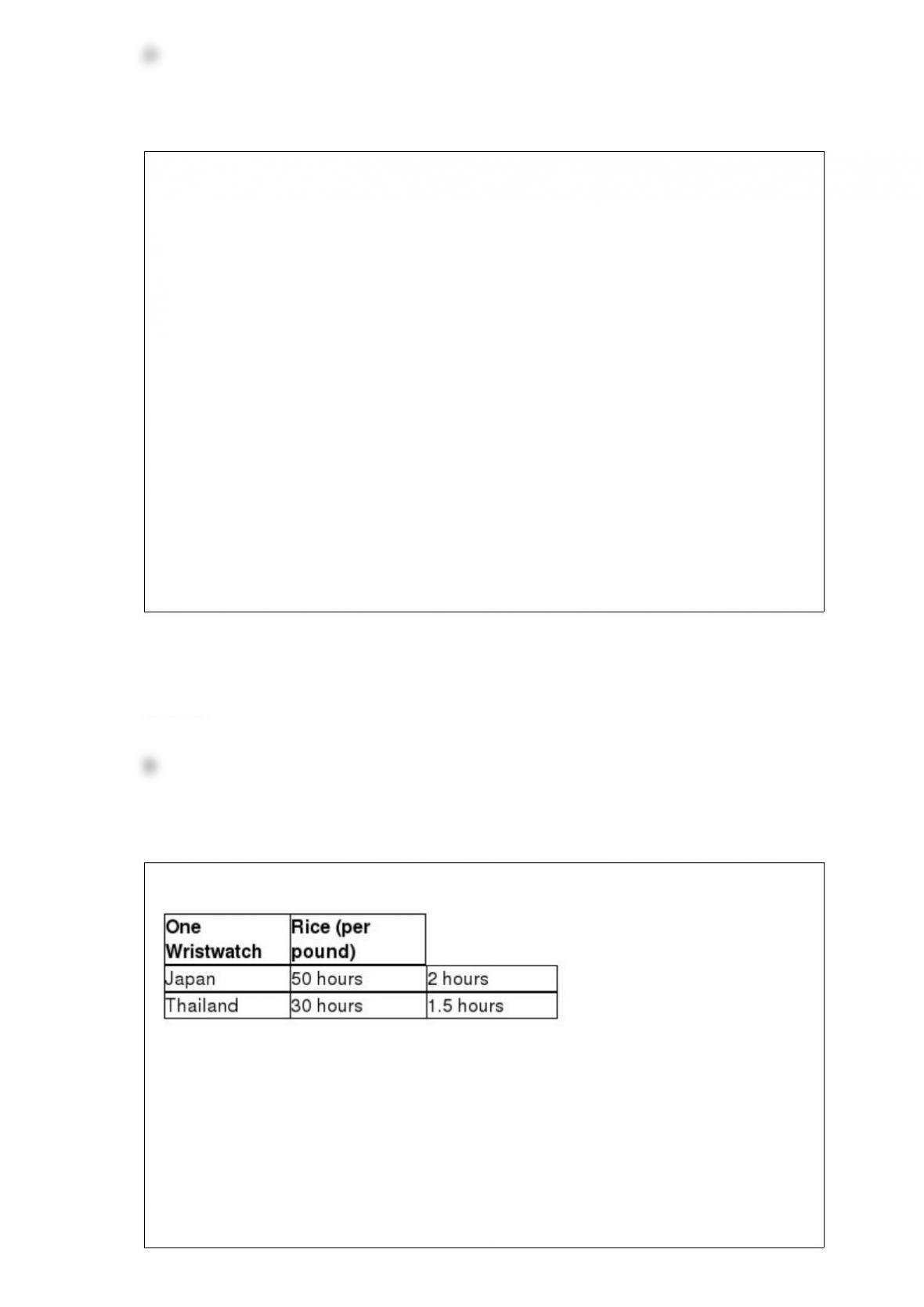
Table 2-9
Table 2-9 shows the number of labor hours required to produce a wristwatch and a
pound of rice in Japan and Thailand. What is Thailand’s opportunity cost of producing
one wristwatch?
A) 0.05 pounds of rice
B) 20 pounds of rice
C) 25 pounds of rice

D) 60 pounds of rice
Answer:
Donnie’s Donuts incurs $450,000 per year in explicit costs and $200,000 in implicit
costs. The bakery earns $800,000 in revenues and has $2 million in net worth. Based on
this information, what is the economic profit for Donnie’s Donuts?
A) $150,000
B) $350,000
C) $600,000
D) $1.2 million
Answer:
Currency traders expect the value of the dollar to rise. What effect will this have on the
demand for dollars and the supply of dollars in the foreign exchange market?
A) Demand for dollars will increase, and supply of dollars will decrease.
B) Demand for dollars will increase, and supply of dollars will increase.
C) Demand for dollars will decrease, and supply of dollars will increase.
D) Demand for dollars will decrease, and supply of dollars will decrease.
Answer:
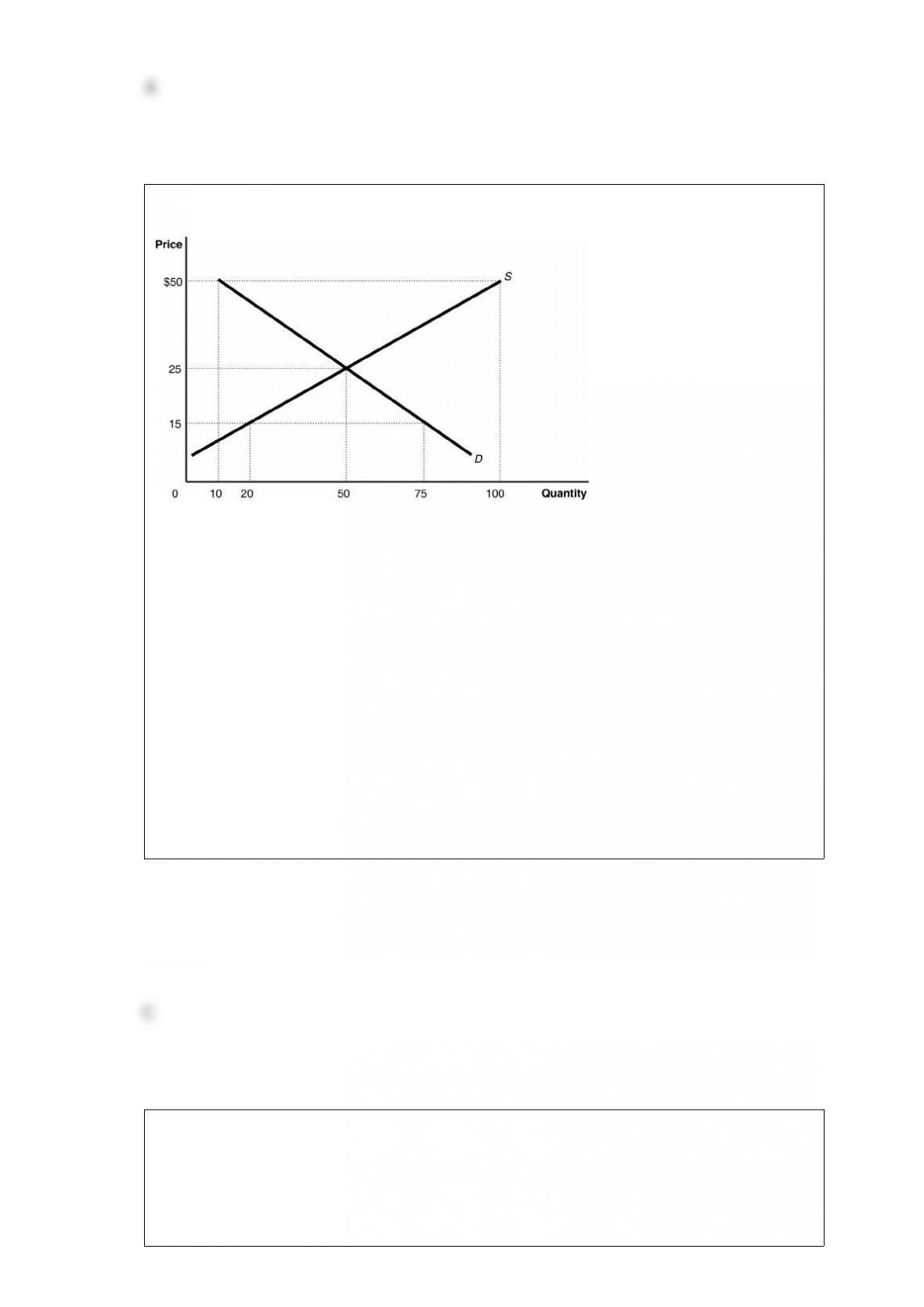
Figure 3-6
The figure above represents the market for canvas tote bags. Assume that the price of
tote bags is $15. At this price
A) the quantity demanded exceeds the quantity supplied of tote bags by 75. The price
will eventually rise to $25 where quantity demanded will equal quantity supplied.
B) the demand exceeds the supply of tote bags by 55. Some consumers will have an
incentive to offer to buy tote bags at a higher price.
C) there is a shortage, equal to 55 tote bags, that will be eliminated when the price rises
to $25.
D) there is a shortage equal to 55 tote bags; the price of tote bags will rise until demand
is equal to supply.
Answer:
Consider a used car market in which half the cars are good and half are bad (lemons). If
buyers are rational, the prices being offered for used cars will result in
A) an equal proportion of a good cars and lemons being sold in an efficient market.
B) a larger proportion of good cars being sold and consequently, consumer surplus is
increased.
C) a larger proportion of lemons being sold and consequently, producer surplus is
increased.
D) an equal proportion of good cars and lemons being sold in an inefficient market.
Answer:
Explain the Differences between a change in supply and a change in quantity supplied.
Answer:
Explain how the decision by parents to not immunize their children, hoping that their
children will not get sick because other parents have had their children immunized, is
an example of free riding. How is this behavior dangerous to the public?
Answer:
Suppose the velocity of money is not fixed, but stable at about two percent growth per
year. How could the quantity theory of money be modified to include a stable growth
rate of the velocity of money? In this modified quantity theory of money with velocity
growing at two percent per year, what would the growth rate of the other variables in
the theory need to be to cause inflation?
Answer:
What assumptions are necessary for a market to be perfectly competitive? Explain why
each of these assumptions is important.
Answer:

From a supply perspective, what impact would an increase in the price of motorcycles
have on the market for motorcycles?
Answer:
Explain why the long-run aggregate supply curve is vertical.
Answer: