1) If the United States and France are both on the international gold standard and U.S.
exports to France exceed United States imports from France, gold will flow from the
United States to France.
2) The fact that most of a farmer’s costs are variable costs has hastened the movement
of resources from agriculture to industry.
3) Sales taxes are proportional in relation to income because the same tax rate applies
regardless of the size of a purchase.
4) According to monetarists, discretionary monetary policy has been a major source of
economic instability.
5) each point on a single indifference curve reflects the same level of total utility for a
consumer.
6) if economic theories are solidly based on relevant facts, then appropriate economic
policy becomes obvious and uncontroversial.
7) Renewable energy sources account for about 50 percent of U.S. electricity
generation.
8) Social Security is financed by payroll taxes levied on both employers and employees.
9) Labor market discrimination increases the size of the nation’s GDP.
10) The largest single liability of the Federal Reserve Banks is their outstanding loans
to commercial banks.
11) Farmers typically sell their products in highly competitive markets and buy in
imperfectly competitive markets.
12) Depository institutions are a major source of money in the U.S. economy.
13) All of the following are regulatory commissions dealing with social regulation (as
distinct from industrial regulation) except the:
A.Food and Drug Administration.
B.Federal Energy Regulatory Commission.
C.Equal Employment Opportunities Commission.
D.Consumer Products Safety Commission.
14) the basic purpose of the other-things-equal assumption is to:
a.allow one to reason about the relationship between variables x and y without the
intrusion of variable z.
b.allow one to focus upon micro variables by ignoring macro variables.
c.allow one to focus upon macro variables by ignoring micro variables.
d.determine whether x causes y or vice versa.
15) Imports have the same effect on the current size of GDP as:
A.exports.
B.investment.
C.consumption.
D.saving.
16) To say money is socially defined means that:
A.money has been defined in a Constitutional amendment.
B.whatever performs the functions of money extremely well is considered to be money.
C.the money supply includes all public and private securities purchased by society.
D.society, acting through Congress, specifies what shall be included in the money
supply.
17) when the economist says that economic wants are insatiable, this means that:
a.economic resources are valuable only because they can be used to produce consumer
goods.
b.economic resources-land, labor, capital, and entrepreneurial ability-are scarce.
c.these wants are virtually unlimited and therefore incapable of complete satisfaction.
d.the structure of consumer demand varies from time to time and from country to
country.
18) The idea of efficiency wages is that:
A.the wages of each type of labor must be proportionate to their marginal products.
B.the wages of each type of labor must be equal to their marginal products.
C.firms might get greater work effort by paying above-equilibrium wage rates.
D.workers are more diligent when paid below-equilibrium wages.
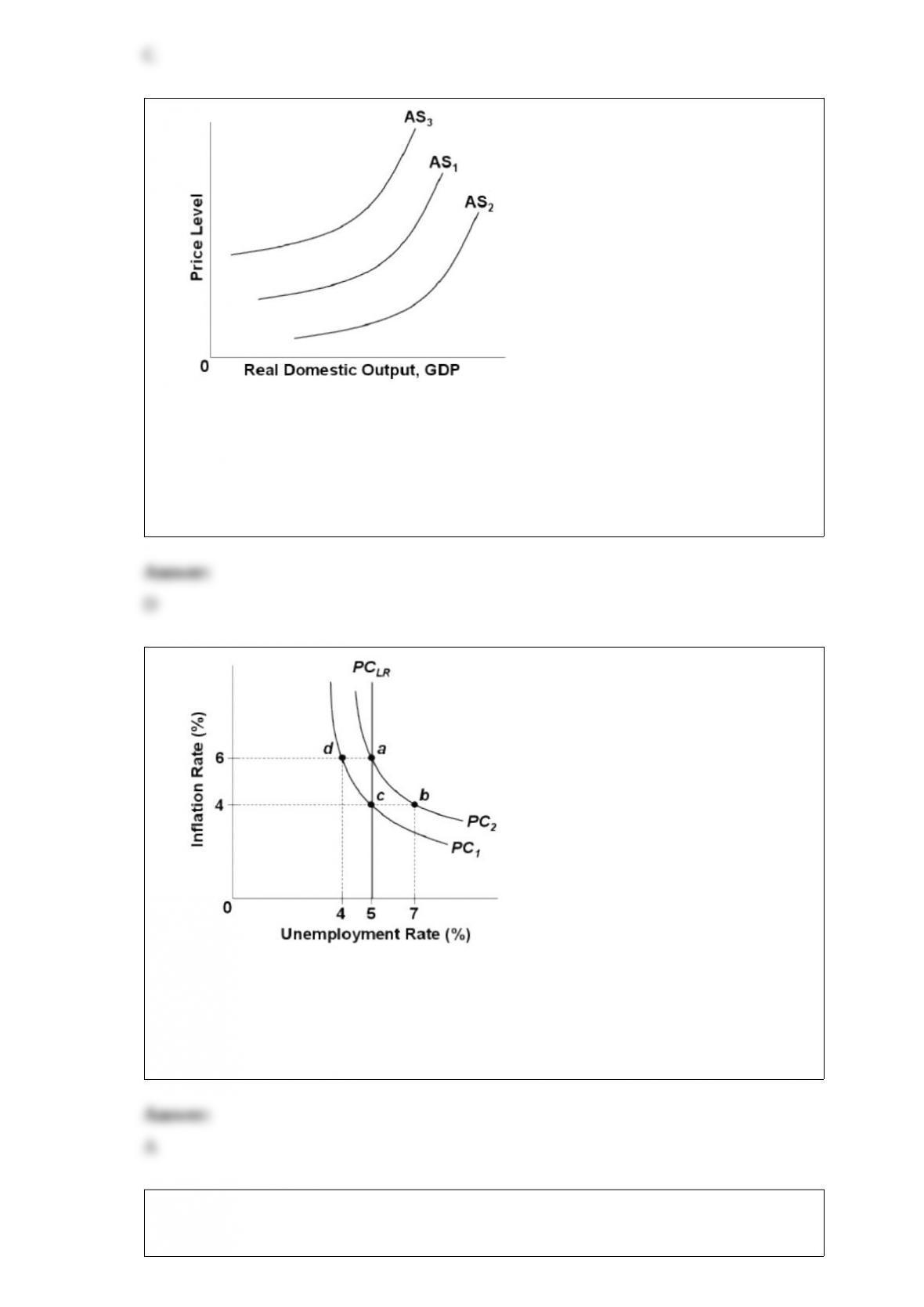
19)
In the above diagram, the most favorable shift of the aggregate supply curve for the
economy would be from:
A.AS1 to AS2.
B.AS1 to AS3.
C.AS2 to AS3.
D.AS3 to AS2.
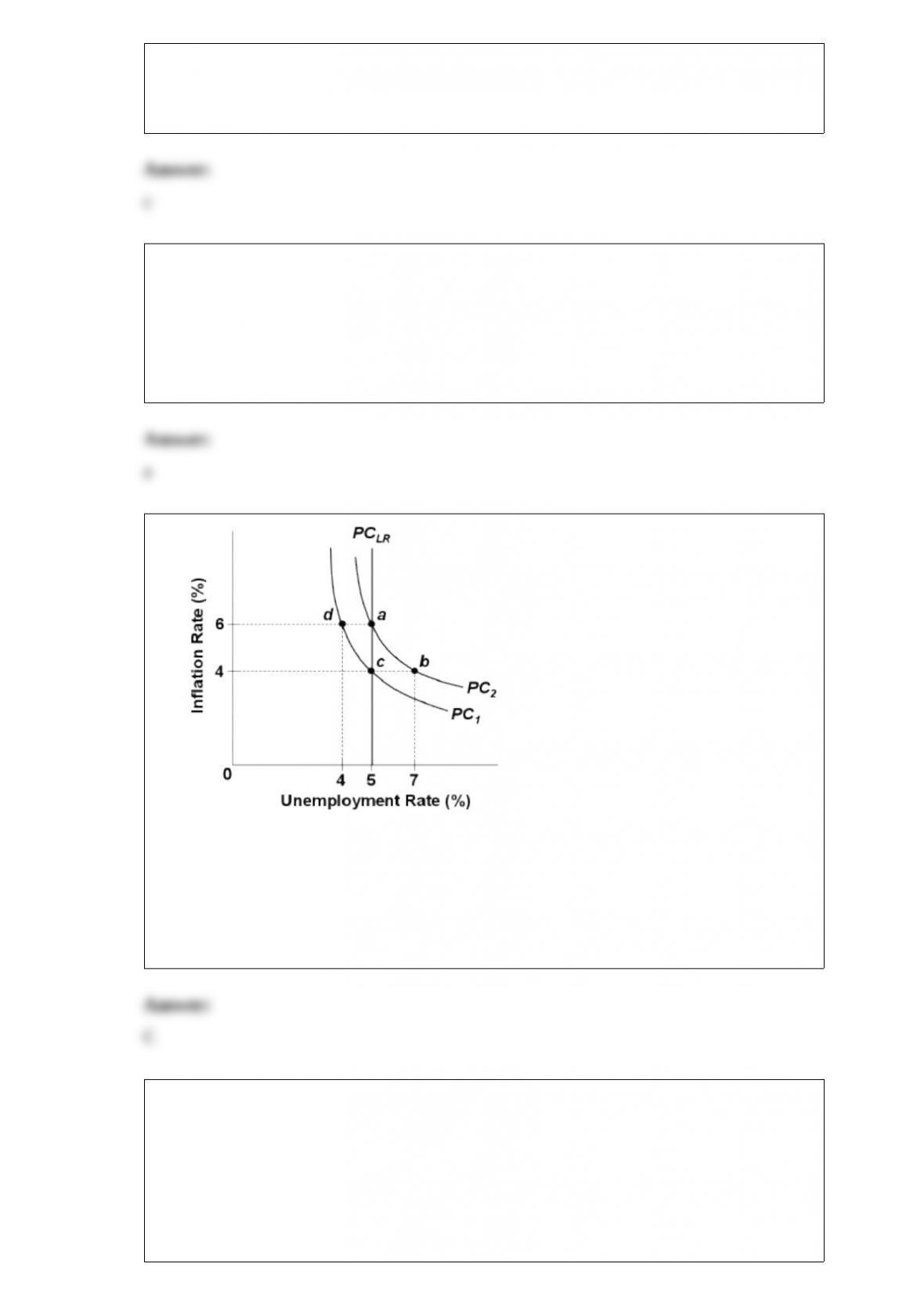
20)
Refer to the above diagram. Point b would be explained by:
A.an actual rate of inflation that exceeds the expected rate.
B.an actual rate of inflation that is less than the expected rate.
C.cost-push inflation.
D.an increase in long-run aggregate supply.
21) a change in the dollar price of yen from $1 = 100 yen to $1 = 50 yen will:
a.make u.s. goods more expensive to the japanese.
b.make japanese goods less expensive to americans.
c.increase u.s. exports and depress japanese exports.
d.increase japanese exports and depress u.s. exports.
22) cyclical unemployment results from:
a.a deficiency of spending on goods and services.
b.the decreasing relative importance of goods and the increasing relative importance of
services in the u.s. economy.
c.the everyday dynamics of a free labor market.
d.technological change.
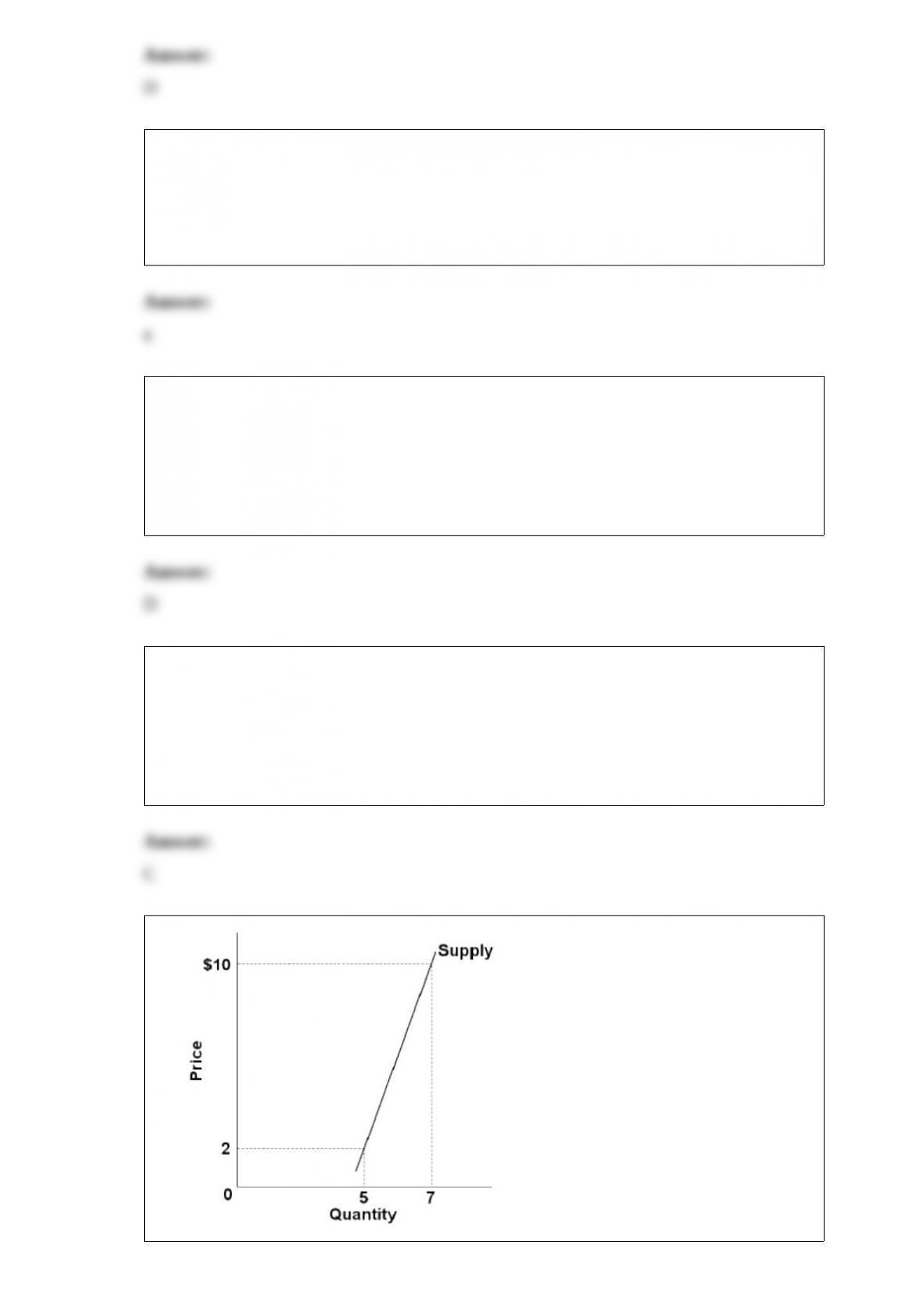
23)
Refer to the above diagram. The move of the economy from c to e on short-run Phillips
Curve PC2 would be explained by an:
A.increase in aggregate demand in the economy.
B.increase in aggregate supply in the economy.
C.actual rate of inflation that is less than the expected rate.
D.actual rate of inflation that exceeds the expected rate.
24) The rule of reason indicated that:
A.if less than four firms account for three-fourths of an industry’s sales, the industry is
in violation of the Sherman Act.
B.social regulation should not be enforced unreasonably so that costs exceed benefits.
C.the mere possession of monopoly power is a violation of the antitrust laws.
D.only contracts and combinations that unreasonably restrain trade violate the antitrust
laws.
25) gdp excludes:
a.the market value of unpaid work in the home.
b.the production of services.
c.the production of nondurable goods.
d.positive changes in inventories.
26) As pizza topped with barbecue chicken became popular at specialty restaurants,
Pizza Hut introduced a similar pizza. This imitation illustrates:
A.innovation.
B.invention.
C.creative destruction.
D.diffusion.
27) If the MPC in an economy is .75, a $1 billion increase in taxes will ultimately
reduce consumption by:
A.$1 billion.
B.$.75 billion.
C.$3 billion.
D.$4 billion.
28)
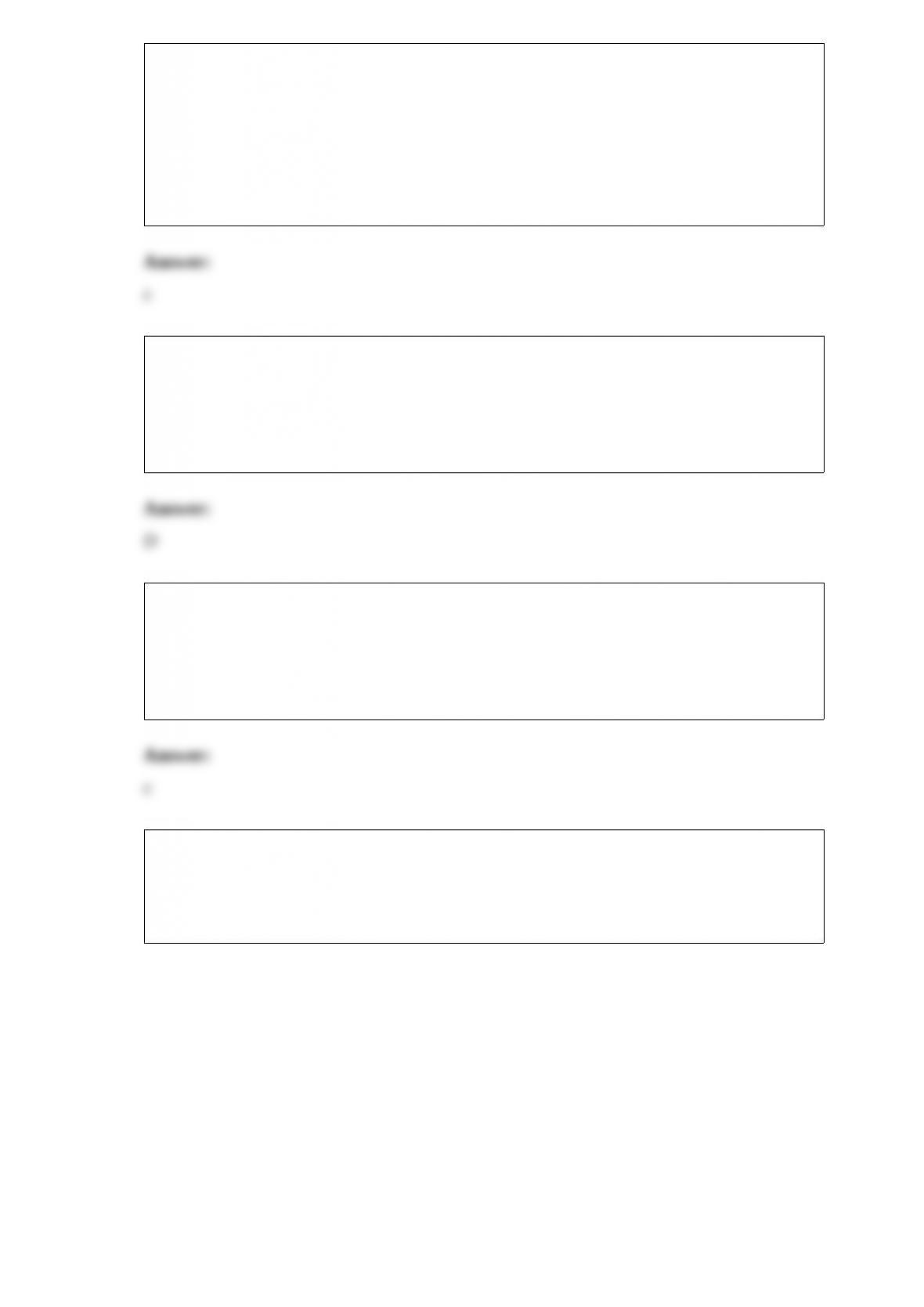
refer to the above diagram and assume that price increases from $2 to $10. the
coefficient of the price elasticity of supply (midpoints formula) relating to this price
change is about:
a.5 and supply is elastic.
b.1 and supply is unit elastic.
c..25 and supply is inelastic.
d.2.5 and supply is elastic.
29) An increase in the reserve ratio:
A.increases the size of the spending income multiplier.
B.decreases the size of the spending income multiplier.
C.increases the size of the monetary multiplier.
D.decreases the size of the monetary multiplier.
30) the introduction and use of the euro is expected to:
a.increase the rate of inflation slightly in the euro zone nations.
b.increase poverty substantially in euro zone nations.
c.increase international trade among the euro zone nations.
d.increase income inequality within the euro zone nations.
31) Assume the atmosphere of an urban area is able to reabsorb 8000 tons of pollutants
per year. The schedule below shows the price polluters would be willing to pay for the
right to dispose of 1 ton of pollutants per year and the total quantity of pollutants they
would wish to dispose of at each price.
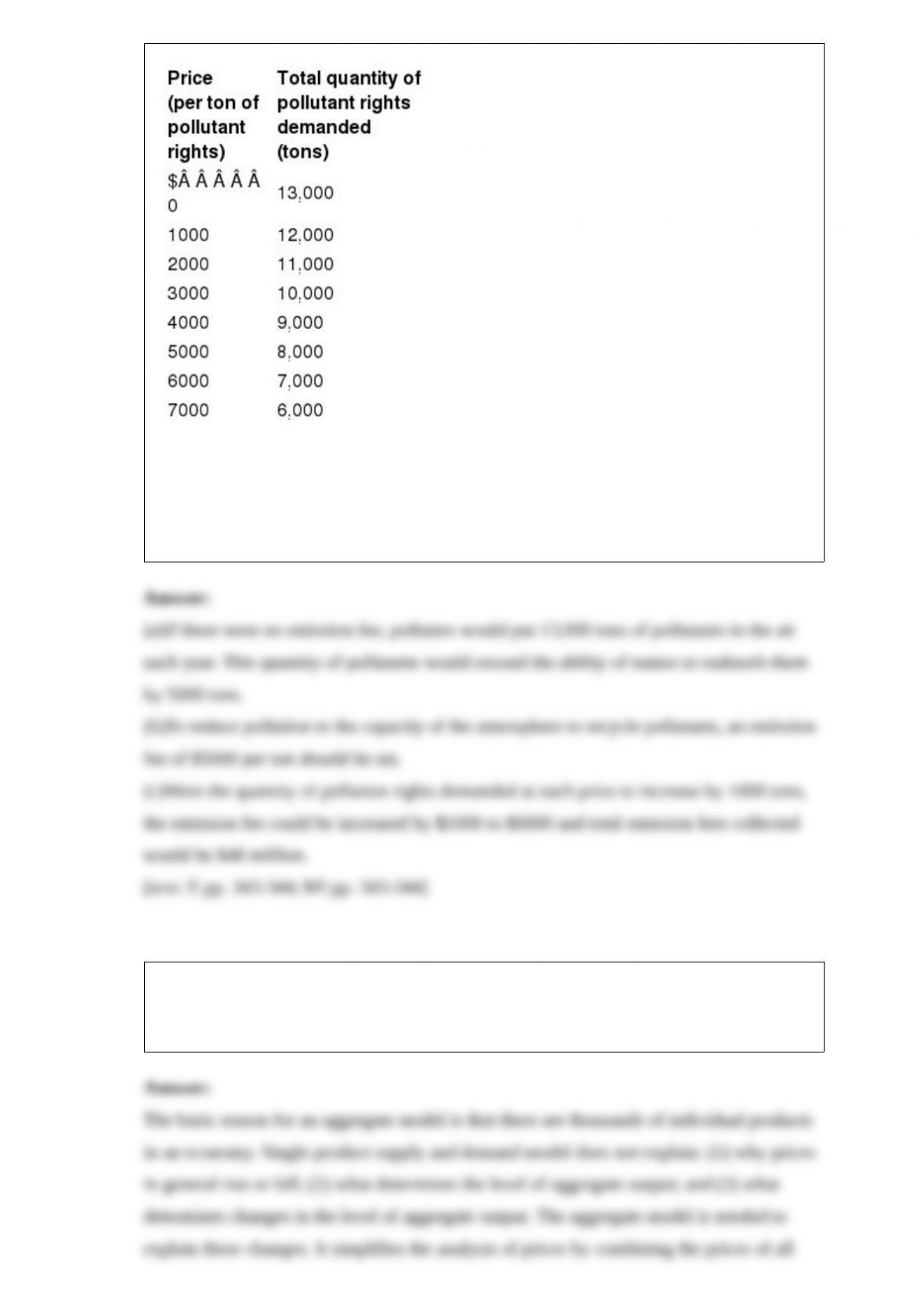
(a)If there were no emission fee, how many tons of pollutants would there be and how
much greater would this amount be than the capacity for reabsorption?
(b)What pollution fee should the urban authorities charge to solve the problem?
(c)What would happen in this market for pollution rights if quantity demanded
increased by 1000 tons at each price?
32) Why is there a need for an aggregate demand and aggregate supply model of the
economy? Why cant the supply and demand model for a single product explain
developments in the economy?
33) GDP figures can be used to make international comparisons of living standards.
What are three adjustments made by the International Monetary Fund (IMF) to each
countrys GDP to allow for meaningful comparisons of living standards between
countries? Explain.
34) Explain four problems with the argument that trade protection is needed to protect
American jobs.
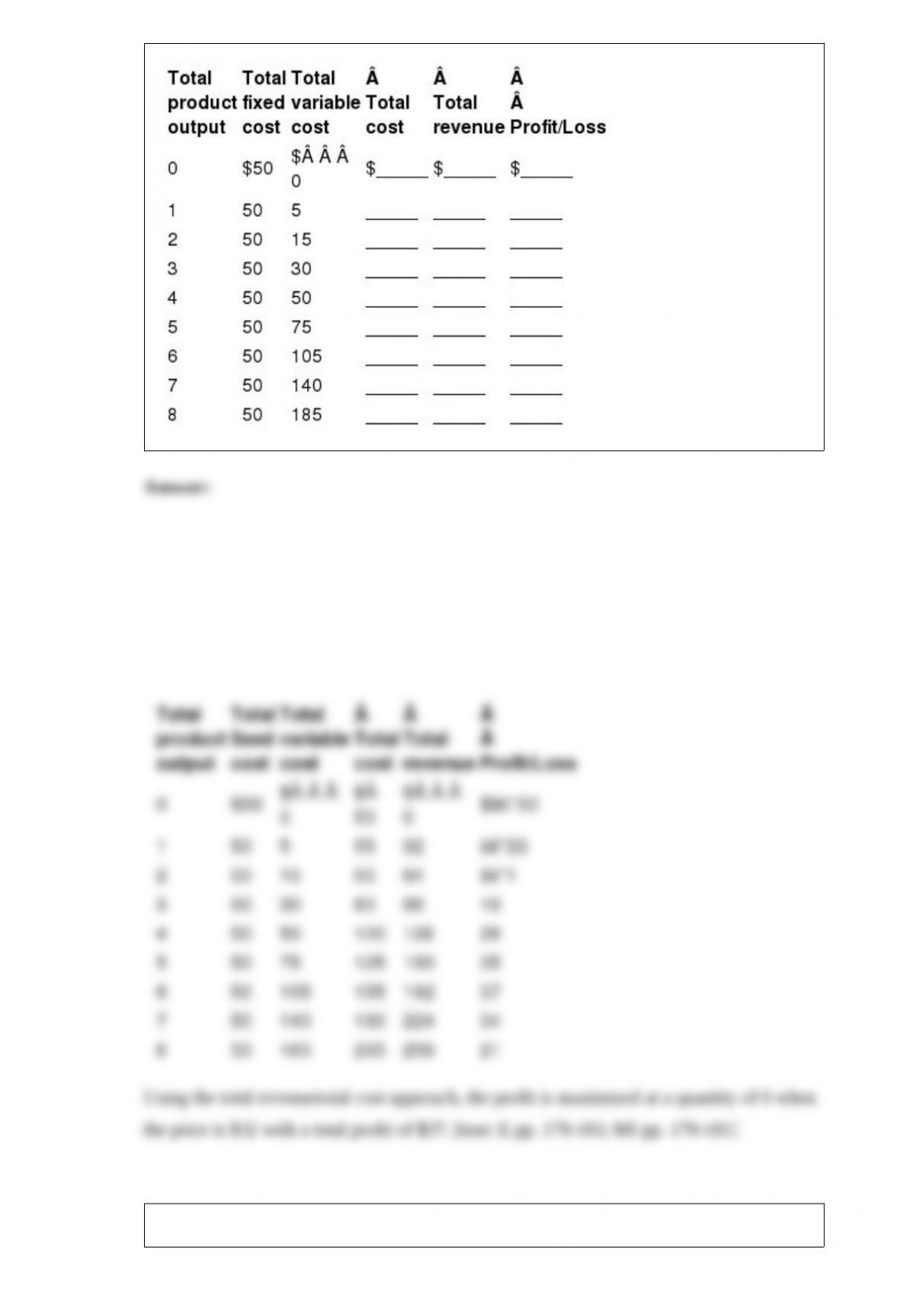
35) Fill in the following table for a product in a purely competitive market. The market
price for the good is $32. Use the total revenuetotal cost approach to evaluate at what
quantity the firm can maximize its profits.
36) Explain the new classical view of self-correction in the economy.
37) The welfare state is not a mechanism which provides something for nothing; every
piece of social insurance must be paid for. Evaluate and explain. Can you think of any
circumstances in which unemployment compensation might provide something for
nothing?
38) What is the term auction facility and how does it affect the excess reserves and the
monetary multiplier of the banking system?
39) How might competition eradicate discrimination? Historically, has this been
observed?
40) Describe the characteristics of direct foreign aid from IACs to DVCs.
41) Distinguish between and give examples of nonrenewable resources and renewable
resources.