
Which of the following is not a reason why the wages of workers and the prices of
inputs rise more slowly than the prices of final goods and services?
A) Contracts make prices and wages ‘sticky.”
B) Firms are often slow to adjust wages.
C) Menu costs make some prices sticky.
D) Unions are successful in pushing up wages.
According to Robert Fogel, economic growth ________ health, and health ________
economic growth.
A) improves; worsens
B) improves; improves
C) worsens; improves
D) worsens; worsens
A patent is a government-imposed entry barrier because
A) it allows a firm to achieve economies of scale.
B) it is a key input owned by the firm that is granted the patent.
C) it limits the quantity of a good that can be imported into a country.

D) it gives a firm the exclusive right to a new product for a period of 20 years from the
date the product is invented.
By the height of the housing bubble in 2005 and early 2006, lenders had greatly
loosened the standards for obtaining a mortgage loan, with many mortgages being
granted to ________ borrowers with flawed credit histories and ________ borrowers
who did not document their incomes.
A) sub-prime; “Alt-A”
B) adjustable rate; shadow-banking
C) “credit crunch”; black market
D) “fresh-start”; prime rate
A decrease in the price level results in a(n) ________ in household consumption
spending and a(n) ________ in investment spending.
A) increase; decrease
B) increase; increase
C) decrease; decrease
D) decrease; increase

Which of the following is not an assumption of perfectly competitive markets?
A) There are many sellers and many buyers, all of which are small relative to the
market.
B) Each firm produces a similar but not identical product.
C) There are no barriers to new firms entering the market.
D) The products sold by all firms in the market are identical.
The best measure of the income households actually have available to spend is
A) personal income.
B) disposable personal income.
C) national income.
D) net national income.
In the real world
A) all sellers charge one price equal to the marginal cost of production.
B) profitable sellers will set one price based on the average elasticity of demand of
buyers.
C) many firms charge different prices based on consumers’ willingness to pay.
D) all sellers charge one price set by the government.
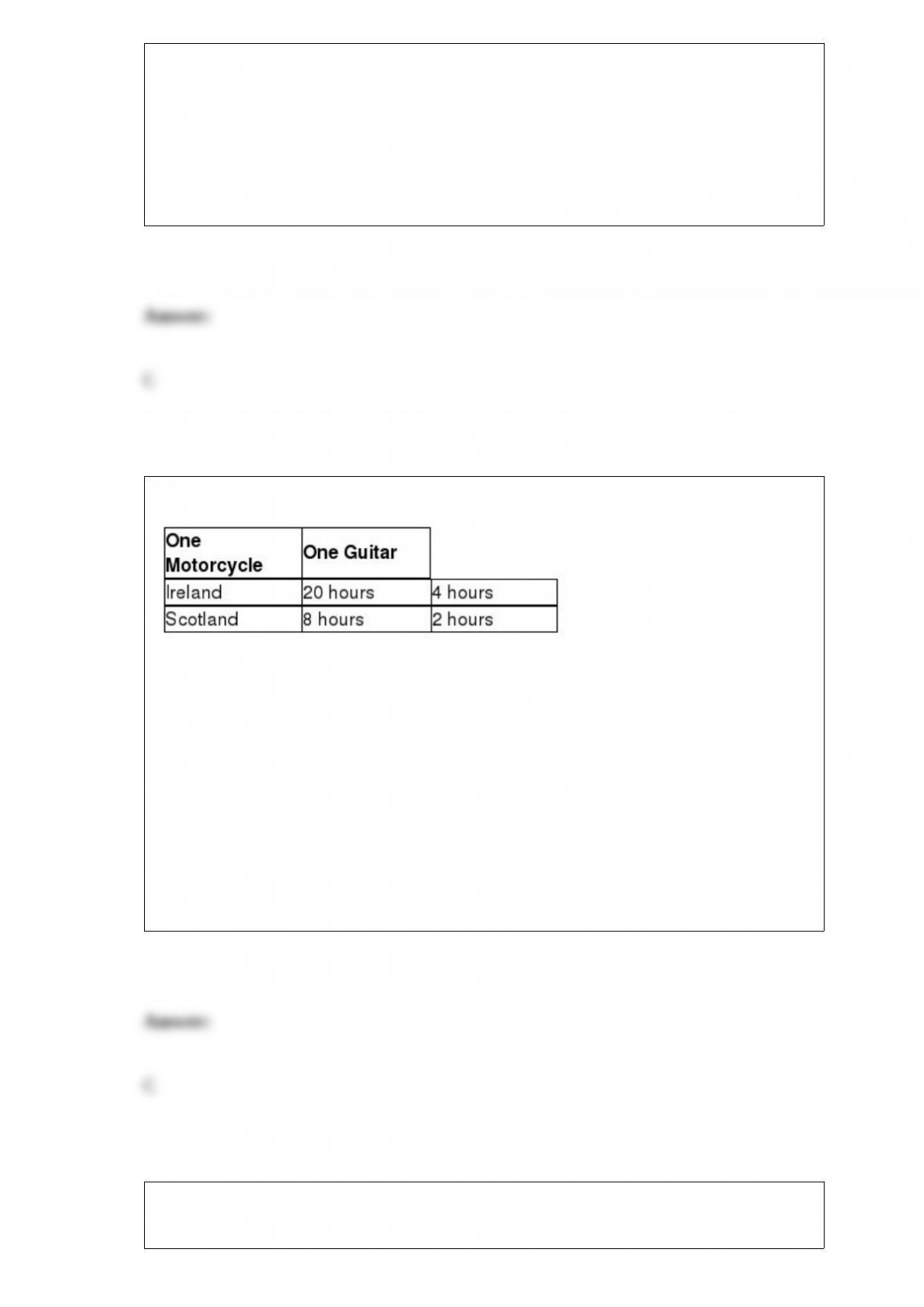
Table 2-11
Table 2-11 shows the number of labor hours required to produce a motorcycle and a
guitar in Ireland and Scotland.
If the two countries specialize and trade, who should export motorcycles?
A) There is no basis for trade between the two countries.
B) Ireland
C) Scotland
D) They should both be importing motorcycles.
When the U.S. government places a tariff on a product, such as the tariff on tires
imported from China, the quantity of the product imported will generally ________ and

the price paid by consumers for the product will generally ________.
A) increase; increase
B) increase; decrease
C) decrease; increase
D) decrease; decrease
The substitution bias in the consumer price index refers to the idea that consumers
________ the quantity of products they buy in response to price, and the CPI does not
reflect this and ________ the cost of the market basket.
A) change; overestimates
B) change; underestimates
C) do not change; overestimates
D) do not change; underestimates
Bringing oil to the market is a relatively long and costly process. The whole process
from exploration to pumping significant amounts of oil can take years. What does this
indicate about the price elasticity of supply for oil?
A) The elasticity coefficient is likely to be very high, and supply is inelastic.
B) The elasticity coefficient is likely to be close to zero, and supply is perfectly elastic.

C) The elasticity coefficient is likely to be low, and supply is highly inelastic.
D) The elasticity coefficient is likely to be low, and supply is highly elastic.
Nominal GDP will increase
A) only if the price level rises.
B) only if the price level falls.
C) only if the quantity of final goods and services produced rises.
D) if either the price level or the quantity of goods and services produced rises.
The 1994 agreement that eliminated most tariffs among the United States, Canada, and
Mexico is known as
A) the Pacific Trade Association.
B) Trade Without Borders.
C) NAFTA.
D) the Western Trade Union.

One requirement for a firm pursuing a price-discrimination strategy is the ability to
segment the market for its product. This means that
A) the firm must set different prices for different regions where the product is sold.
B) the firm must be willing to offer price discounts for senior citizens and children.
C) the firm must be able to divide the market in a way that makes arbitrage impossible.
D) the firm must choose a marketing strategy that appeals to different segments of the
economy.