1) the first, second, and third workers employed by a firm add 24, 18, and 9 units to
total product respectively. therefore, the:
a.marginal product of the third worker is 9.
b.total product of the three workers is 54.
c.average product of the three workers is 18.
d.marginal product of the first worker is 18.
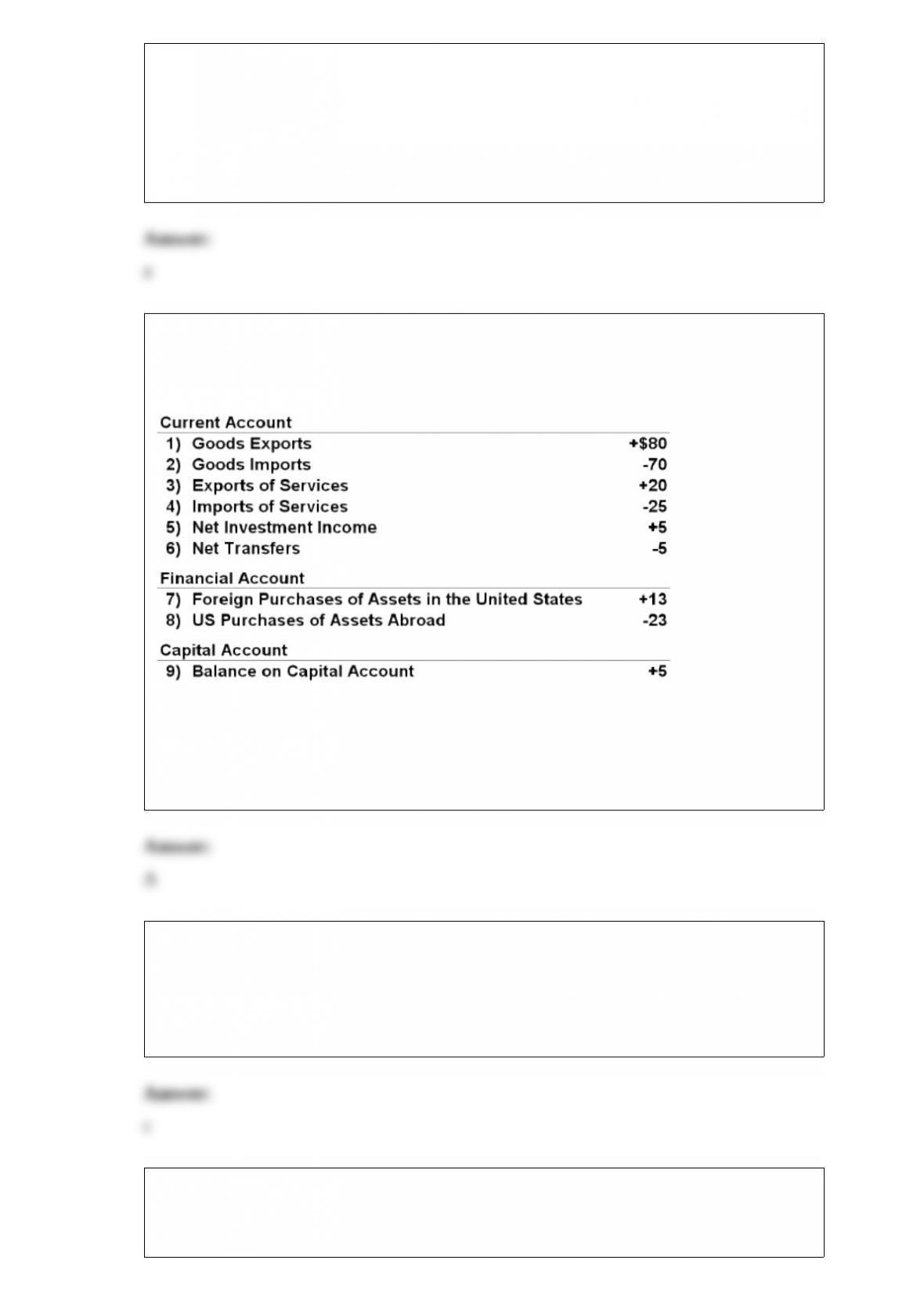
2) The following 2006 balance of payments data (+ and -) for the hypothetical nation of
Zabella. All figures are in billions of dollars.
Refer to the above data. Zabella’s balance on financial account shows a:
A.deficit of $10 billion.
B.surplus of $5 billion.
C.deficit of $28 billion.
D.surplus of $13 billion.
3) real gdp and nominal gdp differ because the real gdp:
a.is adjusted for changes in the volume of intermediate transactions.
b.includes the economic effects of international trade.
c.has been adjusted for changes in the price level.
d.excludes depreciation charges.
4) allocative efficiency is concerned with:
a.producing the combination of goods most desired by society.
b.achieving the full employment of all available resources.

c.producing every good with the least-cost combination of inputs.
d.reducing the concavity of the production possibilities curve.
5) Factors that impede the attainment of economic efficiency in the public sector are
called:
A.market failures.
B.externalities.
C.government failures.
D.voting irregularities.
6) The Earned Income Tax Credit:
A.increases the personal income tax liability of low-income working families.
B.provides a cash payment to low-income working families if their tax credit exceeds
their tax liability.
C.is designed to make labor force employment less attractive.
D.was eliminated as part of welfare reform in 1996.
7) The legal cartel theory of regulation argues that:
A.regulation encourages firms to inflate their production costs.
B.firms in certain industries want to be regulated rather than face the rigors of
competition.
C.social regulation has been carried beyond the point at which marginal benefits and
marginal costs are equal.
D.the government is the logical agency to protect consumers from natural monopolies.
8) If aggregate demand increases and aggregate supply decreases, the price level:
A.will decrease, but real output may either increase or decrease.
B.will increase, but real output may either increase or decrease.
C.and real output will both increase.
D.and real output will both decrease.
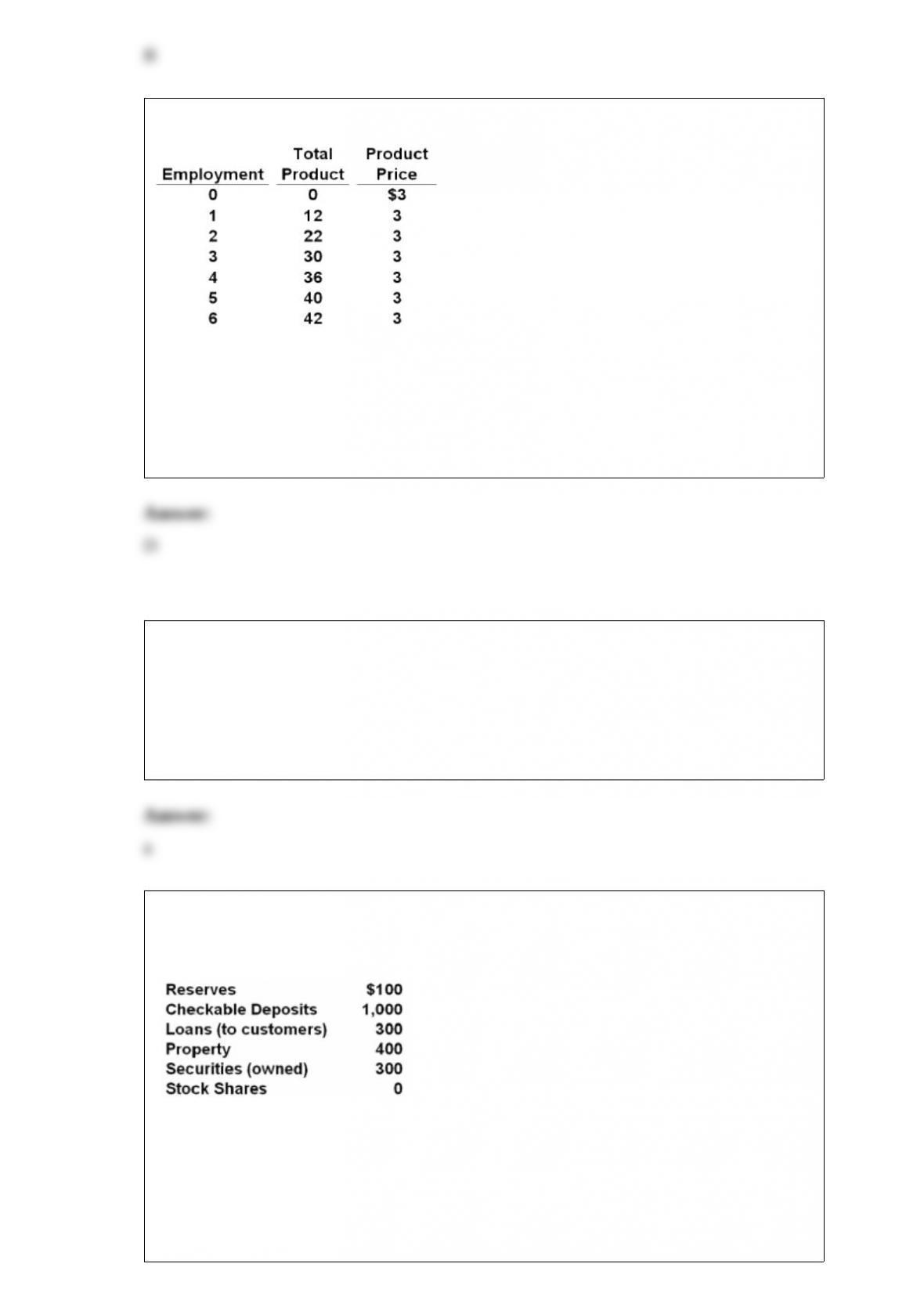
9)
Refer to the above data. If the firm is hiring workers under purely competitive
conditions at a wage rate of $10, it will employ:
A.2 workers.
B.3 workers.
C.4 workers.
D.5 workers.
10) a nation’s gross domestic product (gdp):
a.is the dollar value of all final output produced within the borders of the nation.
b.is the dollar value of all final output produced by its citizens, regardless of where they
are living.
c.can be found by summing c + in + s + xn.
d.is always some amount less than its c + ig+ g + xn.
11) The following information for the Moolah Bank.
Refer to the above information. If Moolah Bank is legally “loaned up,” the reserve
requirement must be:
A.10 percent.
B.15 percent.
C.20 percent.
D.25 percent.

12) (Consider This) According to economists Krueger and Perri:
A.Despite the fact that income inequality has increased in recent decades, consumption
inequality has remained relatively constant.
B.Increases in income inequality over recent decades understate the growth in
consumption inequality.
C.Both income and consumption inequality have increased at approximately the same
rate over recent decades.
D.Both income and consumption are more equally distributed than they were 30 years
ago.
13) Wealth represents:
A.a stock of real and financial assets.
B.a flow of income.
C.financial assets only.
D.real assets only.
14) The share of income going to the highest 10 percent of income receivers is:
A.nearly 75 percent in the United States.
B.lower in the United States than in some South American countries such as Mexico,
Guatemala, and Brazil.
C.lower today in the United States than in 1969.
D.remarkably similar over a wide range of nations, including those which are rich and
those which are poor.
15) The crowding model of discrimination suggests that:
A.women and selected minorities are systematically excluded from high-paying
occupations and crowded into low-paying occupations, decreasing their wages and
reducing domestic output.
B.employers having high discrimination coefficients will be crowded out by
nondiscriminating employers in the long run.
C.firms will base hiring decisions on group averages, rather than on individual
characteristics and productivity.
D.occupational segregation is largely the result of freely made rational choices of
women and minorities.