
When the price level rises from 110 to 115, the aggregate level of GDP supplied rises
from $80 billion to $120 billion. This ________ relationship represents the ________
relationship between the quantity of real GDP firms are willing to supply and the price
level.
A) negative; short-run
B) positive; short-run
C) negative; long-run
D) positive; long-run
A perfectly competitive firm earns a profit when price is
A) equal to minimum average total cost.
B) above minimum average total cost.
C) equal to minimum average variable cost.
D) equal to minimum average fixed cost.
One method of setting price using the cost-plus method is to add
A) a given percentage of marginal cost to marginal cost of production.
B) a given percentage of fixed cost to total fixed cost.
C) a given percentage of average total cost to average total cost.
D) a given percentage of average variable cost to average total cost.
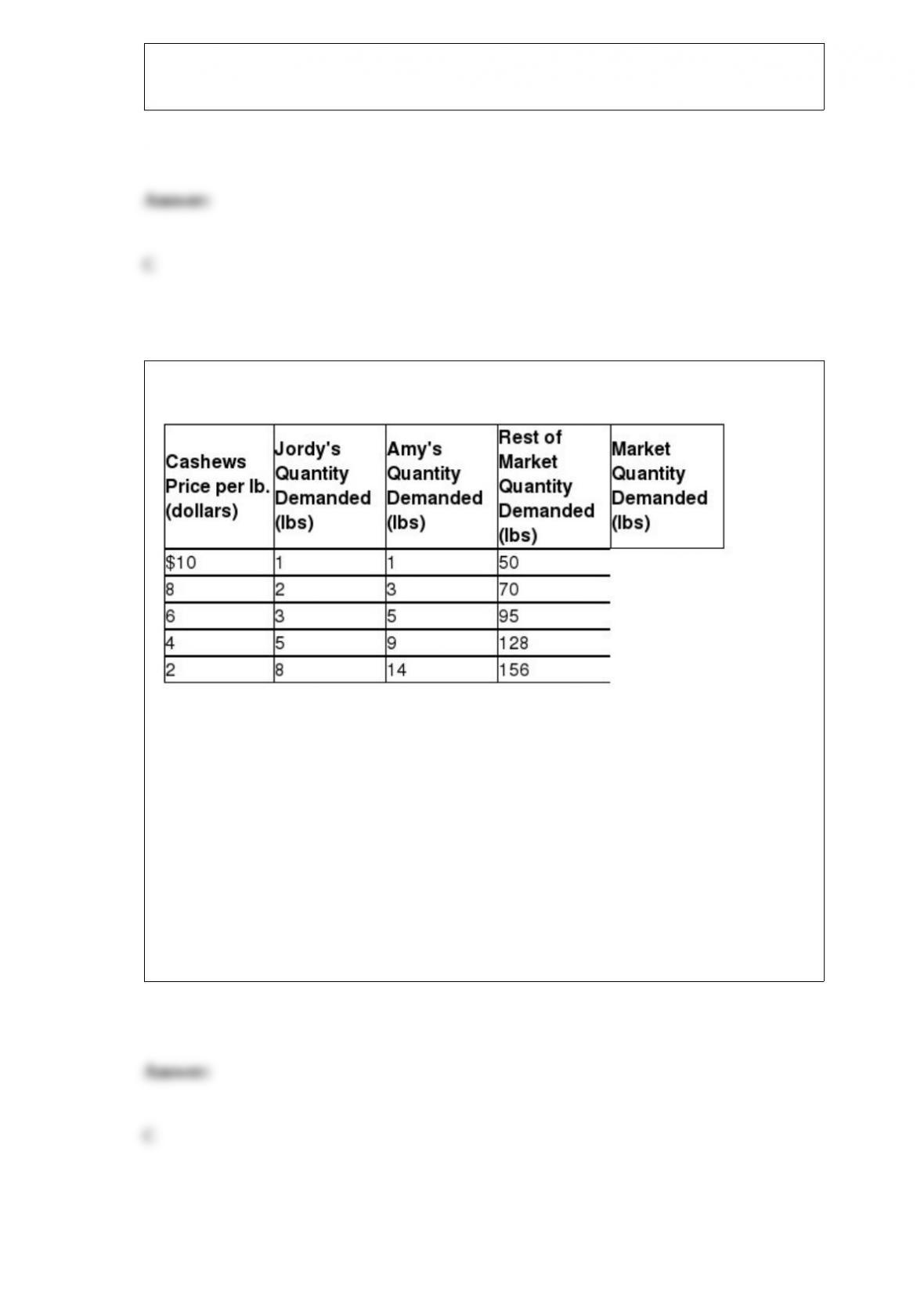
Table 3-4
The table above shows the demand schedules for cashews of two individuals (Jordy and
Amy) and the rest of the market. At a price of $6, the quantity demanded in the market
would be
A) 87 lbs.
B) 95 lbs.
C) 103 lbs.
D) 215 lbs.

Firms in a small economy anticipated that inventories would grow over the past year by
$750,000, and over that year, inventories grew by exactly $750,000. This implies that
A) aggregate expenditure and GDP were equal that year.
B) there was an unplanned increase in inventories that year.
C) there was an unplanned decrease in inventories that year.
D) aggregate expenditure was greater than GDP that year.
Hyperinflation can be caused by
A) the government selling bonds to the central bank.
B) the central bank selling bonds to the public.
C) the government selling bonds to the public.
D) the central bank selling bonds to the government.
Figure 18-3
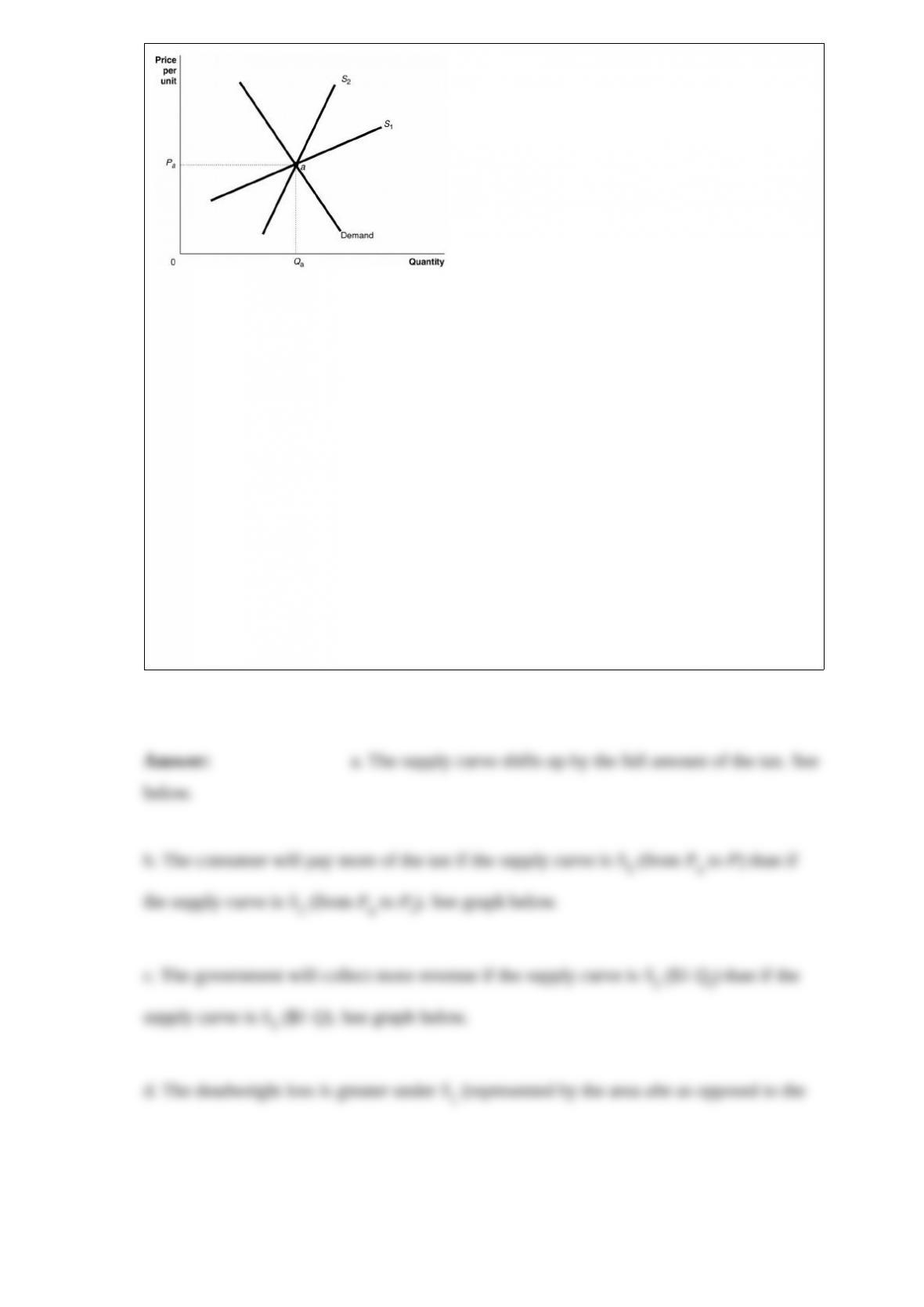
The figure above shows a demand curve and two supply curves, one more elastic than
the other. Use Figure 18-3 to answer the following questions.
a. Suppose the government imposes an excise tax of $1.00 on every unit sold. Use the
graph to illustrate the impact of this tax.
b. If the government imposes an excise tax of $1.00 on every unit sold, will the
consumer pay more of the tax if the supply curve is S1 or S2? Refer to the graphs in
your answer.
c. If an excise tax of $1.00 on every unit sold is imposed, will the revenue collected by
the government be greater if the supply curve is S1 or S2?
d. If the government imposes an excise tax of $1.00 on every unit sold, will the
deadweight loss be greater if the supply curve is S1 or S2?

The U.S. work week has declined from 60 hours in 1890 to 40 hours today. The impact
of the decline in working hours
A) increases U.S. GDP and increases the well-being of a typical working person in the
U.S.
B) increases U.S. GDP and decreases the well-being of a typical working person in the
U.S.
C) decreases U.S. GDP and increases the well-being of a typical working person in the
U.S.
D) decreases U.S. GDP and decreases the well-being of a typical working person in the
U.S.
National income is defined as
A) gross national product plus transfer payments.
B) gross national product less retained earnings plus transfer payments.
C) gross domestic product less retained earnings plus transfer payments.
D) gross domestic product less the consumption of fixed capital.

Tanesha sells homemade candles over the Internet. Her annual revenue is $64,000 per
year, the explicit costs of her business are $17,000, and the opportunity costs of her
business are $22,000. What are the implicit costs of her business?
A) $17,000
B) $22,000
C) $39,000
D) $47,000