1) In which of the following market structures is(are) there a large number of sellers?
(i)monopolistic competition
(ii)perfect competition
(iii)oligopoly
a.(i) and (ii) only
b.(ii) and (iii) only
c.(ii) only
d.(i), (ii), and (iii)
2) An increase in demand will cause an increase in price, which will cause an increase
in quantity supplied.
a.True
b.False
3) In a monopolistically competitive industry, a firm’s demand curve also represent its
a.marginal revenue.
b.marginal cost.
c.average revenue.
d.profit.
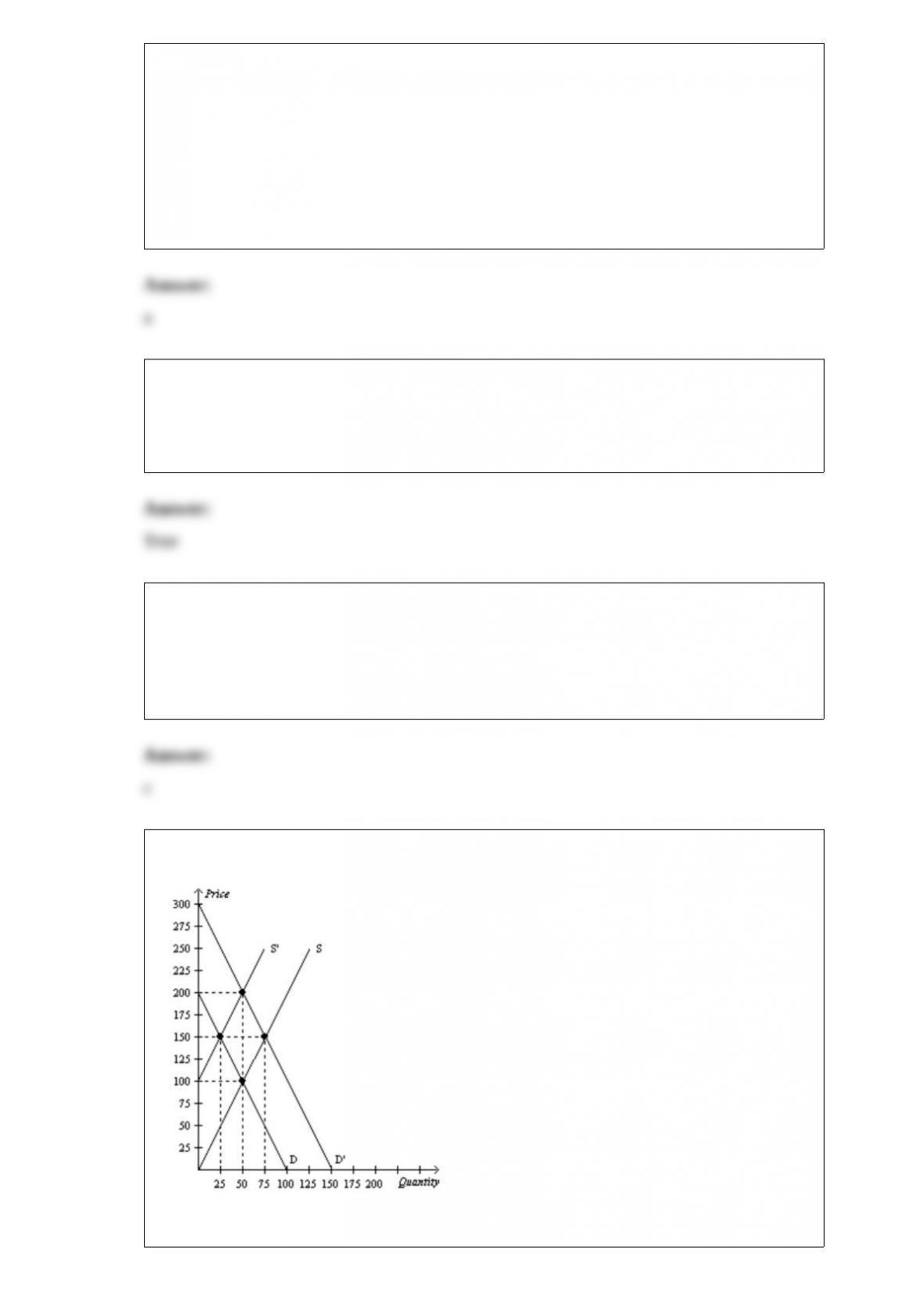
4) Figure 7-11
If the demand curve is D and the supply curve shifts from S’ to S, what is the change in

producer surplus?
a.Producer surplus increases by $625.
b.Producer surplus increases by $1,875.
c.Producer surplus decreases by $625.
d.Producer surplus decreases by $1,875.
5) The marginal product of labor is equal to the
a.incremental cost associated with a one unit increase in labor.
b.incremental profit associated with a one unit increase in labor.
c.increase in labor necessary to generate a one unit increase in output.
d.increase in output obtained from a one unit increase in labor.
6) If the for a good is 5, then a 10 percent increase in price results in a
a.0.5 percent decrease in the quantity demanded.
b.2 percent decrease in the quantity demanded.
c.5 percent decrease in the quantity demanded.
d.50 percent decrease in the quantity demanded.
7) The theory of consumer choice illustrates the
a.importance of property rights in creating efficient markets.
b.ability of a single economic actor to have a substantial influence on market prices.
c.the trade-offs that people face in their role as purchasers.
d.All of the above are correct.
8) Which of the following tax systems could not be structured to satisfy conditions of
vertical equity?
a.a proportional tax
b.a regressive tax
c.a progressive tax
d.a lump-sum tax
9) Miguel, Maria, and Marcos all would like a place to sit while waiting at their
children’s bus stop. The neighborhood association is considering installing several park
benches at the bus stop. Miguel values the benches at $20, Maria at $30, and Marcos at
$40. The park benches and labor for installation cost $100. If Miguel, Maria, and
Marcos are the only residents who value the benches, what should the neighborhood
association do?
a.Install the park benches because people like places to sit.
b.Install the park benches because the benefits outweigh the costs.
c.Do not install the park benches because the costs outweigh the benefits.
d.Do not install the park benches to prevent the Tragedy of the Commons problem of
overuse.
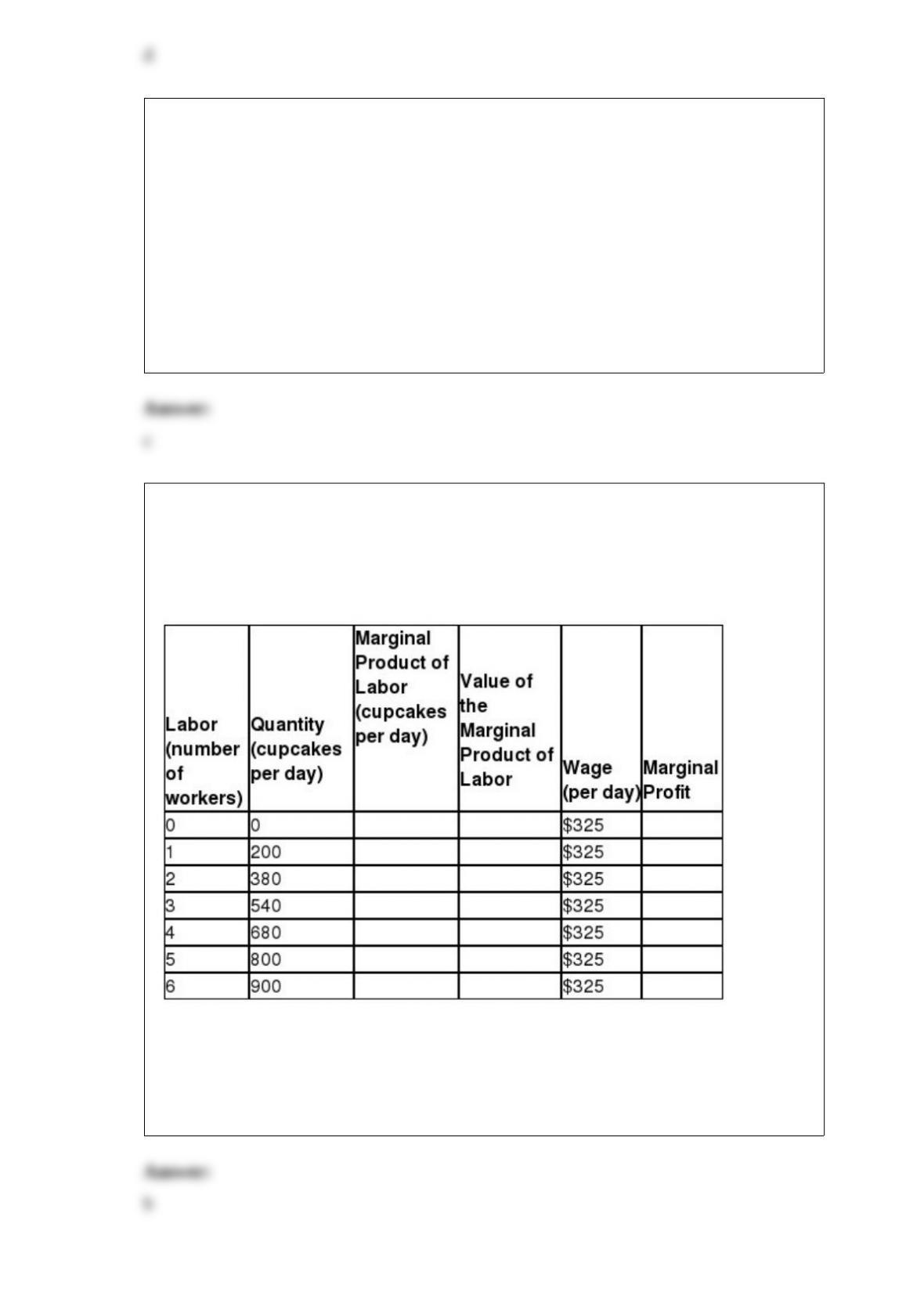
10) Table 18-11
Consider the following daily production data for MadeFromScratch, Inc.
MadeFromScratch sells cupcakes for $2 each and pays the workers a wage of $325 per
day.
Refer to Table 18-11. What is the value of the marginal product of the fifth worker?
a.$120
b.$240
c.$300
d.$1,600

11) Table 17-20
Nadia and Maddie are two college roommates who both prefer a clean common space
in their dorm room, but neither enjoys cleaning. The roommates must each make a
decision to either clean or not clean the dorm room’s common space. The payoff table
for this situation is provided below, where the higher a player’s payoff number, the
better off that player is. The payoffs in each cell are shown as (payoff for Nadia, payoff
for Maddie).
Refer to Table 17-20. If Maddie chooses to clean, then Nadia will
a.clean and Maddie’s payoff will be 30.
b.not clean and Maddie’s payoff will be 7.
c.clean and Maddie’s payoff will be 50.
d.not clean and Maddie’s payoff will be 10.
12) Other things equal, the deadweight loss of a tax
a.decreases as the size of the tax increases.
b.increases as the size of the tax increases, but the increase in the deadweight loss is
less rapid than the increase in the size of the tax.
c.increases as the size of the tax increases, and the increase in the deadweight loss is
more rapid than the increase in the size of the tax.
d.increases as the price elasticities of demand and/or supply increase, but the
deadweight loss does not change as the size of the tax increases.
13) In a competitive market the current price is $5. The typical firm in the market has
ATC = $5.50 and AVC = $5.15.
a.In the short run firms will shut down, and in the long run firms will leave the market.
b.In the short run firms will continue to operate, but in the long run firms will leave the
market.
c.New firms will likely enter this market to capture any remaining economic profits.
d.The firm will earn zero profits in both the short run and long run.

14) Tariffs and quotas are different in the sense that
a.tariffs cause deadweight losses, while quotas do not cause deadweight losses.
b.tariffs raise revenue for the government, while quotas do not raise revenue for the
government.
c.tariffs enhance the well-being of domestic consumers, while quotas diminish the
well-being of domestic consumers.
d.tariffs enhance the well-being of domestic producers, while quotas diminish the
well-being of domestic producers.