
A risk-averse individual will:
A. never accept any gamble.
B. accept a fair gamble.
C. only choose certain events.
D. accept only better-than-fair gambles.
The AD curve ______ because, holding all else constant, an increase in ______ causes
C, IP and NX to fall.
A. slopes downward; real GDP
B. slopes downward; the inflation rate
C. slopes upward; real GDP
D. is horizontal; the inflation rate
Joe is the owner of the 7-11 Mini Mart, Sam is the owner of the SuperAmerica Mini
Mart, and together they are the only two gas stations in town. Currently, they both
charge $3 per gallon, and each earns a profit of $1,000. If Joe cuts his price to $2.90 and
Sam continues to charge $3, then Joe’s profit will be $1,350, and Sam’s profit will be
$500. Similarly, if Sam cuts his price to $2.90 and Joe continues to charge $3, then
Sam’s profit will be $1,350, and Joe’s profit will be $500. If Sam and Joe both cut their
price to $2.90, then they will each earn a profit of $900. You may find it easier to
answer the following questions if you fill in the payoff matrix below.
In this situation, the Nash equilibrium yields a:
A. lower payoff than each would receive if each played his dominant strategy.
B. higher payoff than each would receive if each played his dominant strategy.
C. lower payoff than each would receive if each played his dominated strategy.
D. the same payoff that each would receive if each played his dominated strategy.
Suppose Erie Textiles can dispose of its waste “for free” by dumping it into a nearby
river. While the firm benefits from dumping waste into the river, the waste reduces fish
and bird reproduction. This causes damage to local fishermen and bird watchers. At a
cost, Erie Textiles can filter out the toxins, in which case local fishermen and bird
watchers will not suffer any damage. The relevant gains and losses (in thousands of
dollars) for the three parties are listed below.
When Erie Textiles operates without a filter, the total gain (in thousands of dollars) to
all three parties is ______.
A. $985
B. $325

C. $510
D. $475
One reason nonunionized firms do not always drive unionized firms out of business is
that:
A. markets are not competitive.
B. unionized firms reduce the value of total output.
C. unionized firms hire more selectively, employing workers with greater human
capital.
D. unionized firms receive government subsidies.
What might cause a supply function to shift to the left today?
A. An increase in the product’s own price.
B. An expectation that the product’s price will fall in the future.
C. An expectation that the product’s price will rise in the future.
D. A decrease in the price of one of the inputs to making the product.

The value of the marginal product of new capital increases when the:
A. price of new capital goods increases.
B. real interest rate increases.
C. the price of the good the firm produces decreases.
D. productivity of new capital increases.
Economic growth may face environmental limits because:
A. economic growth can take the form of new, different, and “cleaner” goods and
services.
B. economic growth may lead to less, not more, pollution.
C. the market mechanism mobilizes resources to deal with shortages.
D. global environmental problems are not handled by markets or national governments.
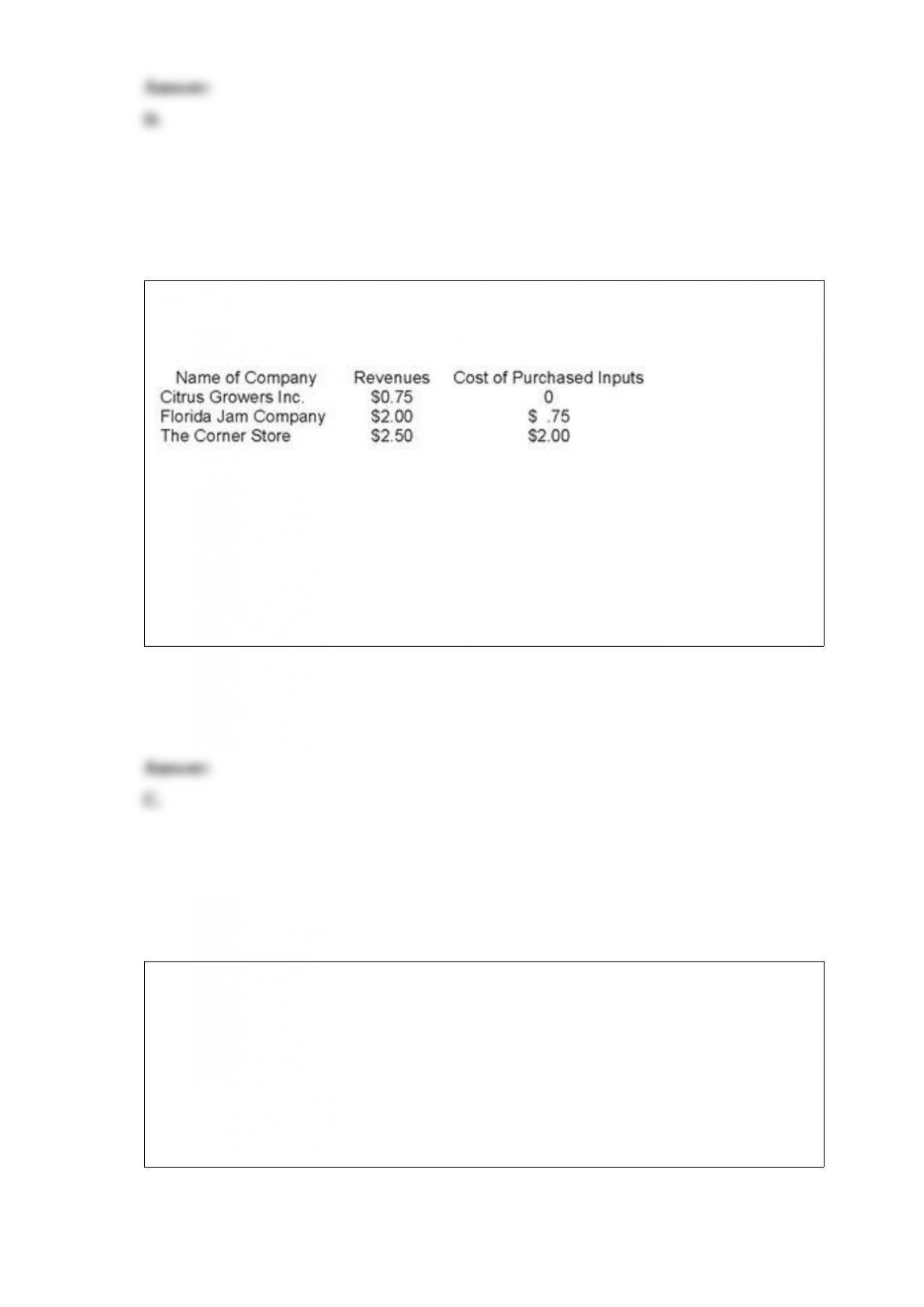
Suppose a jar of orange marmalade that is ultimately sold to a customer at The Corner
Store is produced by the following production process:
What is the value added of Florida Jam Company?
A. $0.50
B. $0.75
C. $1.25
D. $2.00
If the output gap equals -3.2 percent, then:
A. cyclical unemployment equals the sum of structural and frictional unemployment.
B. there is a recessionary gap.
C. there is no cyclical unemployment.
D. potential GDP is lower than actual GDP.

An economy produces 1,000,000 computers valued at $2,000 each. Households
purchase 200,000 computers, of which 100,000 are imported. Businesses purchase
300,000 domestically produced computers, the government purchases 300,000
domestically produced computers, and 100,000 domestically produced computers are
sold abroad. At the end of the year, the computer manufacturers hold the unsold
computers in inventory.. What is the value of the investment component of GDP?
A. $0.6 billion
B. $0.8 billion
C. $0.9 billion
D. $1.0 billion
Suppose Vinnie is looking for a month-long vacation rental in San Diego. The first
vacation rental Vinnie finds costs $800 per month. If he looks for another vacation
rental, there’s a 75 percent chance he’ll find another one for $800 per month and a 25
percent chance he’ll find one for $600 per month. Other than price, all of the vacation
rentals are identical. Vinnie’s marginal cost of searching for an additional vacation
rental is $45. Since searching for another apartment is a ______ gamble, if Vinnie is
risk-neutral, then he ______ search for another apartment.
A. better-than-fair; will not
B. better-than-fair; will
C. fair; will not
D. fair; will

Refer to the figure below. If the price of soda is $1.25 per can, then the quantity of soda
demanded in the market each week is:
A. 40
B. 30
C. 10
D. 0
On January 1, 2008, Edward invested $10,000 at 5% interest for one year. The CPI on
January 1, 2008 stood at 1.60. On January 1, 2009, the CPI was 1.76. The real rate of
interest earned by Edward was ______ percent.
A. -5
B. 0
C. 5
D. 10

A college graduate in 1972 found a job paying $7,200. The CPI was 0.418 in 1972. A
college graduate in 2005 found a job paying $28,000. The CPI was 1.68 in 2005. The
1972 graduate’s job paid ______ in nominal terms and ______ in real terms than the
2005 graduate’s job.
A. more; less
B. more; more
C. less; more
D. less, less
Refer to the figure below. If this firm is a price taker, then when the price of each unit if
output is $15, what is this firm’s profit-maximizing level of output?
A. 0
B. 45
C. 60
D. 80

If a consumer reallocates his or her spending away from good B and towards good A,
then the consumer’s total utility will increase if:
A. MUA/PA > MUB/PB
B. MUA/PA < MUB/PB
C. MUA/PA > 0 and MUB/PB > 0
D. MUA/PA < 0 and MUB/PB < 0
Player 1 and Player 2 are playing a game in which Player 1 has the first move at A in
the decision tree shown below. Once Player 1 has chosen either Up or Down, Player 2,
who can see what Player 1 has chosen, must choose Up or Down at B or C. Both
players know the payoffs at the end of each branch.
If Player 2 could make a credible commitment to choose either Up or Down when his
or her turn came, then what would Player 2 do?
A. Player 2 would not commit to choosing either strategy.
B. Player 2 would commit to choosing Up.
C. Player 2 would commit to choosing Down.
D. Player 2 would commit to mimicking Player 1’s strategy.

This graph shows the marginal cost and marginal benefit associated with roadside litter
clean up. Assume that the marginal benefit curve and marginal cost curve each have
their usual slope.
According to this graph, the marginal benefit of litter removal is highest when the
______ bag of litter is removed.
A. first
B. 10th
C. 15th
D. 30th
Involuntary part-time workers are:
A. chronically unemployed.
B. considered out of the labor force.
C. short-term unemployed workers.
D. not counted as unemployed.

Suppose Sarah owns a small company that makes wedding cakes. The table below
shows how Sarah’s total cost varies depending on the number of wedding cakes she
makes each day.
If the market for wedding cakes is perfectly competitive, and wedding cakes sell for
$95 each, then at her profit-maximizing level of output, Sarah will earn a ______ of
______ per day.
A. loss; $100
B. loss; $15
C. profit; $15
D. profit; $285
Suppose farmers in a given market can either grow soy beans or corn on their land. In
addition, suppose an increase in the demand for corn causes the price of corn to
increase. As a result of the increase in the price of corn, farmers who were already
growing corn will earn an:
A. economic loss in the short run.
B. economic profit in the long run.
C. economic profit in the short run.
D. economic loss in the long run.

In a short-run Keynesian model where the marginal propensity to consume is 0.5, to
offset a recessionary gap resulting from a $1 billion decrease in autonomous
consumption, government purchases must be:
A. increased by $1 billion.
B. decreased by $1 billion.
C. increased by $0.5 billion.
D. increased by $2 billion.
Matt is offered a job driving the campus shuttle bus from 4 p.m. to 6 p.m. each Monday.
His reservation wage for this job is $7 per hour. Now suppose the director offers Matt
$50 per hour, but also announces that the earnings from the job will be divided equally
among Matt and four other students. Will Matt accept this job?
A. No, because the other students are free riders.
B. No, because it is not fair for Matt to do the work and then have to share the wage.
C. Yes, because $50 divided by five is greater than Matt’s reservation wage.

D. Yes, because Matt believes in the Rawlsian theory of justice.
Announced numerical inflation targets are advocated for all of the following reasons
except that announced inflation targets:
A. reduce inflation uncertainty.
B. anchor inflationary expectations.
C. enhance central bank credibility.
D. eliminate the tradeoff between maintaining output or inflation in the event of adverse
inflationary shocks.
In Econland autonomous consumption equals 700, the marginal propensity to consume
equals 0.80, net taxes are fixed at 50, planned investment is fixed at 100, government
purchases are fixed at 100, and net exports are fixed at 40. The slope of the expenditure
line is:
A. 0.20.
B. 0.80.
C. 0.90.

D. 0.99.
Holding all else constant, an increase in preferences by Mexicans for U.S. goods will
______ the demand for dollars in the foreign exchange market and ______ the
equilibrium Mexican peso/U.S. dollar exchange rate.
A. increase; increase
B. increase; decrease
C. decrease; decrease
D. decrease; increase
Paper Pushers Inc. hires workers in a competitive labor market. Apart from labor, the
company has no other variable inputs. The company’s hourly output varies with the
number of workers hired, as shown in the table below.
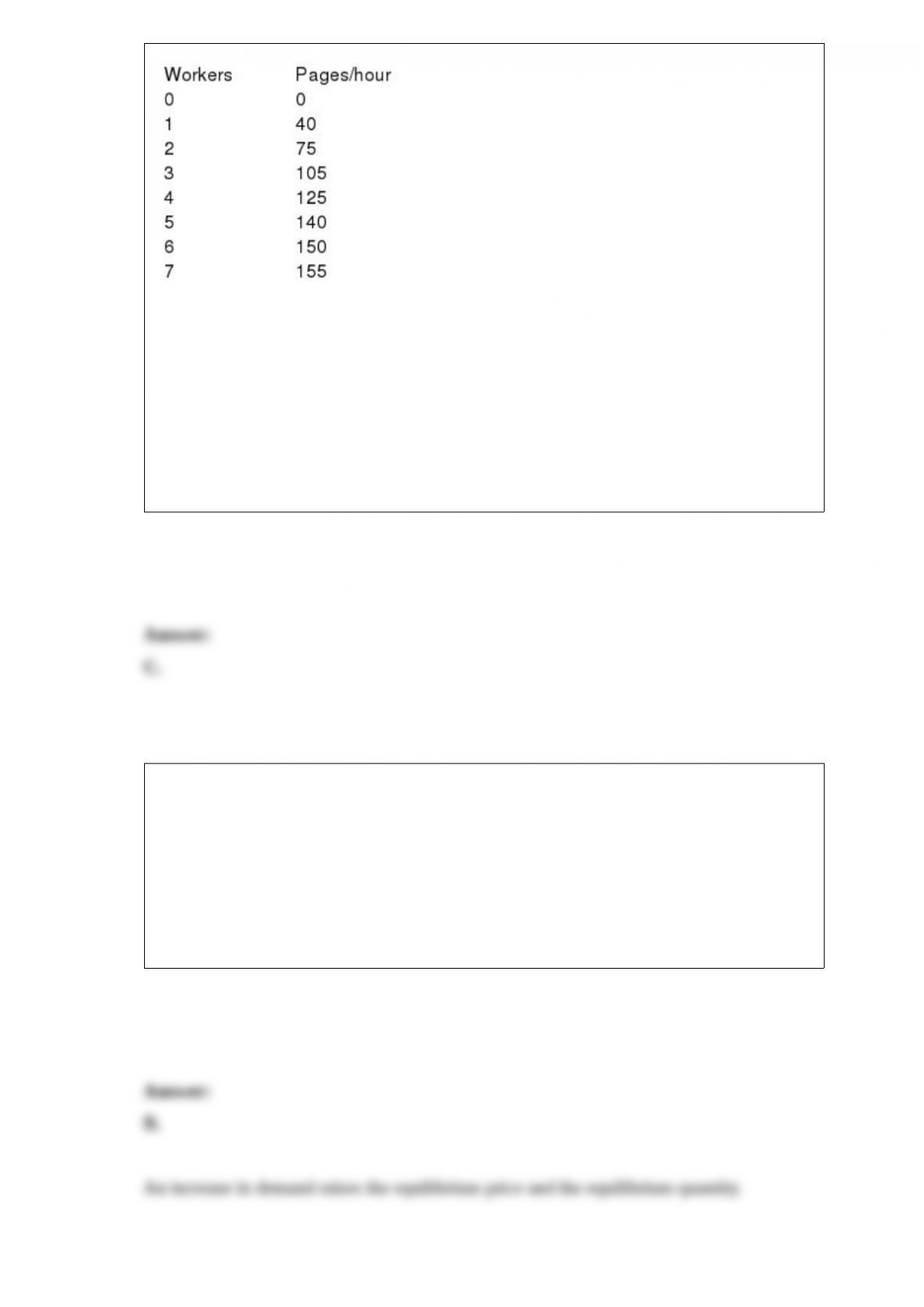
If each page sells for $2 and the market wage is $15 per hour, then this firm will hire
______ workers per hour.
A. 4
B. 5
C. 6
D. 7
An increase in the demand for GM automobiles results in:
A. a lower equilibrium price for GM automobiles.
B. an increase in the quantity supplied of GM automobiles.
C. an increase in the supply of GM automobiles.
D. a lower equilibrium quantity of GM automobiles.

Organizing production, obtaining financing, assigning workers to jobs, and dealing with
suppliers are among the ways that ______ increases average labor productivity.
A. human capital
B. physical capital
C. an entrepreneur
D. a manager
The aggregate supply curve will shift rightward in response to:
A. an increase in the expected rate of inflation.
B. a decrease in the expected rate of inflation.
C. an increase in potential GDP.
D. a decrease in potential GDP.
If the popular television show The Bachelor is shown on pay-per-view television every
Monday at 9pm, then the demand curve for each episode is given below.

If the regulated pay-per-view charge is decreased from $20 to $0 per household, what
would be the gain in total economic surplus?
A. $4000 million
B. $320 million
C. $1280 million
D. $720 million
If the price elasticity of demand for cigarettes is 0.55, and the price of cigarettes
increases by 10 percent, then the quantity of cigarettes demanded will fall by:
A. 0.55 percent.
B. 5.5 percent.
C. 55 percent.
D. 550 percent.