
Suppose the market demand curve for cable internet service is completely elastic. At the
market equilibrium price under perfect competition, the consumer surplus in this market
equals:
A) total consumer expenditures.
B) total sales revenue.
C) zero.
D) an amount slightly more than total consumer expenditure.
In the dominant firm model, the fringe firms
A) are price takers.
B) maximize profit by equating average revenue and average cost.
C) determine their price and output before the dominant firm determines its price and
output.
D) all of the above
E) none of the above
For national security reasons a government decides that all of its base metal industry
should not be located in the same geographical region, as it presently is. The

government decides to allocate production quotas to firms in different parts of the
country, but does not restrict in any way the transactions between consumers and base
metal producers. This scheme is
A) efficient as consumers still buy from whoever they like.
B) efficient as those consumers who value base metals the most can purchase them.
C) likely to be inefficient as some of the industry’s output is not produced by the firms
with the lowest cost.
D) likely to be inefficient as the scheme will require subsidies to work.
E) efficient as learning by doing effects will be strongest in the firms set up in new
geographical regions.
You are analyzing the demand for good X. Which of the following will result in a shift
to the right of the demand curve for X?
A) A decrease in the price of X
B) An increase in the price of a good that is a complement to good X
C) An increase in the price of a good that is a substitute for X
D) all of the above

When one party suffers negative external effects due to the actions of another party, a
lawsuit may not lead to the efficient outcome if:
A) property rights are not clearly assigned.
B) the parties have incomplete information.
C) the legal costs of the lawsuit are too high.
D) All of the above
The demand curve facing a perfectly competitive firm is
A) the same as the market demand curve.
B) downward-sloping and less flat than the market demand curve.
C) downward-sloping and more flat than the market demand curve.
D) perfectly horizontal.
E) perfectly vertical.
The market structure in which strategic considerations are most important is
A) monopolistic competition.

B) oligopoly.
C) pure competition.
D) pure monopoly.
Joan Summers has $100,000 to invest and is considering two alternatives. She can buy
a risk free asset that will pay 10% or she can invest in a stock that has a 0.4 chance of
paying 15%, a 0.3 chance of paying 18%, and a 0.3 chance of providing a 6% return.
Joan plans to invest $70,000 in the stock and $30,000 in the risk free asset.
a. Determine the expected percentage return on the stock and the standard deviation.
b. Calculate the weighted average return on the portfolio, given the planned investment
strategy outlined above.
c. Determine the standard deviation for the portfolio.
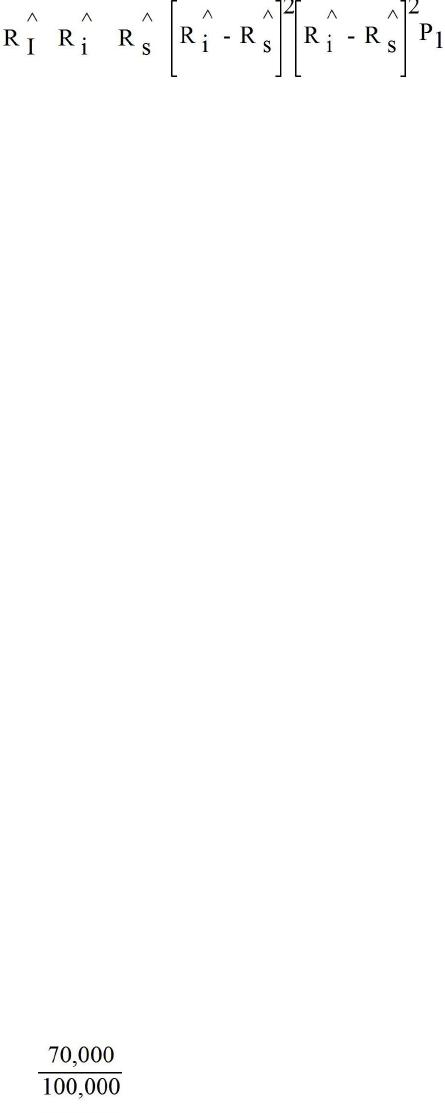
d. Write the equation that represents the budget line in the risk-return tradeoff. What is
the slope of the budget line? Interpret this slope.
Scenario 13.1:
You are negotiating with your florist over the price of flowers for your wedding. You
value the floral arrangements at $500. The florist’s cost for the arrangement is $200.
You finally settled on a price of $250.
Refer to Scenario 13.1. At your negotiated price your consumer surplus is:
A) $50.
B) $200.
C) $250.
D) $300.

Consider the information below:
For Group A the cost of attaining an educational level y is
CA(y) = $6,000y
and for Group B the cost of attaining that level is
CB (y) = $10,000y.
Employees will be offered $50,000 if they have y < y*, where y* is an education
threshold determined by the employer. They will be offered $130,000 if they have y >
y*.
An employer who only wants to hire those people who find learning less costly can do
so by choosing y* to be anywhere between
A) 15 and 45.
B) 15 and 30.
C) 13 1/3 and 30.
D) 8 and 20.
E) none of the above
Two isoquants, which represent different output levels but are derived from the same
production function, cannot cross because
A) isoquants represent different utility levels
B) this would violate a technical efficiency condition
C) isoquants are downward sloping
D) additional inputs will not be used by profit maximizing firms if those inputs
decrease output
E) Both B and D are true.
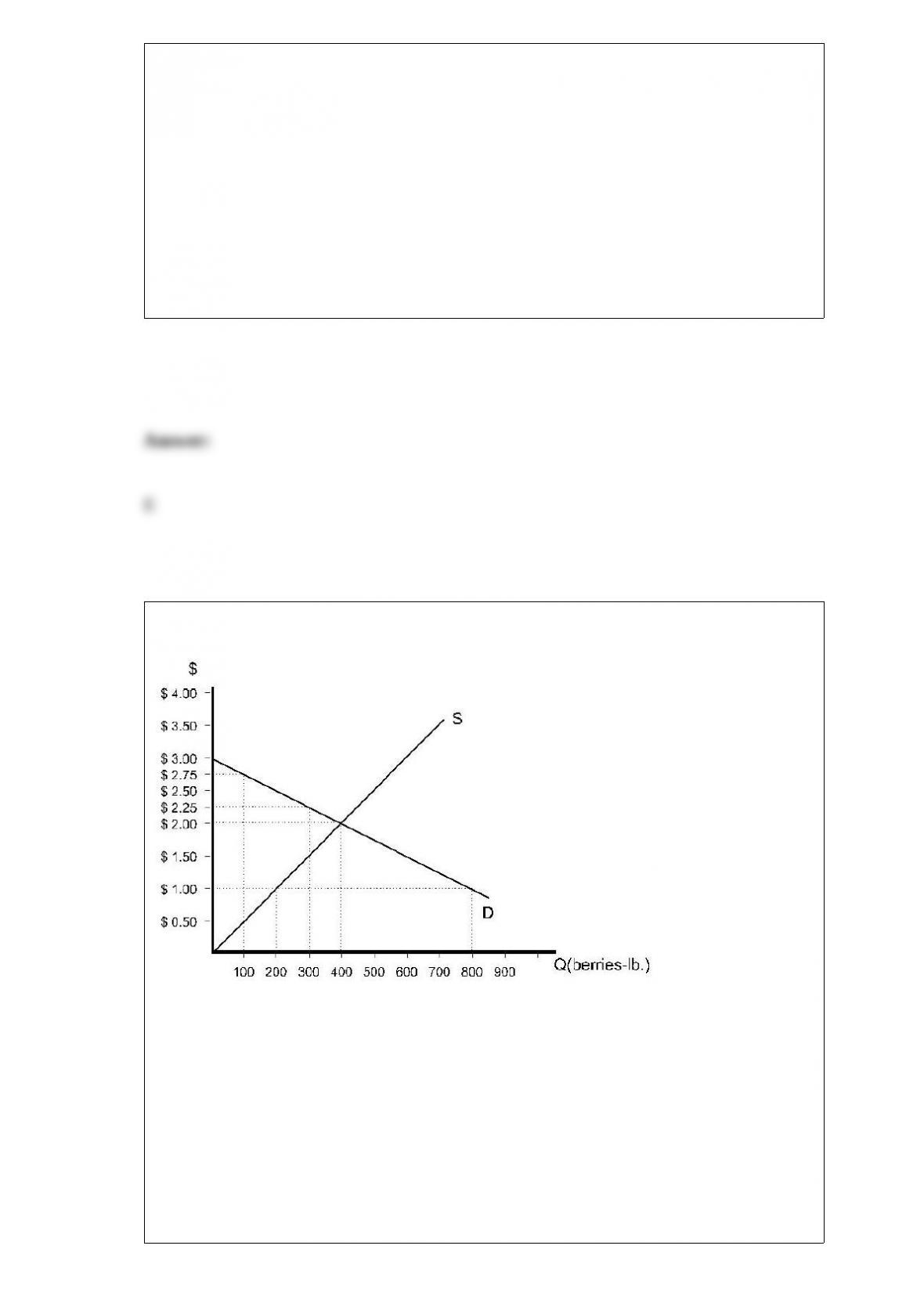
Figure 9.3
Refer to Figure 9.3. If the government establishes a price ceiling of $1.00, the resulting
deadweight loss will be
A) $1.50.
B) $200.
C) $150.

D) $300.
E) $600.
Luxury brands like designer sunglasses are goods that may exhibit snob effects.
Suppose this is true, and the price for a particular brand increases. What happens to the
component changes in the quantity demanded?
A) Pure price effect and snob effect are negative
B) Pure price effect and snob effect are positive
C) Pure price effect is positive, snob effect is negative
D) Pure price effect is negative, snob effect is positive
Which of the following would shift the demand curve for new textbooks to the right?
A) A fall in the price of paper used in publishing texts
B) A fall in the price of equivalent used textbooks
C) An increase in the number of students attending college
D) A fall in the price of new textbooks.

The “perfect information” assumption of perfect competition includes all of the
following except one. Which one?
A) Consumers know their preferences.
B) Consumers know their income levels.
C) Consumers know the prices available.
D) Consumers can anticipate price changes.
E) Firms know their costs, prices and technology.
Scenario 10.2:
A monopolist faces the following demand curve, marginal revenue curve, total cost
curve and marginal cost curve for its product:
Q = 200 – 2P
MR = 100 – Q
TC = 5Q
MC = 5
Refer to Scenario 10.2. Suppose that a tax of $5 for each unit produced is imposed by
state government. How much profit does the monopolist earn?

A) $4050
B) $4950
C) $450
D) $5
The Laspeyres price index tends to ________ the ideal cost-of-living index.
A) be higher than
B) be lower than
C) be equal to
D) zero faster than
All possible efficient allocations of 2 goods between 2 people are located on
A) the indifference curve.
B) the contract curve.
C) the production possibilities frontier.
D) the budget line.

Which of the following policies could lead to a deadweight loss?
A) price ceilings.
B) price floors.
C) policies prohibiting human cloning.
D) all of the above
E) A and B only
Consider two identical firms (no. 1 and no. 2) that face a linear market demand curve.
Each firm has a marginal cost of zero and the two firms together face demand:
P = 50 – 0.5Q, where Q = Q1 + Q2.
a. Find the Cournot equilibrium Q and P for each firm.
b. Find the equilibrium Q and P for each firm assuming that the firms collude and share
the profit equally.
c. Contrast the efficiencies of the markets in (a) and (b) above.
Consider the following diagram where a perfectly competitive firm faces a price of $40.
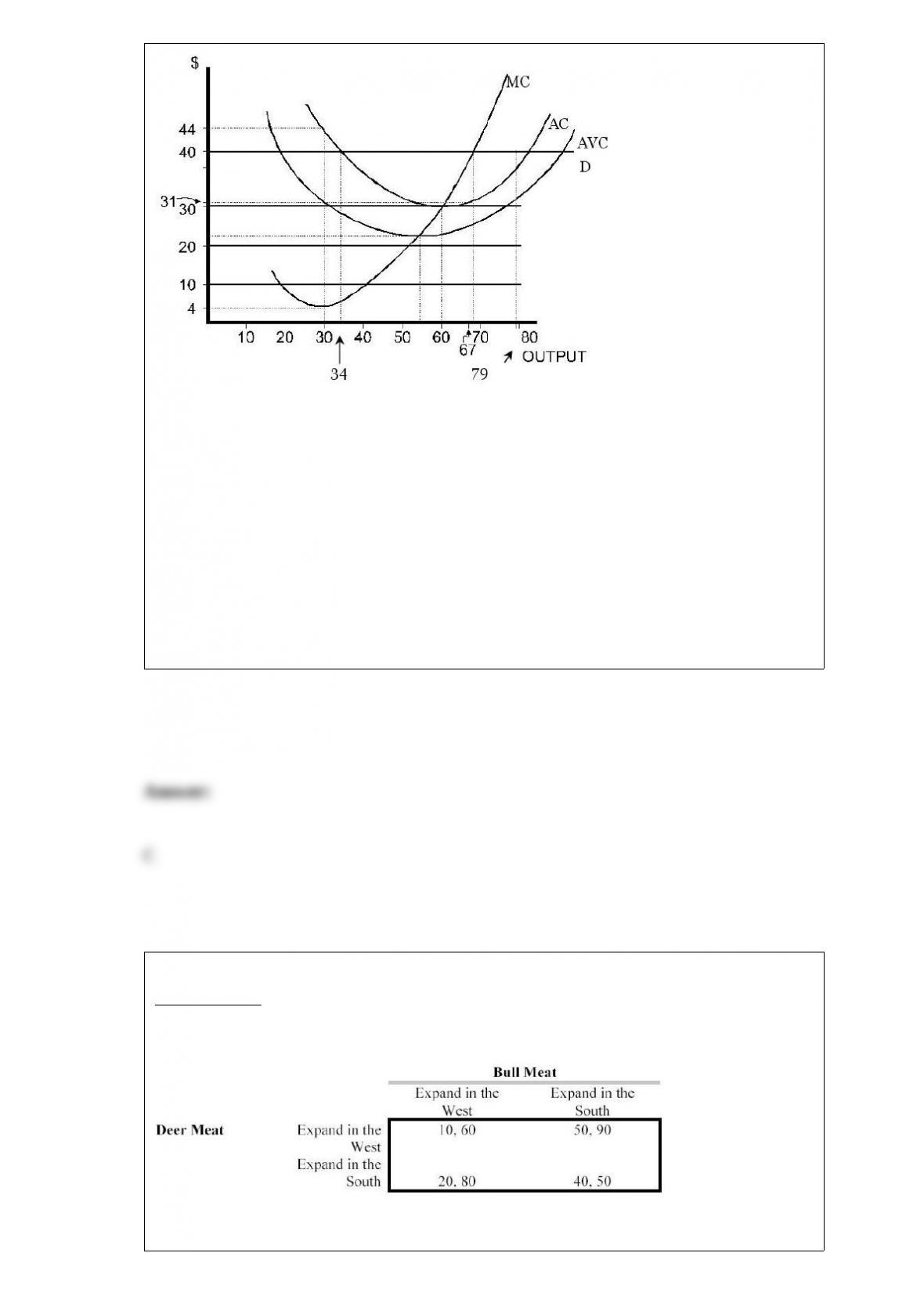
At the profit-maximizing level of output, ATC is
A) $26.
B) $30.
C) $31.
D) $40.
E) $44.
Scenario 13.5
Consider the following game:
In the game in Scenario 13.5,

A) there is one equilibrium: for both to expand West.
B) there is one equilibrium: for both to expand South.
C) there are two equilibria: either can expand in the West, and the other expands in the
South.
D) there is only a mixed strategies equilibrium.
E) all four outcomes are equilibria.
A production function assumes a given
A) technology.
B) set of input prices.
C) ratio of input prices.
D) amount of capital and labor.
E) amount of output.
Which of the following is NOT a generally accepted measure of the riskiness of an
investment?

A) Standard deviation
B) Expected value
C) Variance
D) none of the above
The local zoo has hired you to assist them in setting admission prices. The zoo’s
managers recognize that there are two distinct demand curves for zoo admission. One
demand curve applies to those ages 12 to 64, while the other is for children and senior
citizens. The two demand and marginal revenue curves are:
PA = 9.6 – 0.08QA
MRA = 9.6 – 0.16QA
PCS = 4 – 0.05QCS
MRCS = 4 – 0.10QCS
where PA = adult price, PCS = children’s/senior citizen’s price, QA = daily quantity of
adults, and QCS = daily quantity of children and senior citizens. Crowding is not a
problem at the zoo, so that the managers consider marginal cost to be zero.
a. If the zoo decides to price discriminate, what are the profit maximizing price and
quantity in each market? Calculate total revenue in each sub-market.
b. What is the elasticity of demand at the quantities calculated in (a) for each market.
Are these elasticities consistent with your understanding of profit maximization and the
relationship between marginal revenue and elasticity?


Scenario 10.3:
The demand curve and marginal revenue curve for red herrings are given as follows:
Q = 250 – 5P
MR = 50 – 0.4Q
Refer to Scenario 10.3. At the profit-maximizing level of output, demand is
A) completely inelastic.
B) inelastic, but not completely inelastic.
C) unit elastic.
D) elastic, but not infinitely elastic.
E) infinitely elastic.
Bill currently uses his entire budget to purchase 5 cans of Pepsi and 3 hamburgers per
week. The price of Pepsi is $1 per can, the price of a hamburger is $2, Bill’s marginal
utility from Pepsi is 4, and his marginal utility from hamburgers is 6. Bill could increase
his utility by:
A) increasing Pepsi consumption and reducing hamburger consumption.
B) increasing hamburger consumption and reducing Pepsi consumption.

C) maintaining his current consumption choices.
D) We do not have enough information to answer this question.
Sugar can be refined from sugar beets. When the price of those beets falls,
A) the demand curve for sugar would shift right.
B) the demand curve for sugar would shift left.
C) the supply curve for sugar would shift right.
D) the supply curve for sugar would shift left.
Scenario 10.5:
A firm produces garden hoses in California and in Ohio. The marginal cost of producing
garden hoses in the two states and the marginal revenue from producing garden hoses
are given in the following table:
California Ohio
Qc MCc Qo MCo Qc + o MR
1 2 1 3 1 24
2 3 2 4 2 20

3 5 3 6 3 16
4 9 4 8 4 12
5 16 5 12 5 8
6 24 6 17 6 4
Refer to Scenario 10.5. From the perspective of the firm, what is the marginal cost of
the 5th garden hose?
A) 4
B) 5
C) 16
D) 12
E) 8
Another commonly used algebraic form for a demand function is the semi-logarithmic
functional form, ln(Q) = a – bP + cI, where Q is quantity demanded, P is the product
price, and I is income. Here, 100 c represents the percentage change in quantity
demanded given a one unit increase in income. For a normal good, we should expect
the value of c to be:
A) positive.
B) negative.
C) positive or negative.
D) We do not have enough information to answer this question.

A third-degree price discriminating monopolist can sell its output either in the local
market or on an internet auction site (or both). After selling all of its output, the firm
discovers that the marginal revenue earned in the local market was $20 while its
marginal revenue on the internet auction site was $30. To maximize profits the firm
should
A) have sold more output in the local market and less at the internet auction site.
B) do nothing until it acquires more information on costs.
C) have sold less output in the local market and more on the internet auction site.
D) sell less in both markets until marginal revenue is zero.
E) sell more in both markets until marginal cost is zero.
The supply curve for a competitive firm is
A) its entire MC curve.
B) the upward-sloping portion of its MC curve.
C) its MC curve above the minimum point of the AVC curve.
D) its MC curve above the minimum point of the ATC curve.
E) its MR curve.

Use the following two statements to answer this question:
I. Consumer theory can determine whether giving an individual a more preferred basket
of goods doubles her overall level of satisfaction, less than doubles her satisfaction, or
more than doubles her satisfaction.
II. There is not much empirical evidence to support the assumption that higher incomes
result in higher levels of satisfaction.
A) Both I and II are true.
B) I is true and II is false.
C) I is false and II is true.
D) Both I and II are false.
Suppose that the long-run world demand and supply elasticities of crude oil are -0.906
and 0.515, respectively. The current long-run equilibrium price is $30 per barrel and the
equilibrium quantity is 88 billion barrels per year. Derive the linear long-run demand
and supply equations. Next, suppose the long-run supply curve you derived above
consists of competitive supply and OPEC supply. If the long-run competitive supply
equation is: SC= 7.78 + 0.29P, what must be OPEC’s level of production in this
long-run equilibrium?
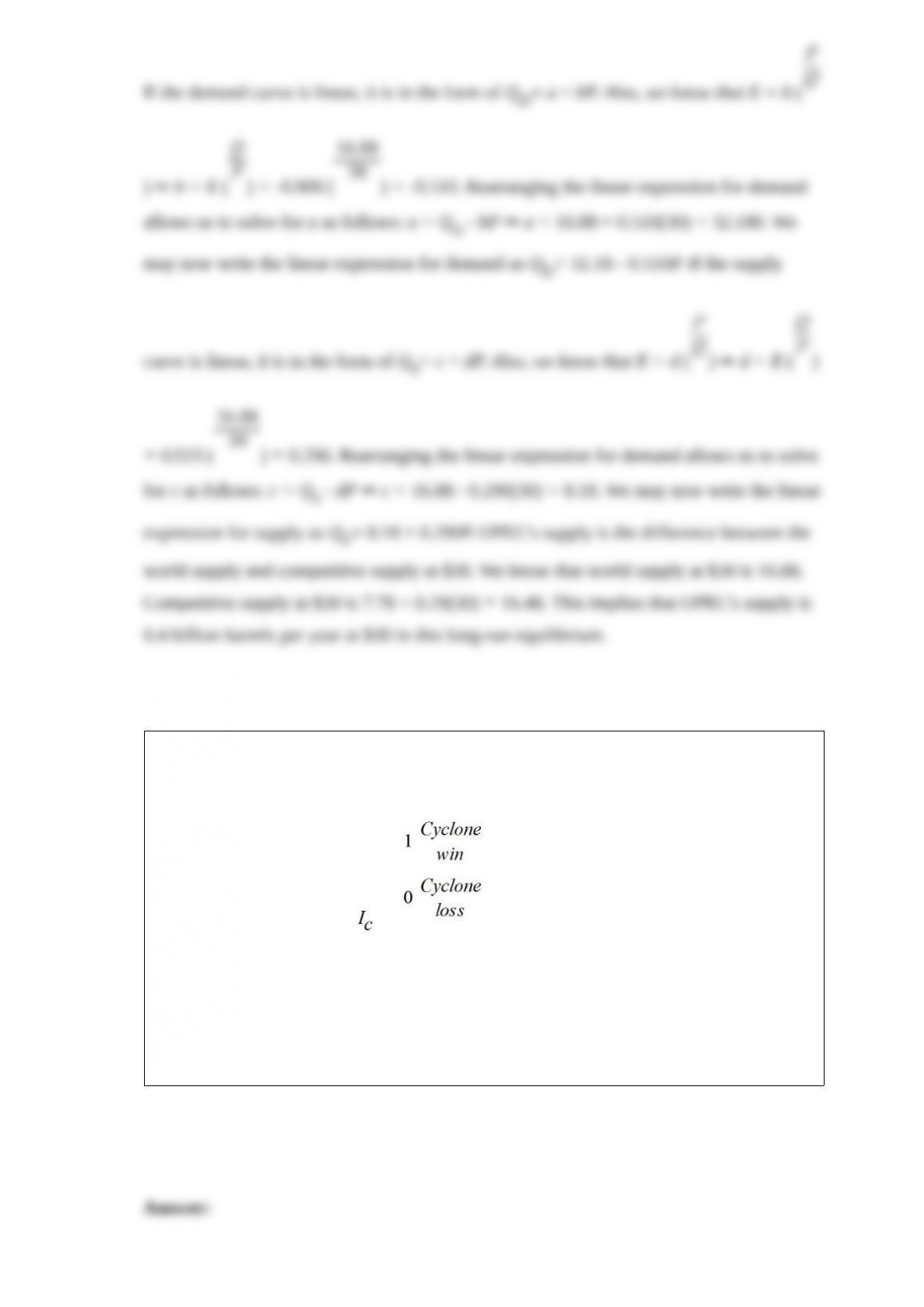
Mary is a fervent Iowa State University Cyclone Basketball fan. She derives utility as a
function of the ISU team winning the Big XII championship and from income
according to the function
U(Ic, w) = 35Ic + w, where = { and w is her level of wealth. Mary believes
the probability of a Cyclone championship is 1/4. Mary has been offered the following
“insurance policy.” The insurance policy costs $16. If the Cyclones win the
championship, she pays only the policy cost of $16. If the Cyclones lose, she will
receive $21.50 (so that after taking into account the policy cost of $16, her net return is
$5.50). Will Mary’s expected utility increase if she purchases the policy?
Two individuals, A and B, are free to engage in trade of clothing and food. Initially, A
has 12 units of clothing and 9 units of food, and B has 8 units of clothing and 11 units
of food. The individuals have the following utility functions in clothing C and food F:
UA = 0.15QC ∙ QF
UB = 0.08QC ∙ QF
where QF represents units of food, QC represents units of clothing, and U represents
utility. Determine if a mutually beneficial trade is possible between A and B. If so, who
would trade for what?
The local farmer’s market sells corn for 20 cents an ear. At this price, Sam buys 6 ears
each Thursday. What would happen to Sam’s consumption of corn if the market offered
corn at 20 cents an ear for the first 6 ears, but 10 cents an ear for each additional ear?
Explain your answer.
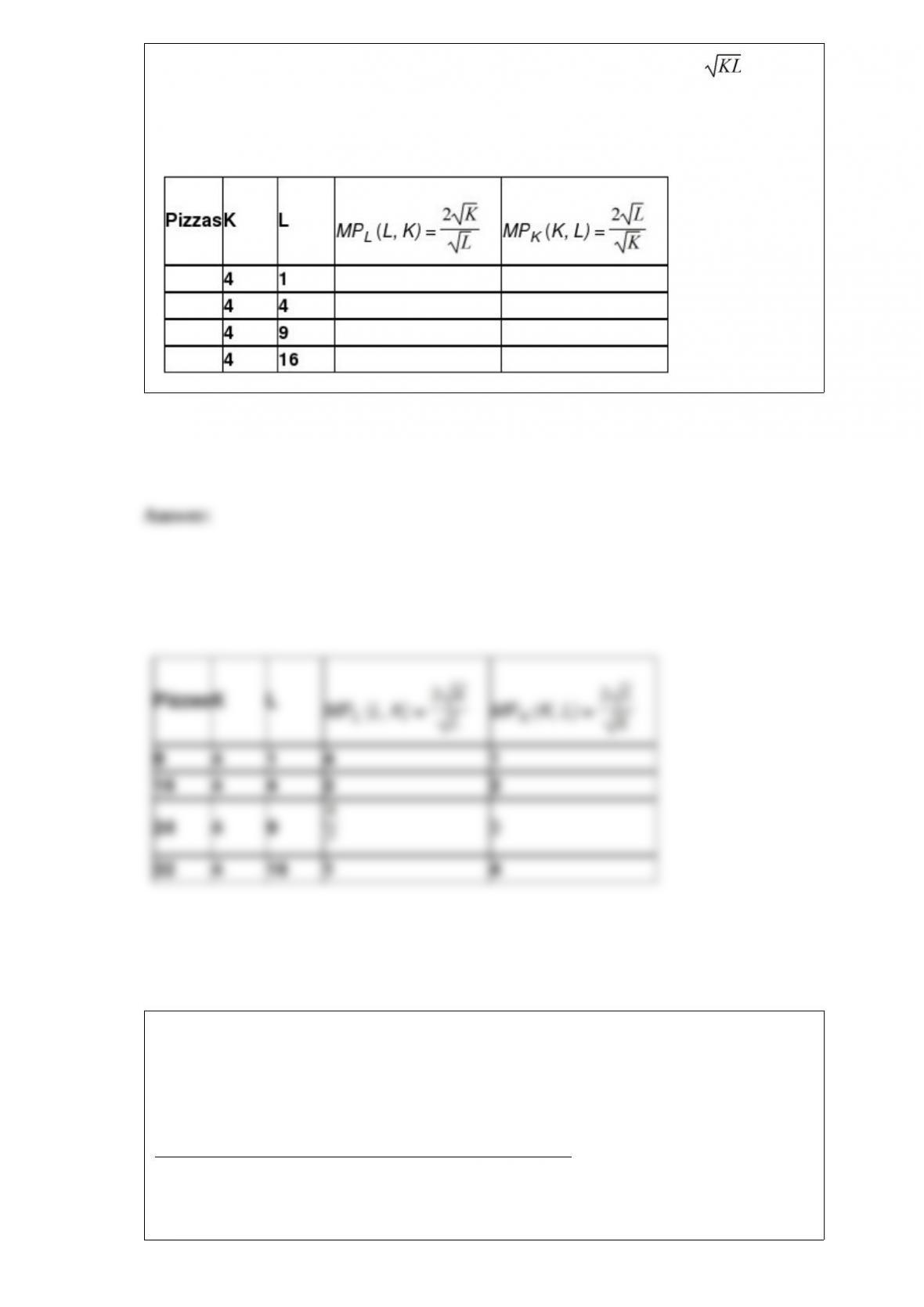
The production function of pizzas for One Guy’s Pizza shop is y(K, L) = 4 . K
represents the number of ovens One Guy’s Pizza uses and is fixed in the short-run at 4
ovens. L represents the number of labor hours One Guy’s Pizza employees and is
variable in the short and long-run. Fill in the empty columns in the table below.
The following table contains information for a price taking competitive firm. Complete
the table and determine the profit maximizing level of output (round your answer to the
nearest whole number).
Total Marginal Fixed Average Total Average Marginal
Output Cost Cost Cost Cost Revenue Revenue Revenue
0 25

1 35
2 30
3 45
4 185
5 57
6 120 240
Suppose the cable TV industry is currently unregulated. However, due to complaints
from consumers that the price of cable TV is too high, the legislature is considering
placing a price ceiling on cable TV below the current equilibrium price. Assuming the
government does make this price ceiling law, please construct a diagram that shows the
impact of this law on the cable TV market, and please briefly explain the effects on
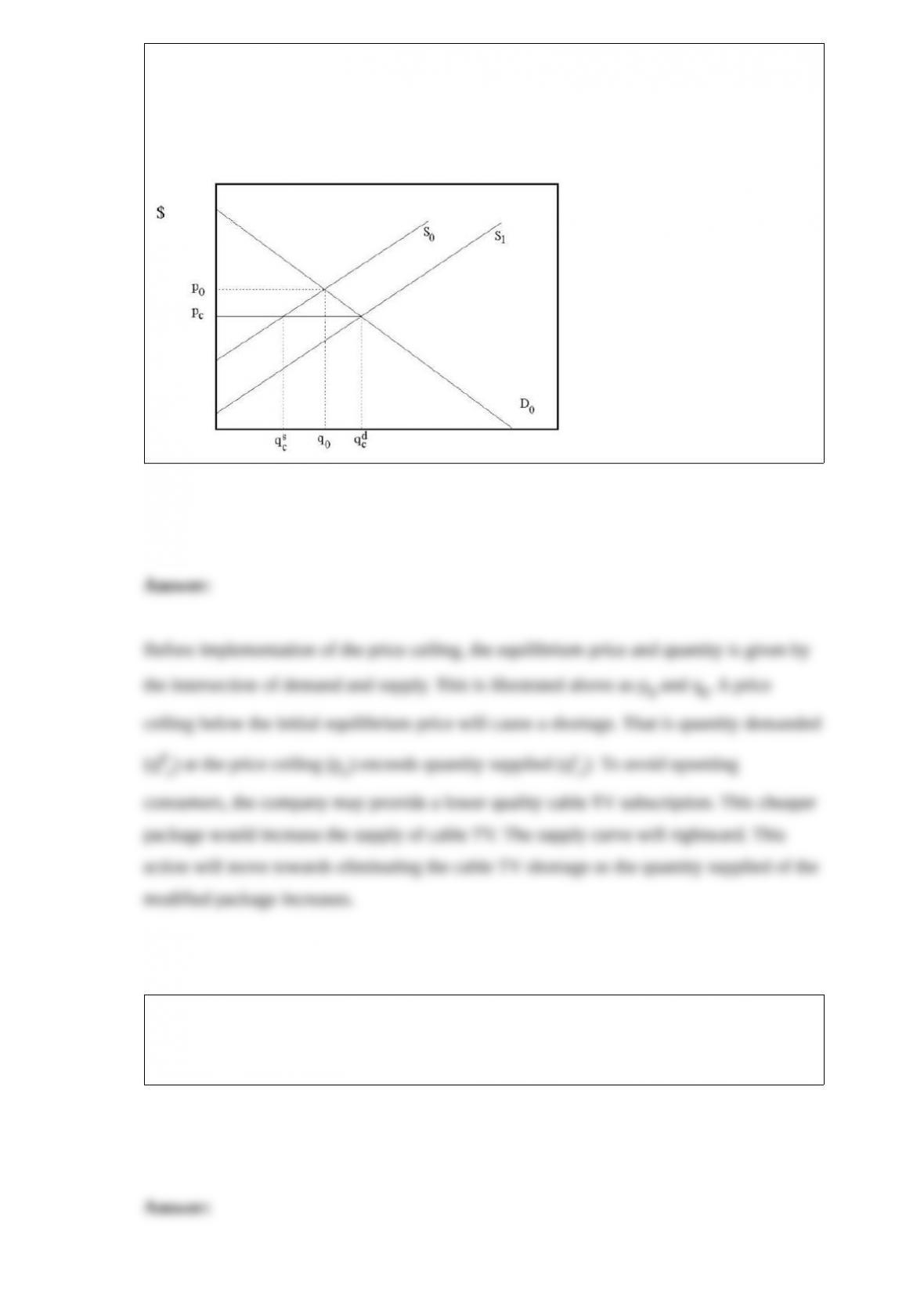
market prices and quantities with supply and demand analysis. Also, if the cable TV
company is worried about disgruntling customers, the company may introduce a
different type of programming that is cheaper for the company to provide yet is equally
appealing to customers. What would be the effects of this action?
In the theory of consumer behavior, several assumptions are made about the nature of
preferences. What are these assumptions? Illustrate the significance of these
assumptions using indifference curves.

The market structure of the local boat industry is best characterized by monopolistic
competition. Homer’s Boat Manufacturing is one of the producers in the local market.
The demand for Homer’s Boats is:
Qd = 5000 – P ⇔P = 5000 – Qd.
The resulting marginal revenue curve is
MR(Qd) = 5000 – 2Qd.
Homer’s cost function is:
C(Q) = 3Q2 ⇒MC(Q) = 6Q.
Determine Homer’s profit maximizing level of output and the price charged to
customers. Is this a long-run equilibrium?
Hawkins MicroBrewery can influence demand by advertising. Hawkins spends $5,000
per period on advertising. The advertising elasticity of demand is 2. The price elasticity
of demand is -1.5. Hawkins sells each unit for $15. Given that Hawkins is maximizing
profit, calculate the number of units sold.
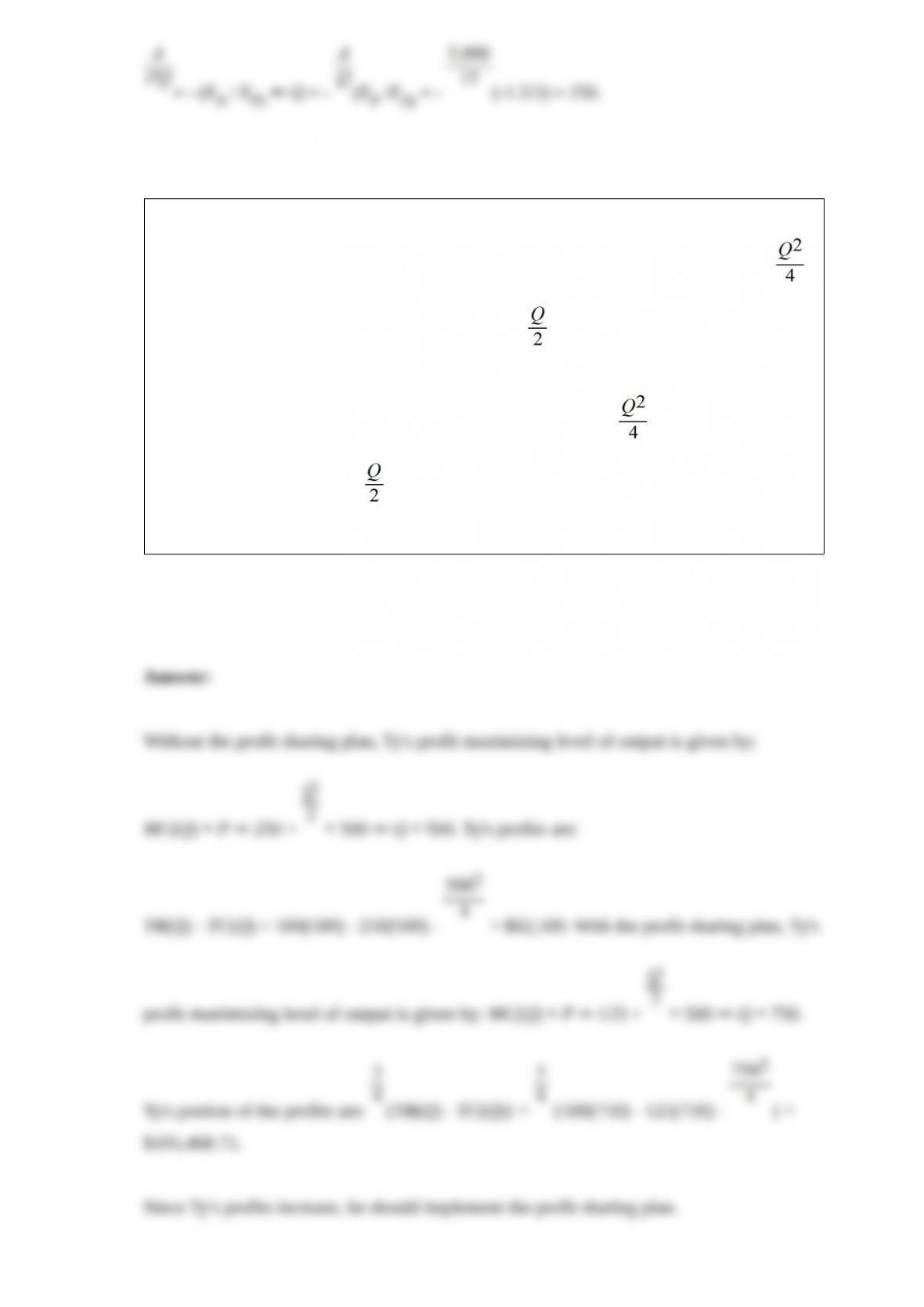
Ty’s Sporting Goods is considering rewarding employees with profit sharing for good
performance. Without the sharing plan, Ty’s total cost function is: TC(Q) = 250Q +
and his marginal cost function is: MC(Q) = 250 + . Ty can sell all his output for $500.
Calculate Ty’s optimal output level. What is his level of profits? If Ty implements the
profit sharing plan, his total cost function is: TC(Q) = 125Q + and his marginal cost
function is: MC(Q) = 125 + . If the profit sharing plan entitles his employees to 25%
of the profits, should Ty institute the plan?
The demand and supply functions for oil on the world market are given as: QD = 25.64
– 0.06P and QS = 21.74 + 0.07P. Calculate consumer surplus. If the Clinton
Administration puts a price ceiling of $20 per unit, calculate the resulting consumer
surplus. Are consumers better off?
Mr. Barnes has a monopoly in the production of power in the local market. The demand
for Mr. Barnes power is: P = 100 – 0.25q MR(q) = 100 – 0.5q. Mr. Barnes marginal
costs are constant at 5. In the generation of power, Mr. Barnes plant emits pollution that
causes marginal external damages according to: MEC(q) = 0.05q. If the local
government does nothing, how much will Mr. Barnes produce to maximize profits?
What is the marginal social cost of his level of output? What price do consumers pay
for each unit of Mr. Barnes’ output? Is this level of production optimal? Should the local
government institute a pollution fee? If so, what is the optimal fee?