
The Fed’s purchase and sale of government securities is known as
a. margin operations.
b. open market operations.
c. bank reserve operations.
d. cash management operations.
A bond and stock differ in that a stock is an IOU for a fixed amount and a bond is a
portion of ownership.
a. True
b. False
The elasticity of a demand curve at any point can be ascertained by its steepness.
a. True
b. False

The terms “correlation” and “causation” are synonymous.
a. True
b. False
Capital is defined as
a. a flow of money into a business to buy various inputs.
b. automated production processes which require little or no labor.
c. interest payments to owners of companies.
d. an inventory of plant, equipment and other productive resources held by a firm.
Due to Pigou’s “defective telescopic faculty,” a market economy is inefficient in
allocating resources between the present and the future.

a. True
b. False
Given a typical demand curve and a decline in price, the consumer who wishes to
maximize total utility must increase the quantity purchased of a good to arrive at an
optimal MU = P point.
a. True
b. False
The invention of the Internet should make poorer countries
a. poorer due to the expense of new technology.
b. poorer because the Internet is primarily in richer countries.
c. richer because technology adoption is easier.
d. richer because they can distribute information without costs.

In the 1990s, the United States benefited from a series of favorable supply shocks. This
caused a(n)
a. increase in inflation and unemployment.
b. decrease in inflation and unemployment.
c. increase in inflation and a decrease in unemployment.
d. decrease in inflation and an increase in unemployment.
The term “satisficing” indicates an optimal choice.
a. True
b. False
Economists assume that business firms have many goals, and profit maximization is
just one of them.
a. True

b. False
The movements of real GDP and inflation during the 1973-1975 recession can be best
explained by a:
a. rightward shift of the aggregate demand curve.
b. leftward shift of the aggregate demand curve.
c. rightward shift of the aggregate supply curve.
d. leftward shift of the aggregate supply curve.
The productivity slowdown in the U.S. from 1973 to 1995
a. can be explained easily with economic theory.
b. continued into the third millennium.
c. still confuses economists.
d. was a continuation of the slowdown from 1948 to 1973.

Which of the following is not a characteristic of perfect competition?
a. Firms and consumers all have perfect information about the good and market.
b. Sellers can enter the market easily.
c. All goods sold are identical.
d. All consumers have identical individual demand curves.
The net worth of a bank is
a. equal to the value of assets.
b. equal to the value of deposits.
c. equal to the value of liabilities.
d. the value of assets less liabilities.
e. the value of loans and securities.

Which of the following would cause a movement up (or leftward) along the demand
curve for European autos in the United States?
a. an increase in the price of American autos
b. a decrease in the price of American autos
c. an increase in income in the United States
d. an increase in the price of European cars
Some college students think that because a college degree greatly increases their
earning potential there is no opportunity cost of attending college. How would an
economist look at the matter?
a. There is no opportunity cost, assuming that future earnings actually increase as
expected.
b. The opportunity cost is much less than it would appear, assuming that earnings
increase.
c. Opportunity cost is a meaningless concept in this situation.
d. The college students are completely correct in all respects.
e. There is still an opportunity cost, even if it is justified by higher future earnings.

If workers demand wage compensation in advance of inflation, the economy’s
aggregate supply curve will
a. have a positive slope.
b. have a negative slope.
c. be vertical.
d. be horizontal.
A change in the price of a good will shift the indifference curves.
a. True
b. False
Philip purchased one million dollars’ worth of New York City bonds. His interest
earnings were $100,000. His total federal tax on this income will be
a. $40,000, since his marginal tax rate was 40 percent.
b. $40,000, since only 40 percent of capital gains is taxed.
c. zero.
d. very small, since he had a clever accountant who knew how to use loopholes.

If coal prices are rising faster than the rate of interest, then
a. investors should buy coal instead of bonds.
b. investors should buy bonds instead of coal.
c. coal prices should be expected to fall.
d. bond prices should be expected to rise.
When a perfectly competitive industry is in long-run equilibrium, firms maximize
profits, and entry forces the price down
a. until all loss making firms leave the industry.
b. until each firm can earn acceptable level of economic profit.
c. until price becomes tangent to the long run average cost curve.
d. until the long average cost curve rises above the demand curve.

The use of chlorofluorocarbons in refrigerators and air conditioners is alleged to cause
the destruction of the ozone layer that surrounds the earth and which protects humans
from ultraviolet radiation. Output of this substance has been restricted by a licensing
system where producers have to bid in the open market for licenses to produce them in
specified quantities. This is an example of dealing with externalities by
a. voluntary compliance.
b. direct controls.
c. taxes.
d. the market mechanism.
Inheritance taxes tend to increase income inequality in the long run.
a. True
b. False
Under the Bretton Woods agreements,
a. the IMF was created to punish countries that did not maintain fixed exchange rates.
b. a system of fixed exchange rates based on gold was established.

c. each country agreed to buy and sell its currency to maintain a fixed exchange rate.
d. All of the above are correct.
A vertical aggregate supply curve increases the size of the multiplier effect.
a. True
b. False
Inflation affects borrowers and lenders differently. After signing a contract with a fixed
nominal interest rate, it can be expected that
a. borrowers will hope that prices fall.
b. lenders will hope that prices rise.
c. lenders will hope that the purchasing power of money will fall.
d. borrowers will hope that prices rise.

The imposition of price ceilings on a market often results in
a. an increase in investment in the industry.
b. a persistent surplus in the market.
c. the diversion of income toward black-market suppliers.
d. lower prices being offered on the black market.
Antitrust laws are designed to promote competition.
a. True
b. False
If the Fed decides to sell T-bills, it increases the supply of T-bills. How will this affect
the price of T-bills and the interest rate?
a. T-bill prices fall and interest rates fall.

b. T-bill prices rise and interest rates rise.
c. T-bill prices rise and interest rates fall.
d. T-bill prices fall and interest rates rise.
As of December 31, 2010, the assets listed on the balance sheet of Bank A were: $1.5
million in cash reserves, and $6 million in outstanding loans to its customers. Its
liabilities totaled $6.5 million in checking deposits. What was the bank’s net worth on
that date?
a. $1 million
b. $4.5 million
c. $5 million.
d. $14 million.
e. Zero
Figure 5-5
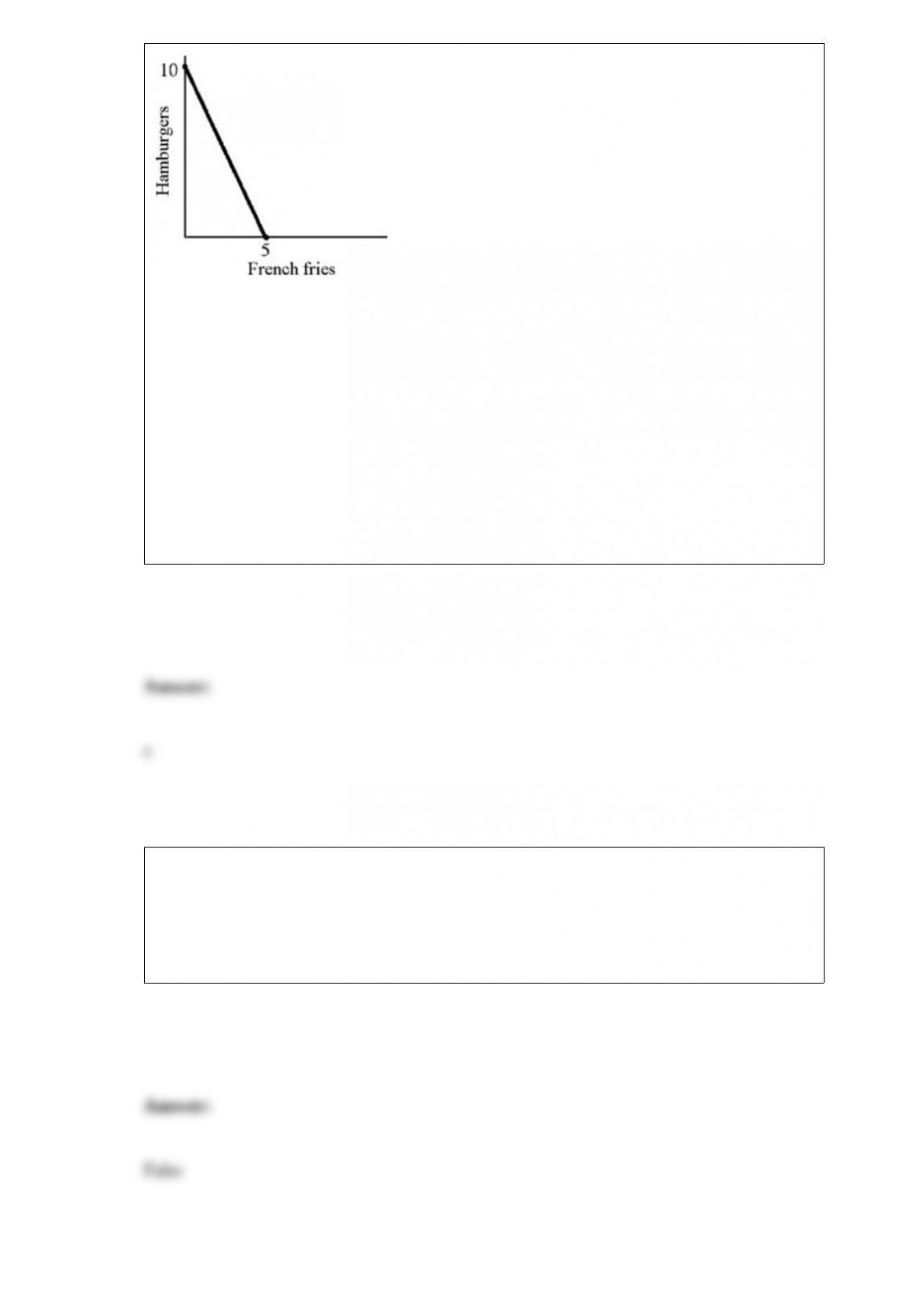
Figure 5-5 shows a consumer budget line for French fries and hamburgers. The
household allocates a budget for these two goods.. If the price of an order of french
fries is $2, how much income is allocated to fries and burgers combined?
a. $2
b. $4
c. $20
d. $40
If the selling price falls and input costs are fixed, profit margins will increase.
a. True
b. False

Production for war and environmental clean-up services are not included in GDP.
a. True
b. False
The demand for Exxon gasoline is ____ the demand for all gasoline.
a. exactly as elastic as, and of a different slope from
b. more elastic than
c. less elastic than
d. exactly as elastic and of a different slope from