
If the consumer’s income and all prices simultaneously triple, then his optimum will not
change.
A negligence standard, with the allowance of contributory negligence, always leads to a
socially optimal outcome.
A free-rider problem occurs when people can share in the benefits of an activity without
being forced to contribute to its costs.
The towns of Mattoon and Charleston can produce one of two goods: books and bagels.
In Charleston factories, 12 laborers can produce 100 books in an hour, while 6 laborers
can produce 400 bagels in an hour.
(i) What is the cost of producing books in Charleston?
(ii) Suppose the cost of producing books in Mattoon is 10 bagels per book. Which town

should specialize in bagel production and which town should specialize in book
production?
Suppose a monopolist sells in two distinct markets. The demand and marginal revenue
for the first market are given by P1 = 240 – 2Q1 and MR1 = 240 – 4Q1, respectively,
where Q1 is the quantity demanded and P1 is the price paid by the first group. The
demand and marginal revenue for the second market are given by P2 = 120 – Q2 and
MR2 = 120 – 2Q2, respectively, where Q2 is the quantity demanded and P2 is the price
paid by the second group. The monopoly’s marginal cost is given by MC = 4/9 Q, where
Q is the total output produced by the monopoly.

A new licensing fee would cause an immediate upward shift in an industry’s short-run
supply curve.
Define the term Nash equilibrium. In general, what can be claimed about the existence,
uniqueness, and Pareto optimality of Nash equilibria? Support your answers with
appropriate examples.
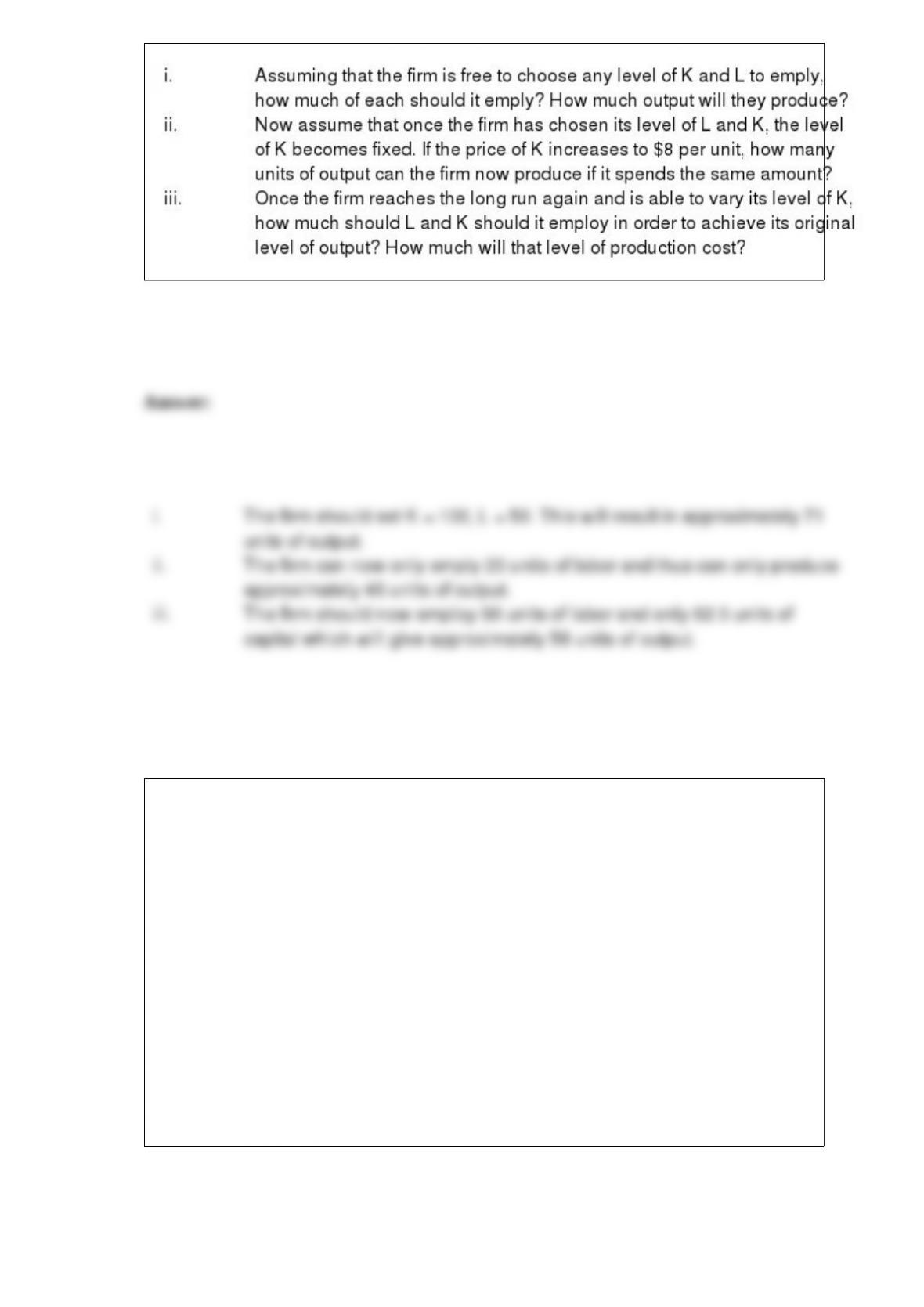
A firm has the production function q = . The MSTSLK = K/L. The wage rate is $10
per unit of labor and the rental rate is $5 per unit of capital and the firm is going to
spend $1000 on production.
Suppose that the local utility regulators have recently approved an increase in the price
of electricity from 10¢ per kilowatt-hour to 10.5¢ per kilowatt-hour. The long-run price
elasticity of demand for electricity is estimated to be -1.2.
(i) By how much will the quantity demanded of electricity drop in the long run because
of this price increase?
(ii) When the price of electricity increases, will consumers’ total expenditures on
electricity rise or fall in the long run? (Hint-Consider which is larger, the percentage
increase in price or the percentage decrease in quantity demanded.)
(iii) The cross elasticity of demand for electricity with respect to natural gas is 0.2. By
how much would the price of natural gas have to change to totally offset the effect that
the price increase in electricity has on the quantity of electricity consumed? In other
words, by how much would the price of natural gas have to change to cancel out the fall
in the quantity demanded that you calculated in part i?

The past performance of a stock is the best guide to future performance.
Consider a technological improvement that raises labor’s marginal product. Explain
why the subsequent effect on the labor market is different when the improvement is
temporary as compared to when it is permanent.

When formulating an economic model, one must explicitly identify both an agent’s
objectives and his constraints.