
Once the profit-maximizing output where MR = MC is determined, price is set by
a. adding a standard markup percentage to marginal cost.
b. the demand curve.
c. making it equal to MR = MC.
d. subtracting the marginal cost from total revenue.
The difference between zero accounting profit and zero economic profit is that
a. an economic profit of zero indicates a fair rate of return because it includes
opportunity cost. opportunity cost and
b. an economic profit of zero indicates an unacceptable rate of return because it does
not include opportunity cost.
c. an economic profit of zero indicates more than a fair rate of return because it includes
opportunity cost and explicit cost..
d. an accounting profit of zero indicates a fair rate of return because it includes
opportunity cost.
Is the monopolist supply decision more complicated than that of competitive supply?
a. Yes, because the monopolist can choose its price, and the perfect competitor cannot.

b. No, because they are both price takers.
c. No, because the market determines the quantity for the monopolist.
d. No, because the market determines the price for both firms.
Assume Joe invests a total of $10,000 in a company – $5,000 of which is his own
money and $5,000 which he borrowed at a 10% interest rate. If the company’s stock
value decreases by 5% in one year at which time Joe sells his shares of the stock, what
is Joe’s rate of return on his investment?
a. −5%
b. −10%
c. −20%
d. −30%
In Japan, the market value of the land is approximately four times that of all the land in
the United States, even though Japan is only about the size of California. The most
likely explanation for this fact is
a. greater demand for land in Japan relative to the supply than in the United States.
b. land is very productive in Japan.

c. land is not fixed in supply in the United States.
d. Japanese workers are very productive.
If Asian economies suffer a serious economic slump, U.S. net exports will
a. increase and AD will shift outward.
b. increase and AD will shift inward.
c. decrease and AD will shift inward.
d. decrease and AD will shift outward.
Comparative advantage explains how two nations can benefit from trade.
a. True
b. False

Any change in a firm’s fixed costs will change its profit-maximizing level of output.
a. True
b. False
When will stabilization policy be most effective in combating recessions?
a. when AS is flat
b. when AS is very steep
c. when AS has a moderately upward slope
d. when AS has a moderately downward slope.
The metaphor used to describe the working of the price system to achieve efficiency in
a free market is
a. Occam’s razor.
b. the prisoner’s dilemma.

c. the invisible hand.
d. the benefit principle.
Most economists think that, in the short run, there is
a. a trade-off between inflation and unemployment, but not in the long run.
b. no trade-off between inflation and unemployment, nor is there one in the long run.
c. a trade-off between inflation and unemployment, and in the long run also.
d. no trade-off between inflation and unemployment, but there is one in the long run
also.
A favorable supply shock abroad would
a. increase U.S. imports and decrease aggregate demand.
b. decrease U.S. net exports and reduce aggregate supply.
c. decrease U.S. net exports and decrease national income.
d. increase U.S. net exports and increase aggregate demand.

If workers underestimate inflation, the aggregate supply curve will tend to be
a. upward sloping.
b. downward sloping.
c. vertical.
d. horizontal.
At higher interest rates, fewer people or firms will want to borrow. At lower interest
rates, fewer people or firms will want to save.
a. True
b. False
Economists generally agree that in reducing poverty, policies should be sought that do

the
a. greatest good for total production.
b. least harm to work incentives.
c. most good for the poor.
d. least harm to equality of income.
On January 1, 2006, a consumer borrowed $10,000 for a term of one year at an interest
rate of 12 percent. How much principal and interest will the consumer pay back on
January 1, 2007?
a. $10,000
b. $1,200
c. $8,929
d. $11,200
Currently in the United States, money is backed by
a. silver in the IMF vaults.
b. Federal Reserve notes in banks.

c. gold in Fort Knox.
d. everyone’s willingness to accept it.
Which of the following observations is not true of a budget line?
a. It indicates what choices are available to the consumer.
b. It is a curve of constant expenditure.
c. Its slope reports the market terms on which the consumer can trade one good for
another.
d. It helps examine the consumer’s preferences.
From 2007 to 2008, the Federal Reserve System reduced interest rates, the price that
borrowers pay. As a result, economists expected demand for money to
a. increase.
b. decrease.
c. not change.
d. be influenced by the interest rate, but with an uncertain effect.
Almost all of the rent that tenants pay to landlords of apartments buildings is economic
rent.
a. True
b. False
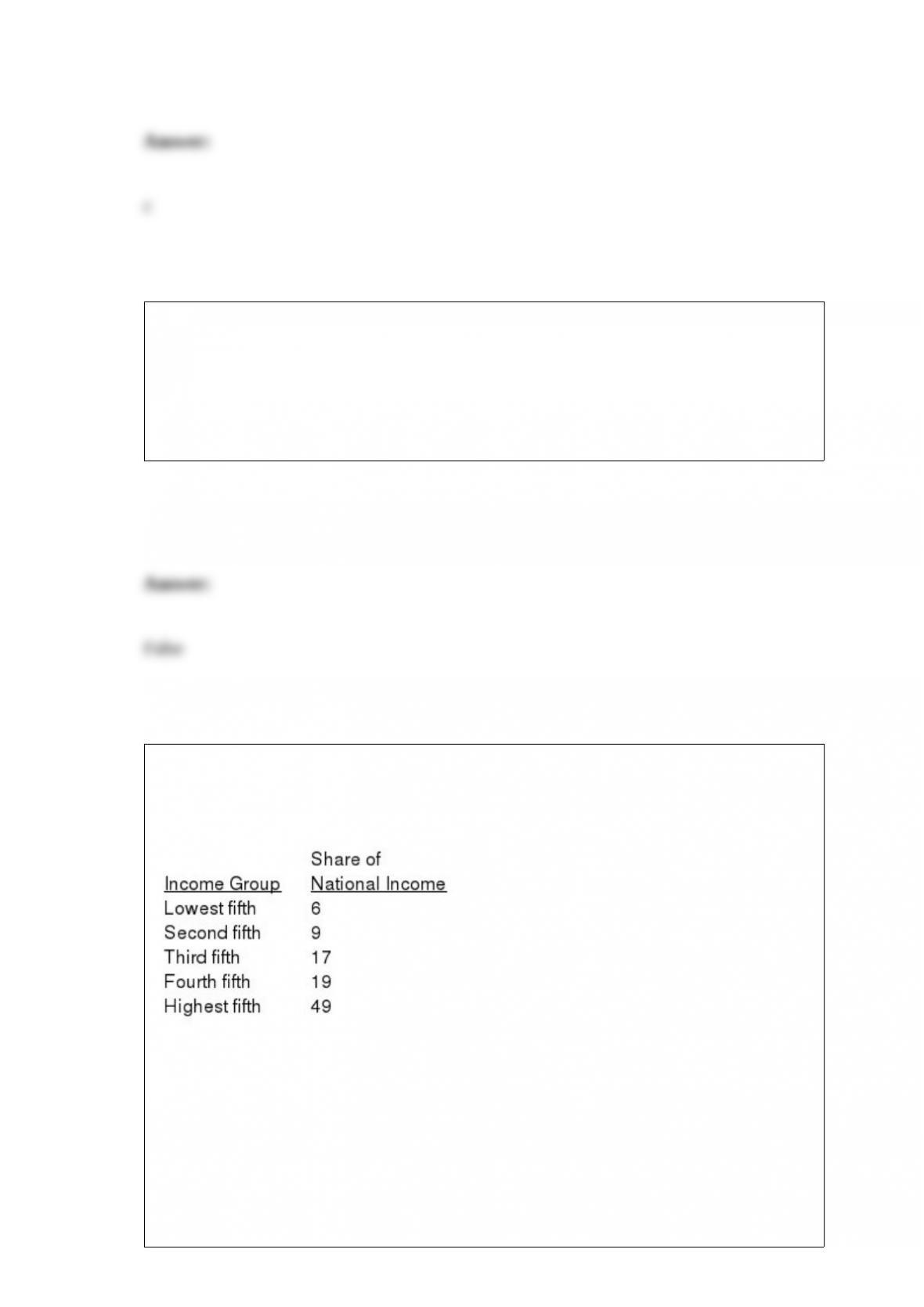
Table 21-1
Consider the economy described by the income distribution in Table 21-1. From this
table, we can conclude that the
a. poorest quarter of the population earns 15 percent of the income.
b. “middle” fifth of the population earns 32 percent of the income.
c. poorest quarter of the population earns 19 percent of the income.

d. richest fifth of the population earns 49 percent of the income.
In most countries, primary and secondary education is the responsibility of the
a. private business sector.
b. religious institutions.
c. government sector.
d. household.
In 2012, approximately what income level was the cut-off point for defining a family as
“rich”?
a. $72,000
b. $104,000
c. $143,000
d. $195,000

The exchange rate is the price of one currency in terms of another.
a. True
b. False
Since rent controls have been in effect in New York City, apartments have been more
plentiful.
a. True
b. False
The analysis of oligopolistic behavior is difficult because
a. there are few real-world examples of oligopolies for economists to study.
b. oligopolists make decisions independently of each other.
c. firms in oligopolistic industries react to each other’s behavior in many ways.

d. economists have paid little attention to the topic in recent years and so have not yet
applied to it the techniques of modern economic theory.
If the demand effect dominates during a currency depreciation, then
a. real GDP should fall.
b. real GDP should increase.
c. the price level should fall.
d. net exports should decrease.
In our modern economy, the adjustment process necessary to eliminate a recessionary
gap is very rapid.
a. True
b. False

The achievement of greater efficiency in the United States has been at the expense of
growing inequality.
a. True
b. False
U.S. government policy to stimulate research and development activities would be most
likely to succeed if it involved
a. interest rate policy.
b. corporate tax policy.
c. personal income tax policy.
d. payroll tax policy.