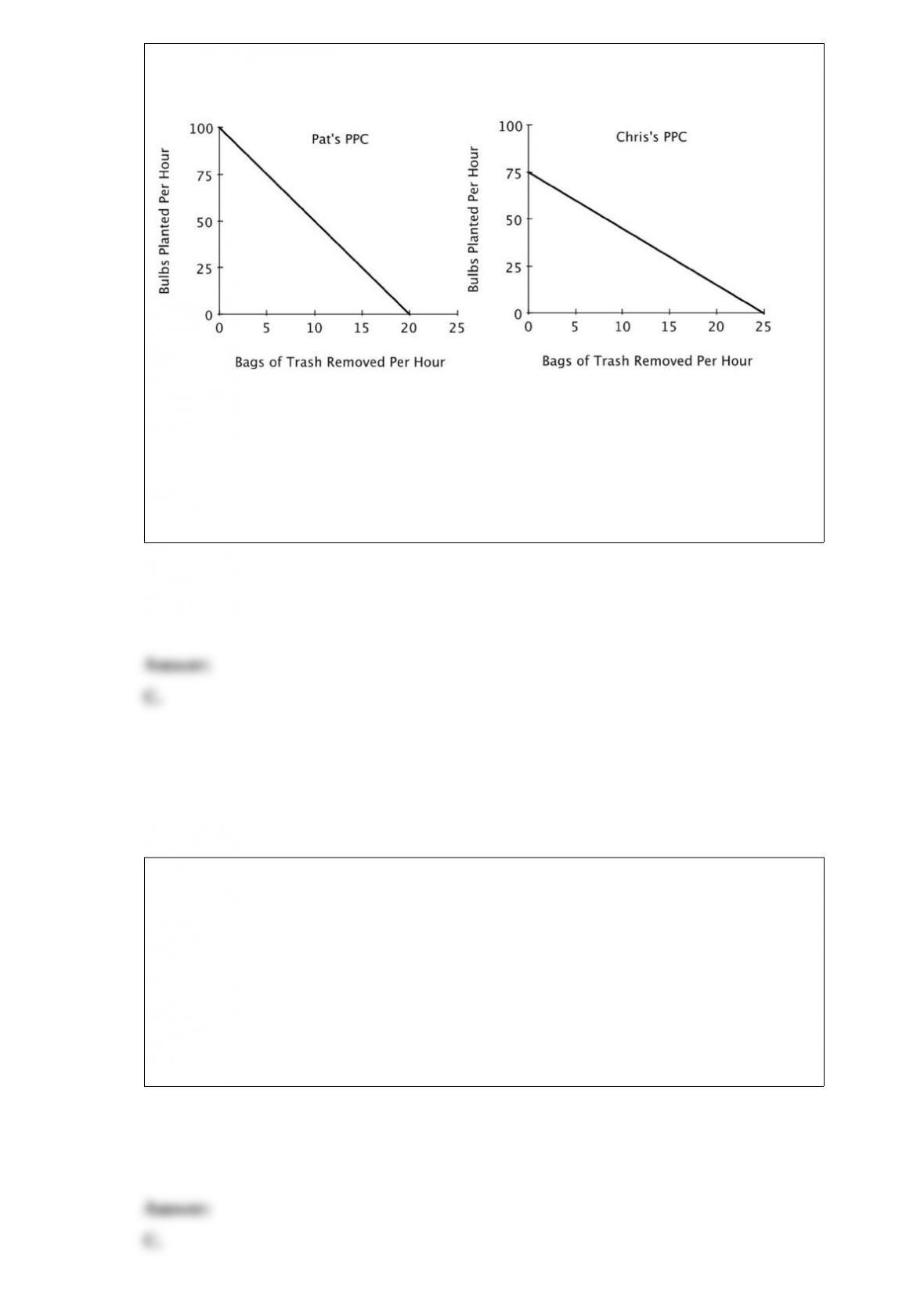
Refer to the figure below. For Chris, the opportunity cost of removing one bag of trash
is planting:
A. 25 bulbs.
B. 1/25 of a bulb.
C. 3 bulbs.
D. 1/3 of a bulb.
The demand curve for a public good is constructed by:
A. summing voters’ desired quantity of the public good at each price.
B. surveying voters on how much of a particular public good they would use at each
price.
C. summing voters’ reservation prices at each quantity.
D. dividing the total cost of providing the public good by the number of potential users.

Consumption spending includes spending on:
A. durables, nondurables, and services.
B. stocks, bonds, and other financial instruments.
C. capital goods, residential housing, and changes in inventories.
D. goods and services by federal, state, and local governments.
Assume that Dusty has $30 in income, the price of a loaf of bread is $1.50, and the
price of a jar of peanut butter is $3. Dusty can buy a maximum of ______ loaves of
bread or a maximum of ______ jars of peanut butter.
A. 20; 10
B. 15; 15
C. 10; 20
D. 10; 5

Assume one investor bought a 10-year inflation-protected bond with a fixed annual real
rate of 1.5% and another investor bought a 10-year bond without inflation protection
with a nominal annual return of 4.2%. If inflation over the 10-year period averaged 2
%, which investor earned a higher real return?
A. The investor who purchased the inflation protected bond.
B. The investor who purchased the bond without inflation protection.
C. Both investors earned the same real return.
D. Neither investor earned a positive real return.
Psychological incentives:
A. are not important in economic settings.
B. never serve as commitment devices.
C. are not important in non-economic settings.
D. can serve as commitment devices.
An investor purchasing an inflation-protected bond with a fixed annual real return of
1.75 percent will earn a nominal annual return of ______ percent if the actual inflation
rate turns out to be 3.25 percent.
A. 1.50%
B. 1.86%
C. 5.00%
D. 5.69%
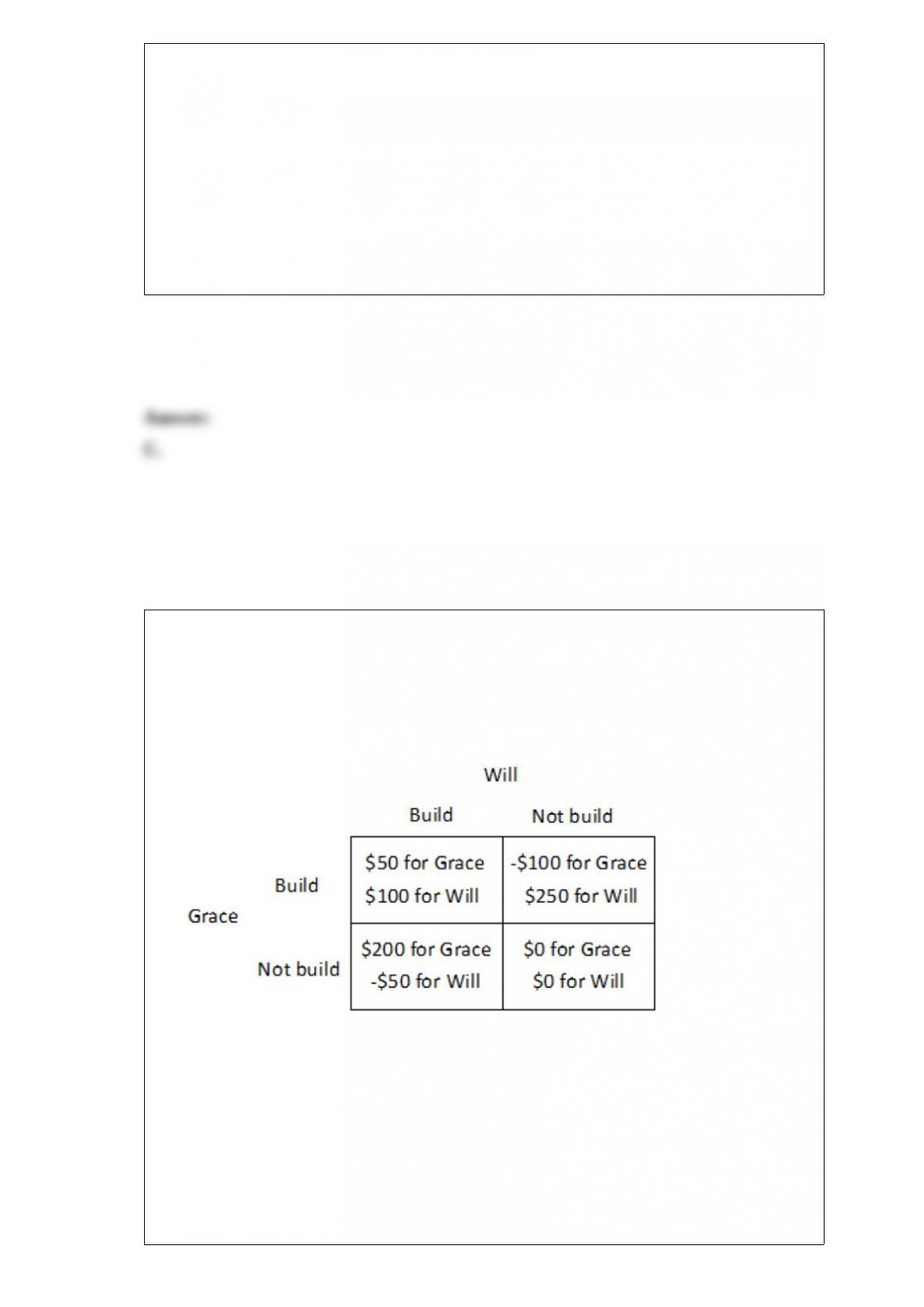
Will and Grace have adjoining unfenced back yards and each has just adopted a new
puppy. Will values a fence between their yards at $250 and Grace values a fence
between their yards at $200. The cost of building the fence is $300, which will be split
equally if they both agree to build the fence. Therefore, their payoff matrix is as
follows.
If Will decides to build the fence, then Grace will earn a higher payoff by ______, and
if Will decides to not build the fence, then Grace will earn a higher payoff by ______.
A. not helping to build the fence, building the fence
B. helping to build the fence; also not building the fence
C. helping to build the fence; building the fence
D. not helping to build the fence; also not building the fence
Refer to the figure above. An increase in demand is represented by shifting from:
A. curve A to curve B.
B. curve B to curve A.
C. curve C to curve D.
D. curve D to curve C.
Suppose that there are two types of houses for sale: those with solid foundations and
those with cracked foundations. In all other respects, the two types of houses are
identical. Houses with solid foundations are worth $200,000, while those with cracked
foundations are worth $200,000 minus the $20,000 to fix the crack, or $180,000. Sellers
know which type of house they have, but buyers cannot detect whether the foundation
has a crack. Suppose that 80 percent of the houses for sale have a solid foundation and
20 percent of the houses for sale have a cracked foundation. If some of the owners of
houses with solid foundations remove their houses from the market because they can’t

sell their house for a price that is as high as the value of their house, then:
A. buyers’ reservation prices will rise.
B. the owners of houses with a cracked foundation will also take their houses off the
market.
C. the proportion of homes for sale with a cracked foundation will rise.
D. the average sales price of a house will rise.
If the price of computers increases and the demand for monitors decreases as a result,
then:
A. computers and monitors are complements.
B. computers are a normal good and monitors are inferior.
C. computers and monitors are substitutes.
D. computers are an inferior good and monitors are normal.
When the price of NBA tickets is $25 each, 30,000 tickets are sold. After the price rises
to $30 each, 20,000 tickets are sold. At the original price, the demand for NBA ticket is:
A. elastic.
B. inelastic.
C. unit elastic.
D. perfectly elastic.
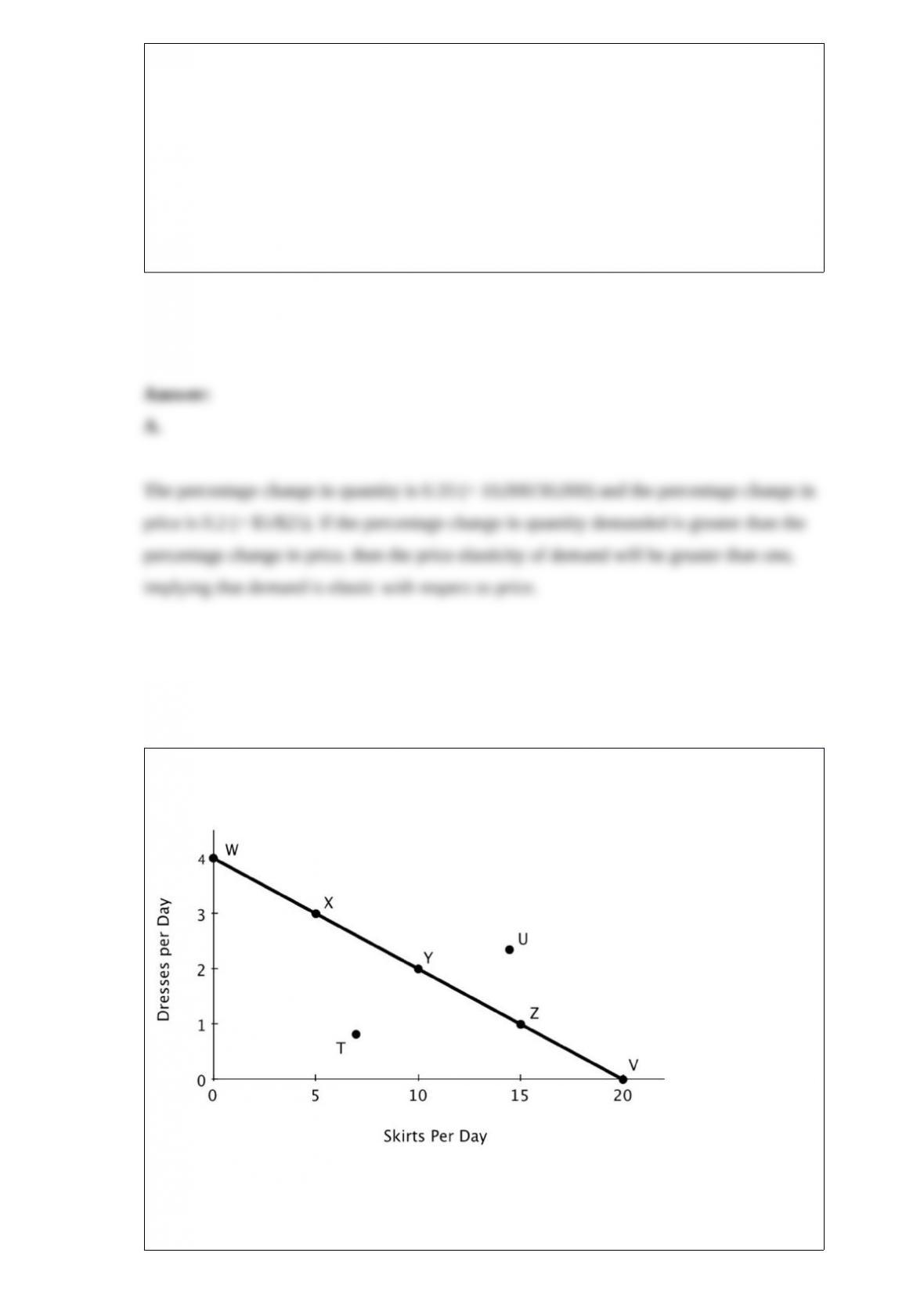
The figure below shows Becky’s daily production possibilities curve for dresses and
skirts.
Point T is:
A. attainable
B. efficient
C. both attainable and efficient
D. neither attainable nor efficient
Jordan has the following assets and liabilities:
Jordan’s wealth is _____, the value of Jordan’s assets is _____, and the value of Jordan’s
liability is _____.
A. $107,000; $213,000; $100,000
B. $109,000; $213,000; $104,000
C. $111,000; $213,000; $100,000
D. $213,000; $317,000; $104,000
The market for bagels contains two firms: BagelWorld (BW) and Bagels’R’Us (BRU).
The owners of the two firms decide to fix the price of bagels. The table below shows
how each firm’s profit (in dollars) depends on whether they abide by the agreement or
cheat on the agreement.
Suppose the game above is repeated every day, and both firms adopt the following
strategy: cooperate on the first day, then if the other firm cheats, cheat the next day, and
if the other firm abides, abide the next day. This type of strategy is known as: ______.
A. a prisoner’s dilemma
B. the cartel solution
C. a tit-for-tat strategy
D. the golden rule
When a market is not in equilibrium:
A. government intervention is required to achieve equilibrium.
B. firms will increase contributions to political action committees.
C. the economic motives of sellers and buyers will move the market to its equilibrium.
D. it will simply stay in a state of disequilibrium.

The most important, most convenient, and most flexible way in which the Federal
Reserve affects the supply of bank reserves is through:
A. conducting open-market operations.
B. changing the Federal Reserve discount rate.
C. changing bank reserve requirement ratios.
D. changing interest rates.
After subsistence levels of food, shelter, and clothing have been provided, economists
refer to all other goods and services as:
A. “inferior goods”
B. “needs”
C. “wants”
D. “luxuries”

The consumer price index for Planet Econ consists of only two items: books and
hamburgers. In 2010, the base year, the typical consumer purchased 10 books for $25
each and 25 hamburgers for $2 each. In 2015, the typical consumer purchased 15 books
for $30 each and 30 hamburgers for $3 each. The consumer price index for 2015 on
Planet Econ equals:
A. 1.00
B. 1.15
C. 1.25
D. 1.45
Historically speaking, a one-dollar decrease in household wealth will cause consumer
spending to fall by:
A. $0.03 to $0.07.
B. $0.30 to $0.70.
C. $3.00 to $7.00.
D. $30.00 to $70.00.

If the share of population employed in two countries is the same, average living
standards will be higher in the country with:
A. the smaller population.
B. the larger population.
C. higher average labor productivity.
D. lower average labor productivity.
“Market power” refers to a firm’s ability to:
A. undercut its competitors’ prices.
B. force consumers to buy high-priced products.
C. raise its price without losing all of its sales.
D. influence the price its competitors charge.

Suppose there are ten people playing cards in a room. One of them wants to smoke a
cigar; nine of them dislike the smell of cigar smoke. The smoker values the privilege of
smoking at $5, and each of the other nine people of the room would be willing to pay
fifty cents for clean air in the room. The rules governing use of the room state that
smoking is not allowed unless everyone agrees to allow smoking. If the cigar smoker
paid each other occupant fifty cents for the right to smoke, the cigar smoker would be
______ and the other occupants would be _______.
A. better off; worse off
B. better off; just as well off as before the payment
C. better off; better off
D. worse off; just as well off as before the payment
In the Soviet Union, firm managers had ______ incentive to reduce costs and produce
better products because of ______.
A. little; the absence of private property rights
B. little; the absence of import restrictions
C. great; government threats
D. great; the complexity of coordinating economic activity

The excess of government spending over tax collections is:
A. national income.
B. national saving.
C. national wealth.
D. the government budget deficit.
A swing at a popular, unfenced public park is:
A. nonrival.
B. nonexcludable.
C. a collective good.
D. a pure public good.
Refer to the figure below. Based on the diagram, the nominal interest rate equals
______ and the money supply equals ____.
A. 7%; 300
B. 1%; 500
C. 5%; 500

D. 3%; 700
The real interest rate is the:
A. market interest rate.
B. annual percentage increase in the nominal value of a financial asset.
C. annual percentage increase in the purchasing power of a financial asset.
D. the interest rate charged on a loan in dollar terms.
Each of the following statements describes how the political and legal environment
encourages productivity except:
A. Well-defined property rights encourage production and saving.
B. Political stability promotes economic growth.
C. Price changes in markets give suppliers incentives to supply goods to markets.
D. Pay rates determined by a governmental planning agency provide workers with
incentives to work hard.

Which of the following is NOT a characteristic of a perfectly competitive market?
rev: 08_28_2015_QC_CS-20886
A. Each firm in the market sells a somewhat different variant of the good.
B. There are many sellers, each of which sells only a small fraction of the total quantity
exchanged.
C. Buyers and sellers are well-informed.
Suppose Cathy and Lewis work in a bakery making pies and cakes. Suppose it takes
Cathy 1.5 hours to make a pie and 1 hour to make a cake, and suppose it takes Lewis 2
hours to make a pie and 1.5 hours to make a cake. Which of the following statements is
correct?
A. Cathy should specialize in both pies and cakes.
B. There are no gains from specialization and trade.
C. Lewis should specialize in pies, and Cathy should specialize in cakes.
D. Cathy should specialize in pies, and Lewis should specialize in cakes.

One way sellers can credibly signal that they have a high-quality product is to:
A. sell very little of their product in order to create scarcity.
B. spend a lot of money on advertising.
C. lower their marginal cost of production.
D. simply tell buyers more about their product.