
Which of the following conditions would distinguish a competitive firm from a
monopolist?
a. The existence of a demand curve for the firm.
b. The slope of the demand curve facing the firm.
c. The rule of profit maximization, i.e., produce where MR = MC.
d. The relationship between marginal revenue and total revenue.
e. The existence of diseconomies of scale.
What is true of marginal cost when marginal returns are increasing?
a. It is negative and increasing.
b. It is negative and decreasing.
c. It is positive and increasing.
d. It is positive and decreasing.
e. It is positive and has a constant slope.
Which of the following is true of marginal revenue product (MRP) and marginal
product (MP)?
a. MRP = MP x price, whether the firm is a price searcher or not.
b. MRP = MP x price only if the firm is a price searcher.

c. MRP = MP x price only if the firm sells in a perfectly competitive market.
d. MRP = MP x marginal cost only if the firm is a price searcher.
e. MRP = MP/price only if the firm is a price taker.
If general tax revenues were used to subsidize production of toothpicks, the
government’s actions would have
a. widespread benefits and costs
b. widespread costs and concentrated benefits
c. concentrated benefits and costs
d. widespread benefits and concentrated costs
e. widespread benefits and either widespread or concentrated costs
Which of the following would not be considered a signal for a job as a public relations
representative?
a. the number of minutes the candidate is allotted in the interview
b. a high grade point average

c. the suit the candidate wears to an interview
d. the reputation of the college the candidate attended
e. past salary history
One reason a computer manufacturer may make its own microchips rather than buy
them is that
a. it can maintain control over the quality during production
b. the total cost of components is the same as the price of chips purchased from a chip
manufacturer
c. firms do not make high-quality microchips
d. managers at the computer firm place a high value on their time
e. firms do not produce goods for the market that can be made in-house
Ceteris paribus means “other things constant.”
a. True
b. False

If the cross-price elasticity of demand between two goods is positive, then
a. consumers are being irrational
b. supply is elastic
c. the goods may have similar uses
d. the goods may go well together in consumption
e. one good must be a necessity
Which of the following could explain an increase in demand for labor?
a. additional training that increases the productivity of each unit of labor in this market
b. an increase in the amount of risk associated with this job
c. a decrease in the amount of risk associated with this job
d. an improvement in the working conditions associated with this job
e. a decline in the working conditions associated with this job

When firms differentiate their products, they
a. provide information to consumers with no additional use of productive resources
b. always increase their profits
c. always create real differences among products
d. frequently create artificial or superficial differences among products, thus raising
production costs
e. usually strain the physical capacity of their plants
In the long run, the beneficiaries of farm price supports are
a. tenant farmers
b. consumers
c. taxpayers
d. milk drinkers
e. early owners of specialized resources

Which of the following is likely to result from the regulation of taxicabs in Mexico
City?
a. The price of taxi rides will decrease.
b. The price of taxi rides will increase.
c. The income of taxi owners will increase.
d. Taxi owners will have greater monopoly power.
e. The supply of taxis will decrease.
Exhibit 4-1
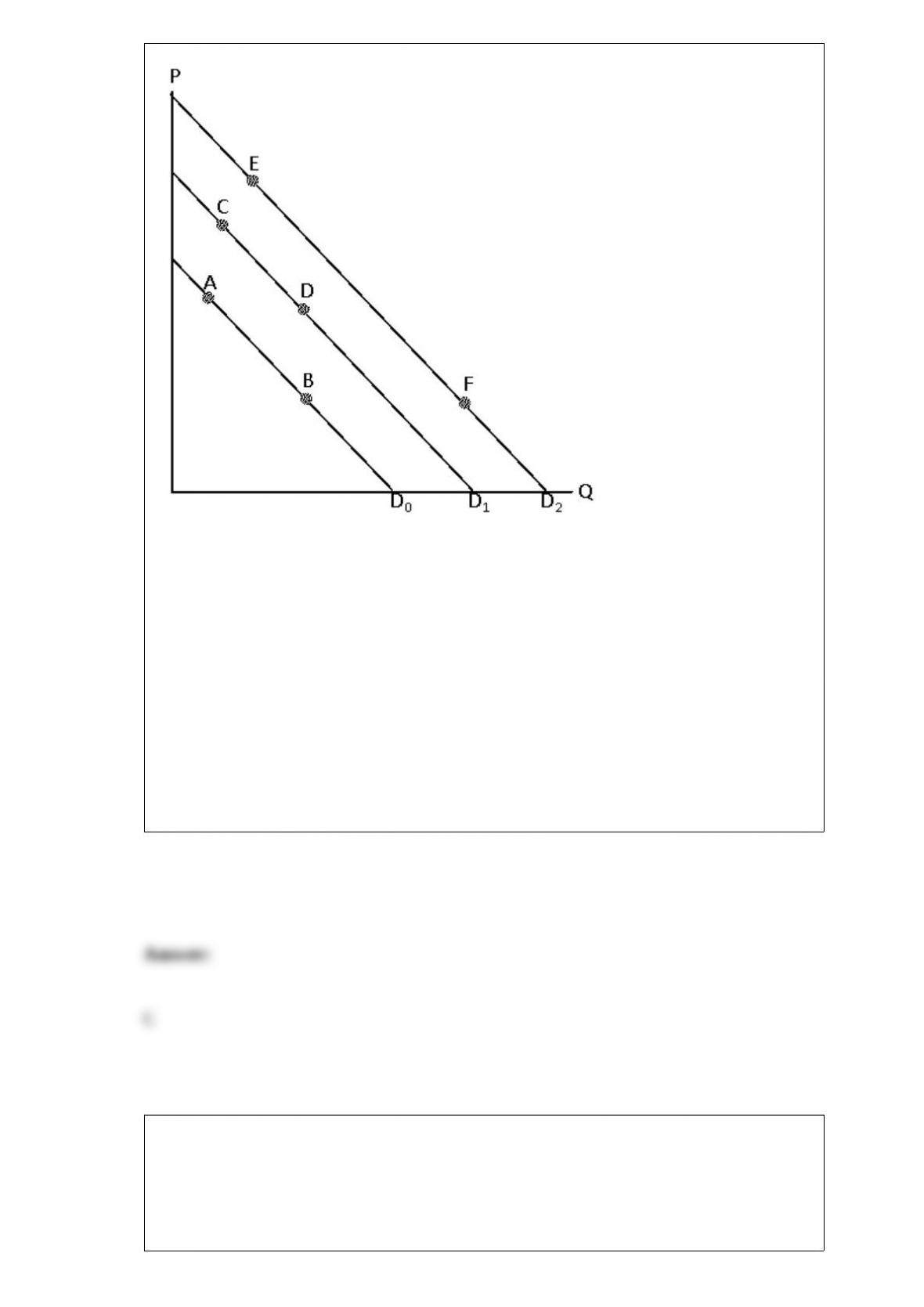
Consider Exhibit 4-1. Which of the following best represents an increase in quantity
demanded?
a. the movement from A to D
b. the movement from C to E
c. the movement from A to B
d. the movement from F to E
e. the movement from B to D
Administrative costs make small loans less profitable than large ones, other things
equal.
a. True
b. False

The official poverty level in the United States
a. has been the same since 1980
b. is the same as in other developed countries because it is based on a United Nations
definition
c. is defined by the United Nations
d. is defined by the Department of Agriculture and based on food costs
e. has been adjusted for inflation but not for changes in family size
Explicit costs are
a. not part of opportunity cost
b. the only cost considered in opportunity cost
c. exactly the same as implicit costs
d. actual monetary payments for resources purchased
e. the opportunity costs of using resources owned by the firm

If the real wage decreases, the opportunity cost of working in the home will
a. increase
b. decrease
c. not be affected
d. increase as long as worker productivity also rises
e. increase only if households want to maintain their standard of living
Production through the firm is often more efficient than market exchange when
a. production requires many transactions among many resource owners
b. production requires few transactions between two resource owners
c. the cost of transacting business through market relations is less than the cost of
undertaking the same activity within the firm
d. inputs are easily identified, measured, priced, and hired
e. the costs of determining inputs and negotiating contracts are low

In a command economy
a. a dictator makes every economic decision
b. owners can sell their resources to the highest bidder
c. no individual or group coordinates the economy
d. in theory, individual choices are reflected in collective decisions, and decisions are
made by central planners
e. public ownership of resources is combined with free markets to direct economic
activity
In economics, “capital” refers to
a. money
b. stocks, bonds, and other financial assets
c. the seat of government
d. machines, buildings, tools, and knowledge
e. net worth (assets minus liabilities)

Which of the following is not true about migration?
a. Migration plays an important role in the economies of developing countries
b. A major source of foreign exchange in some countries is the money sent home by
migrants
c. Migration provides a valuable safety valve for poor countries
d. The best and brightest professionals are very unlikely to migrate to developed
countries
e. Every year thousands of nurses migrate from countries such as Kenya and the
Philippines to the United States
The term structure of interest rates describes the relationship between the rate of interest
charged and the
a. length of time until repayment of the loan
b. amount of the loan
c. riskiness of the borrower
d. identity of the borrower
e. age of the lender

The demand curve facing a single-price monopolist
a. is the same as its average revenue curve
b. is the same as its marginal revenue curve
c. is the same as the perfect competitor’s demand curve
d. lies above its average revenue curve
e. lies below its marginal revenue curve
You are more likely to hire a plumber to repair a leaky drain pipe
a. as the tax rate on your earned income rises
b. if you already own the specialized tools required to complete the plumbing repair
work
c. following an increase in the opportunity cost of your time
d. the more knowledge and experience in plumbing repair work that you possess
e. as the transaction cost of entering into a plumbing contract increases due to
government regulations
As the interest rate increases, consumers will tend to increase their amount of saving
due to
a. increased profit
b. their greater reliance on borrowing
c. the lower opportunity cost of current consumption

d. diminishing marginal utility
e. the higher opportunity cost of current consumption
Under the Bretton Woods agreement,
a. nations could not adjust their exchange rates relative to the dollar for any reason
b. exchange rates were based on a market basket of European currencies plus the dollar
c. the United States stood ready to convert foreign holdings of dollars into gold at a
fixed rate of $35 per ounce
d. the international monetary system operated exactly like the gold standard of
pre-World War II years
e. gold played no role in the international monetary system
Which of the following is an example of a permanent resource price differential?
a. When the price of oil increases, oil exploration increases.
b. When the price of CDs falls, CD production decreases.
c. When demand for land in a city increases, its price increases above prices of land
elsewhere.
d. When demand for computer programmers increased, more people went into that

field.
e. When the price of oil rose, demand for solar panels increased.
Suppose the equilibrium price in a perfectly competitive industry is $10 and a firm in
the industry charges $9. Which of the following will happen?
a. The firm will not sell any output.
b. The firm will sell less output than its competitors.
c. The firm will make more profit than it could at the $10 price.
d. The firm will make less profit than it could at the $10 price.
e. The firm’s revenue will increase and its costs may decrease.
Most of the disagreement among economists involves normative debates.
a. True
b. False
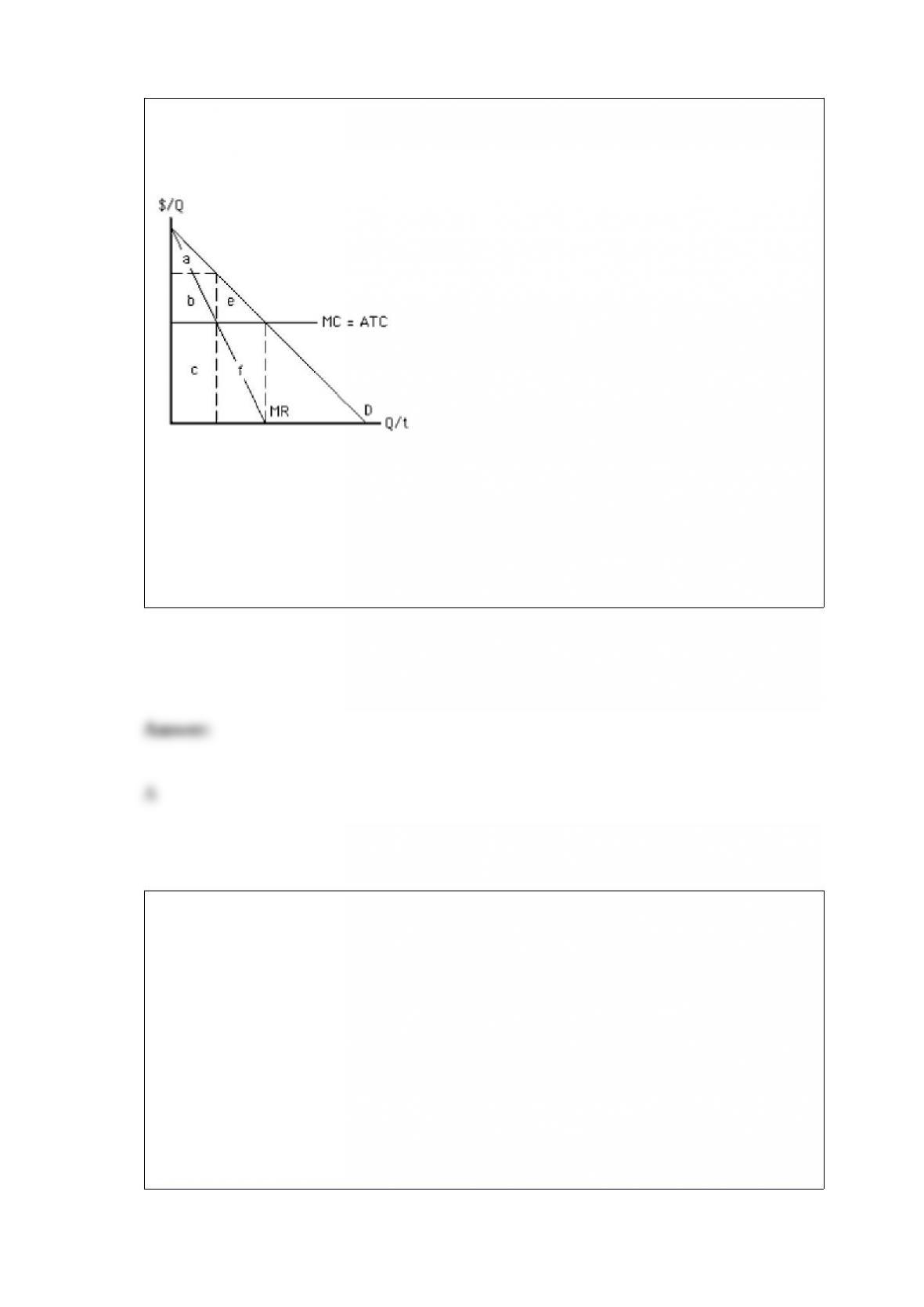
Exhibit 9-17
What area in Exhibit 9-17 represents consumer surplus under monopoly without price
discrimination?
a. area a
b. area b
c. area c
d. area a + b + e
e. area e
To maximize social welfare in the presence of a negative externality, marginal
__________ must equal marginal __________.
a. social cost; private cost
b. private cost; social cost
c. social cost; social benefit
d. private cost; social benefit
e. social cost; external cost

Scarcity
a. exists because people have wants that are unlimited relative to the availability of
resources to satisfy those wants
b. applies when a resource is not freely available
c. means that each society and each individual must make choices
d. exists in all societies
e. all of the above are true
Antitrust policy is designed to
a. improve health and safety in products and in working conditions
b. regulate the firms in industries where “cut-throat” competition is potentially
damaging
c. create monopolies by forcing competitive firms to merge
d. control price and output in industries where monopoly is desirable
e. promote competition and reduce anticompetitive behavior

If the minimum efficient scale in the production of aluminum exceeds the quantity of
aluminum any individual siding producer buys, siding producers should integrate
backward into aluminum production.
a. True
b. False