
Suppose that a nation has adopted a fixed exchange rate with another country, and has a
persistent trade deficit. What is most likely to happen?
a. a gradual increase in the value of its currency
b. a gradual decrease in the value of its currency
c. a “run” on its currency and a sudden appreciation
d. a “run” on its currency and a sudden devaluation
If the Fed sells a T-bill to an individual rather than to a commercial bank, how will this
affect the money supply?
a. It will increase the money supply.
b. It will increase the checking account balance of the individual.
c. It will have no effect on the money supply.
d. It will decrease the money supply.
Investment spending is a leakage from the circular flow model.
a. True
b. False

A patent
a. is given only to government owned companies.
b. is not a legal impediment to entry.
c. is a privilege granted by a state to an inventor over his invention.
d. does not give the holder a monopoly during the period it is in effect.
The period of 1973 to 1980 can best be described as a time of
a. deflation.
b. reflation.
c. unflation.
d. stagflation.
e. disflation.
Double taxation of corporate earnings means
a. for individuals who get dividends on personal income, tax rates are twice as high as
for wage earners.
b. stockholders pay personal income taxes and corporation taxes on profits.
c. stockholders don’t get the plowback but still pay taxes on it.
d. the corporation tax raises stock prices so individuals also pay a capital gains tax in
addition to a tax on dividends.
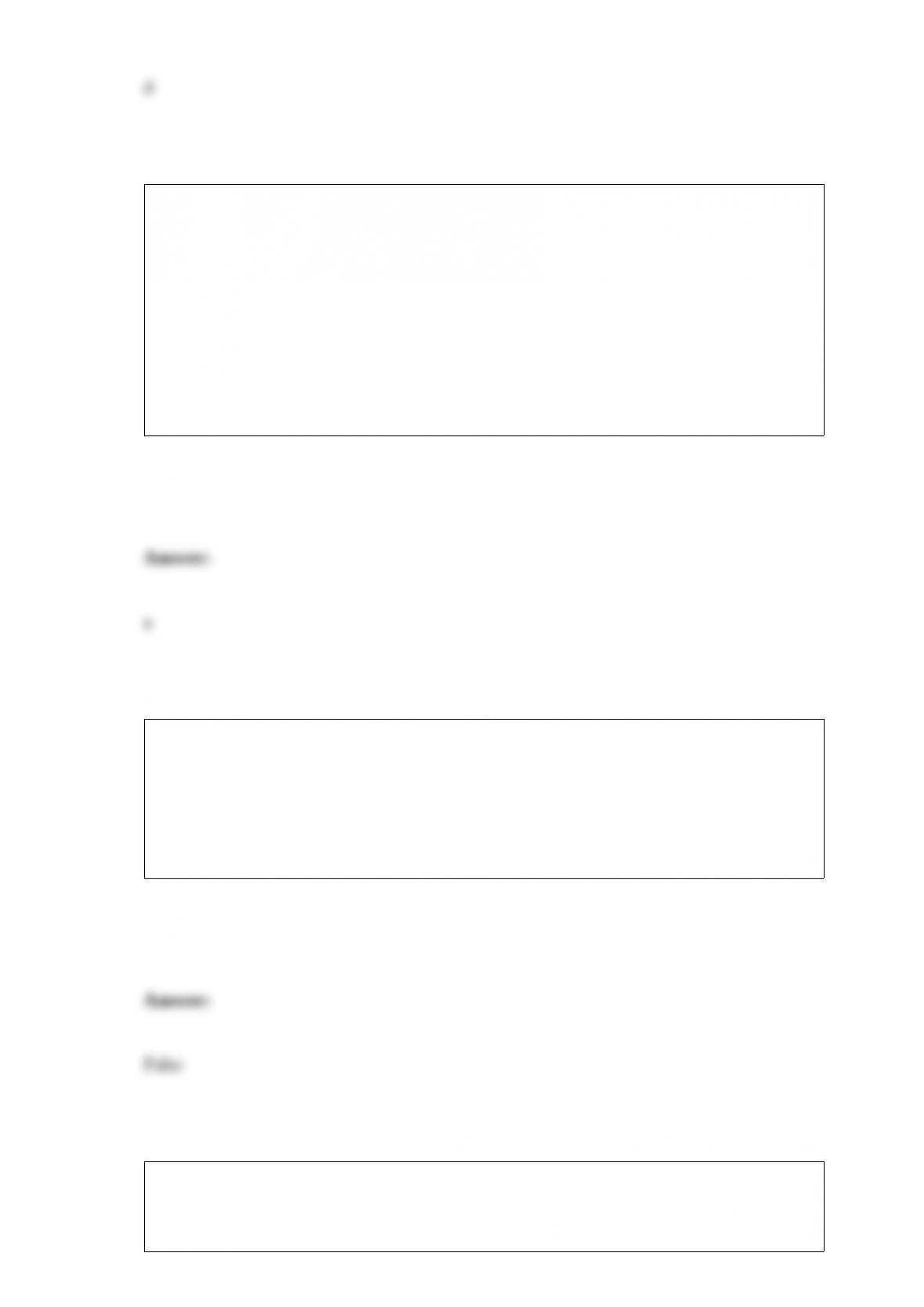
Table 7-5
Table 7-5 shows short-run total cost figures for a stereo manufacturer. At what output
level does short-run average total cost reach a minimum?
a. 2
b. 3
c. 4
d. 5
When the inflationary gap is finally eliminated, a long-run equilibrium is established
with a ____ price level and with GDP ____ potential GDP.
a. higher; equal to
b. higher; greater than
c. lower; equal to
d. lower; greater than
Higher price levels will eventually lead to lower interest rates as people reduce their
demand for money.
a. True
b. False
Figure 6-4
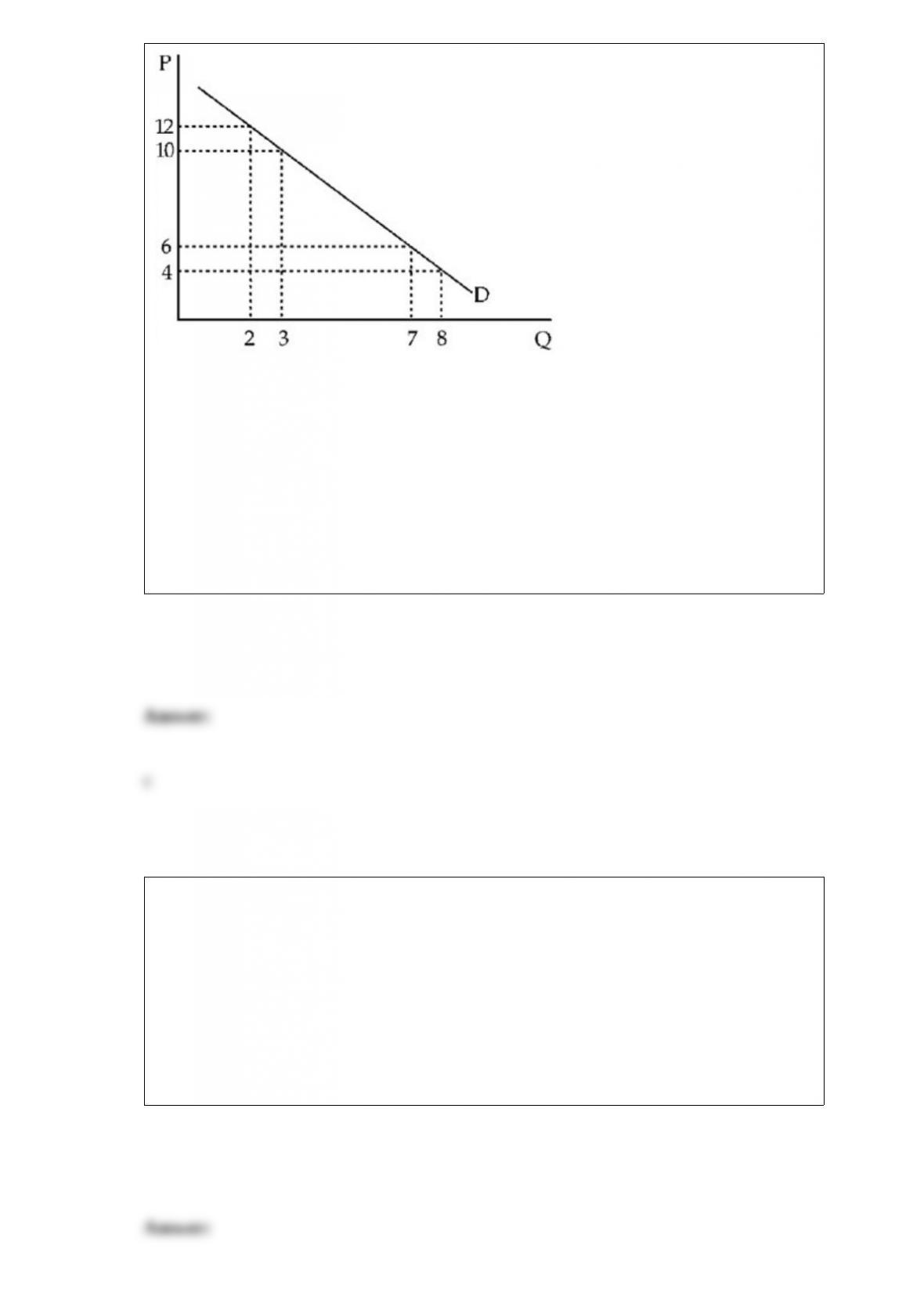
In Figure 6-4, total expenditure ____ as price falls from P = 12 to P = 10.
a. falls
b. stays constant
c. rises
d. rises by more than $12
The problem of scarcity
a. has been “cooked up” by disenchanted anticapitalists.
b. exists because resources are limited relative to wants.
c. is solved by promoting economic growth.
d. is caused by artificially high prices.
Redistribution programs that reduce poverty and income inequality
a. always increase GDP.
b. always decrease GDP.
c. usually increase GDP.
d. usually decrease GDP.
Under the Bretton Woods system, a country with a balance of payments deficit
a. could get loans from the U.S. government.
b. could devalue if deflationary policies failed to eliminate the deficit.
c. was not allowed to devalue under any circumstance.
d. was required to devalue its currency immediately.
The position of the supply curve in the market for garbage removal

a. is irrelevant since the cost is fixed.
b. depends on the marginal cost of garbage removal.
c. depends on the demand for garbage removal services.
d. is unaffected by taxes levied per household amount of garbage.
Which of the following was not a factor that contributed to improved productivity from
1995 to 2009?
a. surging investment
b. falling energy prices
c. advances in information technology
d. decreased costs for higher education
Whenever the interest rate goes up, the price of bonds will go down.
a. True
b. False

A “conservative” would most likely argue in favor of
a. tax increases when fiscal stimulus is necessary, and spending cuts when fiscal
restraint is necessary.
b. tax cuts when fiscal restraint is necessary, and spending cuts when fiscal stimulus is
necessary.
c. tax cuts when fiscal stimulus is necessary, and spending cuts when fiscal restraint is
necessary.
d. spending increases when fiscal expansion is necessary, and tax increases when fiscal
stimulus is necessary.
In a long-run equilibrium in a perfectly competitive market, the average firm earns
positive economic profits.
a. True
b. False

The stock market provides two functions for corporate financing: reducing investors’
risk and setting the prices of stocks.
a. True
b. False
The people most likely to pay little personal income tax to the U.S. government are
a. the middle class.
b. renters.
c. the very poor.
d. earners of wages (as opposed to salaries).
Profit maximization is
a. the only motive of any firm’s management.
b. a behavioral assumption to simplify analysis.
c. the same as satisficing.
d. a literal description of a firm’s behavior.
There is no way that externalities can be corrected.
a. True
b. False
The Federal Reserve System is
a. controlled by the Department of the Treasury.
b. the central bank for the United States.
c. completely similar to the Bank of England.
d. All of the above are correct.
The derived demand curve for loans slopes downward because as interest rates
a. fall, future income becomes less valuable.
b. fall, investors develop pessimistic expectations.
c. fall, future income becomes more valuable.
d. rise, investors become pessimistic.
Elasticity of demand equals the ratio of the percentage change in the price of a good to
the percentage change in the quantity demanded.
a. True
b. False
If mining companies are indifferent between operating and not operating a quarry, that
quarry is
a. discounted.
b. usurious.
c. marginal.
d. nonexcludable.
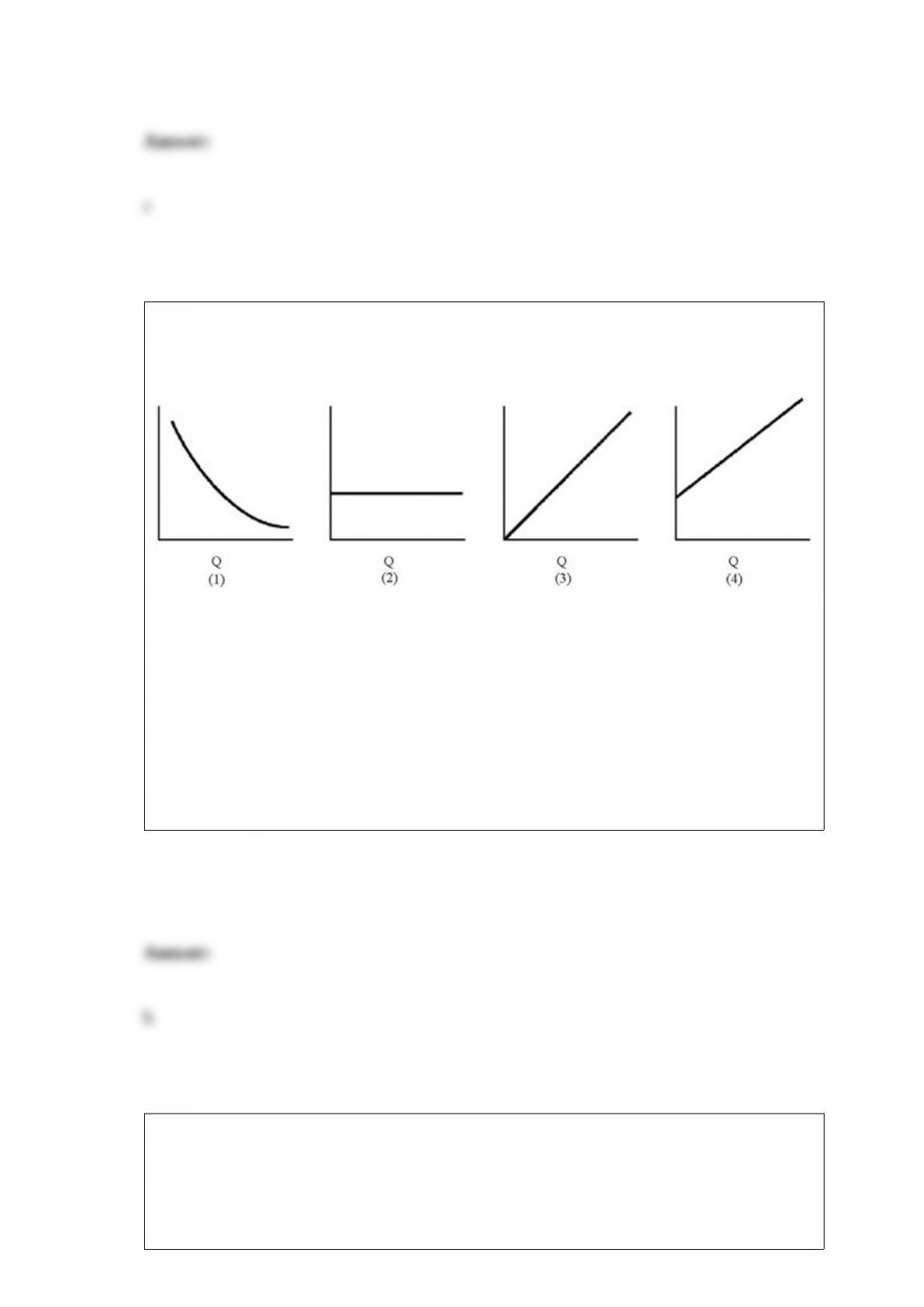
Figure 7-9
Of the graphs in Figure 7-9, which represents total fixed cost?
a. 1
b. 2
c. 3
d. 4
Recent data and analysis confirms that minimum wage laws have significantly
increased teenage unemployment.
a. True

b. False
Labor unions in the United States
a. tend to be more outspoken politically than those in Europe.
b. have experienced steady declines in membership since the 1950s.
c. tend to be more powerful in deregulated industries (for example, airlines) than in
regulated industries.
d. universally support socialist principles.
In the modern U.S. economy, most transactions are made with
a. cash.
b. gold and silver.
c. credit cards.
d. checking deposits.
The short-run market demand schedule in perfect competition is positively sloped.
a. True
b. False
“Free trade benefits one country at another country’s expense.” Evaluate this statement
using economic analysis.
Explain how the demand for labor is determined.
Using the aggregate demand/aggregate supply model, explain the difference in the
employment prospects of the graduates of 2007 and 2009.
Why do economists consider perfect competition to be the most efficient market
structure?
Suppose a professor announces at the beginning of a course that he will give no failing
grades because they are too damaging to self-esteem. How does such a policy affect
equality and efficiency?
Why is comparative advantage rather than absolute advantage the basis for trade?
What is an aggregate? How is it used in macroeconomics? Give two examples of
specific aggregates that are used in the study of macroeconomics.
How might a court use cross elasticity in an antitrust case?
Explain the linkages in the causal chain when the Fed conducts a contractionary
monetary policy. What will be the ultimate effect on GDP?
Why might well-educated economists disagree on appropriate public policy in some
situations?
As an investor, would you agree to the statement “put all your eggs in one basket?”
Substantiate your answer.
How does the idea of a leaky bucket relate to the study of income distribution?
How does the shape of the aggregate supply curve affect macroeconomic analysis and
policy making? Illustrate your answer with the appropriate graphs.
What is the difference between tax cuts imposed on higher-income households
compared with lower- and middle-income households? Discuss the implications for the
multiplier and the effectiveness of the tax cuts for boosting GDP.
Suppose that a quota is imposed on imports of minivans. Show graphically what the
effect is in terms of price and quantity of imports. Be sure that your graph is completely
and correctly labeled. What determines how much of the quota is paid by the buyers of
the minivans?
For a number of years, General Motors used a pricing strategy designed to maintain at
least 40 percent of the American car market. Does this strategy suggest that GM was
maximizing profits or pursuing an alternative strategy?
A market system works very well in solving some basic problems of the economy but it
fails in some cases. Provide examples.