
Firms
a. are where entrepreneurs combine resources
b. are economic units formed by profit-seeking entrepreneurs
c. are assumed to try to maximize profit
d. reward entrepreneurs with profits, which are sales revenue minus the cost of
production
e. All of the answers are correct.
Total cost is calculated as
a. FC + MC
b. FC / MC
c. (VC + FC) / MC
d. VC + FC
e. VC x output
If we wanted to prove that macaroni is an inferior good, we would test the __________
of macaroni and get a __________.

a. cross-price elasticity; negative number
b. income elasticity; number less than 1
c. income elasticity; positive number
d. price elasticity of demand; number greater than negative 1
e. income elasticity; negative number
Michigan has an abundant supply of fresh water. However, an economist would
consider it a scarce resource because
a. water is necessary for humans’ physical survival
b. pollution will eventually destroy all life in the Great Lakes
c. water is limited relative to people’s unlimited wants
d. water commands a very high price
e. nature can destroy water as well as create it
A perfectly competitive firm is a price taker. Therefore, it faces a
a. perfectly elastic supply curve for its output
b. perfectly elastic demand curve for its output
c. perfectly inelastic supply curve for its output
d. perfectly inelastic demand curve for its output
e. unit-elastic demand curve for its output
A rotation of the budget line indicates a change in the price of one of the goods under
consideration.
The U.S. Census Bureau considers in-kind transfers (such as employer provided
benefits) when measuring income.
a. True
b. False

After paying admission and entering King’s Island Amusement Park near Cincinnati,
Alan Fujiwara sees a list of waiting times for each attraction and ride. At this point,
Alan’s marginal dollar cost is
a. zero and so are the marginal time costs of each attraction or ride
b. zero, so he will base his next move on the marginal time costs of each attraction or
ride
c. greater than zero based on the admission price, so he will base his next move on the
marginal time costs of each attraction or ride
d. greater than zero based on the admission price, so he will ignore the marginal time
costs of each attraction or ride
e. less than zero and so are the marginal time costs of each attraction or ride
A firm produces staples in a perfectly competitive market and hires workers in a
perfectly competitive labor market. Which of the following is true?
a. The supply curve of staples is horizontal.
b. The supply curve of workers is horizontal.
c. The firm’s demand curve for labor is horizontal.
d. The marginal revenue product of labor curve is horizontal.
e. The marginal product of labor curve is horizontal.
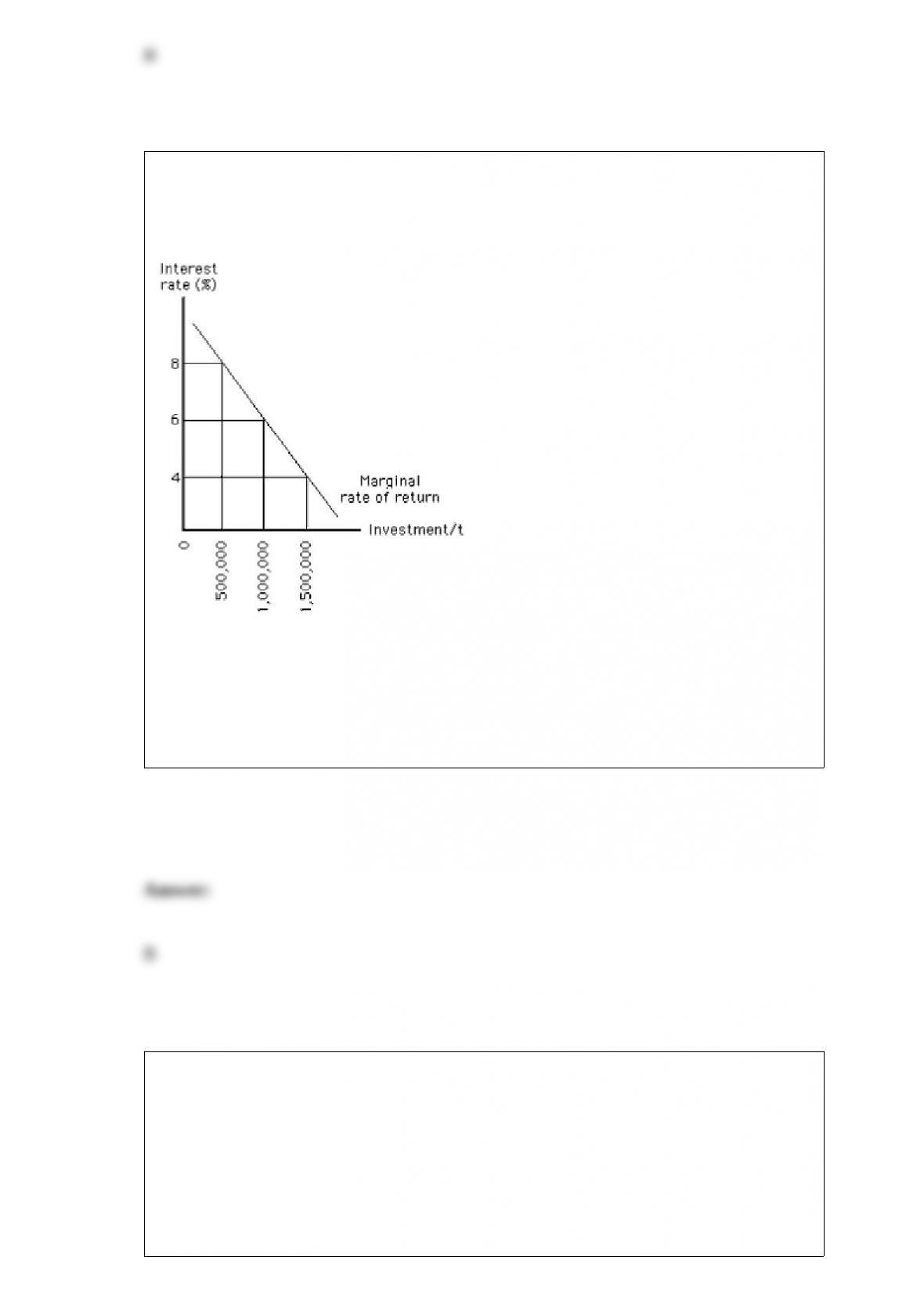
Exhibit 13-7
In Exhibit 13-7, if the interest rate is 8 percent, investment will equal approximately
a. $1,500,000
b. $500,000
c. $1,000,000
d. $950,000
e. $1,250,000
What is the relationship between price elasticity of demand and the monopolist’s
revenue?
a. marginal revenue is maximized where demand is unit elastic.
b. average revenue is maximized where demand is unit elastic.
c. marginal revenue is negative where demand is inelastic.
d. average revenue is negative where demand is inelastic.
e. marginal revenue is lowest where demand is unit elastic.

Which of the following events would not be recorded in the U.S. balance of payments?
a. The money supply of a foreign nation increases.
b. Oxfam America, a U.S. relief agency, sends food to drought victims in sub-Saharan
Africa.
c. Oxfam America, a U.S. relief agency, sends farm equipment to drought victims in
sub-Saharan Africa.
d. The Pentagon stations troops in Saudi Arabia.
e. Pepsi-Cola sends its soft drink to Russia; in return, the United States gets Stolichnaya
vodka. No money changes hands.
On a production possibilities frontier, the opportunity cost of one more unit of a
commodity per time period is measured by the
a. monetary price of the commodity
b. amount of the other commodity that must be sacrificed
c. amount of unemployed resources that must be used
d. amount of satisfaction it gives consumers
e. amount of tax paid to government for production, sale, and use of the commodity

A monopolist’s short-run supply curve is
a. its average fixed cost curve
b. the part of the marginal cost curve above the average variable cost curve
c. the part of the marginal cost curve below the average variable cost curve
d. nonexistent
e. its demand curve
In determining the poverty level, the Census Bureau counts cash transfers, but not
in-kind transfers, thereby understating the actual amount of antipoverty transfers made.
a. True
b. False
The optimal level of pollution is

a. zero
b. the level at which the marginal social cost of air quality equals the marginal social
benefit
c. the level at which the average social cost of air quality equals the average social
benefit
d. the level at which the total social cost of air quality equals the total social benefit
e. the level at which the marginal social cost of air quality is minimized
John takes 10 minutes to iron a shirt and 20 minutes to type a paper. Harry takes 10
minutes to iron a shirt and 30 minutes to type a paper. Which of the following
statements is correct?
a. Harry has a comparative advantage in ironing.
b. Harry has a comparative advantage in typing.
c. Harry has an absolute advantage in typing.
d. Harry has an absolute advantage in ironing.
e. Neither can gain from specialization and exchange.

When consumption of a good or service produces benefits or costs that are not reflected
in the market price for the good, this is known as a(n)
a. externality
b. common pool problem
c. nonexcludable resource
d. public good
e. renewable resource
An increase in labor supply will increase the equilibrium wage rate.
a. True
b. False
Permanent resource price differentials are caused by
a. differences in resource quality
b. differences in the time and training required to perform the job
c. differences in nonmonetary aspects of the job

d. a lack of resource mobility
e. all of the above
The total revenue curve that corresponds to a downward-sloping linear demand curve
a. slopes downward
b. slopes upward
c. is a horizontal line
d. first rises, then falls
e. first falls, then rises
Suppose it costs Minnie’s Mini-Golf (a monopolist) not a penny more to let another
person on the course. If Minnie’s faces a linear (downward-sloping) market demand
curve, it will maximize profit by choosing the point on the demand curve at which
a. marginal revenue is greatest
b. price elasticity is unit elastic
c. price elasticity is inelastic
d. price exceeds average total cost by the greatest amount
e. price exceeds marginal cost by the greatest amount

Which of the following is notconsidered a barrier to entry?
a. patents
b. government licenses
c. economies of scale
d. diseconomies of scale
e. control over essential resources
When income is allocated to two goods, x and y, consumer equilibrium occurs when
a. MUx = MUy
b. MUx = MUy, and the budget is exhausted
c. MUx/Py = PUx/Py
d. MUx/Py = PUx/Py, and some money is not spent
e. MUx/Py = PUx/Py, and the budget is exhausted

For each watch Denmark produces, it gives up the opportunity to make 50 pounds of
cheese. Germany can produce one watch for every 100 pounds of cheese it produces.
Which of the following is true with regard to opportunity costs in the two countries?
a. The opportunity cost of producing watches is higher in Denmark.
b. The opportunity cost of producing cheese is higher in Denmark.
c. The opportunity cost of producing cheese is identical in both countries.
d. It is impossible to compare opportunity costs because the two countries use different
currencies.
e. In both countries combined, the opportunity cost of one watch is 150 pounds of
cheese.
Amanda, age 6, opens a lemonade stand. She makes all the lemonade from a mix she
found in her parents’ pantry. Her stand is an old box she found in the garage. The
pitcher and paper cups were taken from the kitchen. Which of the following is true?
a. The opportunity cost of the lemonade is zero.
b. The only opportunity cost of the lemonade is Amanda’s time.
c. Amanda’s explicit costs are zero.
d. The implicit costs of Amanda’s lemonade are zero.
e. Whatever revenue Amanda gets will be pure economic profit.

Which of the following illustrates the law of diminishing marginal utility?
a. The marginal utility of Diane’s second Coke is greater than the marginal utility of her
third pretzel, other things constant.
b. The marginal utility of Diane’s second Coke is greater than the marginal utility of
Ken’s third pretzel, other things constant.
c. The marginal utility of Diane’s second Coke is greater than the marginal utility of her
third Coke, other things constant.
d. The total utility of one Coke is greater than the total utility of two Cokes, other things
constant.
e. The marginal utility of Diane’s second Coke is greater than the marginal utility of
Ken’s third Coke, other things constant.
Tim Tupper’s term paper-typing business is a perfectly competitive firm in long-run
equilibrium. Which of the following does notdescribes the firm’s situation?
a. It will be minimizing average total cost.
b. It will be charging a price equal to marginal cost.
c. It will be charging a price equal to average total cost.
d. It will be earning a normal profit.
e. Entrepreneurs outside the industry will be eager to enter.

The law of diminishing marginal utility implies that the marginal utility of my fifth
waffle is less than the marginal utility of my friend’s second waffle, other things
constant.
a. True
b. False
If the discount rate is 5 percent, the present value of annual $100,000 payments in
perpetuity (i.e., continued indefinitely into the future) is
a. $2,000,000
b. $1,246,296
c. $1,000,000
d. $976,463
e. infinite
Because of specialization and comparative advantage, most people
a. consume only what they produce themselves
b. consume the products produced by their family and friends
c. consume the products of many other specialists

d. do not use money as a medium of exchange
e. share whatever they produce
If clams and mussels are normal goods, then when the amount the consumer can spend
increases,
a. purchases of whichever good is preferred will increase, and purchases of the good not
preferred will decrease
b. purchases of both goods will increase
c. only purchases of the cheaper good will increase
d. only purchases of the more expensive good will increase
e. it is unclear what will happen to purchases of clams and mussels