
To ensure the acceptability of money, a government must
a. back it with gold or silver.
b. create enough of it so people can purchase all the goods they want and need.
c. limit its quantity relative to output.
d. prevent the public from holding it for extended periods.
e. ensure its supply keeps pace with inflation.
A key characteristic of oligopoly is
a. a single firm producing a product with no close substitutes.
b. complete absence of entry barriers.
c. a demand curve much less elastic for price increases than for price decreases.
d. the tendency to spend less on product differentiation and advertising than a perfectly
competitive firm.
e. actual and perceived interdependence among firms.
The following questions are based on the following graph, showing short-run supply
and demand curves for a perfectly competitive market. The initial supply curve is
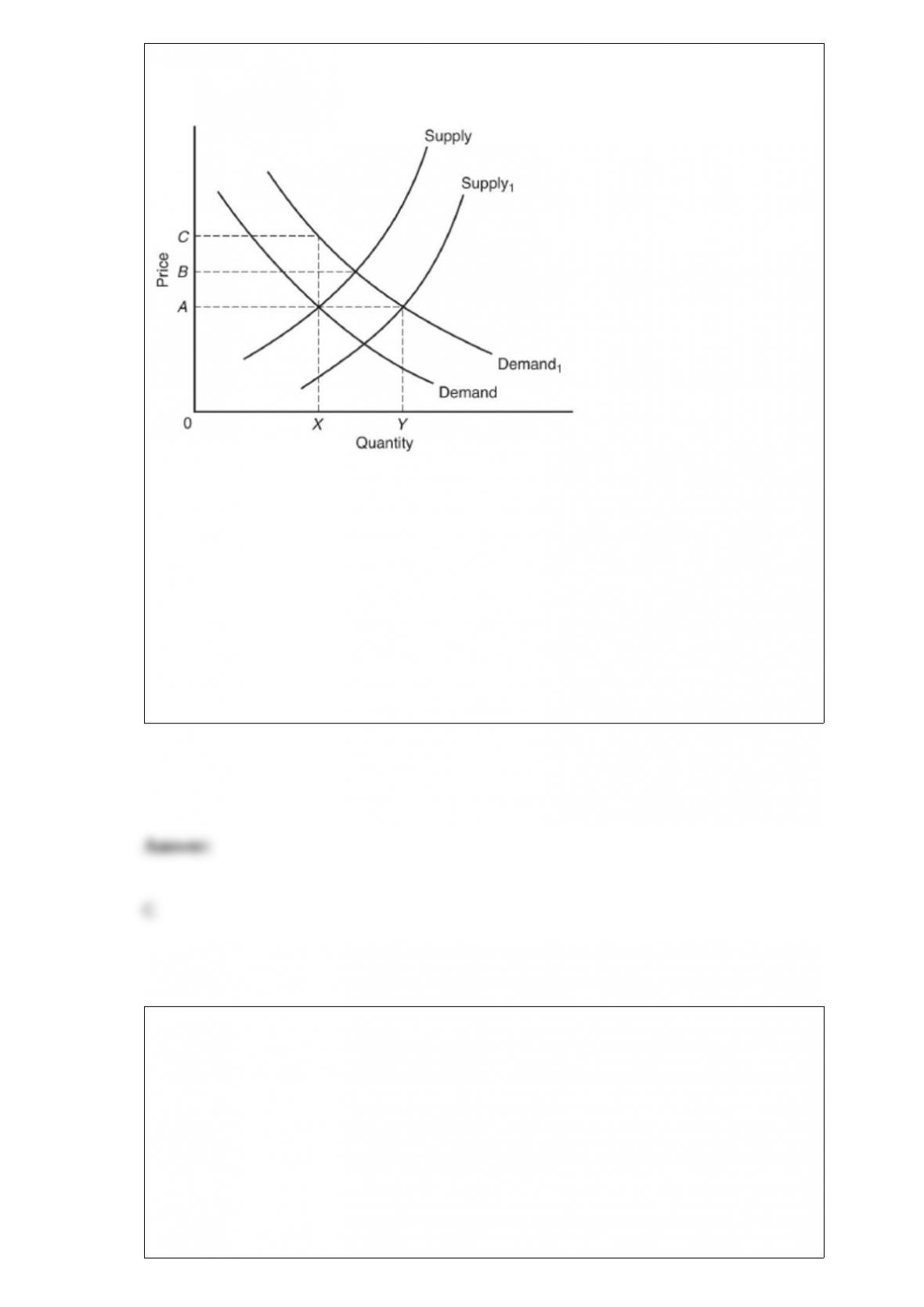
labeled “Supply” and the initial demand curve is labeled “Demand.” Price 0A and
output rate 0X represent the initial equilibrium price and output.
The typical producer in this
market
a. faces a demand curve less elastic than the one shown.
b. minimizes total cost.
c. produces a tiny fraction of output 0X.
d. must produce at least 0Y.
e. must increase price to break even.
Many of the basic innovations introduced into the U.S. economy during the twentieth
century are attributed to the fact that our culture has been able to nurture a great many
a. economists.
b. educators.
c. engineers.
d. entrepreneurs.

e. equestrians.
The rate of return on an asset that costs $6,000 and yields a permanent return of $540
per year is ________ percent.
a. 11
b. 9
c. 6
d. 5.4
e. 0.6
The notion advanced by the Supreme Court in the U.S. steel case that “the law does not
make mere size an offense. It . . . requires overt acts,” exemplifies the application of the
a. golden rule.
b. rule of behavior.
c. rule of law.
d. rule of thumb.

e. rule of reason.
Cash rebates, tax exemptions, preferential financing, and insurance arrangements are all
examples of
a. prohibitive tariffs.
b. voluntary quotas.
c. export subsidies.
d. terms of trade.
e. bilateral accommodations.
Profits from innovation represent greater than normal returns to capital, because in the
case of innovation
a. it is extremely difficult to calculate an expected rate of return.
b. borrowers are often taken advantage of by lenders.
c. no one wants to lend innovators any money to finance their businesses.
d. it leads to the formation of a natural monopoly.
e. the rate of return generally exceeds the interest rate.
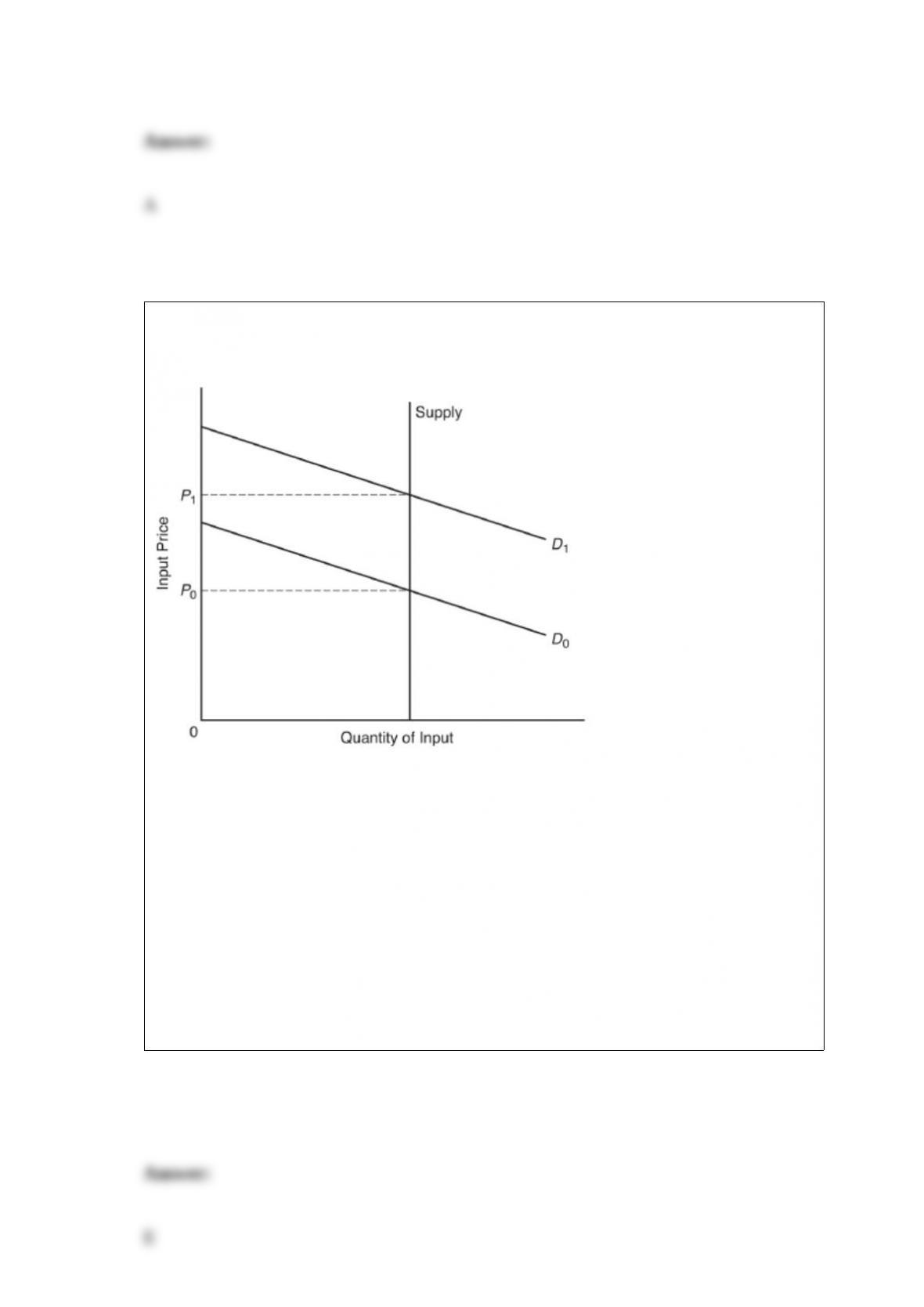
The following questions are based on the following diagram, representing the supply
and demand curves for an input:
If the demand curve is D0, a tax on the income received by the supplier of this input
a. increases the demand to D1.
b. reduces the quantity sold of the input.
c. raises the quantity sold of the input.
d. raises the equilibrium price of the input.
e. has no effect on the equilibrium price and quantity of the input.

To an individual firm, its costs represent
a. gross income to the firm resulting from its ownership of the means of production.
b. profits that accrue to those internally supplied inputs.
c. the payments to owners of resources needed to bid these resources from alternative
uses.
d. the value of the assets used in the production process.
e. the monetary sum of the variety of alternatives open to its resources.
Public confidence in the commercial banking system has been strengthened by
a. the requirement that commercial banks use their reserves mainly to buy government
bonds.
b. bank practices that maintain cash reserves equal to 50 percent of demand deposit
liabilities.
c. the fact that all commercial banks are members of the Federal Reserve System.
d. the over 15 percent spread between interest paid to depositors and interest earned on
loans.
e. the existence of almost universal insurance on deposits up to $250,000.

Monopolistic competition and oligopoly are similar in that firms in both markets
a. face horizontal demand curves.
b. do not earn profits in the long run.
c. tend to charge higher prices than under perfect competition.
d. find that advertising and other types of selling expenses are unnecessary.
e. produce homogeneous products.
Supply-siders advocate influencing aggregate supply through the use of reductions in
a. spending.
b. income.
c. money.
d. tax rates.
e. foreign imports.
The income expenditure model is most relevant when

a. the economy is operating in the horizontal range of the aggregate supply curve.
b. aggregate supply equals aggregate demand.
c. the price level is changing.
d. the equilibrium level of GDP is less than the level of intended spending.
e. actual saving equals actual investment.
In recent decades research and development activities in the United States have been
a. funded primarily by universities and nonprofit institutions.
b. carried out by independent inventors inside commercial research laboratories.
c. noticeably declining in importance as a source of economic growth.
d. generally directed toward making incremental improvements rather than major
advances.
e. directed primarily toward achieving civilian rather than military or political
objectives.
The rationale for using game theory to study oligopoly is that

a. game theory is an exceedingly simple tool.
b. each output produced by an oligopolist is determined by a linear program.
c. it enables the government to dictate the outcome of a competitive situation.
d. game theory allows consideration of the product transformation curve.
e. in oligopoly, each firm must take account of its rivals’ actions.
If the government imposes a tax on rents
a. government revenues will decline.
b. accounting profits will more closely approximate economic profits.
c. there will be no effect on the supply of resources to the economy.
d. land will be less productive.
e. the demand for land will fall.
Before deciding on a course of action, the Fed is faced with the problem of
a. forecasting the economy’s short-term movements.
b. obtaining approval from Congress.

c. clearing its actions with the member banks.
d. getting the consent of Wall Street.
e. consulting with Milton Friedman.
The U.S. economy may be best characterized as an example of
a. market socialism.
b. opportunistic imperialism.
c. militaristic capitalism.
d. pure capitalism.
e. mixed capitalism.
The best example of an indirect business tax is
a. an excise tax on alcoholic beverages.
b. the personal income tax.
c. depreciation.

d. the corporate income tax.
e. retained earnings.
The passing of Proposition 13 in 1978 tends to illustrate that California voters may have
a. been willing to pay higher taxes to ensure increased levels of public services.
b. been fed up with increasingly higher progressive income tax rates and voted to
reduce them.
c. felt the government’s role in the fields of labor and welfare should be increased at the
state level.
d. believed that the existing levels of local government services were being inefficiently
produced and not worth the increasing taxes necessary to finance them.
e. wished to place a greater importance on the property tax as a source of local
government funds.
A country’s economic, social, and political climate can increase its level of potential
output and rate of growth by
a. deemphasizing the importance of material welfare in this world.
b. organizing a command economy with tight constraints on individual behavior.

c. capturing all the increased output for the ruling party’s personal benefit.
d. encouraging competition and allowing economic and political freedom to foster the
introduction of new ideas.
e. sponsoring feudalism.
When monetary authorities decrease the money supply and push up interest rates, they
are pursuing a(n) ________ money policy.
a. easy
b. tight
c. selective
d. fiscal
e. open
Which agency of the executive branch of the government is primarily responsible for
preparing the budget proposal?
a. General Accounting Office
b. Treasury Department

c. Office of Management and Budget
d. Congressional Budget Office
e. Internal Revenue Service
The price leadership model that applies when the largest firms set industry pricing
patterns is the ________ model.
a. marginal firm
b. cartel
c. perceived interdependence
d. barometric firm
e. dominant firm
The following questions are based on the following rates-of-return table for five
independent investment projects:
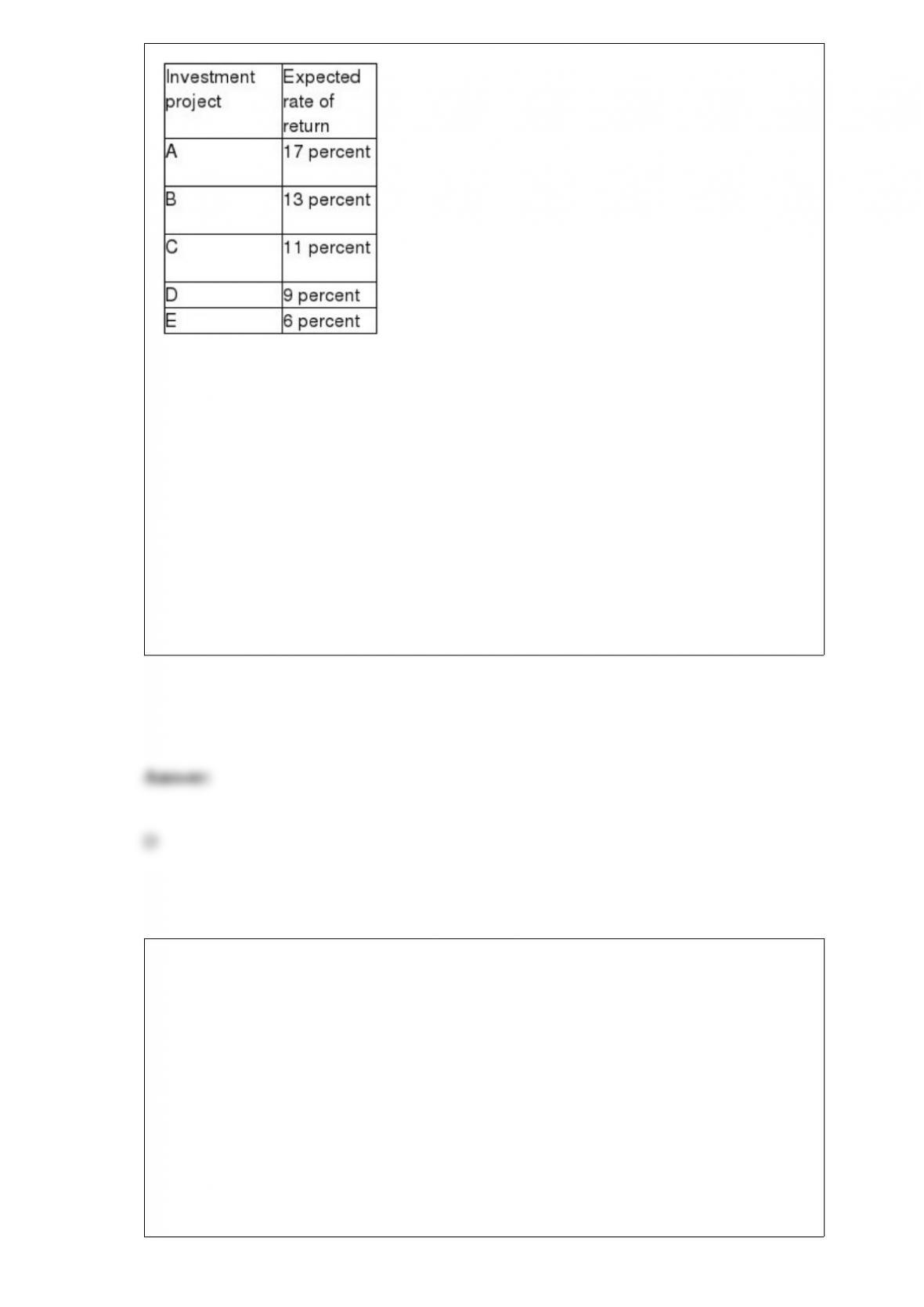
A 3-percentage-point increase in the interest rate might result in canceling the decision
to undertake project
a. A.
b. B.
c. C.
d. D.
e. E.
The inverse relationship between the inflation rate and the unemployment rate is a
result of the assumption that
a. all inflation is demand-side inflation.
b. as the unemployment rate falls, demand for products and resources decreases.
c. as the unemployment rate rises, bottlenecks occur throughout the economy.
d. there is a significant amount of excess capacity at low unemployment rates.
e. as prices rise, unemployment also rises.

The demand for labor and other inputs is a derived demand because
a. as the price rises, the quantity demanded falls.
b. under certain conditions it is backward bending.
c. the firm’s demand curve for labor is derived from the market demand curve for labor.
d. inputs are demanded to produce other things and not as an end in themselves.
e. workers derive income from working.
A country’s currency appreciates relative to other currencies when
a. its inflation rate exceeds that of other countries.
b. its rate of economic growth exceeds that of other countries.
c. its interest rate levels rise more rapidly than elsewhere.
d. it increases the price of gold.
e. gold flows into the country from abroad.