
When players cannot achieve their goals because they are unable to make credible
threats or promises, the situation is called a:
A. prisoner’s dilemma.
B. Nash equilibrium.
C. failure of dominant strategies.
D. commitment problem.
The money demand curve relates ______ to the ________.
A. the aggregate quantity of money demanded; aggregate demand
B. aggregate demand; nominal interest rate
C. the aggregate quantity of money demanded; price level
D. the aggregate quantity of money demanded; nominal interest rate
Suppose Sarah owns a small company that makes wedding cakes. The table below

shows how Sarah’s total cost varies depending on the number of wedding cakes she
makes each day.
If the market for wedding cakes is perfectly competitive, and wedding cakes sell for
$125 each, then at her profit-maximizing level of output, Sarah’s profit will be ______
per day.
A. $90
B. $100
C. $105
D. $625
Suppose that this graph describes the current labor market for high school teachers:
If the wage isw*, then:
A. there will be a shortage of certified teachers.
B. there will be a surplus of certified teachers.
C. there will be neither a shortage nor a surplus of certified teachers.
D. teachers will be underpaid.
Suppose that a vaccine is developed for a highly contagious strain of flu. The likelihood
that anyone will get this flu decreases as more people receive the vaccine. One of the
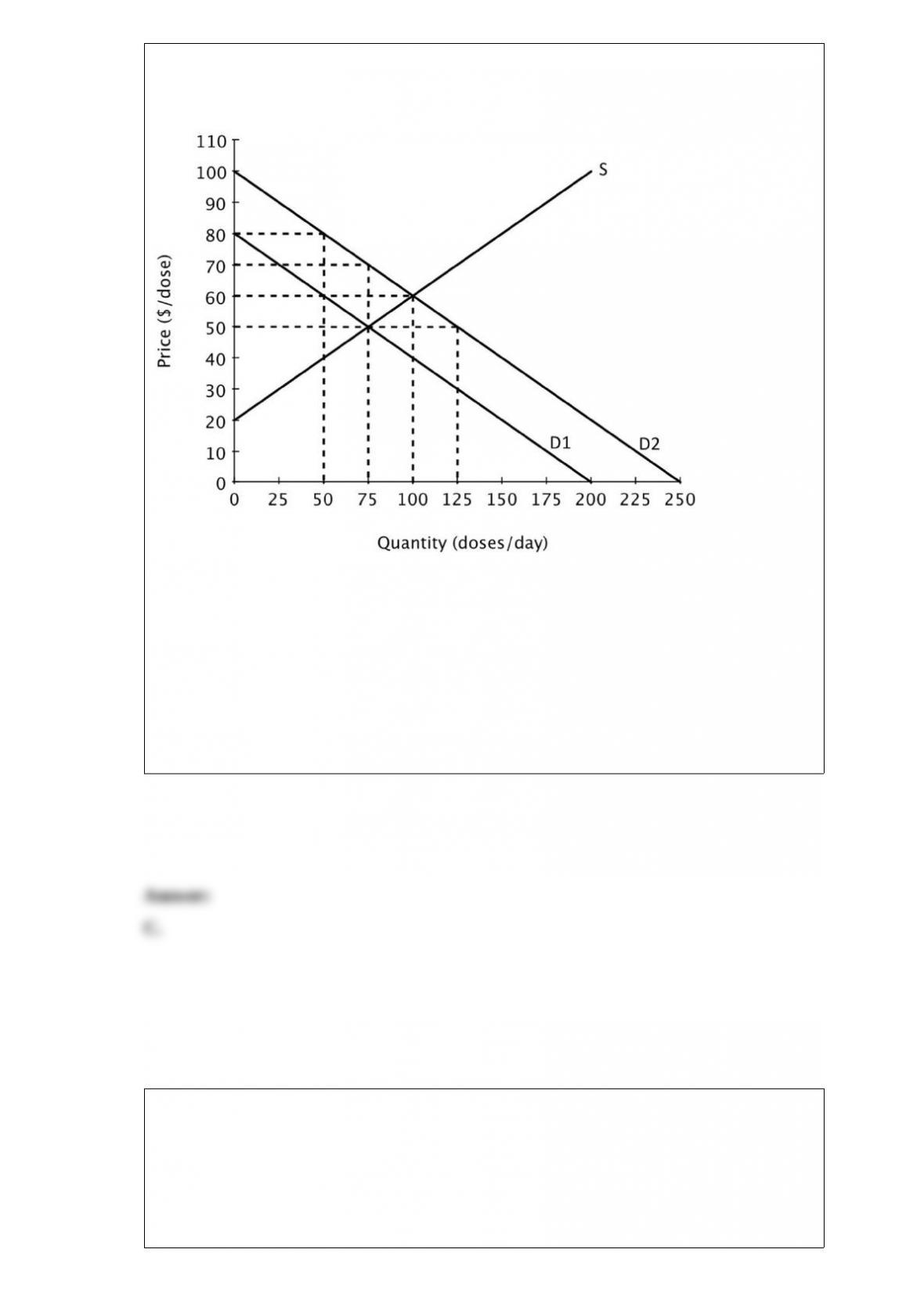
demand curves below represents the private demand for the vaccine and the other
represents the social demand for the vaccine.
The socially optimal quantity of the vaccine is ______ doses per day.
A. 50
B. 75
C. 100
D. 125
Which of the following equations is equivalent to the equation S ” NX = I?
A. S + KI = I
B. S “I = KI
C. S ” KI = NX
D. S + I = NX ” KI
There are ten states in the democratic nation of Fatlandia, and each state has ten
thousand residents. Although incomes vary, each Fatlandian pays a tax equal to the total
cost of all government projects divided by the number of residents in the country.
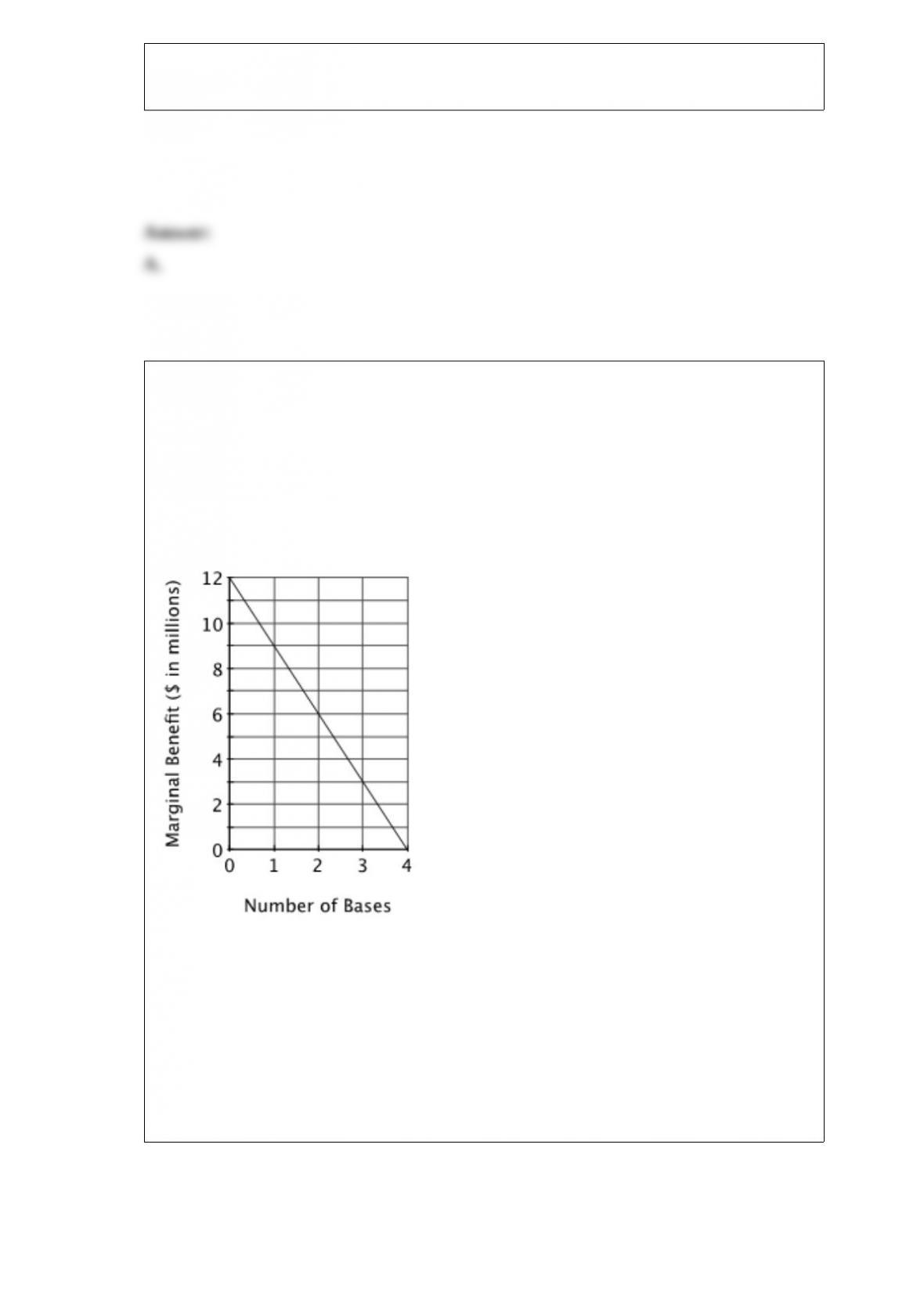
Currently, two states each have one army base. An army base adds $2 million to a
state’s local economy each year. In addition, in terms of increased security, the annual
marginal benefit to Fatlandia of having an additional army base is shown below. The
total cost of an army base is $8 million per year.
Taxes in Fatlandia are:
A. regressive.
B. based on each resident’s willingness to pay.
C. proportional.
D. progressive.

The towns of Jekyll and Hyde each have a labor force of 2,000 people. In Jekyll, 500
people were unemployed for the entire year, while the rest of the labor force was
employed continuously. In Hyde, every member of the labor force was unemployed for
three months and was employed for nine months. The average duration of
unemployment spells over the year was ______ months in Jekyll and ______ months in
Hyde.
A. 3; 3
B. 3; 9
C. 12; 3
D. 12; 9
Imagine that you are an entrepreneur, making designer t-shirts in your garage. Your
total cost (in dollars) is given by the equation TC = 300 + 10Q, where Q represents the
number of t-shirts you make. As you increase your production of t-shirts, your average
fixed cost ______ and your marginal cost ______.
A. decreases; increases
B. increases; decreases
C. decreases; stays the same
D. stays the same; increases
The price elasticity of supply at a point is:
A. the percentage change in quantity supplied divided by the percentage change in
price.
B. the percentage change in price divided by the percentage change in quantity
supplied.
C. the change in quantity supplied divided by the change in price.
D. the change in price divided by the change in quantity supplied.
When the interest rate on newly issued bonds increases, the price of existing bonds:
A. increases.
B. decreases.
C. increases only if the coupon rate is below the new rate.
D. may either increase or decrease.

To close an expansionary gap, the Fed ______ interest rates which ______ planned
aggregate spending and ______ short-run equilibrium output.
A. raises; increases; increases
B. raises; decreases; increases
C. raises; decreases; decreases
D. reduces; increases; decreases
The graph below illustrates the marginal cost, marginal private benefit, and marginal
social benefit of being vaccinated against a contagious childhood disease.
MB1 measures ______ and MB2 measures ______.
A. efficient demand; subsidized demand
B. social demand; private demand
C. private demand; social demand
D. external benefit; marginal private benefit

Consider the labor market below. Suppose the government passes a minimum wage
requiring employers to pay at least $8.00 per hour.
As a result of the imposition of the minimum wage, total economic surplus falls by
______ per day
A. $6,000
B. $8,000
C. $12,000
D. $24,000
Economic activity moves from a trough into a period of ______ until it reaches a
______ and then into a period of _______.
A. expansion; trough; recession.
B. recession; trough; expansion
C. expansion; peak; recession
D. recession; peak; expansion
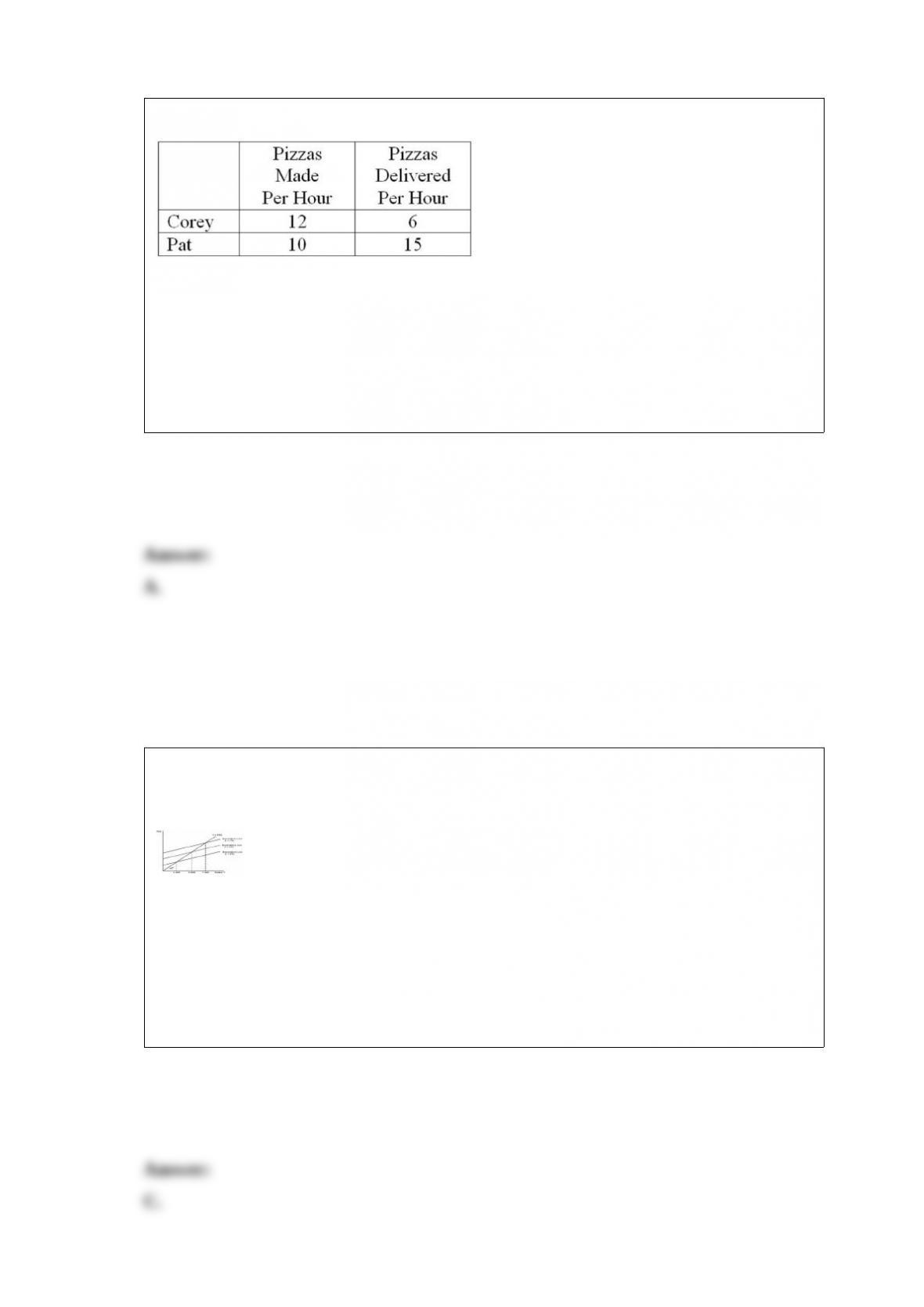
Refer to the table below. According to the table, Corey has the absolute advantage in:
A. making pizza.
B. neither making nor delivering pizza.
C. delivering pizza.
D. making and delivering pizza.
Refer to the figure below. Based on the diagram, if potential output equals 8,000 and
the real interest rate is 4%, then there is ______ gap and the Fed must ______ the real
interest rate so that output will equal potential output.
A. a recessionary; raise
B. a recessionary; lower
C. no output; not change
D. an expansionary; raise

An increase in net taxes (taxes paid by the private sector to the government less transfer
payments and interest payments made by the government to the private sector) will:
A. increase private saving.
B. decrease public saving.
C. increase public saving.
D. reduce investment in new capital equipment.
Which of the following is an example of the precautionary motive for saving?
A. Pat puts $400 per month in his 401(k) retirement account.
B. Jordan sets aside $200 per month in case she has to pay for a new roof for her house.
C. Gerry and Terry put $2,000,000 in a trust fund that will go to their children when the
parents die.
D. Every month, Chris puts $400 into his saving account so that he can buy a new car in
a few years.
House prices in the U.S. increased dramatically _____, and decreased dramatically

______.
A. from 2001 to 2006; from 2007 to 2009
B. from 2007 to 2009; from 2001 to 2006
C. from 2001 to 2009; from 2006 to 2007
D. from 2006 to 2009; from 2001 to 2006
Relative to when a patient has first-dollar medical insurance, the loss in total economic
surplus would be smaller if:
A. medical care providers had to pay the full marginal cost of medical care.
B. medical care providers had to pay more of the marginal cost of medical care.
C. the patient had to pay less of the marginal cost of medical care.
D. the patient had to pay at least some of the marginal cost of medical care.
Game theory provides tools that are used to model:
A. the behavior of perfectly competitive firms.
B. the cost functions faced by firms.

C. consumer demand.
D. strategic interdependencies.
Refer to the figure below. If this firm is a price taker, then when the price of each unit of
output is $30, this firm’s profit-maximizing level of output is ______.
A. 30
B. 60
C. 80
D. 100
Suppose Island Bikes, a profit-maximizing firm, is the only bike rental company in a
small resort town. The marginal cost to Island Bikes of renting out a bike is $3, and
Island Bikes has no fixed costs. Each day Island Bikes has six potential customers,
whose reservations prices are listed below.
Suppose Island Bikes knows that customers whose reservation prices are at least $10
always rent bikes before noon, while those whose reservation prices are below $10
never do so. If Island bikes can charge a different price in the morning and in the
afternoon, then in the afternoon, it will rent out ______ bike(s) and charge ______ per
bike.
A. 1; $8
B. 2; $6
C. 3; $4
D. 5; $10
If in the economy, business saving equals $240 billion, household saving equals $15
billion and government saving equals -$150 billion, what is the value of national
saving?
A. $415 billion
B. $265 billion
C. $250 billion
D. $105 billion

The decline in the natural rate of unemployment between the 1970s and the 2000s
might be the result of:
A. the changing age structure of the population and more efficient labor markets.
B. advances in computer technology and globalization.
C. increasing wage inequality and skill-biased technological change.
D. greater quantities of human capital and increased average labor productivity.
Matt has decided to purchase his textbooks for the semester. His options are to purchase
the books online with next day delivery at a cost of $175, or to drive to campus
tomorrow to buy the books at the university bookstore at a cost of $170. Last week he
drove to campus to buy a concert ticket because they offered 25 percent off the regular
price of $16. Given that driving to campus to buy the concert ticket was rational for
Matt, Matt should:
A. not drive to campus to buy the books because the $5 he would save is only two
percent of the cost of the books, and that is much less than the 25 percent he saved on
the concert ticket.
B. drive to campus to buy the books because the books are cheaper at the bookstore
than online.
C. drive to campus to buy the books because the $5 he would save is more than he
saved by driving to campus to buy the concert ticket.
D. not drive to campus to buy the books because the cost of gas and his time must
certainly be more than the $5 he would save.
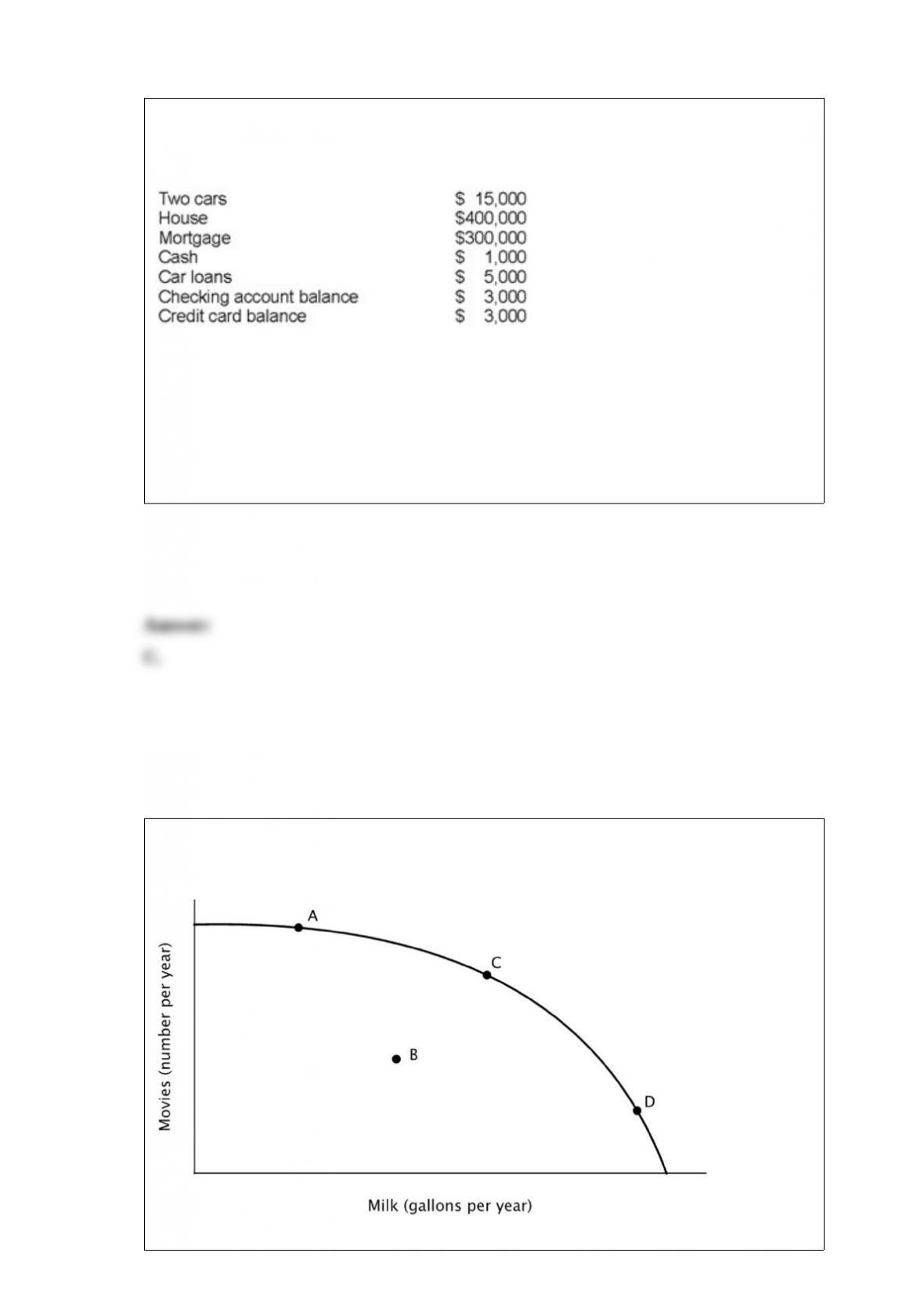
What is the value of Taylor’s liabilities?
Taylor has the following assets and liabilities:
A. $300,000
B. $303,000
C. $308,000
D. $311,000
Refer to the figure below. If this economy were currently operating at point D, then in
order to make more movies:
A. the first productive resources to switch to making movies should be those with the

lowest opportunity cost of making milk.
B. the first productive resources to switch to making movies should be those with the
highest opportunity cost of making milk.
C. no productive resources would need to switch from making milk to movies because
point D is already efficient.
D. no productive resources would need to switch from making milk to movies because
each resource should continue to be used according to its comparative advantage.
The following table shows the relationship between the speed of a computer’s CPU and
its benefits and costs. Assume that all other features of the computer are the same (that
is, CPU speed is the only source of variation), and only the CPU speeds listed below are
available for purchase.
Application of the Cost-Benefit Principle would lead one to purchase a ______
computer.
A. 2.0GHz
B. 2.5GHz
C. 3.0GHz
D. 4.0GHz

If a pizza maker pays $1 for tomatoes, $1 for cheese, $2 for sausage, and sells the pizza
made with these ingredients for $7, then each pizza sold contributes how much to GDP?
A. $3
B. $4
C. $7
D. $11
The credibility of monetary policy is the:
A. recognition that open market purchases increase the money supply, even though
banks and the public affect the money multiplier.
B. degree to which the public believes the central bank’s promises to keep inflation low,
even if doing so may impose short-run costs.
C. pace at which monetary policy can return an economy to potential when inflationary
expectations are anchored.
D. practice of the Federal Reserve of relying primarily on open market operations rather
than discount rate lending or changes in reserve requirements.
If Dylan saves $50 per week, then Dylan’s ______ will increase by $50 per week.
A. investment
B. consumption

C. taxes
D. wealth
Consumer surplus measures:
A. the increase in a buyer’s total utility when the buyer purchases additional units of a
good.
B. the difference between the quantity demanded and the quantity supplied at a given
price.
C. the difference between a buyer’s marginal utility from consuming a product and the
price actually paid.
D. the difference between the most a buyer would be willing to pay for a product and
the price actually paid.
If the absolute value of the price elasticity of demand for tickets to a football game is 2,
then if the price increases by 1%, quantity demanded decreases by:
A. ½%.
B. 1%.
C. 2%.
D. 4%.