
Consider the following information:
StowUrStuff Storage is located slightly below sea level in a coastal town. It could build
and maintain a flood control system around its property at an annual cost of $1000, and
if it did so, the probability of a flood’s doing $1,000,000 in damage during the year
would be .005. With no flood control system, the probability of such a flood would be .
01.
. If the flood control system were not in place, the insurer would not be willing to insure
against the flood for any premium less than
A) $5,000.
B) $10,000.
C) $100,000.
D) $200,000.
E) $1,000,000.
Scenario 10.2:
A monopolist faces the following demand curve, marginal revenue curve, total cost
curve and marginal cost curve for its product:
Q = 200 – 2P
MR = 100 – Q
TC = 5Q
MC = 5
Refer to Scenario 10.2. Suppose that in addition to the tax, a business license is required
to stay in business. The license costs $1000. What is the profit maximizing level of
output?
A) 0
B) 90
C) 95
D) 100
E) none of the above
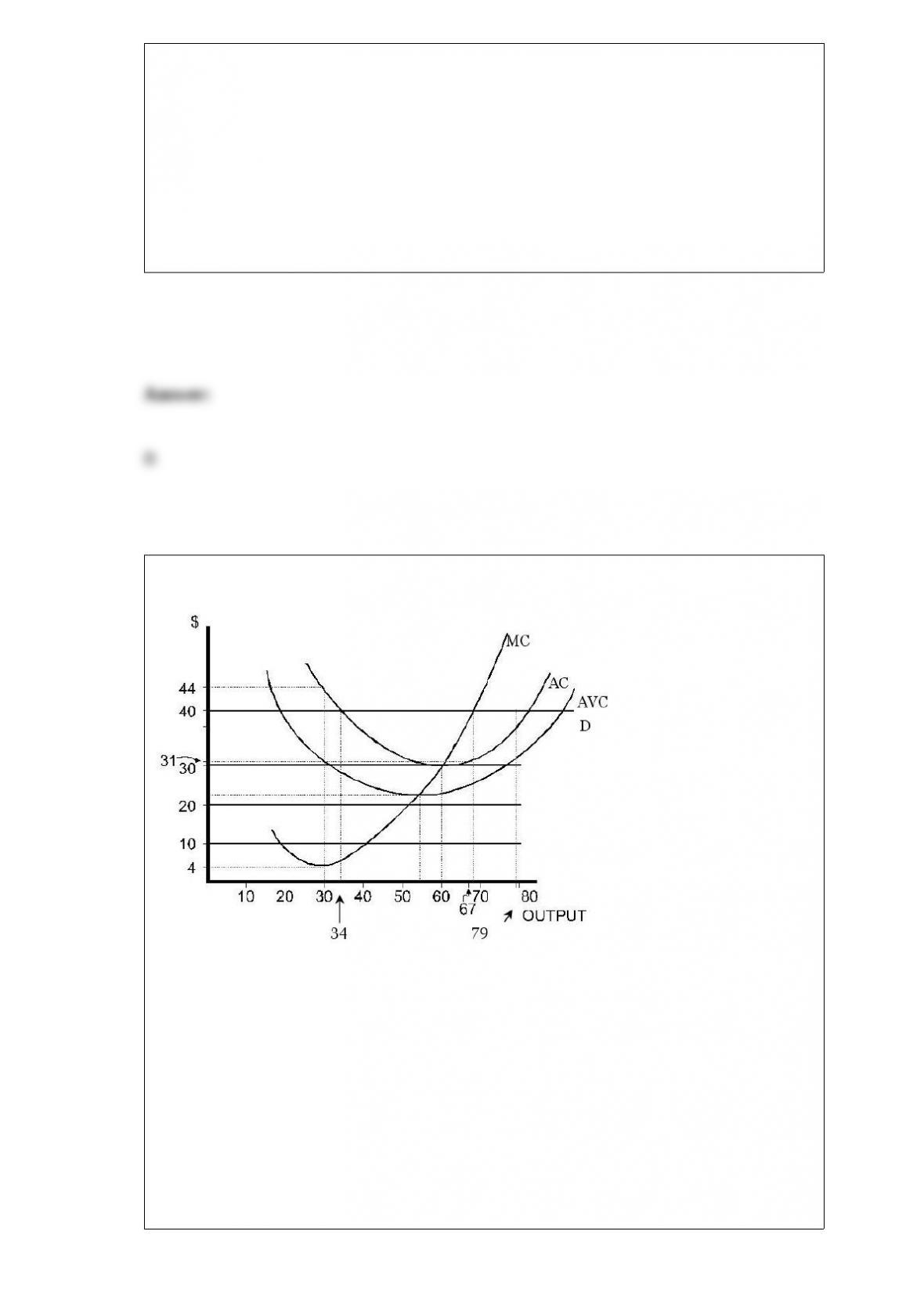
Consider the following diagram where a perfectly competitive firm faces a price of $40.
At the profit-maximizing level of output,
A) AVC is minimized.
B) ATC is minimized.
C) MC is minimized.
D) total cost is minimized.
E) no costs are minimized.

A multiplant monopolist can produce her output in either of two plants. Having sold all
of her output she discovers that the marginal cost in plant 1 is $30 while the marginal
cost in plant 2 is $20. To maximize profits the firm will
A) produce more output in plant 1 and less in the plant 2.
B) do nothing until it acquires more information on revenues.
C) produce less output in plant 1 and more in plant 2.
D) produce less in both plants until marginal revenue is zero.
E) shut down plant 1 and only produce at plant 2 in the future.
Because of the relationship between a perfectly competitive firm’s demand curve and its
marginal revenue curve, the profit maximization condition for the firm can be written as
A) P = MR.
B) P = AVC.
C) AR = MR.
D) P = MC.
E) P = AC.

A firm’s producer surplus equals its economic profit when
A) average variable costs are minimized.
B) average fixed costs are minimized.
C) marginal costs equal marginal revenue.
D) fixed costs are zero.
E) total revenues equal total variable costs.
A “mixed strategy” equilibrium means that
A) the strategies chosen by the players represent different behaviors.
B) one player has a dominant strategy, and one does not.
C) one player has a pure strategy, and one does not.
D) the equilibrium strategy is an assignment of probabilities to pure strategies.
E) the equilibrium strategy involves alternating between a dominant strategy and a
Nash strategy.
Scenario 4.3:
The demand for erasers (Q) is given as follows:
Q = 240 – 4Pe + 2I + Pb + A
where Pe is the price of erasers
I is the level of income
Pb is the price of another good
A is the level of advertising
Suppose that Q = 240, Pe = 10, Pb = 10, and A = 2.Given the information in Scenario
4.3, erasers are:
A) a normal good.
B) an inferior good.
C) neither normal nor inferior.
D) complements.
E) necessities.
Good A is an inferior good. If the price of good A were to suddenly double, the
substitution effect would cause the purchases of good A to increase by
A) more than double.

B) exactly double.
C) less than double.
D) Any of the above are possible.
E) none of the above
Use the following statements to answer the question:
I. Consider the problem of negotiating the price of a rug that costs $100 to make. If
there are two buyers (one with a maximum willingness-to-pay of $200 and one with a
maximum willingness-to-pay of $250), then the situation is no longer a constant sum
game.
II. The likely outcome from the game described in statement I is that the second buyer
will bid a price slightly above $200 (e.g., $201) to win the rug.
A) I and II are true.
B) I is true and II is false.
C) II is true and I is false.
D) I and II are false.
Assume that both high and low quality appliances are sold in the used appliance market.

If we assume asymmetric information with sellers having more information regarding
quality than buyers, which of the following is necessarily true? The
A) fraction of high quality appliances will be greater than under perfect knowledge.
B) fractions of high and low quality appliances will be the same as with perfect
information.
C) fraction of high quality appliances will be less than with perfect information.
D) none of the above
A monopolistically competitive firm in short-run equilibrium:
A) will make negative profit (lose money).
B) will make zero profit (break-even).
C) will make positive profit.
D) Any of the above are possible.
If the quantity of good A (QA) is plotted along the horizontal axis, the quantity of good
B (QB) is plotted along the vertical axis, the price of good A is PA, the price of good B
is PB and the consumer’s income is I, then the slope of the consumer’s budget constraint
is ________.
A) -QA/QB
B) -QB/QA
C) -PA/PB
D) -PB/PA
E) I/PA or I/PB
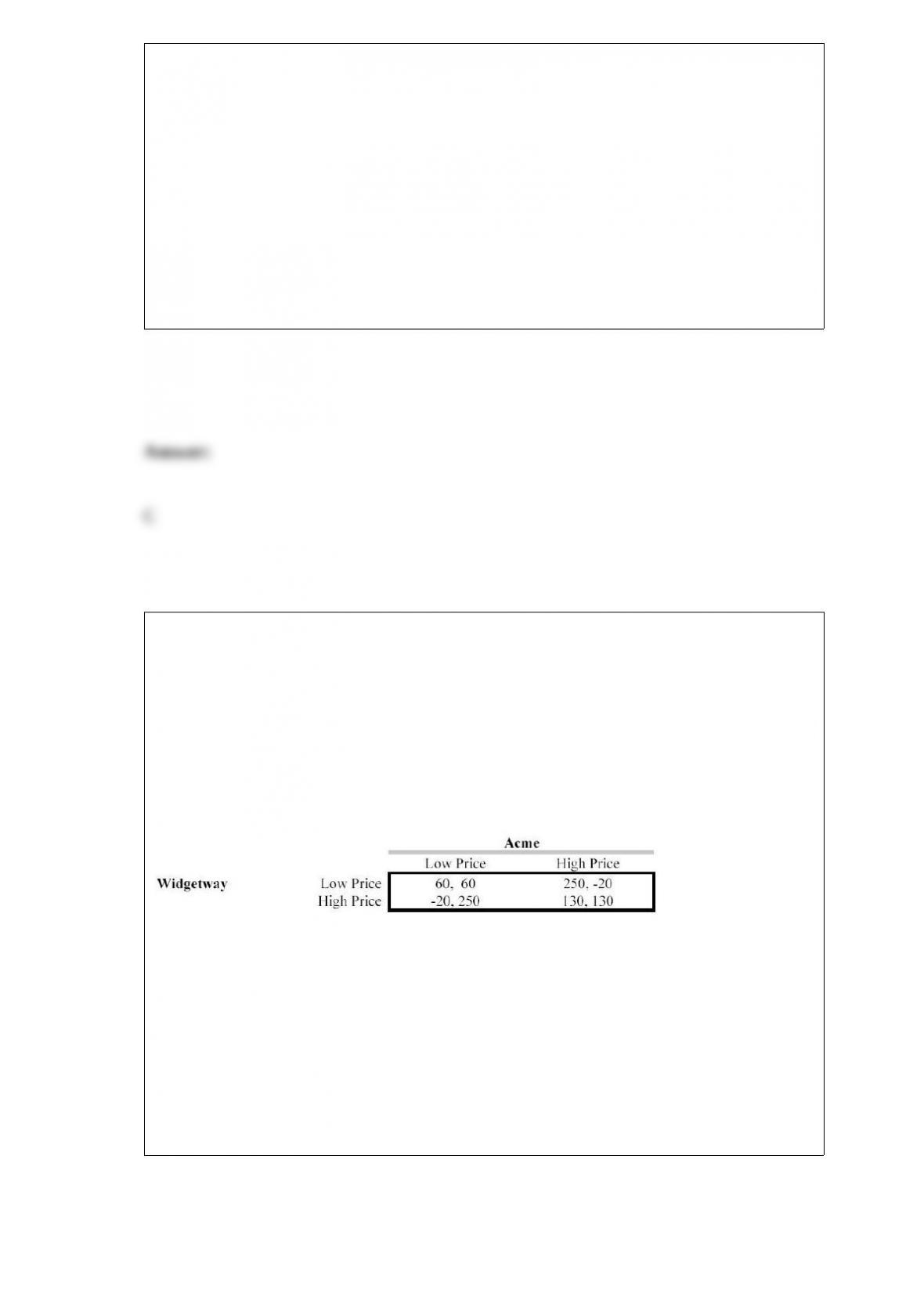
The widget market is controlled by two firms: Acme Widget Company and Widgetway
Manufacturing. The structure of the market makes secret price cutting impossible. Each
firm announces a price at the beginning of the time period and sells widgets at the price
for the duration of the period. There is very little brand loyalty among widget buyers so
that each firm’s demand is highly elastic. Each firm’s prices are thus very sensitive to
inter-firm price differentials. The two firms must choose between a high and low price
strategy for the coming period. Profits (measured in thousands of dollars) for the two
firms under each price strategy are given in the payoff matrix below. Widgetway’s profit
is before the comma, Acme’s is after the comma.
a. Does either firm have a dominant strategy? What strategy should each firm follow?
b. Assume that the game is to be played an infinite number of times. (Or, equivalently,
imagine that neither firm knows for certain when rounds of the game will end, so there
is always a positive chance that another round is to be played after the present one.)
Would the tit-for-tat strategy would be a reasonable choice? Explain this strategy.
c. Assume that the game is to be played a very large (but finite) number of times. What
is the appropriate strategy if both firms are always rational?
Suppose that a consumer regards two types of soap as perfect substitutes for one
another. The price consumption path generated by changing the price of one type of
soap
A) is always upward sloping.
B) is always horizontal.
C) is always vertical.
D) corresponds with the axis for the cheaper soap.
E) corresponds with the axis for the more expensive soap.

Many governments around the world attempt to improve the incomes of commodity
producers by taking steps to increase the commodity price in the domestic market.
Although this may reduce quantity demanded for the product, the action may be
effective because:
A) commodity supply tends to be inelastic, so quantity does not decline by much.
B) commodity supply tends to be elastic, so producer income increases as a result of the
higher prices and quantities.
C) commodity demand tends to be inelastic, so higher prices generate higher sales
revenue.
D) commodity supply tends to be elastic, so producer income increases as a result of the
higher prices and quantities.
Which of the following markets is most likely to be oligopolistic?
A) The market for corn
B) The market for aluminum
C) The market for colas
D) The market for ground coffees
Use the following two statements to answer this question:
I. A market is a collection of buyers and sellers that, through actual or potential
interactions, determine the price for a product or set of products.
II. An industry is a collection of markets for similar or closely related products.
A) Both I and II are true.
B) I is true, and II is false.
C) I is false, and II is true.
D) Both I and II are false.
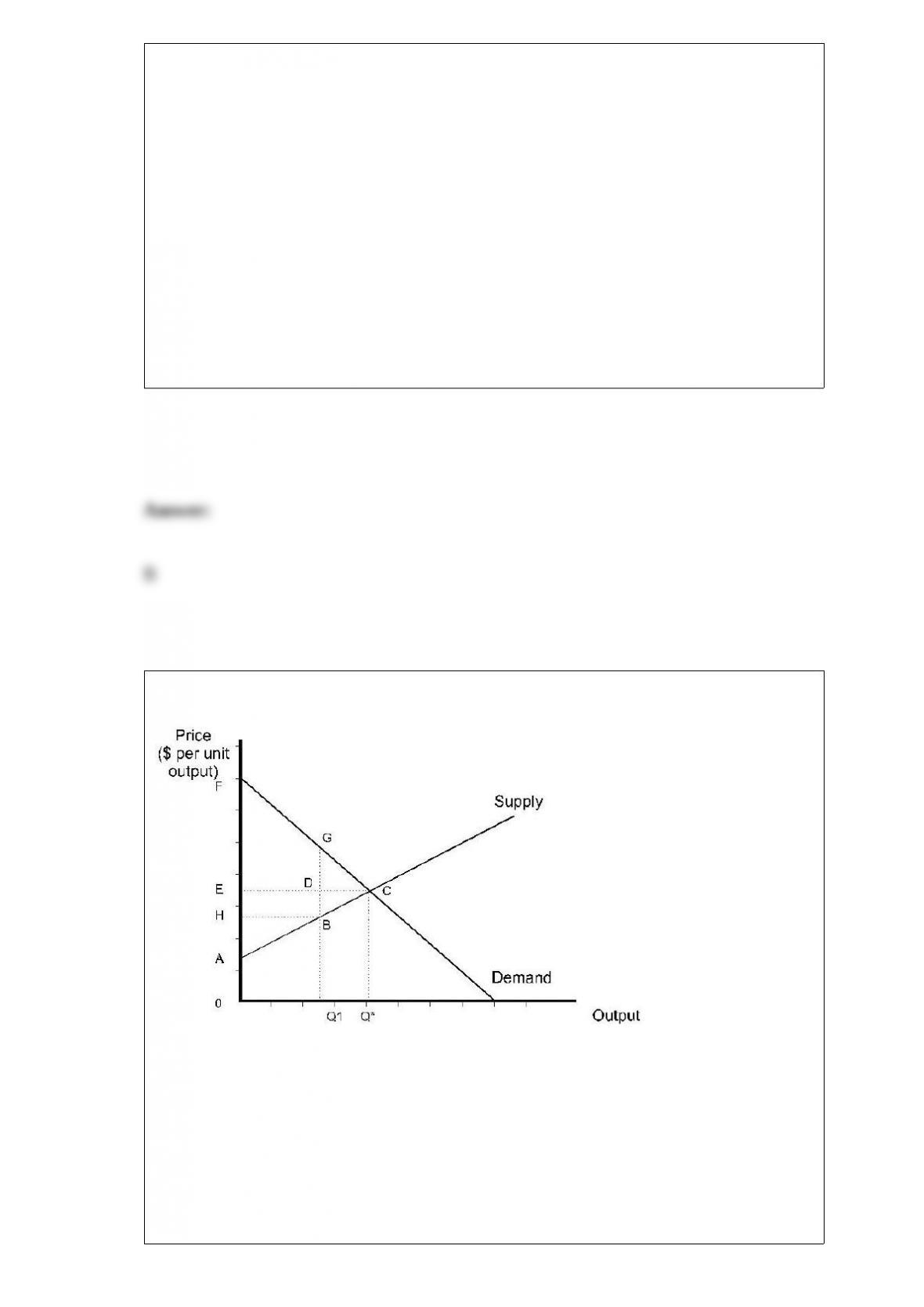
Figure 9.2
Refer to Figure 9.2. At price 0H and quantity Q1, the deadweight loss is
A) DGC.
B) BDC.
C) BGC.

D) 0FGQ1.
E) none of the above
Which of the following represent examples of adverse selection?
A) Unhealthy people are more likely to want health insurance.
B) Careless drivers purchasing extra auto insurance.
C) Risk averse individuals choosing to buy extra insurance.
D) all of the above
E) A and B only
Which of the following is true about the demand curve facing the dominant firm?
A) It equals market demand minus fringe firms’ supply curve.
B) It is identical to market demand.
C) It equals market demand minus demand facing the fringe firms.
D) It is horizontal.

The “constant dollar” price is:
A) the real price of a good.
B) the nominal price of a good adjusted for inflation.
C) the “current dollar” price adjusted for inflation.
D) all of the above
E) none of the above
Based on what we know about asset price formation, what steps can a government use
to restrict the formation of an asset price bubble?
A) Lower interest rates in order to discourage savings and investment
B) Loosen lending requirements for banks, which encourages investors to buy bank
stock rather than the “bubbling” asset
C) Increase the money supply
D) Raise interest rates in order to increase the costs of financing asset purchases

Scenario 17.5
Consider the following information:
Income to the firm from workers who sell door-to-door
Bad Luck Good Luck
Low Effort (e = 0) $5,000 $7,000
High Effort (e = 1) $7,000 $13,000
Cost of effort: c = $2500e
Probabilities: Bad luck = .75; Good luck = .25
If low effort is exerted, expected income is
A) $5000.
B) $5500.
C) $6000.
D) $6500.
E) $7000.
Suppose you only consume food and clothing, and clothing is plotted on the vertical
axis. Also, you purchase food at a fixed price (PF), but the price of clothing declines as

you buy in larger quantities (i.e., quantity discounts). What does the budget line look
like in this case?
A) The budget line is a straight line
B) The budget line is now concave to (bows out from) the origin
C) The budget line is now convex to (bows in toward) the origin
D) The budget line will not be a straight line, but it may be concave or convex
As a group, U.S. consumers view hamburger as a normal good at low income levels and
as an inferior good at high income levels. Based on this information, which of the
following statements is NOT true?
A) As income for all consumers rises, the hamburger demand curves of low-income
consumers shift rightward, and the demand curves of high-income consumers shift
leftward.
B) The aggregate demand curve for hamburger in the U.S. is upward sloping at low
prices.
C) The Engel curve for hamburger consumed in the U.S. is upward sloping at low
income levels and downward sloping at high income levels.
D) The income-consumption curve for hamburger and all other food products cannot be
a straight line.

Joe owns a coffee house and produces coffee drinks under the production function q =
5KL where q is the number of cups generated per hour, K is the number of coffee
machines (capital), and L is the number of employees hired per hour (labor). The
average product of labor and the marginal product of labor are both equal to AP = MP =
5K. Does labor exhibit diminishing marginal returns in this case?
A) Yes, if capital also exhibits diminishing marginal returns.
B) Yes, this is true for all values of K.
C) No, the marginal product of labor is constant (for a given K).
D) No, the marginal product of labor is increasing (for a given K).
A ‘sequential game” is
A) another term for a repeated game.
B) another term for a cooperative game.
C) the term for a game in which individuals receive their payoffs at different times.
D) the term for a game in which individuals do not commit to strategy choices at the
same time.
E) the term for a game in which each outcome occurs, one after the other, as the game is
repeated over time.
Scenario 14.4:
John’s firm is a competitor in your product market and a monopsonist in the labor
market. The current market price of the product that your firm produces is $2. The total
product and marginal product of labor are given as:
TP = 100L – 0.125L2 MP = 100 – 0.25L
where L is the amount of labor employed. The supply curve for labor and the marginal
expenditure curve for labor are given as follows:
L = PL -5 MEL = 2L + 5
Refer to Scenario 14.4. Suppose that a subsidy is implemented on each unit of labor
hired. Then the number of workers hired
A) will decrease.
B) will increase.
C) will not change.
D) will change in an indeterminate fashion.
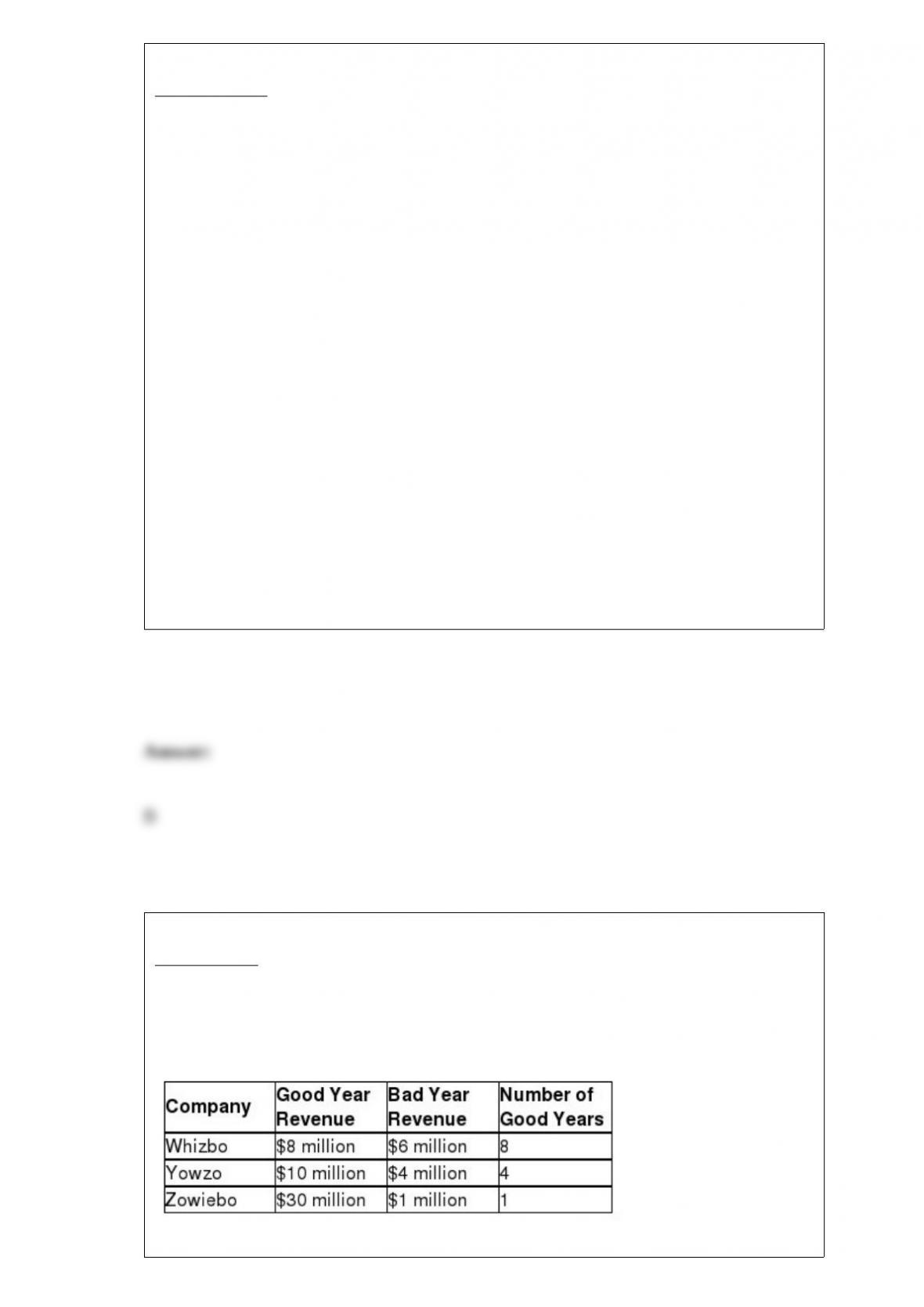
Scenario 5.3:
Wanting to invest in the computer games industry, you select Whizbo, Yowzo and
Zowiebo as the three best firms. Over the past 10 years, the three firms have had good
years and bad years. The following table shows their performance:

Refer to Scenario 5.3. Based on the 10 years’ past performance, what is the probability
of a good year for Zowiebo?
A) 30/31
B) 1/31
C) 9
D) 1
By the method of Lagrange multipliers, the optimal value of the Lagrange multiplier
equals the:
A) marginal utility of income.
B) marginal utility of each good.
C) marginal utility per dollar spent on the last unit of each good.
D) A and B above
E) A and C above
For a market with a linear demand curve and constant marginal cost of production, why
are the reaction functions for the Cournot duopoly sellers also straight lines?
A) The reaction functions do not have to be straight lines, and they are only drawn this
way in the book to keep the figures simple.
B) Cournot thought the lines would be straight, but this was proven wrong by other
economists.
C) Marginal revenue is always linear when marginal costs are constant.
D) We know that the marginal revenue curves for linear demand curves are also straight
lines.