
Suppose the figure below shows the demand curve, marginal revenue curve and
marginal cost curve for a monopolist.
The profit-maximizing level of output for this monopolist is ______ units per day.
A. F
B. G
C. H
D. I
Suppose the stock market crashed, wiping out $5 trillion of household wealth.
Consistent with economic models based on historical trends, consumption spending
might fall by as much as, but probably not more than:
A. $35 billion.
B. $200 billion.
C. $350 billion.
D. $2 trillion.
“Holding all other relevant factors constant, consumers will purchase more of a good as
the price falls.” This statement reflects the behavior underlying:
A. the demand curve.
B. an increase in demand.
C. the supply curve.
D. a decrease in the demand curve.
A firm pays Pam $40 per hour to assemble personal computers. Each day, Pam can
assemble 4 computers if she works 1 hour, 7 computers if she works 2 hours, 9
computers if she works 3 hours, and 10 computers if she works 4 hours. Pam cannot
work more than 4 hours day. Each computer consists of a motherboard, a hard drive, a
case, a monitor, a keyboard, and a mouse. The total cost of these parts is $600 per
computer. What is the marginal cost of producing the computers that Pam can assemble
during her 3rd hour of work?
A. $5,400
B. $5,520
C. $1,200
D. $1,240
The delay between the date a policy change is needed and the date it is implemented is
called the:
A. recessionary gap.
B. expansionary gap.
C. outside lag.
D. inside lag.
Lou and Alex live together and share household chores. They like to cook some meals
ahead of time and eat leftovers. The table below shows the number of rooms they can
each clean and the number of meals they can each cook in an hour.
For Alex, the opportunity cost of cleaning one room is making ______ meal(s); for Lou
the opportunity cost of cleaning one room is making ______ meal(s).
A. 4; 4
B. 1; 4/5
C. 1; 5/4
D. 3; 5
One problem with government ownership of natural monopolies is that:
A. the government has no reason to set price equal to marginal cost.
B. the government could violate its own antitrust laws.
C. government-owned firms have weaker incentives to cut costs than do
privately-owned firms.
D. it forces the government to either raise taxes or lower spending.
If crude oil is a variable factor of production for a firm, then an increase in the price of
crude oil will lead to:
A. a decrease in the quantity supplied by the firm, but no change in the firm’s supply.
B. a decrease in the firm’s supply.
C. an increase in the quantity supplied by the firm, but no change in the firm’s supply.
D. an increase in the firm’s supply.
When attorneys, accountants and other professionals wear expensive clothing, it:
A. only serves as a useful signal of ability if they already have well-established
reputations.
B. does not serve as a credible signal of ability because anyone can wear nice clothes.
C. is a waste of money because professionals do not need to signal their ability.
D. can serve as a credible signal of ability.
A variable factor of production:
A. is fixed in the long run but variable in the short run.
B. plays no role in the law of diminishing marginal returns.
C. is variable in both the short run and the long run.
D. is variable only in the short run.
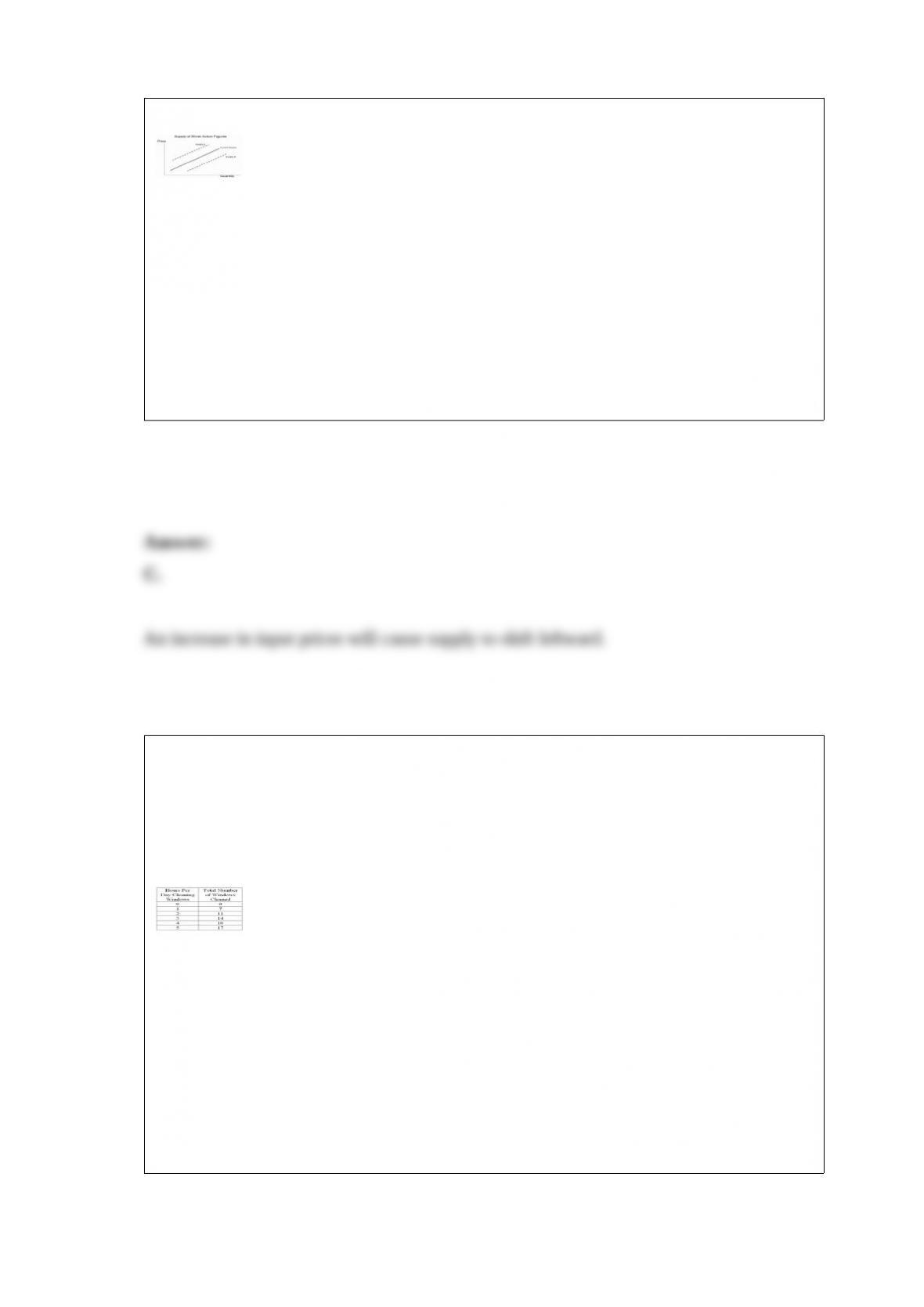
Refer to the figure above. If the price of the plastic used to make action figures rises,
supply will:
A. shift from Current Supply to Supply B.
B. not change because a change in raw material prices cannot affect market prices.
C. shift from Current Supply to Supply A.
D. remain at Current Supply because Demand for Shrek figures is so strong.
John is trying to decide how to divide his time between his job as a stocker in the local
grocery store, which pays $7 per hour for as many hours as he chooses to work, and
cleaning windows for the businesses downtown. He makes $2 for every window he
cleans. John is indifferent between the two tasks, and the number of windows he can
clean depends on how many hours he spends cleaning in a day, as shown in the table
below:
If we plot John’s opportunity cost per window on the vertical axis and the number of
windows cleaned each day on the horizontal axis, we will have John’s ______ curve for
window-cleaning services.
A. production possibilities
B. supply
C. benefit
D. demand

Casey earns $150 a week and consumes only fish and shrimp. The price of fish is $3 a
pound and the price of shrimp is $5 a pound. Suppose the price of fish decreased to
$1.50 a pound, and the price of shrimp remains $5 a pound. At Casey’s original income
of $150 per week, Casey can now buy a maximum of ______ pounds fish or a
maximum of ______ pounds shrimp.
A. 10; 30
B. 30; 50
C. 30; 100
D. 100; 30
The allocative function of price is to:
A. distribute scarce goods and services to those consumers who value them the most
highly.
B. ensure that firms in perfectly competitive markets earn an economic profit.
C. direct resources away from markets that are overcrowded and toward markets that
are underserved.
D. provide subsidies to low-income families so they can purchase essential goods and
services.
Holding all else constant, a decrease in the real interest rate on Mexican assets will
______ the supply of dollars in the foreign exchange market and ______ the
equilibrium Mexican peso/U.S. dollar exchange rate.
A. increase; increase
B. increase; decrease
C. decrease; decrease
D. decrease; increase
An increase in the value of a currency relative to other currencies is called a(n):
A. evaluation.
B. devaluation.
C. appreciation.
D. overvaluation.

Refer to the figure below. From this graph, you can infer that paper production:
A. generates no externalities at quantities less than 300 tons per day.
B. generates an external cost of $50 per ton per year.
C. generates an external cost of $150 per ton per year.
D. should be prohibited.
If the marginal cost of pollution abatement is smaller for large firms than it is for small
firms, then it is efficient for:
A. small firms to reduce pollution by more than large firms.
B. small firms and large firms to reduce pollution by a fixed proportion.
C. small firms and large firms to increase pollution by a fixed proportion.
D. large firms to reduce pollution by more than small firms.
The delay between the date a policy change is implemented and the date when most of
its effects have occurred in the economy is called the:
A. recessionary gap.
B. expansionary gap.
C. outside lag.
D. inside lag.
If the quantity demanded of a good is Q when the price for the good is P, the price
elasticity of demand for that good at that point is:
A. (P/Q) × (1/slope)
B. (Q/P) × (1/slope)
C. (P/Q) × (slope)
D. Q × P × (1/slope)
The following table provides data for an economy in a certain year. __
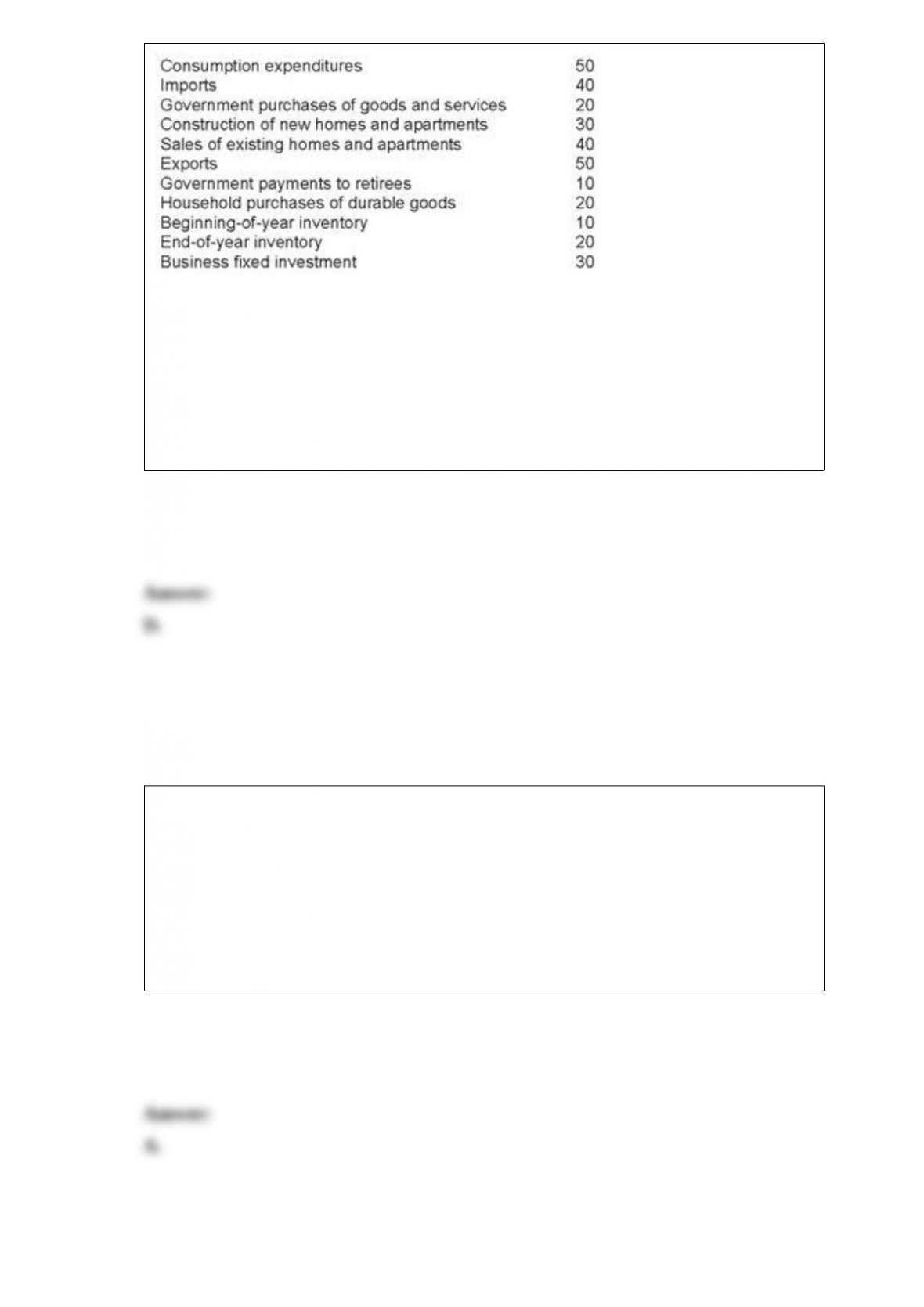
Given the data in the table, compute the investment component of GDP.
A. 30
B. 40
C. 60
D. 70
Which of the following is NOT a capital good?
A. Batteries purchased by a car manufacturer to install in new cars
B. Machines purchased by a car manufacturer to measure metal thicknesses
C. A new house purchased by a family
D. A new apartment building purchased by a corporation

If the annual real interest rate on a 10-year inflation-protected bond equals 1.5 percent
and the annual nominal rate of return on a 10-year bond without inflation protection is
4.2 percent, what average rate of inflation over the ten years would make holders of
inflation-protected bonds and holders of bonds without inflation protection equally well
off?
A. 1.5%
B. 2.7%
C. 4.2%
D. 5.7%
When a pharmaceutical company introduces a new drug, its research and development
costs are ______, and the cost of the chemicals used in manufacturing the drug are
______.
A. start-up costs; fixed costs
B. fixed costs; start-up costs
C. start-up costs; variable costs
D. marginal costs; variable costs
Jeans in general have fewer close substitutes than a specific brand of jeans. Therefore,
the demand for jeans in general will be _______ than the demand for a specific brand of
jeans.
A. more elastic
B. less elastic
C. more unit elastic
D. less inelastic
Moe’s reservation price for his economics textbook is $100. The week before the
semester begins, Moe finds a copy of his textbook online for $75. Moe’s consumer
surplus from buying the textbook online is:
A. $125
B. $100
C. $75
D. $25
Assume the union contract wage exceeds the market-clearing wage. If there is an
increase in the labor supply, then the number of unemployed workers will ______ and
the number of employed workers will _______.
A. increase; increase
B. increase; decrease
C. increase; not change
D. decrease; increase
The annual increase in the dollar value of a financial asset is called the:
A. real rate of return.
B. inflation rate.
C. real interest rate.
D. nominal interest rate.
A decrease in the demand for bananas with no concurrent change in the supply of
bananas will result in a ________ equilibrium price and a(n) ________ equilibrium
quantity.
A. higher; lower
B. lower; lower
C. higher; unchanged
D. higher; higher
If the principal amount of a bond is $10,000,000, the coupon rate is 7%, and the
inflation rate is 4%, then the annual coupon payment made to the holder of the bond is:
A. $70,000.
B. $300,000.
C. $400,000.
D. $700,000.

Three macroeconomic factors that affect the demand for money are:
A. the nominal interest rate, real income, and the price level.
B. the nominal interest rate, capital, and labor.
C. globalization, skill-biased technological change, and labor mobility.
D. capital, labor, and technology.
In the short run, total spending affects ____, and in the long run total spending affects
______.
A. prices; output
B. prices; unemployment
C. output; prices
D. output; unemployment
A regulated maximum price that is above the equilibrium price:
A. will lead to black markets.
B. will have no effect on the market.
C. will lead to excess supply in the market.
D. will lead to excess demand in the market.