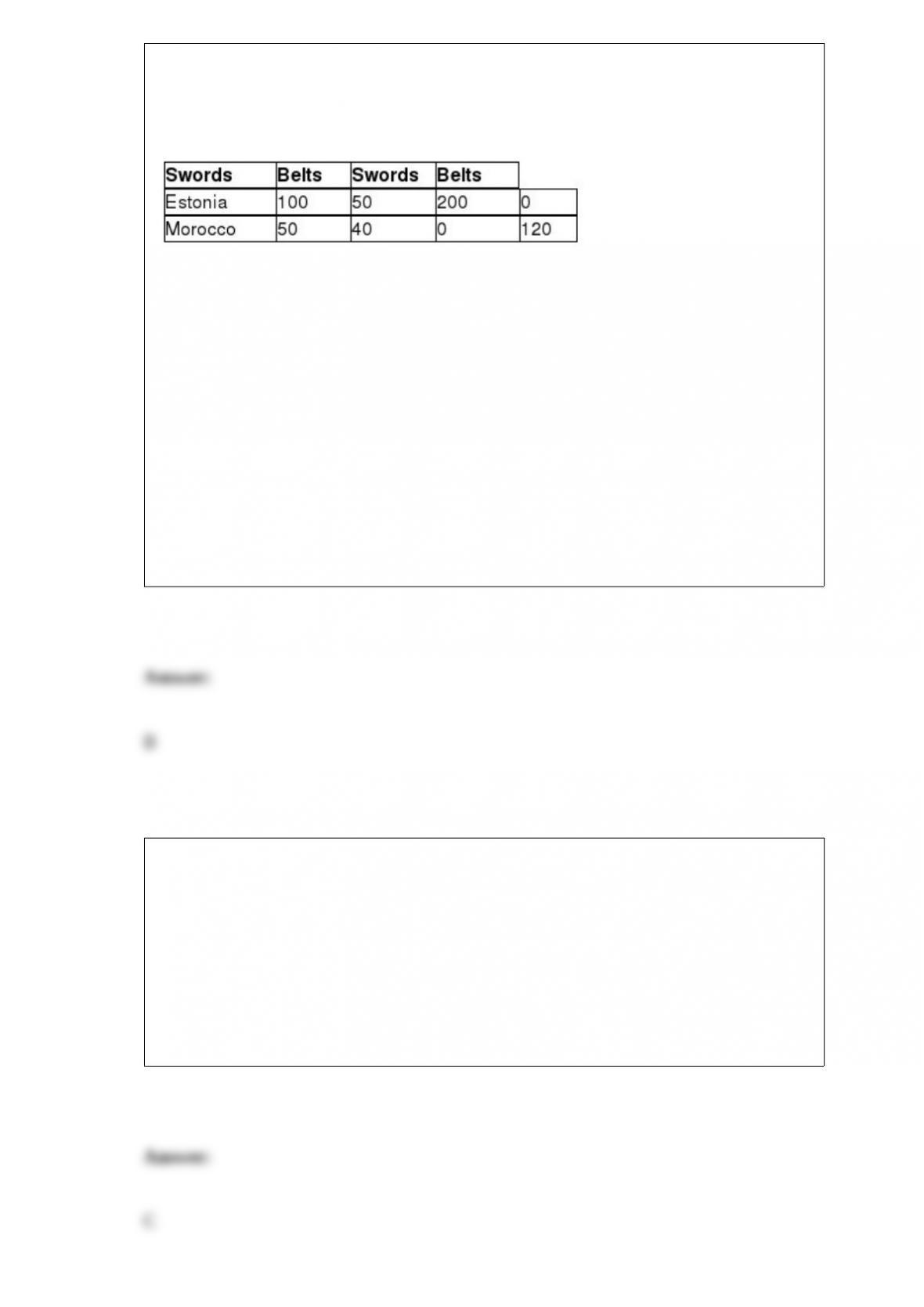
Table 7-6
Production and
Consumption Production
Without Trade With Trade
Estonia and Morocco can produce both swords and belts. Table 7-6 shows the
production and consumption quantities without trade, and the production numbers with
trade.
Refer to Table 7-6. If the actual terms of trade are 1 belt for 1.5 swords and 70 belts are
traded, how many belts will Morocco consume?
A) 40
B) 50
C) 70
D) 120
Every society faces economic trade-offs. This means
A) some people live better than others do.
B) not everyone can have enough goods to survive.
C) producing more of one good means less of another good can be produced.
D) society’s output cannot be made available to all.

A tariff is the same as a quota.
Anything owed by a person or a firm is
A) an asset.
B) a liability.
C) a bond.
D) equity.
If the marginal propensity to consume is 0.6, the marginal propensity to save is
A) 0.4.
B) 0.6.
C) 1
D) 1.5.

To examine how the total production of an economy has changed over time, it would be
better to examine
A) real GDP.
B) nominal GDP.
C) GDP at current prices.
D) the GDP deflator.
In many corporations, there is ‘separation of ownership from control.” What does this
mean?
A) The shareholders control the corporation, although the board of directors owns the
corporation.
B) The managers of the corporation run the corporation, although the shareholders own
the corporation.
C) The board of directors controls corporate operations, although the managers of the
corporation own the corporation.
D) Top corporate managers only make decisions that have been approved unanimously
by shareholders.

An investor is more likely to buy a firm’s stock if the firm’s income statement shows
________ and if its balance sheet shows ________.
A) a large net worth; a large price-earnings ratio
B) a large after-tax profit; a large net worth
C) a large price-earnings ratio; a large dividend yield
D) low opportunity costs; large liabilities
Why do some firms choose not to file for a patent and instead try to keep the results of
their research a trade secret?
A) because firms must disclose information about the product or process being patented
in a patent application
B) because trade secrets are never divulged
C) because a patent only gives the inventor exclusive rights to a product or process for
5 years
D) because trade secrets provide the same exclusive legal rights to a product as a patent
does
Most economists believe that the best monetary policy target is
A) an interest rate.
B) the money supply.

C) total bank reserves.
D) the discount rate.
If households and firms decide to hold less of their money in checking account deposits
and more in currency, then the money supply
A) will not change.
B) will increase.
C) will decrease.
D) may increase or decrease.
Lionel’s Lawn Care is a company that maintains residential yards. Lionel’s cost for his
standard package of mowing, edging, and trimming is $15, and he charges $25 for this
service. For a total price of $40, Lionel will also trim shrubs, a service that adds an
additional $10 to the total cost of the standard package. Should Lionel continue to offer
the shrub-trimming service?
A) yes, his marginal benefit is greater than his marginal cost
B) yes, but only if he raises the price of the standard package
C) no, his marginal benefit is less than his marginal cost
D) More information is needed for Lionel to make this decision.

The aggregate demand curve will shift to the right ________ the initial increase in
government purchases.
A) by less than
B) by more than
C) by the same amount as
D) sometimes by more than and other times by less than
Workers expect inflation to rise from 3% to 5% next year. As a result, this should
A) shift the short-run aggregate supply curve to the left.
B) shift the short-run aggregate supply curve to the right.
C) move the economy up along a stationary short-run aggregate supply curve.
D) move the economy down along a stationary short-run aggregate supply curve.
The quantity theory of money was derived from the quantity equation by asserting that
A) real output was fixed.
B) the money supply was fixed.
C) the velocity of money was fixed.
D) the velocity of money was zero.
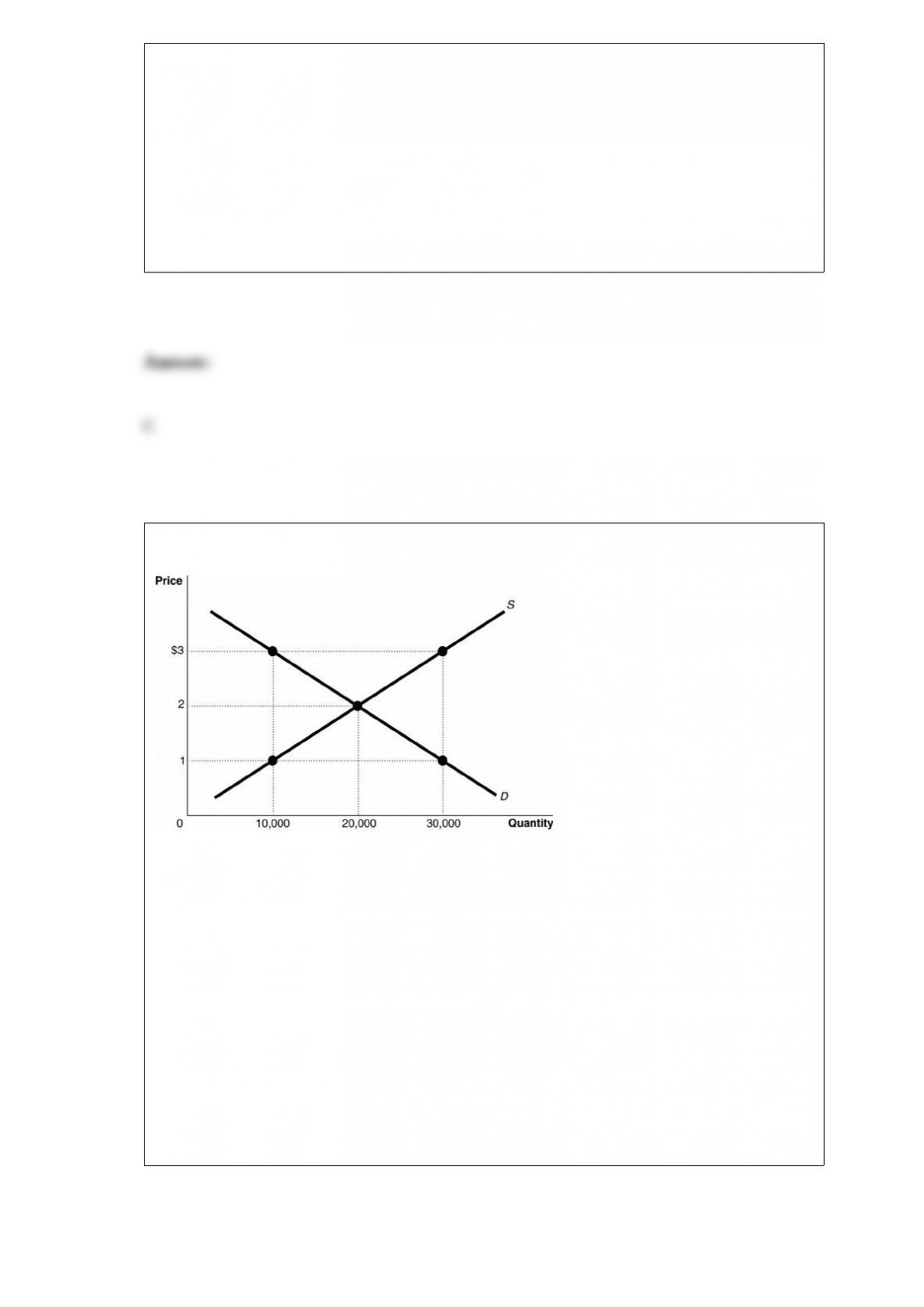
Figure 4-4
Refer to Figure 4-4. The figure above represents the market for iced tea. Assume that
this is a competitive market. At a price of $1
A) the marginal cost of iced tea is greater than the marginal benefit; therefore, output is
inefficiently low.
B) producers should raise the price to $3 in order to sell the quantity demanded of
30,000.
C) the marginal benefit of iced tea is greater than the marginal cost; therefore, output is
inefficiently low.
D) the marginal benefit of iced tea is greater than the marginal cost; therefore, output is
inefficiently high.
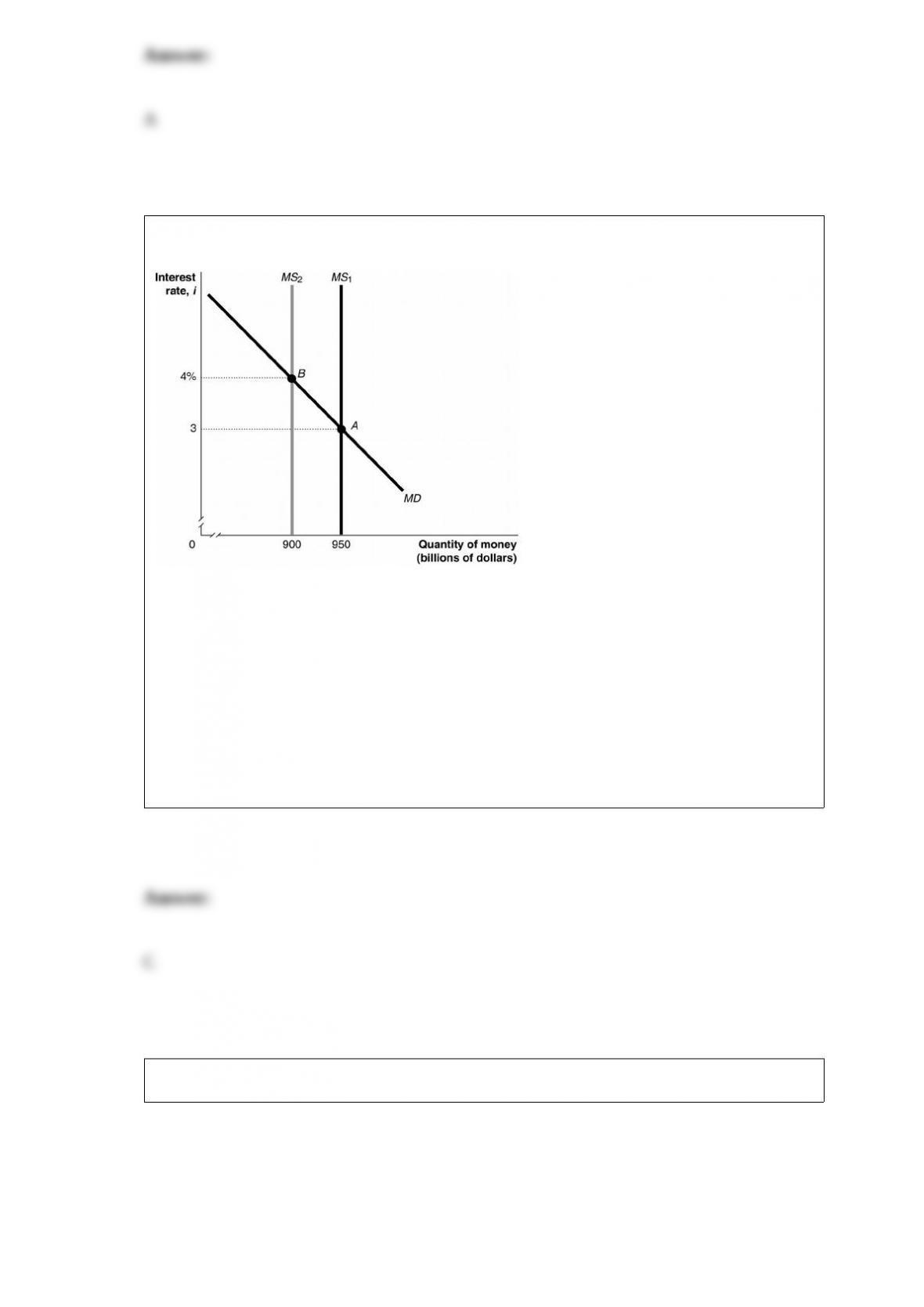
Figure 15-2
Refer to Figure 15-2. In the figure above, the movement from point A to point B in the
money market would be caused by
A) an increase in the price level.
B) a decrease in real GDP.
C) an open market sale of Treasury securities by the Federal Reserve.
D) a decrease in the required reserve ratio by the Federal Reserve.
Table 9-17
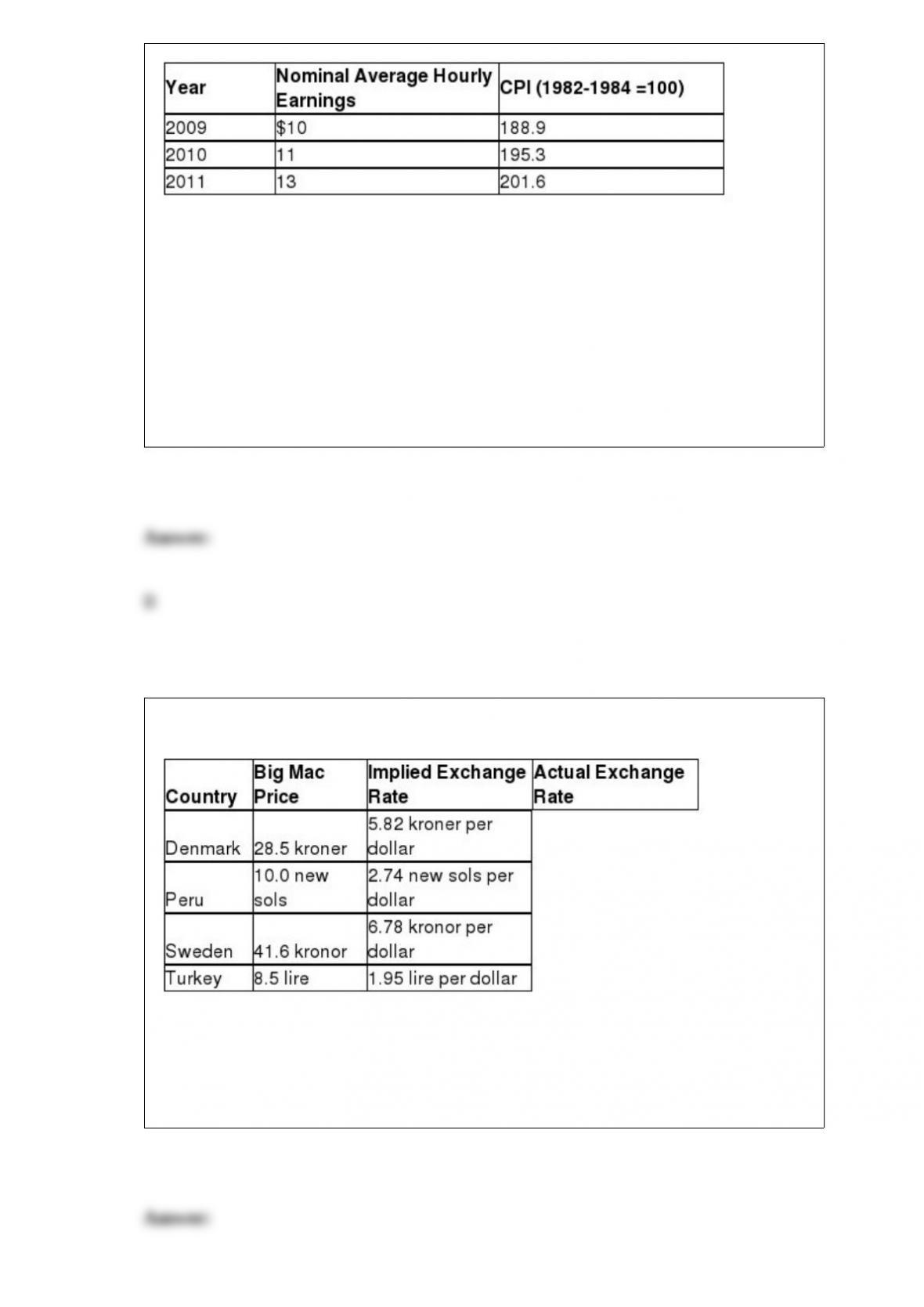
Refer to Table 9-17. Looking at the table above, real average hourly earnings in 2010
were
A) $3.67.
B) $5.63.
C) $10.24.
D) $11.37.
Table 19-1
Source: “The Big Mac Index,” Economist, July 11, 2013.
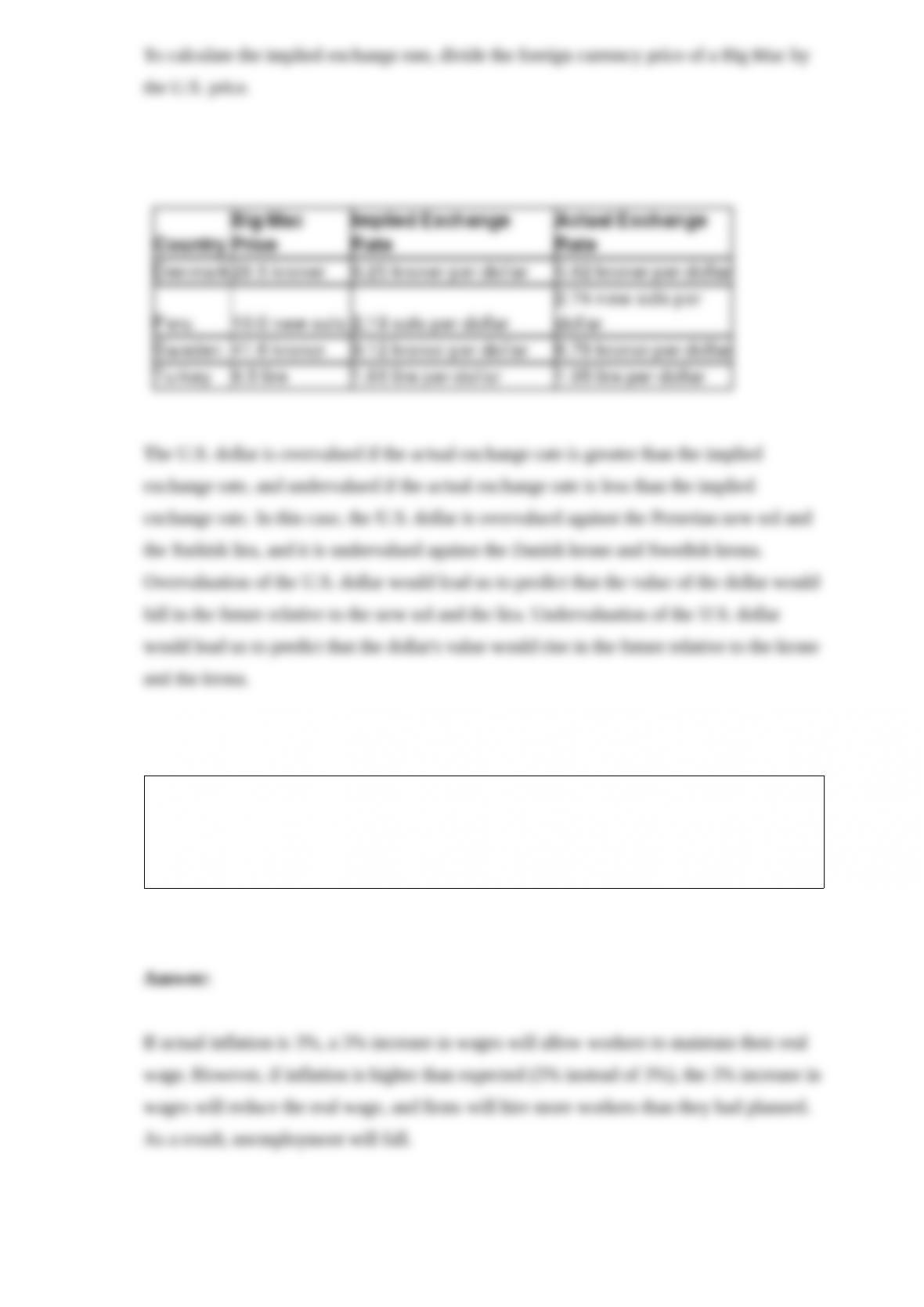
Refer to Table 19-1. Fill in the missing values in the above table. Assume the Big Mac
is selling for $4.56 in the United States. Explain whether the U.S. dollar is overvalued
or undervalued relative to each of the other currencies and predict what will happen in
the future to each exchange rate.
Workers at a local mining company are paid $25.60 per hour, and they have
incorporated a 3 percent annual raise in their contracts to account for expected inflation.
Explain how unexpected inflation of 5 percent will affect the real wage and the
unemployment rate.
Which aspects of globalization help to increase growth in the world economy?
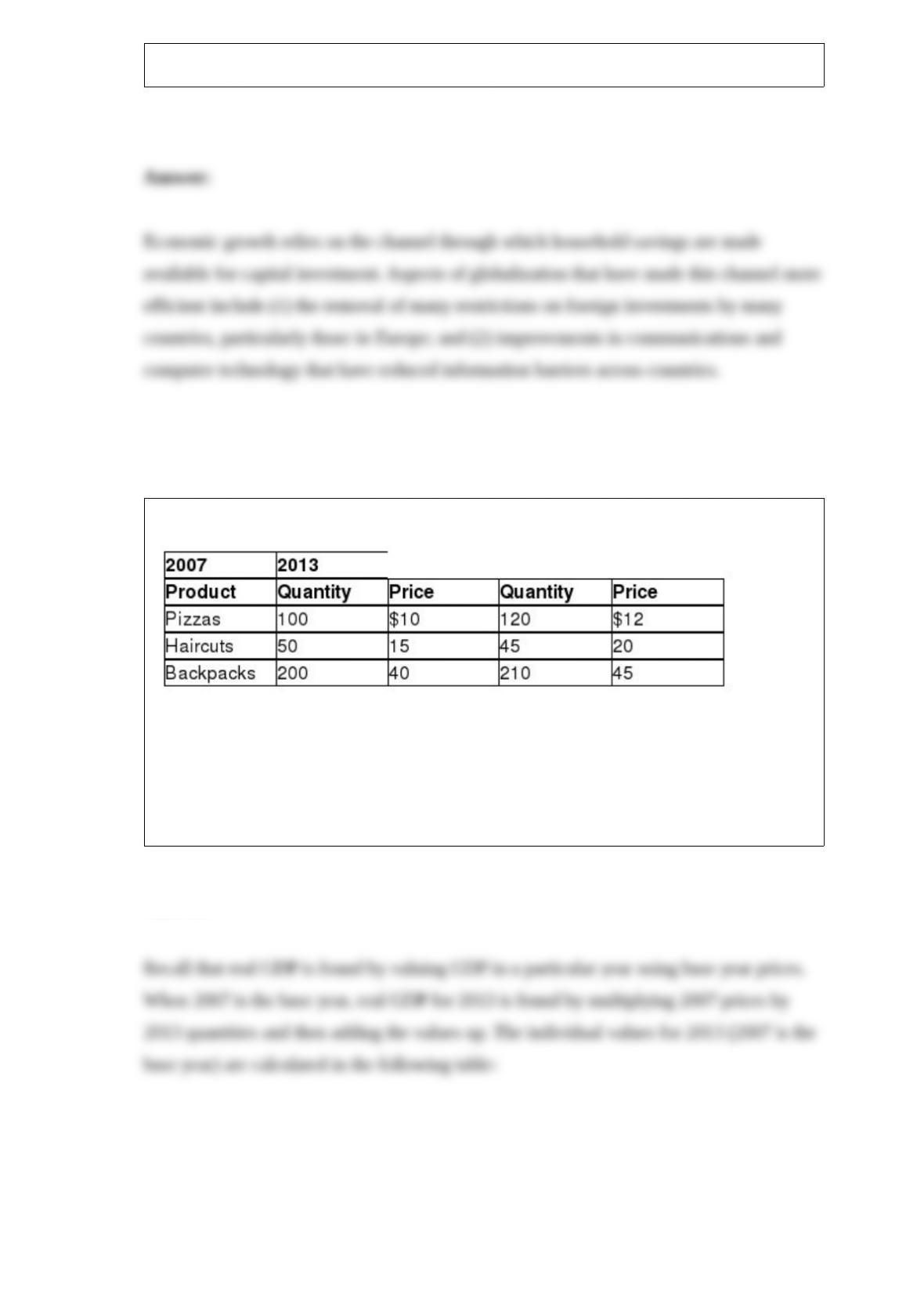
Table 8-24
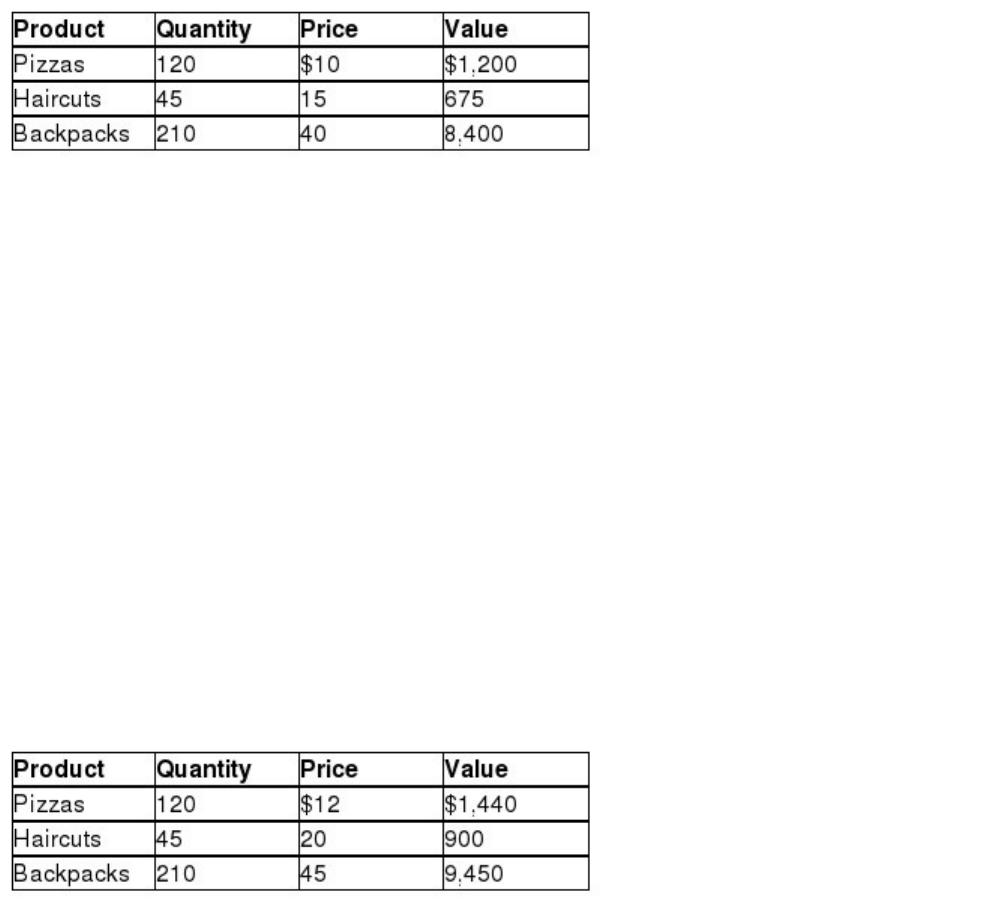
Refer to Table 8-24. Suppose that a very simple economy produces three goods: pizzas,
haircuts, and backpacks. Suppose the quantities produced and their corresponding
prices for 2007 and 2013 are shown in the table above. Use the information to compute
real GDP in the year 2007 and 2013. Calculate real GDP in 2013 assuming the base
year is 2007. Do the same calculation assuming the base year is 2013. Are the
calculations different? Why?
If firms and workers have adaptive expectations, what impact will expansionary
monetary policy have on inflation, unemployment, and the Phillips curve?
Explain why the timing of fiscal policy may be more difficult than the timing of
monetary policy.