1) Fisher Mike can catch salmon for $11 per ton and fisher Tony can catch salmon for
$8 per ton. Both Mike and Tony have an individual transferable quota (ITQ) to catch
1000 tons of salmon. The market price of salmon is $13 per ton.
(a)If both Mike and Tony catch fish that year, what will be the profit for Mike and what
will be the profit for Tony?
(b)If next year, Mike trades his quota for the year to Tony, how much should Mike be
paid for the quota to make more than he can by fishing?
(c)Mike decides to trade his ITQ for the year to Tony. What will be the reduction in
fishing cost to society now that only Tony is doing the fishing?
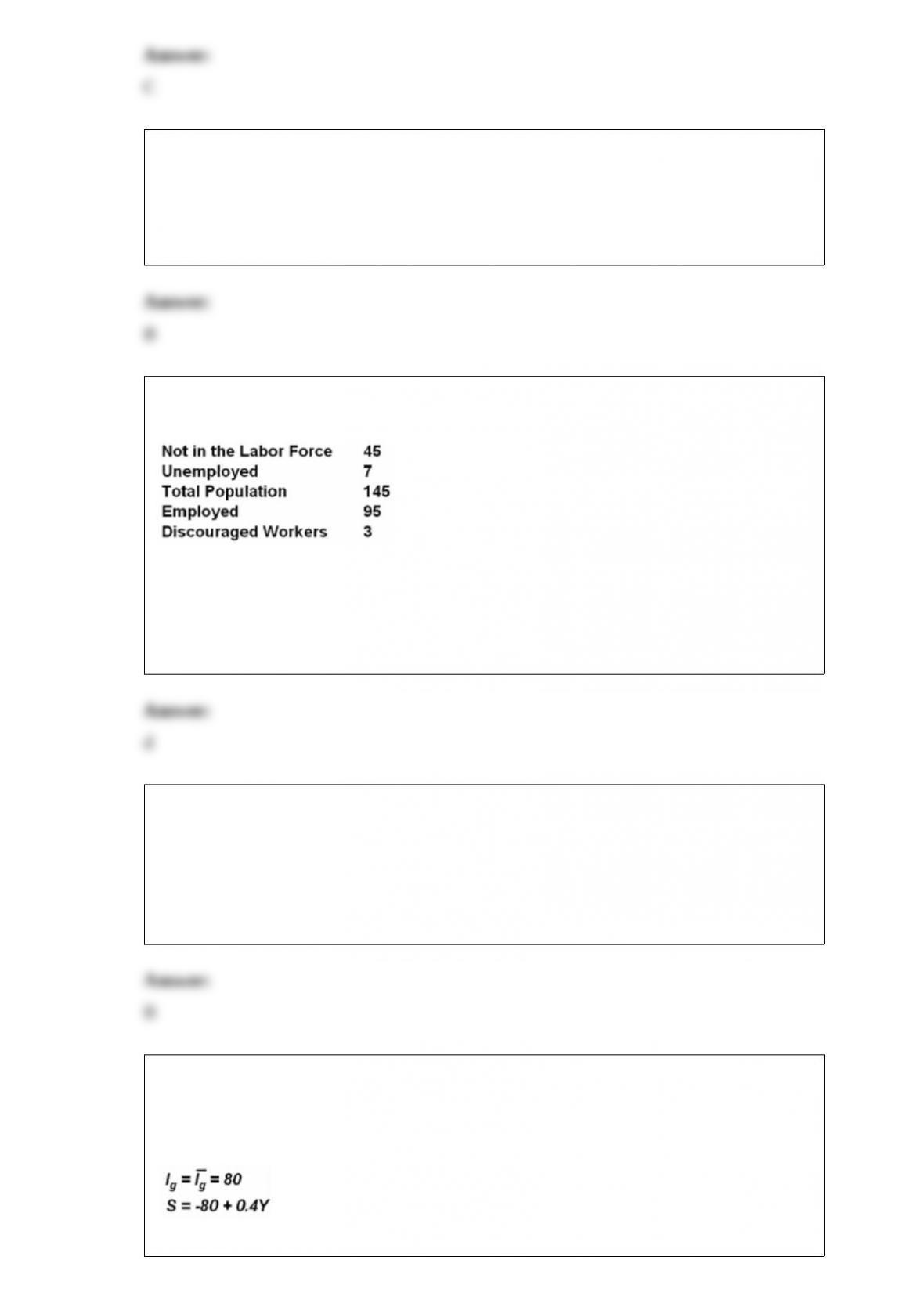
2) answer the next question(s) on the basis of the following data. all figures are in
billions of dollars.
refer to the above data. national income is:
a.$395.
b.$380.
c.$375.
d.$360.
3) 1) W < MRP; W < MRC
2) W = MRP; W < MRC
3) W = MRP; W = MRC
4) W > MRP; W > MRC
Refer to the above list. The outcome in a purely competitive labor market is shown by:
A.1
B.2
C.3
D.4
4) The market supply curve for labor is upsloping because:
A.of diminishing returns.
B.of the opportunity cost of labor in housekeeping, leisure, or alternative employments.
C.of declining MRC.
D.each employer is a “wage taker.”
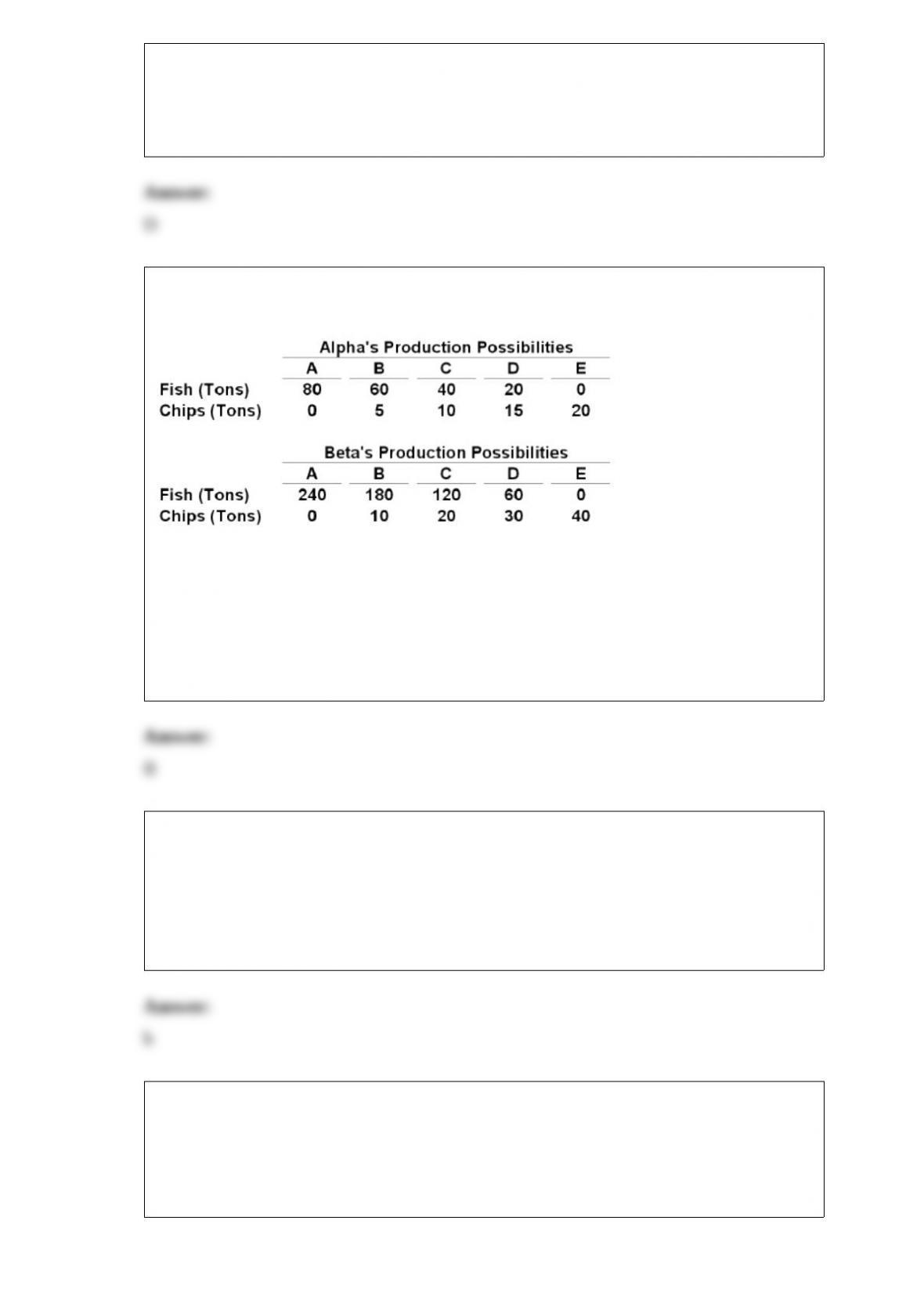
5) answer the next question(s) on the basis of the following information about the
hypothetical economy of scoob. all figures are in millions.
refer to the above information. the unemployment rate in scoob is:
a.2.5 percent.
b.3.2 percent.
c.5.0 percent.
d.6.9 percent.
6) If the top quintile (fifth) of all households receives 48 percent of total income and the
lowest quintile receives 4 percent of total income, we can conclude that:
A.the resulting Lorenz curve will be a 45-degree straight line.
B.the top quintile receives twelve times as much income as the lowest quintile.
C.the middle quintile must receive 60 percent of all income.
D.government must be subsidizing the top quintile.
7) (Advanced analysis) Answer the next question(s) on the basis of the following
information for a private closed economy, where Ig is gross investment, S is saving, and
Y is gross domestic product (GDP).
Refer to the above information. In equilibrium saving will be:
A.$40.
B.$120.
C.$60.
D.$80.
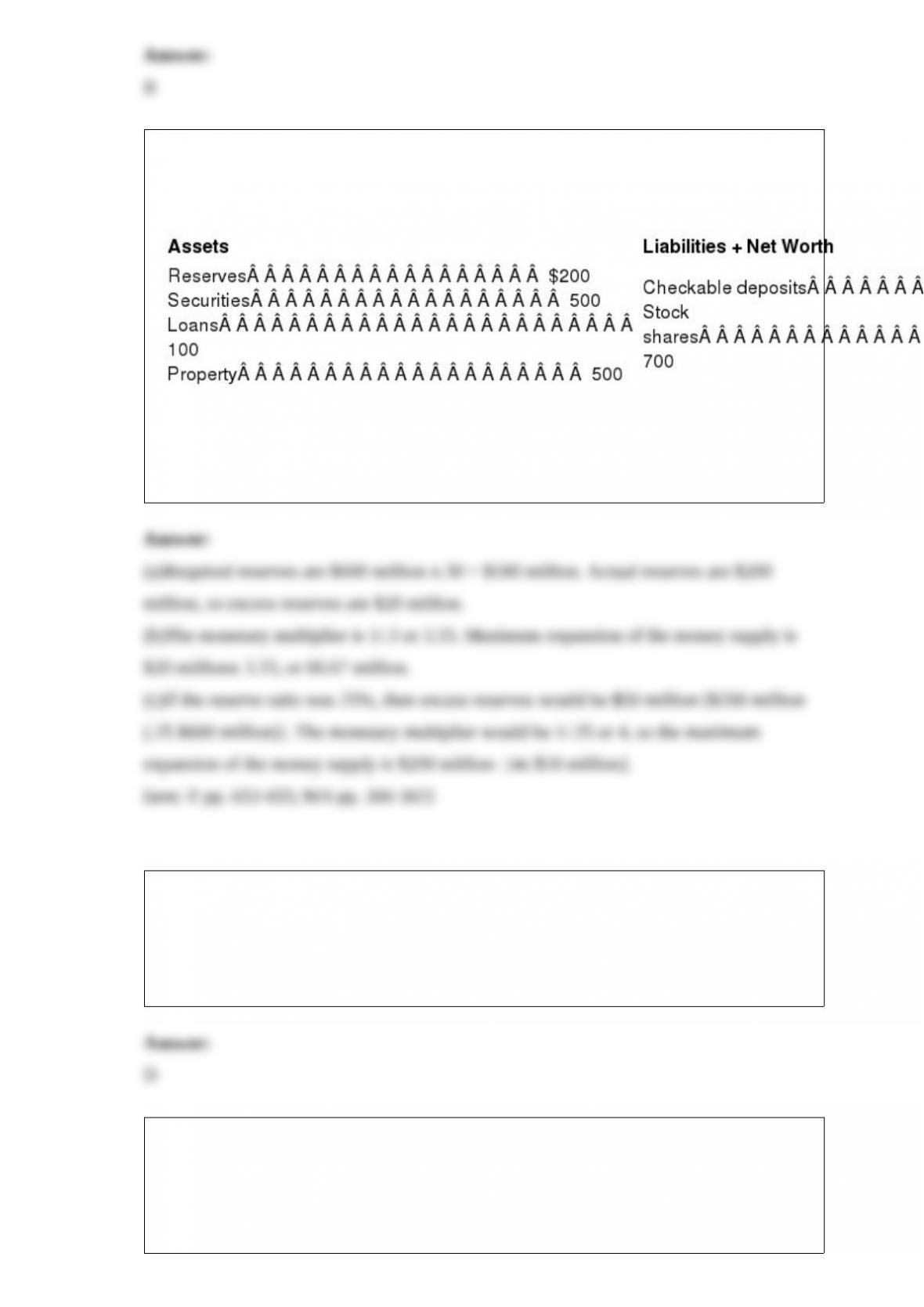
8) The following production possibilities data for two countries, Alpha and Beta, which
have populations of equal size.
Refer to the above data. Assume the production possibilities in Beta double at
alternatives A through E while remaining as shown in the table for Alpha. As a result
Beta should:
A.continue to specialize in producing chips.
B.continue to specialize in fishing.
C.no longer specialize and trade.
D.specialize both in fishing and in producing chips and sell the surplus to Alpha.
9) if a monopolist engages in price discrimination, it will:
a.realize a smaller profit.
b.charge a higher price where individual demand is inelastic and a lower price where
individual demand is elastic.
c.produce a smaller output than when it did not discriminate.
d.charge a competitive price to all its customers.
10) The amount of money reported as M2:
A.is smaller than the amount reported as M1.
B.is larger than the amount reported as M1.
C.excludes coins and currency.
D.includes large ($100,000 or more) certificates of deposit.
11) Answer the next question based on the following consolidated balance sheet for the
commercial banking system. Assume the required reserve ratio is 30%. All figures are
in millions of dollars.
(a)What is the amount of excess reserves in this commercial banking system?
(b)What is the maximum amount that the money supply can be expanded?
(c)If the reserve ratio fell to 25%, what is now the maximum amount that the money
supply can be expanded?
12) An increase in taxes will have a greater effect on the equilibrium GDP:
A.if the tax revenues are redistributed through transfer payments.
B.the larger the MPS.
C.the smaller the MPC.
D.the larger the MPC.
13) Assume a firm purchases resources a and b under purely competitive conditions and
combines these resources to produce X. Product X is sold in a purely competitive
market. The MP of a and b are 6 and 3 respectively and the prices of a and b are $12
and $6 respectively. If equilibrium exists, the price of X will be:
A.$1.
B.$.50.
C.$2.
D.$5.
14) physicians’ incomes:
a.yield a rate of return on educational expenses that is below the returns for lawyers and
holders of mba degrees.
b.yield a rate of return on educational expenses equal to the returns earned by lawyers
and holders of mba degrees.
c.yield a rate of return well above the returns for lawyers and holders of mba degrees.
d.have not risen fast enough to keep the number of physicians per 100,000 people from
falling.
15) in recent years the economy of japan has grown, despite the fact that the population
of japan has declined. which of the following would best explain japan’s economic
growth despite having a smaller population?
a.immigration of new workers into japan.
b.advancements in technology that make labor more productive.
c.reduced employment of capital because fewer workers are available to use it.
d.greater consumption of goods imported from other countries.
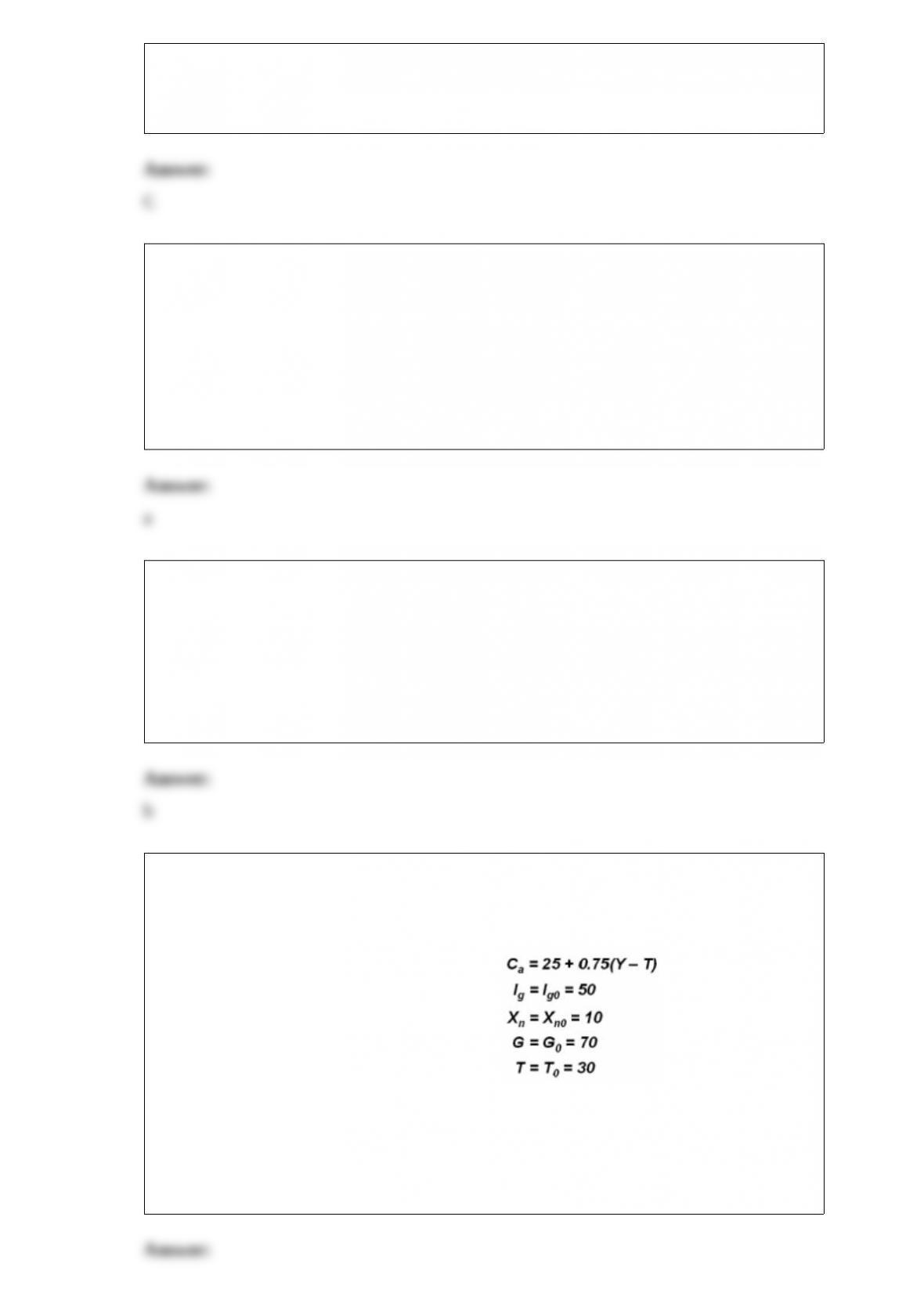
16) (Advanced analysis) Answer the next question(s) on the basis of the following
information for a mixed open economy. The letters Y, Ca, Ig, Xn, G, and T stand for
GDP, consumption, gross investment, net exports, government purchases, and net taxes
respectively. Figures are in billions of dollars.
Refer to the above information. The equilibrium level of GDP for this economy is:
A.$600.
B.$530.
C.$415.
D.$400.
17)
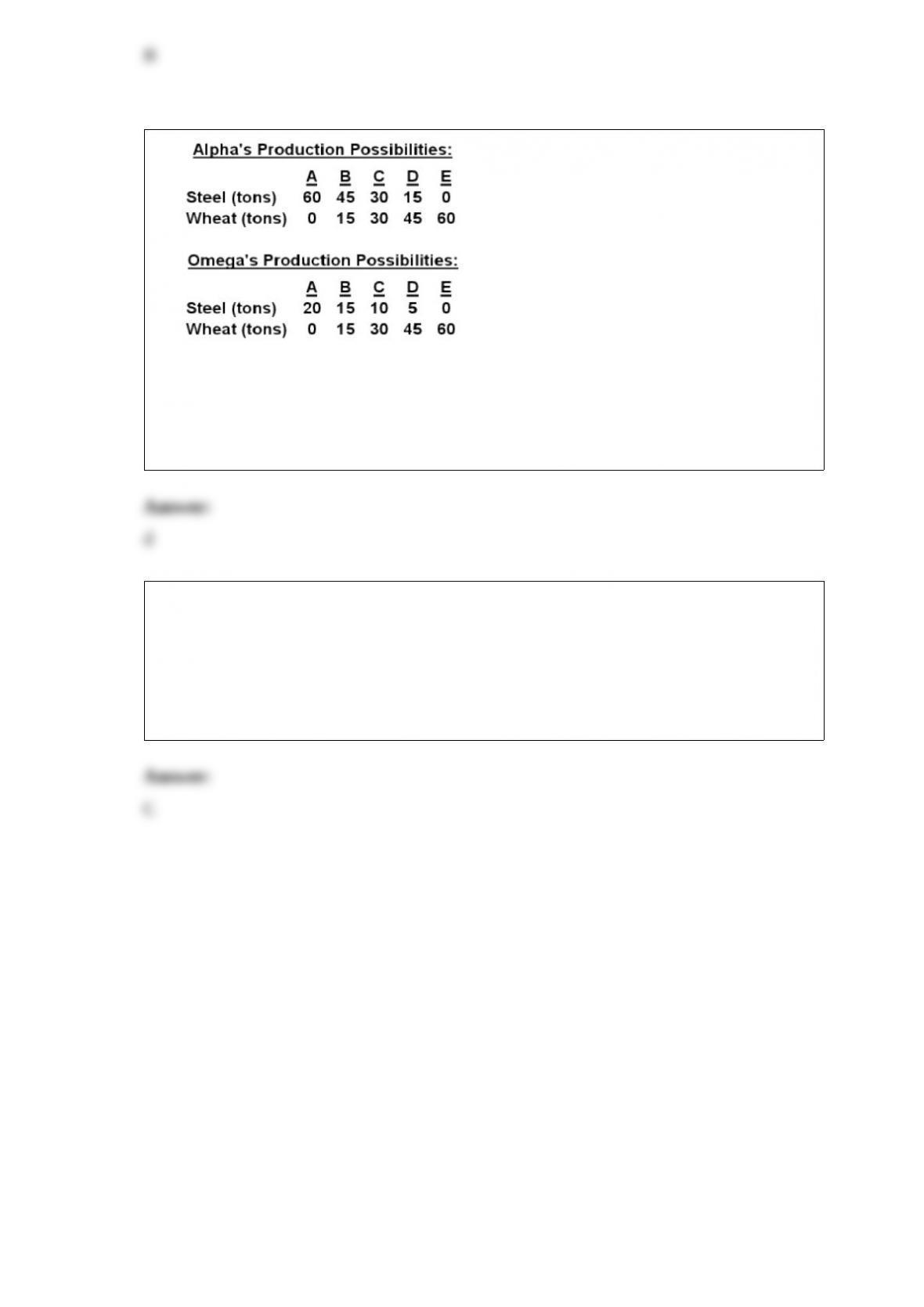
the above data would graph as:
a.a straight line for alpha, but as a concave curve for omega.
b.a concave curve for alpha, but as a straight line for omega.
c.concave curves for both alpha and omega.
d.straight lines for both alpha and omega.
18) In 2007, about ____ percent of the U.S. public debt was held by people and
institutions abroad.
A.42
B.18
C.25
D.33