
1) The aggregate expenditures model does not allow for cost-push inflation.
2) the largest source of local government’s revenue is the sales tax.
3) If the real outputs per capita of a rich nation and a poor nation grow at the same
percentage rate, the absolute income gap between the two nations will shrink.
4) It is more meaningful economically to measure the public debt relative to the GDP
than to measure it in absolute terms.
5) welfare reform in 1996 reversed the trend of growing welfare payments to
immigrants.
6) the short-run supply curve slopes upward because producers must be compensated
for rising marginal costs.
7) Currently over 90 percent of all workers in the United States are covered by Social
Security.

8) marginal revenue is the addition to total revenue resulting from the sale of one more
unit of output.
9) Society’s marginal cost of pollution abatement curve slopes upward because of the
law of diminishing marginal utility.
10) any migration that affects the economies of the countries involved is referred to as
“economic immigration.”
11) the rule of 70 is used to find how long it will take an economy to grow by 70
percent.
12) In the insider-outsider theory, insiders are agents and outsiders are principals.
13) the intense competition of free trade prevents the investment that generates
economic growth.
14) Present value allows us to weigh the benefits and costs of using resources today or
in the future.
15) The fact that most of a farmer’s costs are variable costs has hastened the movement
of resources from agriculture to industry.
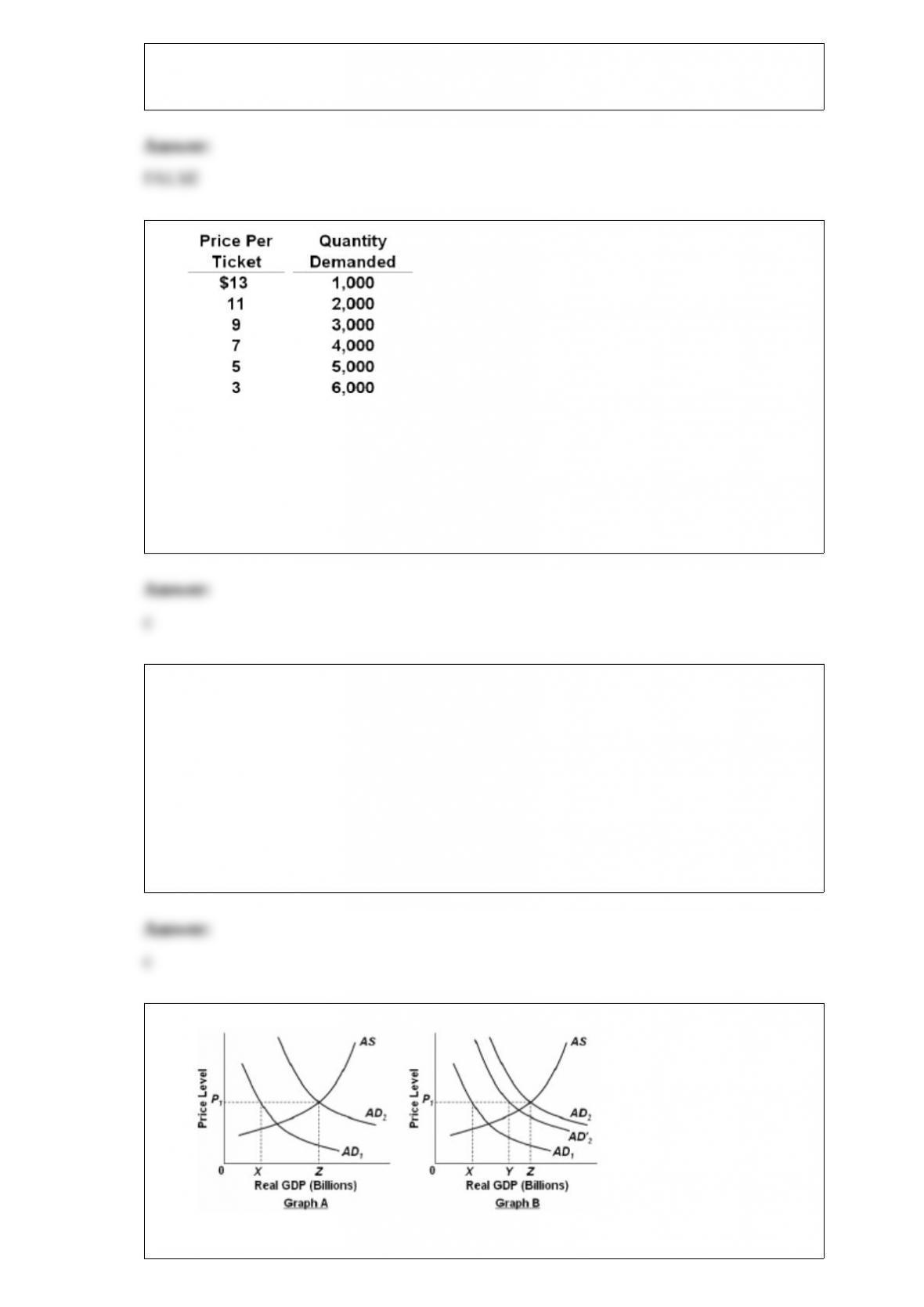
16)
refer to the above information and assume the stadium capacity is 5,000. if the
mudhens’ management wanted a full house for the game, it would:
a.set price so as to maximize its total revenue.
b.encourage scalpers to sell their tickets for more than $7.
c.set ticket prices at $5.
d.set ticket prices at $9.
17) which of the following best expresses the law of diminishing returns?
a.because large-scale production allows the realization of economies of scale, the real
costs of production vary directly with the level of output.
b.population growth automatically adjusts to that level at which the average product per
worker will be at a maximum.
c.as successive amounts of one resource (labor) are added to fixed amounts of other
resources (capital), beyond some point the resulting extra output will decline.
d.proportionate increases in the inputs of all resources will result in a
less-than-proportionate increase in total output.
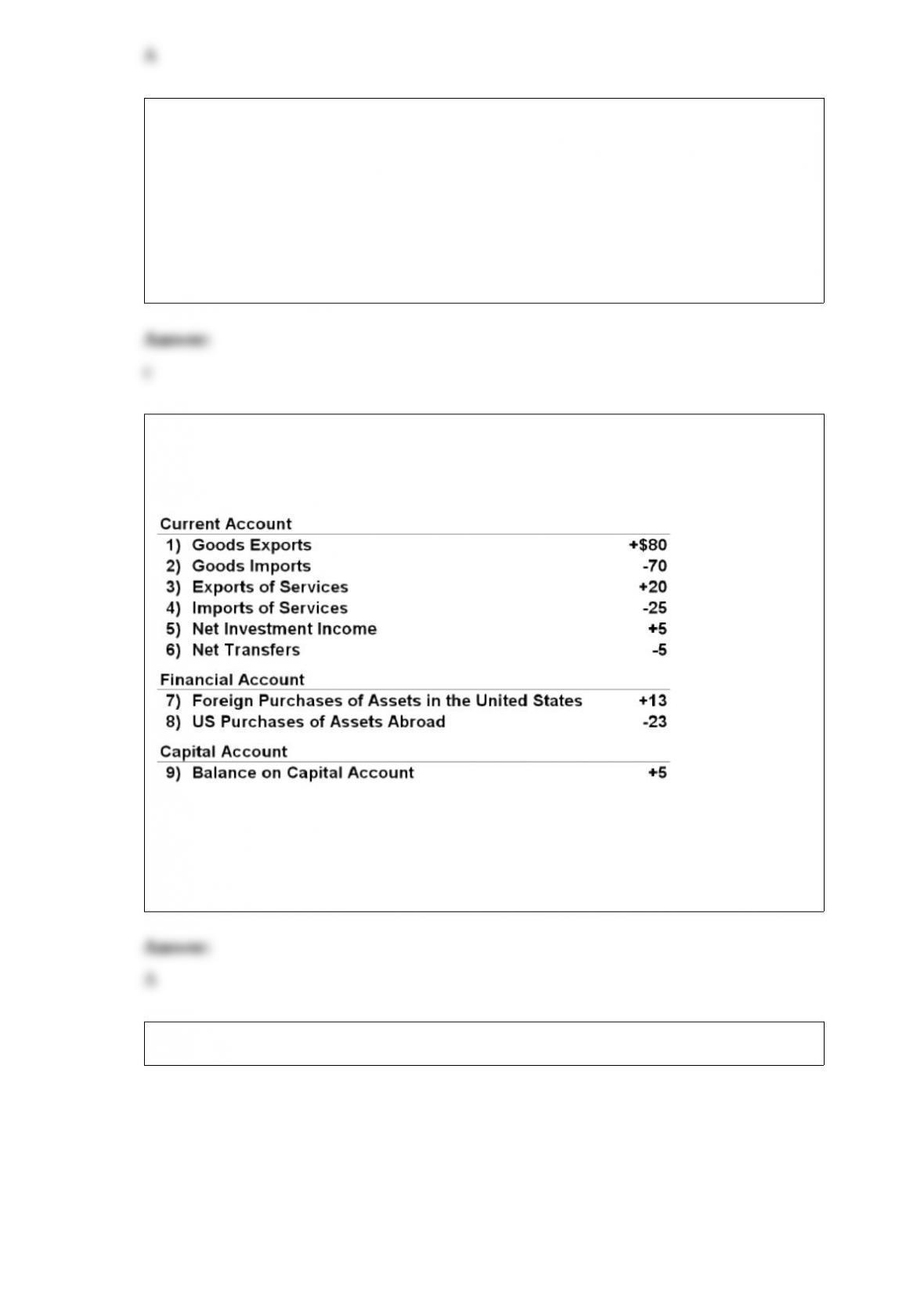
18)
Refer to the above diagrams. Suppose that government undertakes fiscal policy

designed to increase aggregate demand from AD1 to AD2 and thereby to increase GDP
from X to Z. In terms of graph B, which of the following might explain why GDP
increases to Y rather than to Z?
A.inflation
B.an increase in stock prices
C.offsetting state and local finance
D.a ratchet effect
19) If the real GDP of a DVC increases from $600 billion to $630 billion and its
population increases from 200 million to 216 million, its real per capita GDP will have:
A.increased by about $83.
B.decreased by about $83.
C.remained unchanged.
D.decreased by about $19.
20) economies of scale refer to:
a.the idea that proprietorships are less bureaucratic and therefore more efficient than
corporations.
b.public investments in highways, schools, utilities, and such.
c.the fact that large producers may be able to use more efficient technologies than
smaller producers.
d.the reallocation of labor from less-productive to more-productive uses.
21) In a monopsonistic labor market the employer will maximize profits by employing
workers up to that point at which:
A.the difference between the wage rate and marginal resource (labor) cost is at a
maximum.
B.marginal revenue product equals marginal resource (labor) cost.
C.the wage rate equals marginal revenue product.
D.the wage rate equals marginal resource (labor) cost.

22) The legal cartel theory best describes the structure and economic outcomes of the:
A.automobile industry.
B.deregulated airline industry.
C.airline industry before deregulation.
D.local telephone communications industry.
23) Productivity increases in agriculture have:
A.increased the demand for foodstuffs.
B.been negligible since the Second World War.
C.increased the incomes of farm households above the national average.
D.lowered farm prices.
24) (last word) which of the following problems has not accompanied china’s rapid
economic growth over the past twenty-five years?
a.high rates of inflation.
b.structural unemployment of displaced agricultural workers.
c.uneven economic development.
d.falling per capita income.
25) the gdp price index:
a.includes fewer goods and services than the consumer price index.
b.is identical to the consumer price index.
c.is another term for the producer price index.
d.includes all goods comprising the nation’s domestic output.
26) Proponents of inflation targeting generally think that:
A.the economy will have fewer, shorter, and less severe business cycles if the Fed holds
the rate of inflation to low, targeted levels from year to year.
B.low interest rates are inflationary and high interest rates are deflationary.
C.fiscal policy is more effective in stabilizing the economy than monetary policy.
D.the Fed should strive to achieve zero inflation.
27) determine, other things equal, the effects of a given change in a determinant of
demand or supply for product x upon (1) the demand (d) for, or supply (s) of, x, (2) the
equilibrium price (p) of x and (3) the equilibrium quantity (q) of x.
refer to the above. a reduction in the number of firms producing x will:
a.increase d, increase p, and increase q.
b.increase s, decrease p, and increase q.
c.decrease s, increase p, and decrease q.
d.decrease s, decrease p, and increase q.
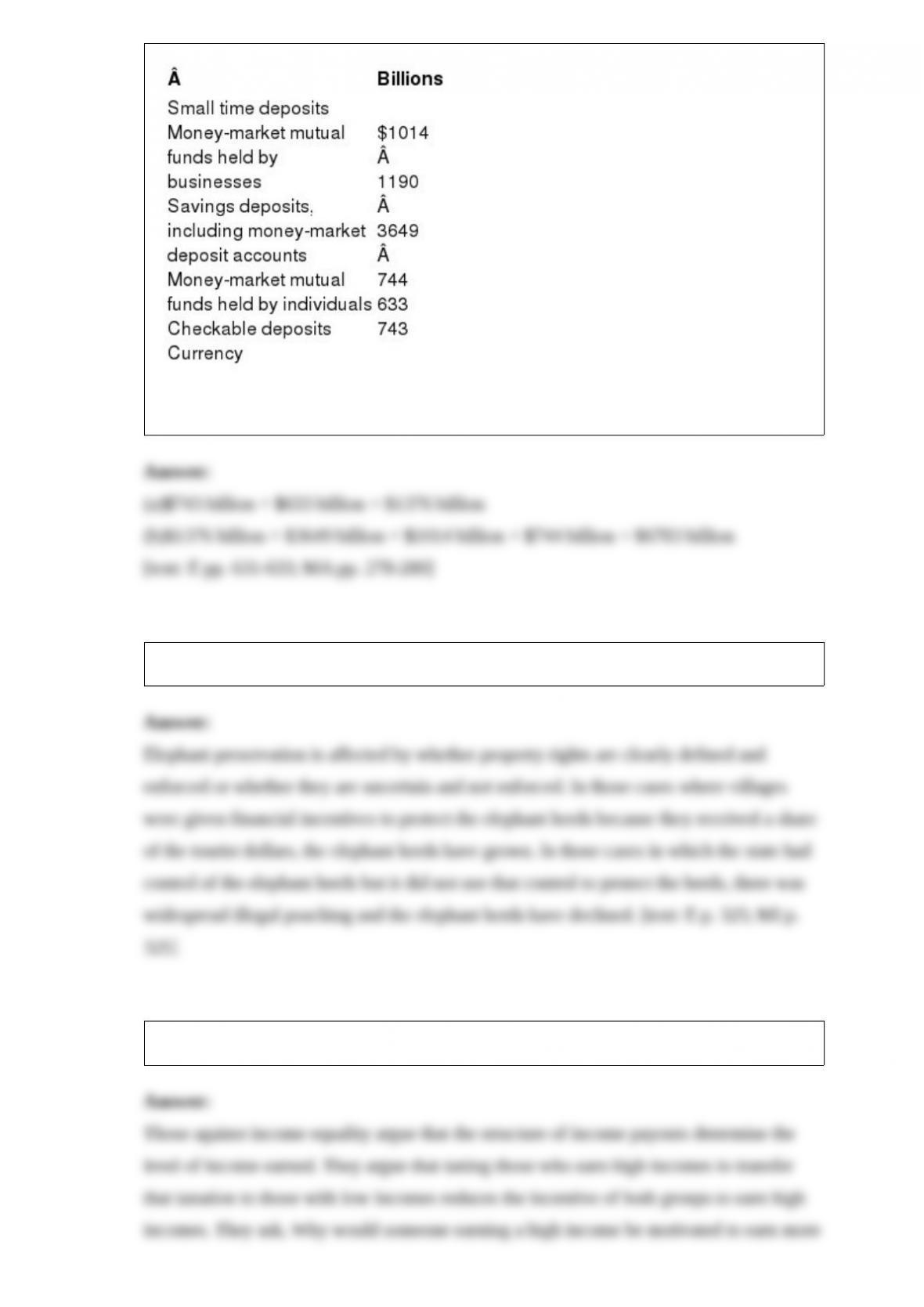
28) The following 2006 balance of payments data (+ and -) for the hypothetical nation
of Zabella. All figures are in billions of dollars.
Refer to the above data. Zabella’s balance on financial account shows a:
A.deficit of $10 billion.
B.surplus of $5 billion.
C.deficit of $28 billion.
D.surplus of $13 billion.
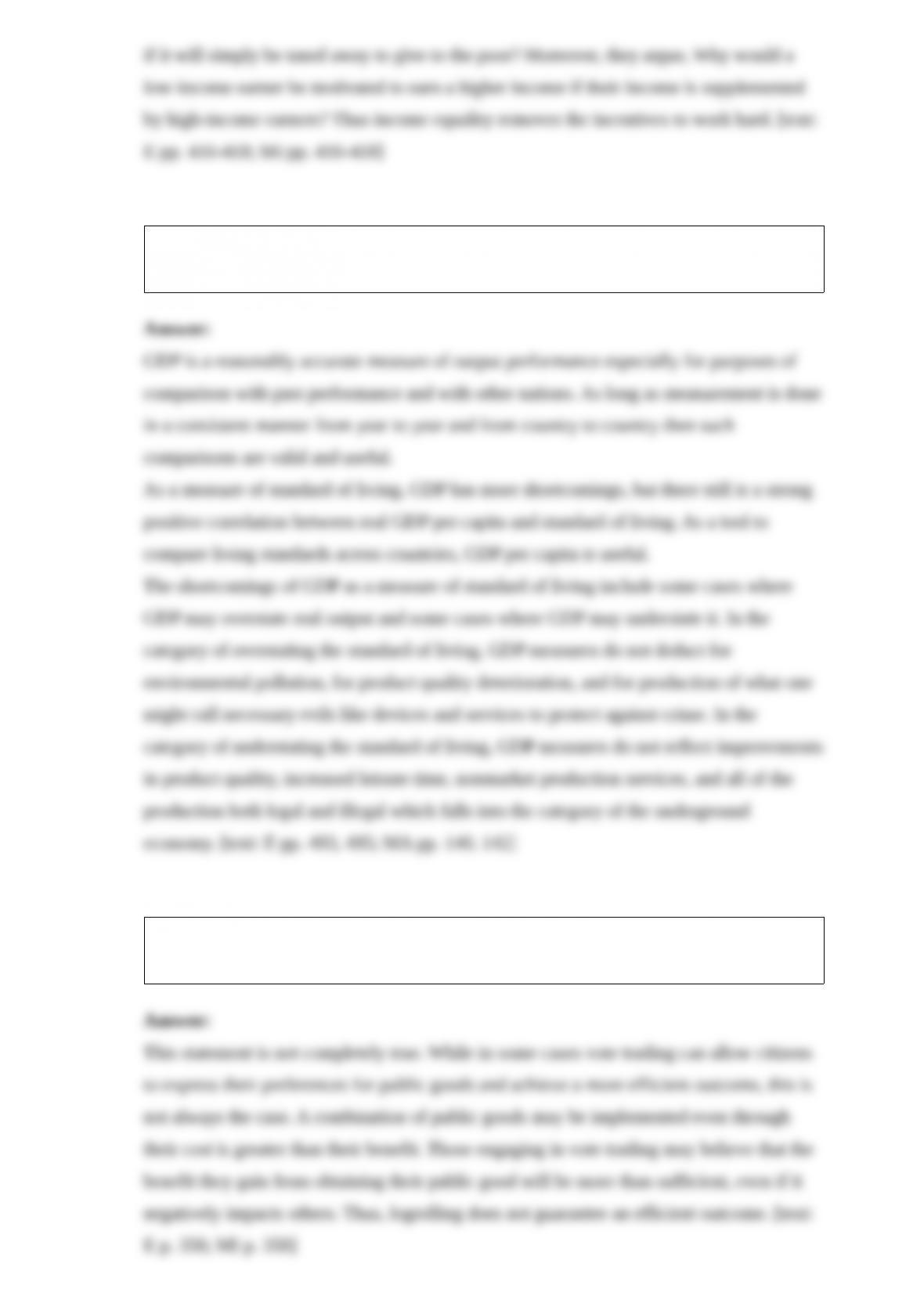
29) Use the figures in the table below to answer the following questions.
(a)What is the value of M1?
(b)What is the value of M2?
30) How is elephant preservation affected by property rights?
31) What is the argument for income inequality?
32) Discuss the merits and demerits of GDP as a measure of the economys output
performance and as a measure of its standard of living.
33) Political logrolling solves the problem of inefficient outcomes in the provision of
public goods. Evaluate.
34) Evaluate this argument for a trade barrier: The U.S. needs protection from cheap
foreign labor.
35) Explain the major causes of the persistent trade deficits in the United States in
recent years.