
Suppose that M is fixed. According to the quantity equation, which of the following
would make the price level lower?
a. Y or V rise
b. Y or V fall
c. Y rises or V falls
d. Y falls or V rises
If expected inflation is constant, then when the nominal interest rate increases, the real
interest rate
a. increases by more than the change in the nominal interest rate.
b. increases by the change in the nominal interest rate.
c. decreases by the change in the nominal interest rate.
d. decreases by more than the change in the nominal interest rate.
Figure 8-5
Suppose that the government imposes a tax of P3 – P1.
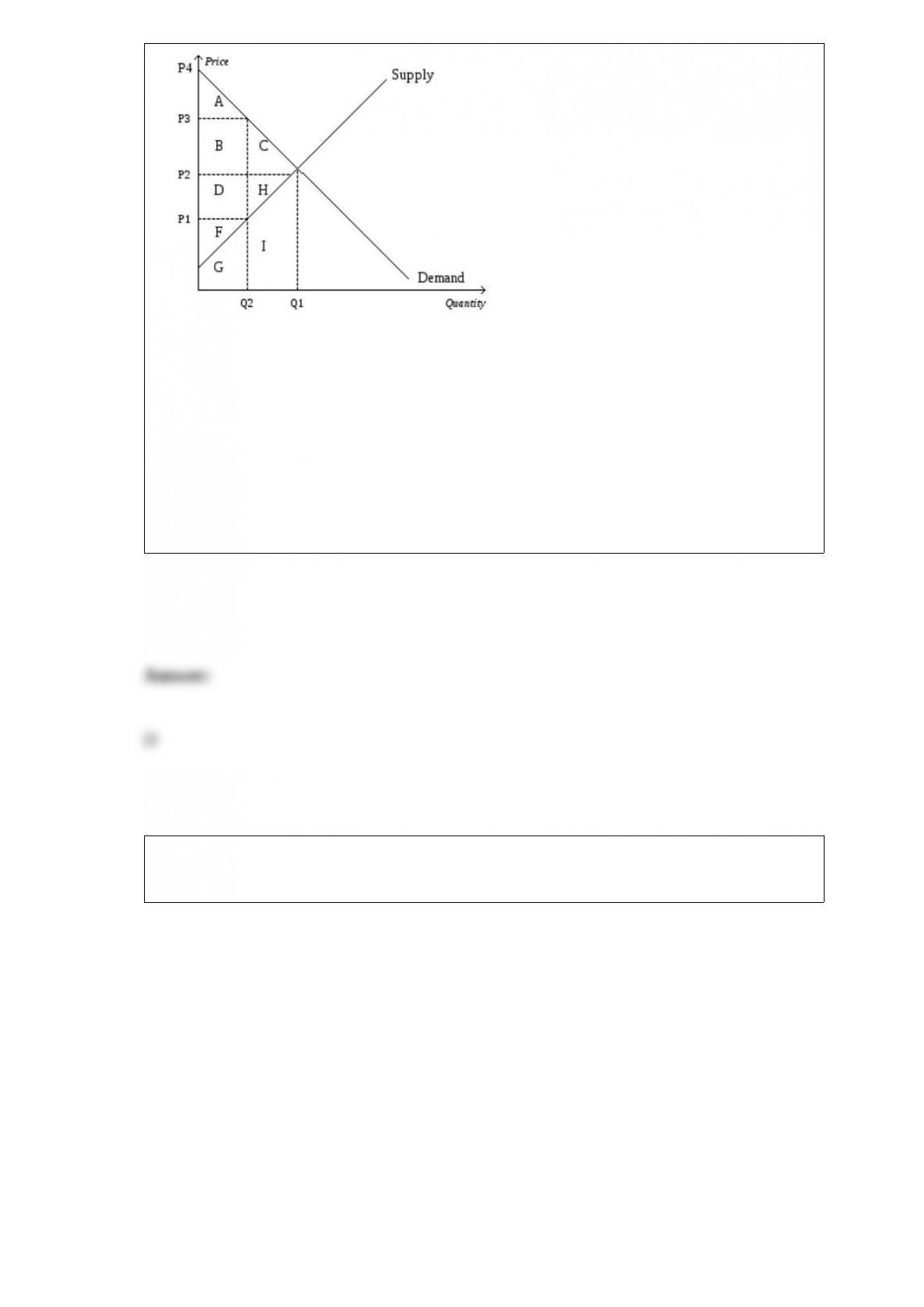
Refer to Figure 8-5. The total surplus with the tax is represented by area
a. C+H.
b. A+B+C.
c. D+H+F.
d. A+B+D+F.
Table 15-4
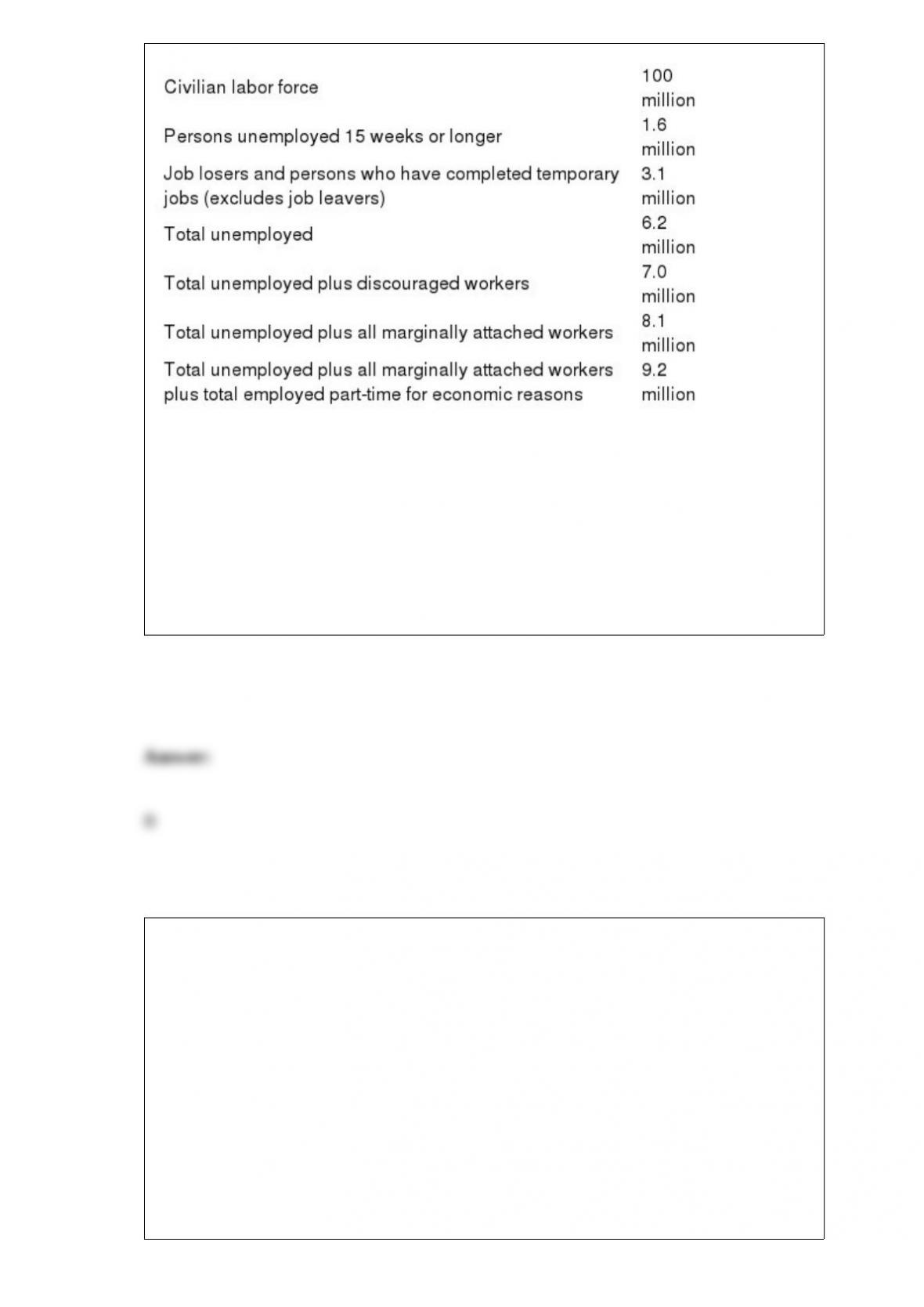
Refer to Table 15-4. What is the U-6 measure of labor underutilization?
a. 8.4 percent
b. 9.0 percent
c. 9.2 percent
d. 35.2 percent
A survey showed that in each of the past 12 months there was one person who was
unemployed who worked in all other months. There were also two people who were
unemployed for all 12 months. What percentage of the unemployment spells during the
year was short-term, and what percentage of the unemployment in a given month was
long-term?
a. 75 percent and 33.3 percent
b. 75 percent and 66.7 percent
c. 85.7 percent and 33.3 percent
d. 85.7 percent and 66.7 percent

Suppose that twenty-five years ago a country had nominal GDP of $1,000, a GDP
deflator of 200, and a population of 100. Today it has nominal GDP of $3,000, a GDP
deflator of 400, and population of 150. What happened to the real GDP per person?
a. It more than doubled.
b. It increased, but it less than doubled.
c. It was unchanged.
d. It decreased.
If the United States imposes an import quota on clothing, then U.S. exports
a. increase, U.S. imports increase, and U.S. net exports will not change.
b. increase, U.S. imports decrease, and U.S. net exports increase.
c. decrease, U.S. imports increase, and U.S. net exports decrease.
d. decrease, U.S. imports decrease, and U.S. net exports will not change.
Which inflation costs could the government take actions to reduce without reducing
inflation?
a. shoeleather and menu costs
b. menu costs and relative price variability
c. unintended changes in tax liabilities and arbitrary redistributions of wealth
d. None of the above is correct.
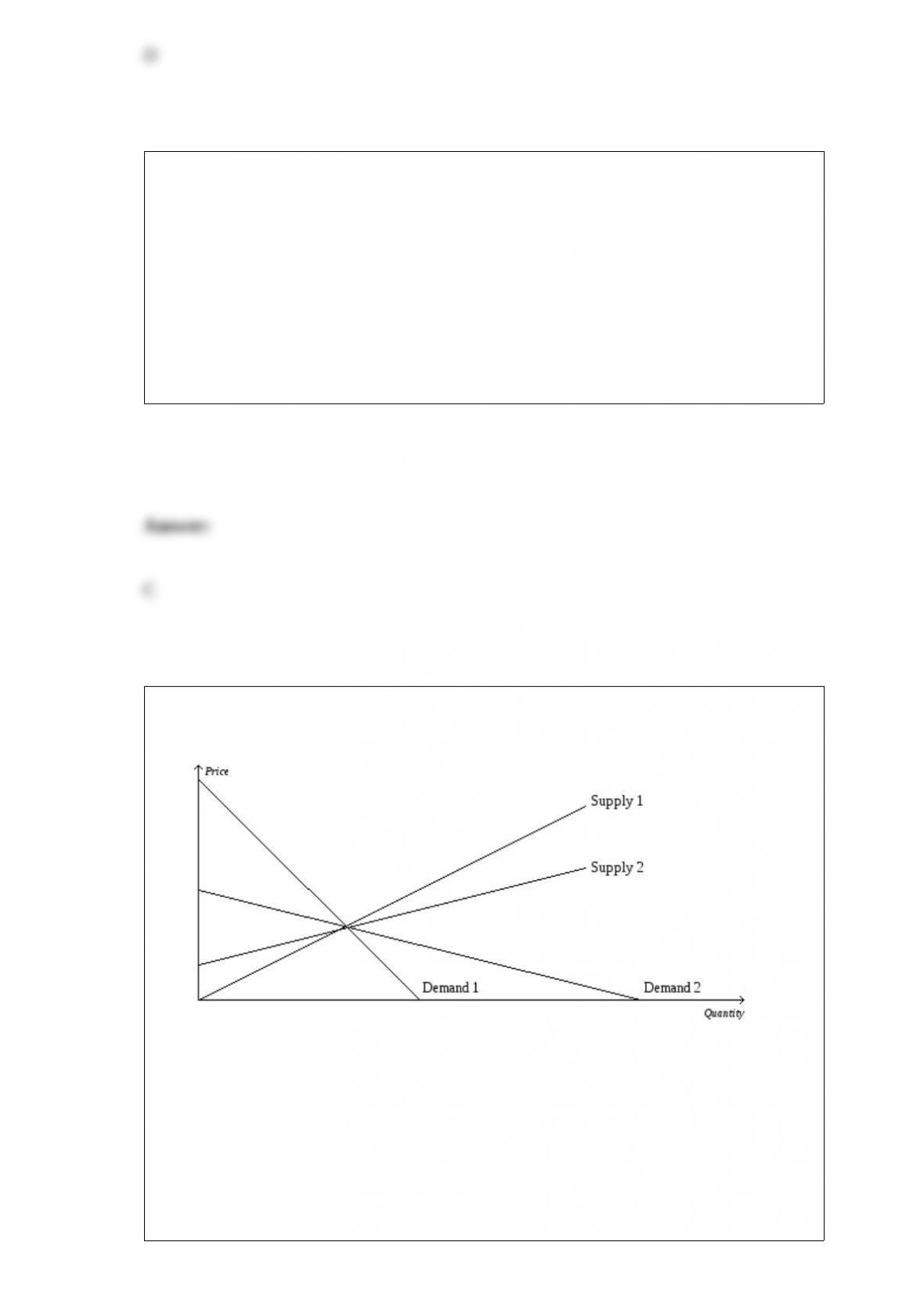
Figure 8-12
Refer to Figure 8-12. Which of the following combinations will minimize the
deadweight loss from a tax?
a. supply 1 and demand 1
b. supply 2 and demand 2
c. supply 1 and demand 2

d. supply 2 and demand 1
In 1936, John Maynard Keynes published a book, The General Theory, which
attempted to explain
a. stagflation.
b. the classical dichotomy.
c. short-run economic fluctuations.
d. how changes in the money supply had created the Great Depression.
The GDP Deflator reflects
a. the prices of all final goods and services currently produced domestically, as does the
CPI.
b. the price of a fixed basket of goods and services purchased by a typical consumer, as
does the CPI.
c. the prices of all final goods and services currently produced domestically, while the
CPI reflects the price of a fixed basket of goods and services purchased by a typical
consumer.
d. the price of a fixed basket of goods and services purchased by a typical consumer,

while the CPI reflects the prices of all final goods and services produced domestically.
Which of the following is an example of U.S. foreign portfolio investment?
a. Joan, a U.S. citizen, buys bonds issued by a Swedish corporation.
b. Russell, a U.S. citizen, opens a dairy in Italy.
c. Both A and B are examples of U.S. portfolio investment.
d. Neither A nor B are examples of U.S. portfolio investment.
A demand curve displaying the relationship between the price of cars and the quantity
demanded of cars should have a slope that is
a. less than 0.
b. between zero and 1.
c. between one and infinity.
d. undefined.

When box office receipts are not corrected for inflation,
a. The Sound of Music ranks as the most popular movie of all time.
b. Gone with the Wind does not rank as one of the 50 most popular movies of all time.
c. Titanic ranks as the most popular movie of all time.
d. Avatar does not rank as one of the 50 most popular movies of all time.
Which of the following pairs of countries experienced approximately the same rate of
growth of real income per person over the last 100 or so years?
a. Germany and Japan
b. Indonesia and the United Kingdom
c. the United States and Japan
d. Mexico and Pakistan

The investment component of GDP measures spending on
a. financial assets such as stocks and bonds. During recessions it declines by a relatively
large amount.
b. residential construction, business equipment, business structures, and changes in
inventory. During recessions it declines by a relatively large amount.
c. financial assets such as stocks and bonds. During recessions it declines by a relatively
small amount.
d. residential construction, business equipment, business structures, and changes in
inventory. During recessions it declines by a relatively large amount.
Which of the following is downward-sloping?
a. both the long-run Phillips curve and the long-run aggregate-supply curve
b. neither the long-run Phillips curve nor the long-run aggregate-supply curve
c. the long-run Phillips curve, but not the long-run aggregate-supply curve
d. the short-run Phillips curve, but not the long-run aggregate-supply curve
Suppose Jim and Tom can both produce two goods: baseball bats and hockey sticks.
Which of the following is not possible?

a. Jim has an absolute advantage in the production of baseball bats and in the
production of hockey sticks.
b. Jim has an absolute advantage in the production of baseball bats and a comparative
advantage in the production of hockey sticks.
c. Jim has an absolute advantage in the production of hockey sticks and a comparative
advantage in the production of baseball bats.
d. Jim has a comparative advantage in the production of baseball bats and in the
production of hockey sticks.
Scenario 12-1. An economy’s production form takes the form Y = AF(L, K, H, N).
Refer to Scenario 12-1. If the production function has the constant-returns-to-scale
property, then it could be rewritten as
a. Y/L = AF(1, K/L, H/L, N/L)
b. Y/L = AF(L, 1, H/L, N/L)
c. Y/L = AF(L, K/L, 1, N/L)
d. Y/L = AF(L, K/L, H/L, 1)
Figure 22-8. The left-hand graph shows a short-run aggregate-supply (SRAS) curve
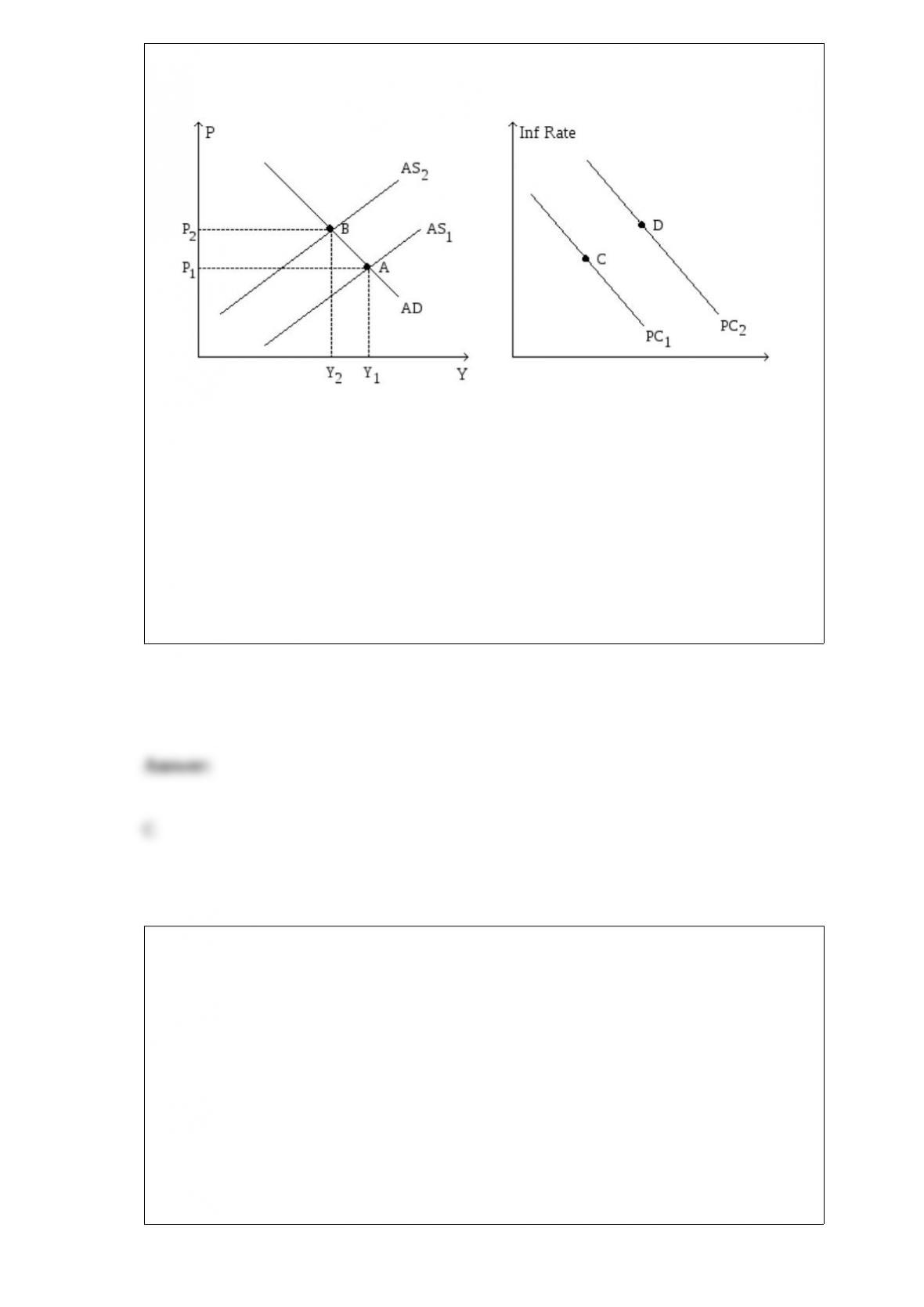
and two aggregate-demand (AD) curves. On the right-hand diagram, “Inf Rate” means
“Inflation Rate.”
Refer to Figure 22-8. A movement of the economy from point A to point B, and at the
same time a movement from point C to point D, would be described as
a. the outcome of a favorable supply shock.
b. falling inflation.
c. stagflation.
d. All of the above are correct.
GDP is defined as the
a. value of all goods and services produced within a country in a given period of time.
b. value of all goods and services produced by the citizens of a country, regardless of
where they are living, in a given period of time.
c. value of all final goods and services produced within a country in a given period of
time.
d. value of all final goods and services produced by the citizens of a country, regardless
of where they are living, in a given period of time.

A market demand curve shows
a. the relationship between price and the number of buyers in a market.
b. how quantity demanded changes when the number of sellers changes.
c. the sum of all prices that individual buyers are willing and able to pay for each
possible quantity of the good.
d. how much of a good all buyers are willing and able to buy at each possible price.
The model of aggregate demand and aggregate supply explains the relationship between
a. the price and quantity of a particular good.
b. unemployment and output.
c. wages and employment.
d. real GDP and the price level.

Given a nominal interest rate of 6 percent, in which of the following cases would you
earn the highest after-tax real rate of interest?
a. Inflation is 2.5 percent; the tax rate is 25 percent.
b. Inflation is 3 percent; the tax rate is 20 percent.
c. Inflation is 2 percent; the tax rate is 30 percent.
d. The after-tax real interest rate is the same for all of the above.
The decision of which assumptions to make is
a. an easy decision for an economist, but a difficult decision for a physicist or a chemist.
b. not a particularly important decision for an economist.
c. usually regarded as an art in scientific thinking.
d. usually regarded as the easiest part of the scientific method.
If policymakers expand aggregate demand, then in the long run
a. prices will be higher and unemployment will be lower.

b. prices will be higher and unemployment will be unchanged.
c. prices and unemployment will be unchanged.
d. None of the above is correct.
If the price of milk rises, when is the price elasticity of demand likely to be the lowest?
a. immediately after the price increase
b. one month after the price increase
c. three months after the price increase
d. one year after the price increase
Figure 8-5
Suppose that the government imposes a tax of P3 – P1.
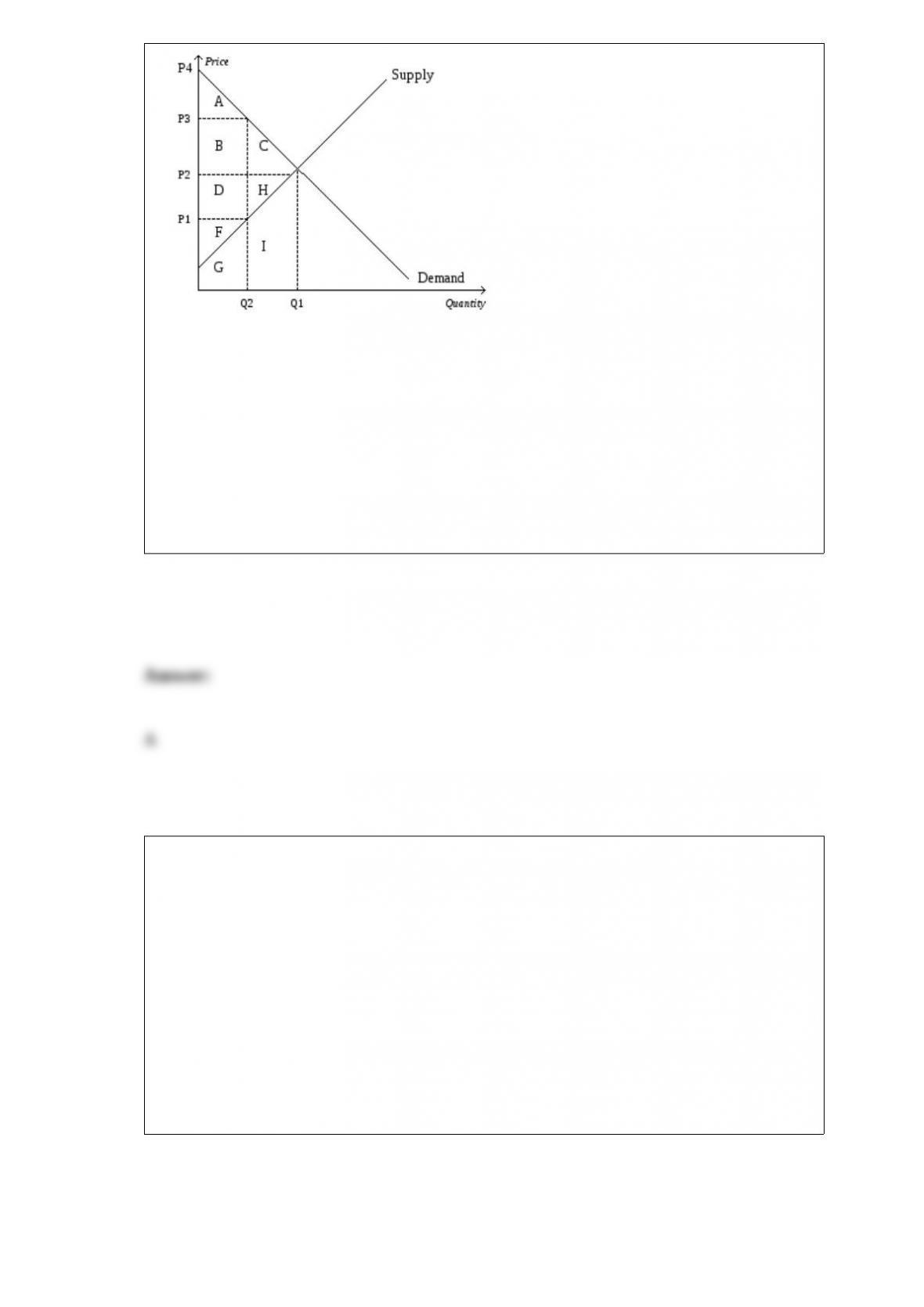
Refer to Figure 8-5. After the tax is levied, consumer surplus is represented by area
a. A.
b. A+B+C.
c. D+H+F.
d. F.
During a presidential campaign, the incumbent argues that he should be reelected
because nominal GDP grew by 12 percent during his 4-year term in office. You know
that population grew by 4 percent over the period and that the GDP deflator increased
by 6 percent during the past 4 years. You should conclude that real GDP per person
a. grew by more than 12 percent.
b. grew, but by less than 12 percent.
c. was unchanged.
d. decreased.
The price received by sellers in a market will decrease if the government
a. imposes a binding price floor in that market.
b. decreases a binding price ceiling in that market.
c. decreases a tax on the good sold in that market.
d. increases a binding price floor in that market.
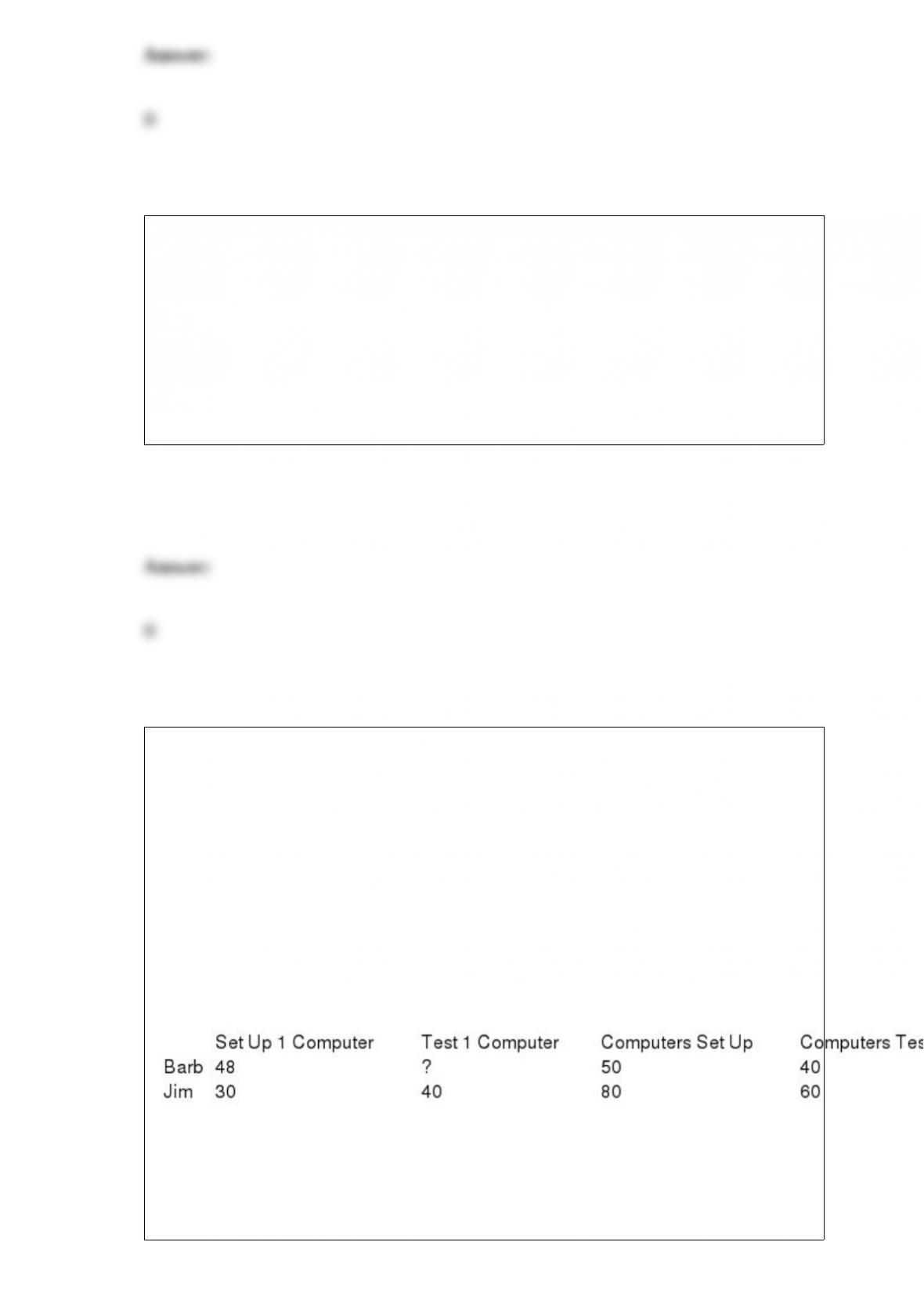
Table 3-9
Barb and Jim run a business that sets up and tests computers. Assume that Barb and Jim
can switch between setting up and testing computers at a constant rate. The following
table applies.
Minutes Needed to Number of Computers
Set Up or Tested in a
40-Hour Week
Refer to Table 3-9. Barb’s opportunity cost of setting up one computer is testing
a. 4/5 computer and Jim’s opportunity cost of setting up one computer is testing 3/4
computer.
b. 4/5 computer and Jim’s opportunity cost of setting up one computer is testing 4/3
computers.
c. 5/4 computers and Jim’s opportunity cost of setting up one computer is testing 3/4
computer.
d. 5/4 computers and Jim’s opportunity cost of setting up one computer is testing 4/3
computers.
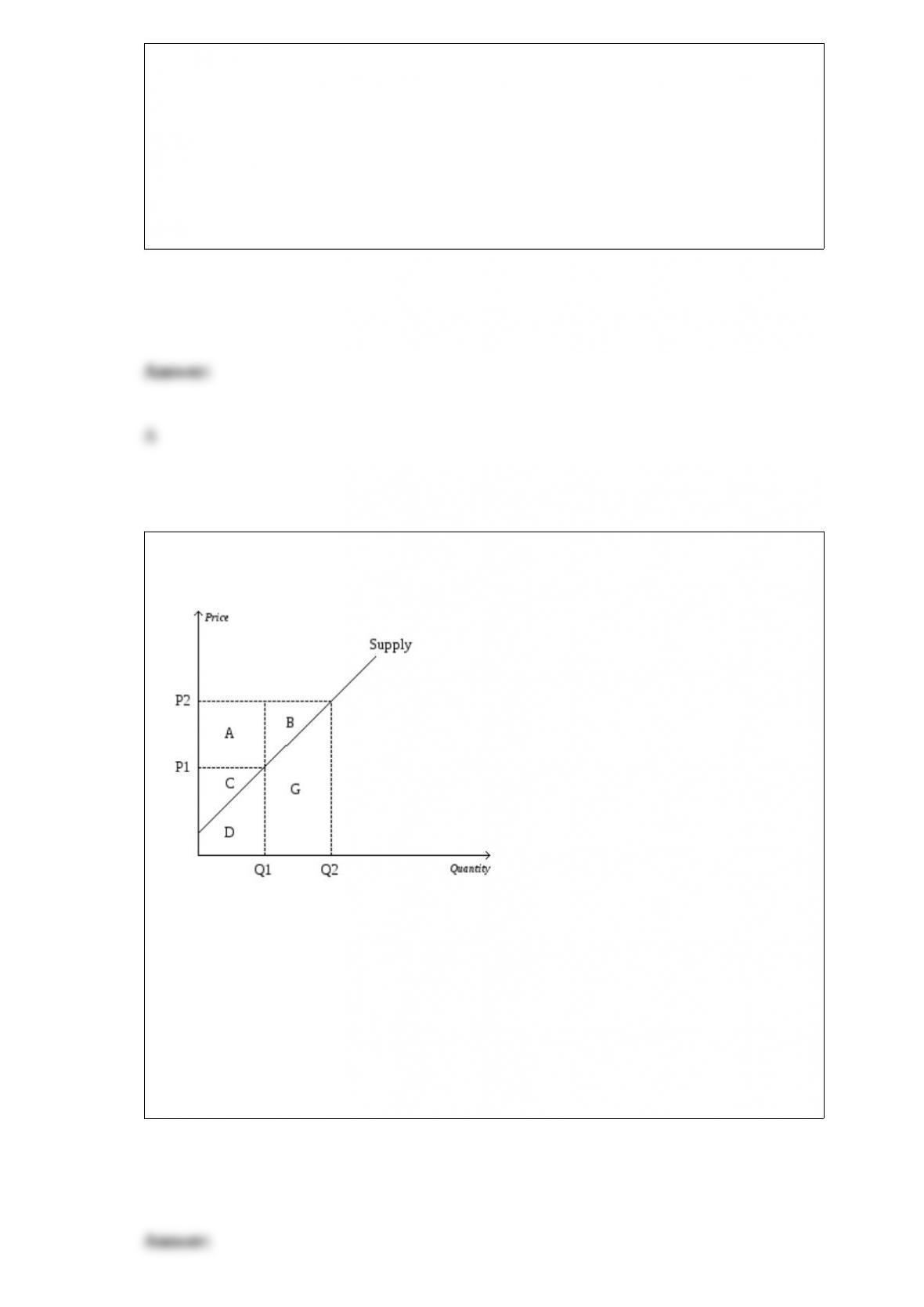
Figure 7-12
Refer to Figure 7-12. When the price is P2, producer surplus is
a. A.
b. A+C.
c. A+B+C.
d. D+G.