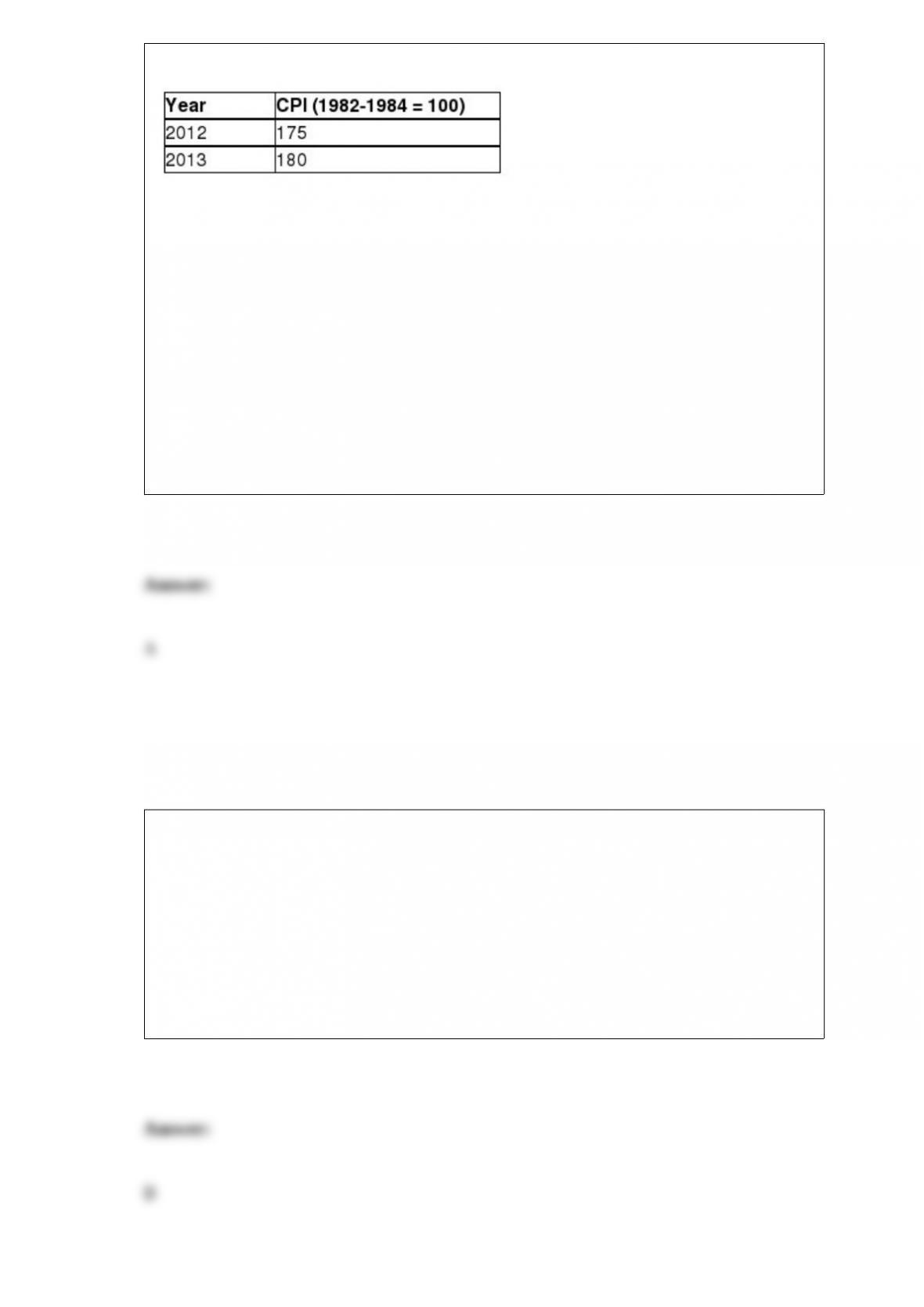
Table 20-7
Suppose that the data in the table above reflect price levels in the economy. What is the
inflation rate between 2012 and 2013?
A) 2.9%
B) 3.5%
C) 4.6%
D) 5%
E) 7.5%
The minimum wage is an example of
A) a subsidy for low-skilled workers.
B) a price floor.
C) a price ceiling.
D) a black market.
Using the quantity equation, if the velocity of money grows at 5 percent, the money
supply grows at 10 percent, and real GDP grows at 4 percent, then the inflation rate will
be
A) 19 percent.
B) 15 percent.
C) 11 percent.
D) 6 percent.
The size of a deadweight loss in a market is reduced by
A) government legislating a ceiling price.
B) government legislating a price floor.
C) market price being close to marginal cost.
D) creative destruction.
Typically, the lower the level of income per person in a country, the lower the level of
spending per person on health care. This relationship between income and spending
indicates that health care is a
A) normal good.
B) inferior good.
C) luxury.
D) necessity.
The balance of trade is defined as
A) the difference between the balance of the current account and the balance of the
capital account.
B) the difference between the value of the goods and services a country exports and the
value of the goods and services a country imports.
C) the difference between the value of the goods a country exports and the value of the
goods a country imports.
D) the difference between the balance of the current account and the balance of the
financial account.
Figure 13-8
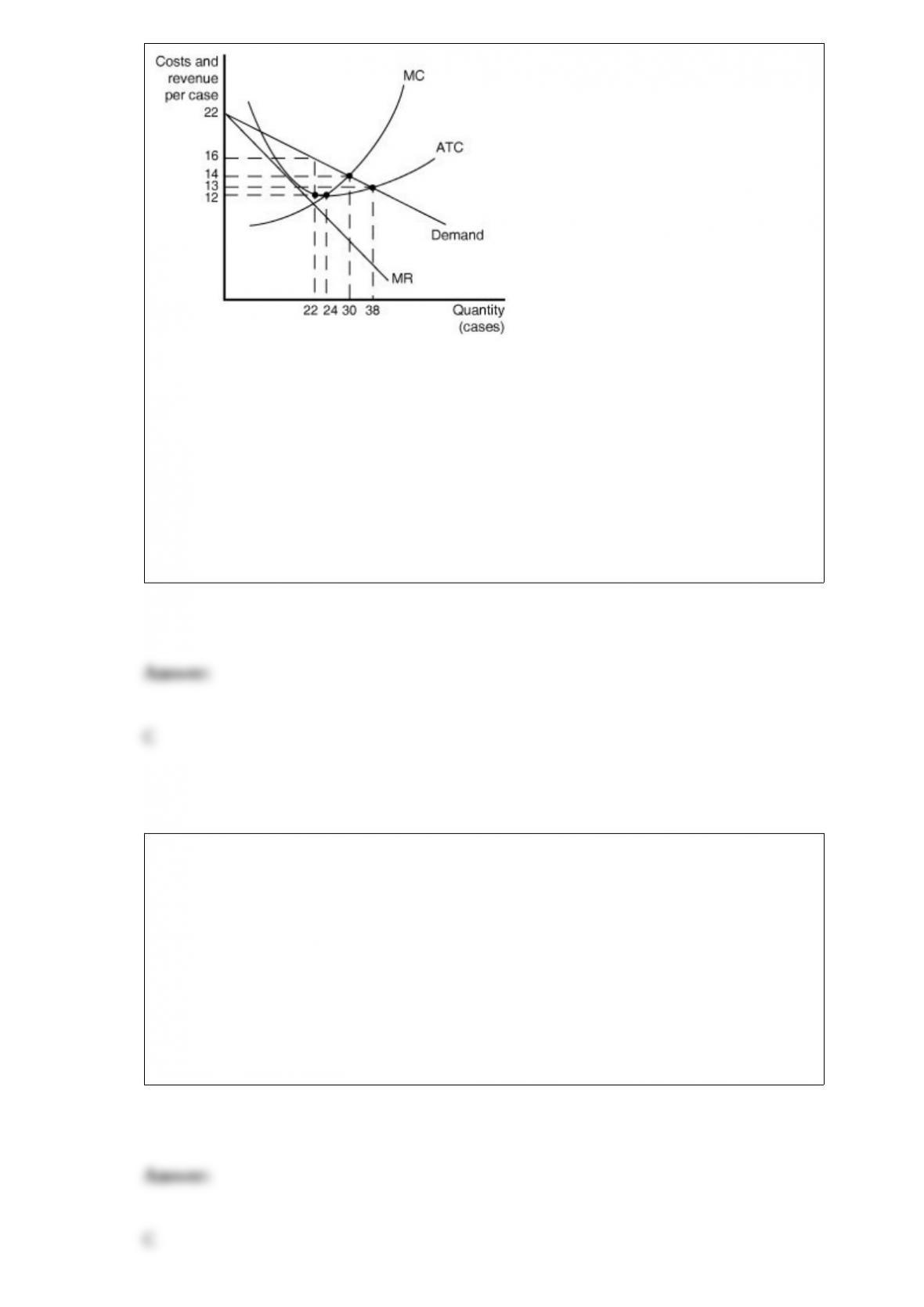
Figure 13-8 shows cost and demand
curves for a monopolistically competitive producer of iced tea. At the
profit-maximizing output level the firm will
A) earn a profit of $176.
B) break even.
C) earn a profit of $88.
D) earn a profit of $60.
Emma is a road construction worker. During the winter months, Emma finds it more
difficult to get work. The unemployment Emma experiences in the winter is
A) structural.
B) cyclical.
C) seasonal.
D) functional.
Arbitrage
A) is the act of buying an item at a low price and reselling the item at a higher price.
B) is the act of selling an item on consignment and collecting a huge portion of the
proceeds to compensate for the seller’s time.
C) is the act of buying an item at a low price, bundling it with another and selling the
new package at a much higher price.
D) is any act of buying and selling that results in the seller earning an above normal
profit.
Money is
A) an asset that people are willing to accept in exchange for goods and services.
B) a liability that people are willing to accept in exchange for goods and services.
C) the income one earns over a period of time.
D) one’s assets net of one’s liabilities at any point in time.
If, when a firm doubles all its inputs, its average cost of production increases, then
production displays
A) diminishing returns.

B) economies of scale.
C) diseconomies of scale.
D) declining fixed costs.