
1) export subsidies are:
a.maximum limits on the quantity or total value of specific products imported to a
nation.
b.excise taxes or duties placed on imported products.
c.licensing requirements, unreasonable quality standards, and the like designed to
impede imports.
d.government payments to domestic producers to enable them to charge lower prices
and sell more goods in world markets.
2) if we say that two variables are inversely related, this means that:
a.the two graph as an upsloping line.
b.an increase in one variable is associated with a decrease in the other.
c.an increase in one variable is associated with an increase in the other.
d.the resulting relationship can be portrayed by a straight line parallel to the horizontal
axis.
3) When the receipts given by goldsmiths to depositors were used to make purchases:
A.the gold standard was created.
B.existing banking laws were violated.
C.the receipts became in effect paper money.
D.a fractional reserve banking system was created.
4) In the 1990s and early 2000s, Japan’s central bank reduced real interest rates to zero
percent, but investment spending did not respond enough to bring the economy out of
recession. Japan’s experience is an illustration of:
A.the crowding-out effect.
B.”pulling on a string.”
C.the Taylor rule.
D.cyclical asymmetry.
5) which of these groups of nations are all members of the euro zone?
a.great britain, france, and switzerland
b.france, germany, and italy

c.denmark, sweden, and norway
d.russia, poland, and hungary
6) The marginal revenue product (MRP) of land declines as more land is brought into
production because:
A.land is a “free and nonreproducible gift of nature.”
B.of diminishing returns.
C.land rent has no incentive function.
D.the supply of land is fixed.
7) Some economists advocate taxes on land because such taxes:
A.do not affect the supply of land.
B.increase the supply of land.
C.improve the allocation of land by shifting it from low-productivity to
high-productivity uses.
D.have a positive incentive function.
8) “International trade” refers to:
A.purchasing or selling currently produced goods or services across an international
border.
B.any transaction across an international border.
C.any financial transaction across an international border.
D.buyer or selling of preexisting assets across an international border.
9) Technological advance improves productive efficiency by:
A.lowering average total cost.
B.increasing marginal utility.
C.enhancing monopoly power.
D.decreasing a nation’s exports.
10) The Federal Reserve Banks buy government securities from commercial banks. As
a result, the checkable deposits:
A.of commercial banks are unchanged, but their reserves increase.
B.and reserves of commercial banks both decrease.
C.of commercial banks are unchanged, but their reserves decrease.
D.and reserves of commercial banks are both unchanged.
11) New classical economists:
A.stress the importance of federal budget deficits in stimulating aggregate demand.
B.hold that, left alone, the economy gravitates to its full employment level of output.
C.emphasize tax cuts as means of increasing aggregate supply.
D.advocate active use of monetary policy to stabilize the economy.
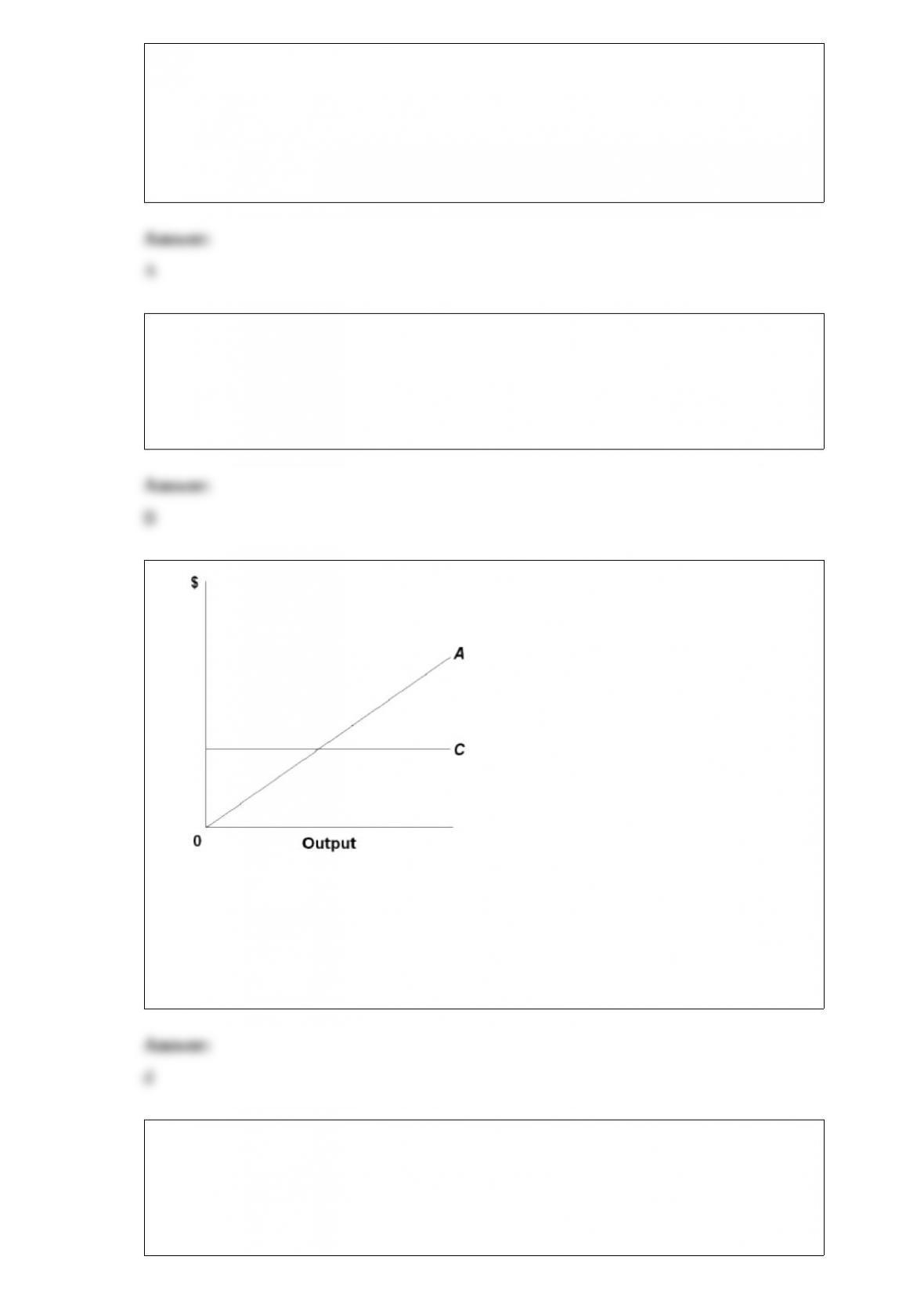
12)
refer to the above diagram, which pertains to a purely competitive firm. curve c
represents:
a.total revenue and marginal revenue.
b.marginal revenue only.
c.total revenue and average revenue.
d.average revenue and marginal revenue.
13) average fixed costs can be determined graphically by:
a.summing the marginal costs of any number of units of output and dividing the sum by
that output.
b.the vertical distance between tc and tvc.
c.the vertical distance between avc and mc.
d.the vertical distance between atc and avc.
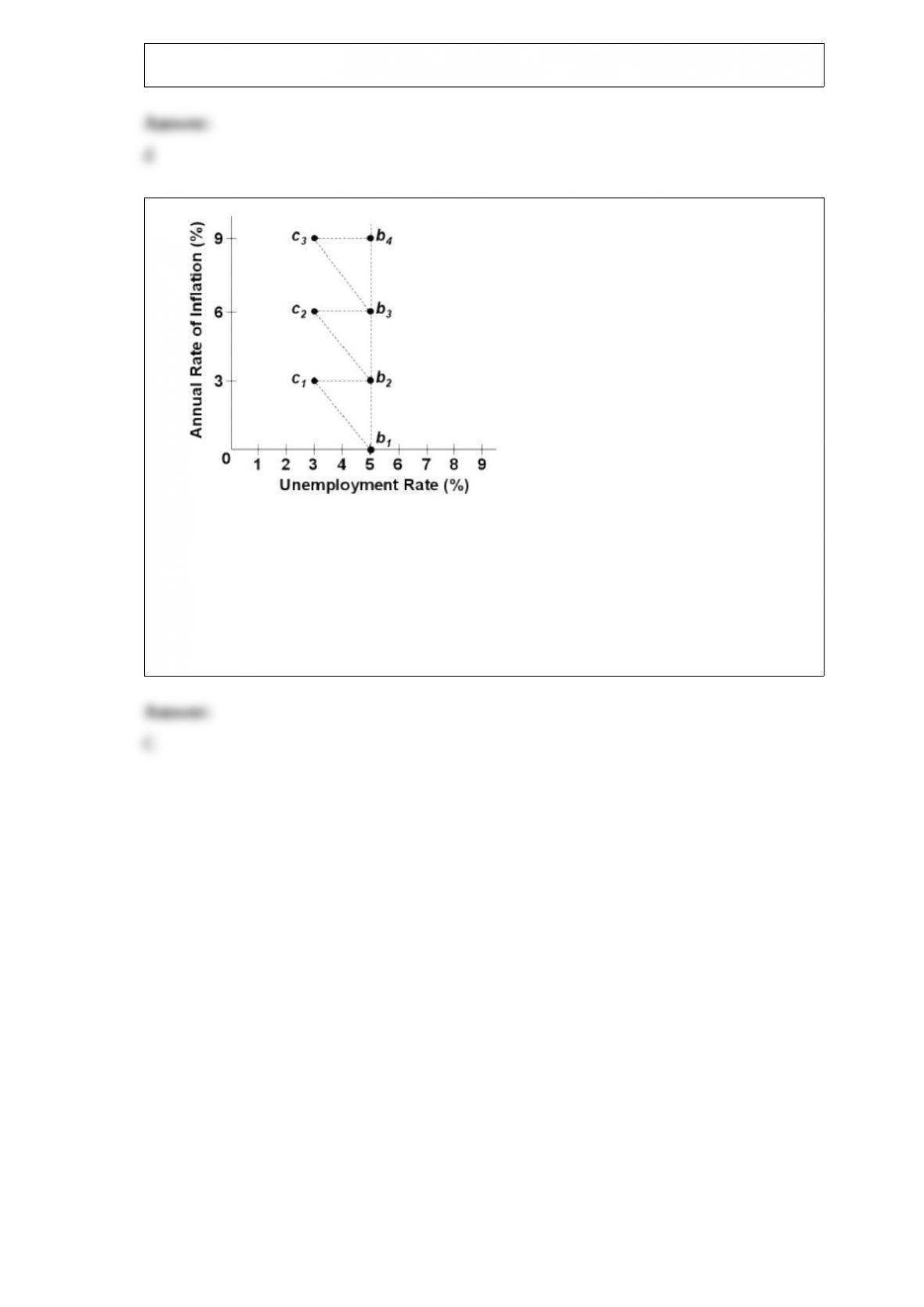
14)
Refer to the above diagram. Assume the economy is initially at point b1. With a time
lag between price and nominal wage adjustments, an increase in aggregate demand will
temporarily move the economy from:
A.b2 to b1.
B.c1 to b2.
C.b1 to c1.
D.b1 to b2.