
1) When investment remains the same at each level of GDP in a private closed
economy, the slope of the aggregate expenditures schedule:
A.exceeds the MPC.
B.is less than the MPC.
C.equals the MPS.
D.equals the MPC.
2) Studies show that:
A.it is impossible to estimate the benefits of trade barriers.
B.costs and benefits of trade barriers are about equal.
C.benefits of trade barriers exceed their costs in developing nations.
D.costs of trade barriers exceed their benefits, creating an efficiency loss for society.
3) Countries engaged in international trade specialize in production based on:
A.relative levels of GDP.
B.comparative advantage.
C.relative exchange rates.
D.relative inflation rates.
4) the medicare prescription drug, improvement, and modernization act of 2003:
a.created both a prescription drug benefit for medicare enrollees and health savings
accounts (hsas).
b.authorized the purchase of lower cost prescription medicine from canada and europe.
c.established limits on malpractice awards for “pain and suffering” cases relating to the
elderly.
d.provides prescription drugs to those over the age of 65 at no direct cost to the patient.
5) trade flows measure the:
a.movement of resources between nations.
b.exports and imports of goods and services.
c.transfer of information from one nation to another.
d.transfer of money between nations.
6) The amount of money reported as M2:
A.is smaller than the amount reported as M1.
B.is larger than the amount reported as M1.
C.excludes coins and currency.
D.includes large ($100,000 or more) certificates of deposit.
7) suppose the supply of product x is perfectly inelastic. if there is an increase in the
demand for this product, equilibrium price:
a.will decrease but equilibrium quantity will increase.
b.and quantity will both decrease.
c.will increase but equilibrium quantity will decline.
d.will increase but equilibrium quantity will be unchanged.
8) According to real business cycle theory:
A.monetary factors affecting aggregate demand cause macroeconomic instability.
B.recessions result from declines in long-run aggregate supply, rather than decreases in
aggregate demand.
C.when real wages fall during recessions, “real” unemployment rates rise.
D.the net long-run costs of business fluctuations are severe.
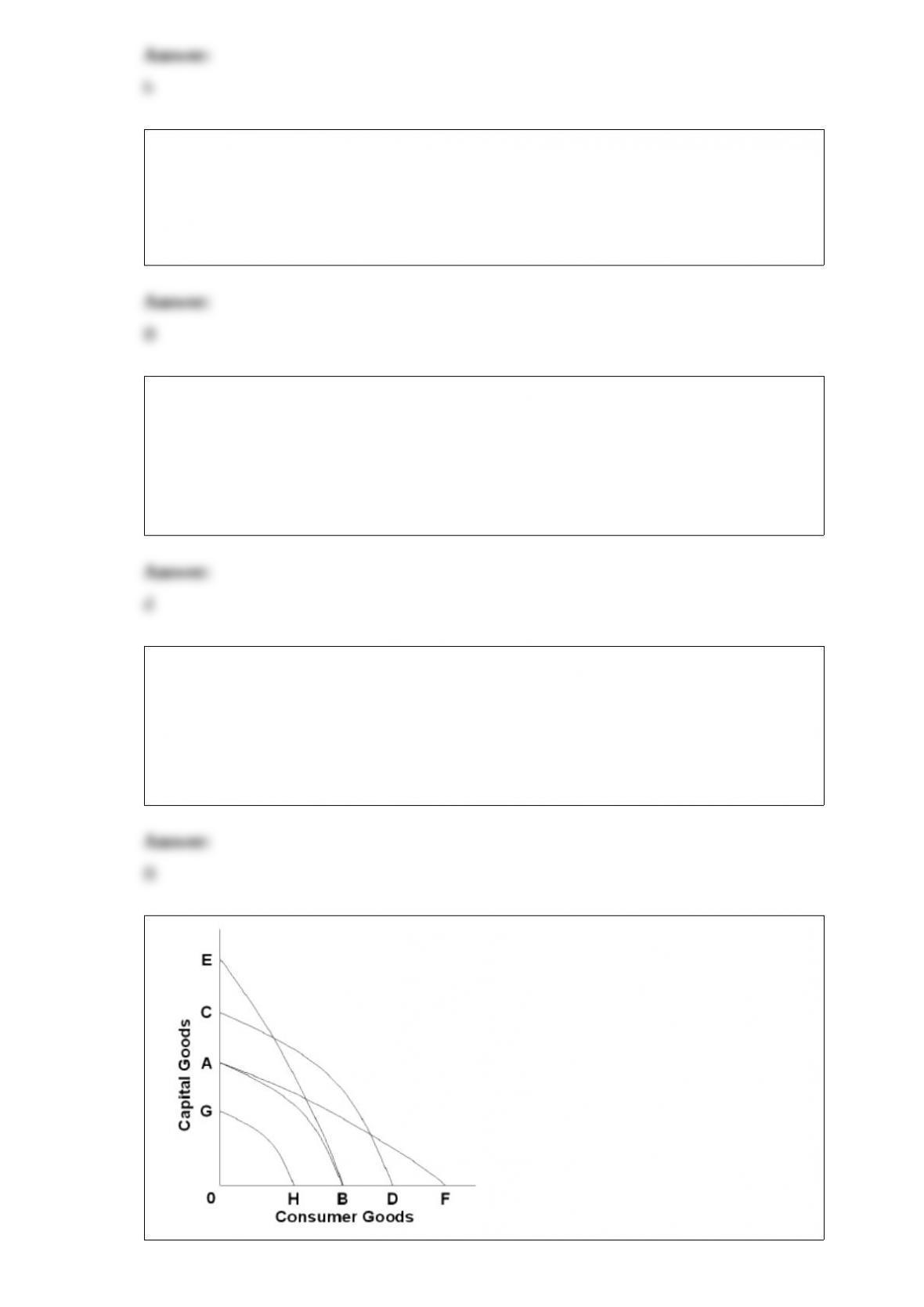
9)

refer to the above diagram. which one of the following would shift the production
possibilities curve from pp1 to pp2?
a.worsening of the aids epidemic
b.immigration of skilled workers into the economy
c.an increase in consumer prices
d.a reduction in hourly wages
10) if a market is competitive but externalities are present, the resulting equilibrium
output:
a.will also be the most efficient output.
b.will always be less than the most efficient output.
c.will always be greater than the most efficient output.
d.may be either larger or smaller than the most efficient output.