
In 2004, hurricanes destroyed a large portion of Florida’s orange and grapefruit crops.
In the market for citrus fruit,
A) the supply curve shifted to the right resulting in an increase in the equilibrium price.
B) the supply curve shifted to the left resulting in an increase in the equilibrium price.
C) the demand curve shifted to the right resulting in an increase in the equilibrium
price.
D) the demand curve shifted to the left resulting in a decrease in the equilibrium price.
The application of economic analysis to human resources issues is called
A) resource economics.
B) personnel economics.
C) human economics.
D) labor economics.
Which of the following statements is false?
A) An explicit cost is a nonmonetary opportunity cost.
B) In the short run: total cost = fixed cost + variable cost.
C) Variable costs are costs that change as output changes.

D) In the long run there are no fixed costs.
If policy makers are concerned that the economy is in danger of rising inflation because
aggregate demand is increasing faster than aggregate supply, the appropriate fiscal
policy response is to
A) increase taxes.
B) increase government spending.
C) use expansionary fiscal policy.
D) increase interest rates.
Assume that a comparable worth law is passed that determines that kindergarten
teachers and bricklayers have comparable jobs; therefore, workers in both of these
occupations should be paid the same wages. Assume that prior to the law, bricklayers
were paid a higher wage than kindergarten teachers. Which of the following is the most
likely result of the comparable worth law?
A) The equilibrium wage will be the same for kindergarten teachers and bricklayers.
B) Some former bricklayers will become kindergarten teachers and some former
kindergarten teachers will become bricklayers.
C) There will be a shortage in the market for bricklayers and a surplus in the market for
kindergarten teachers.

D) There will be surplus in the market for bricklayers and a shortage in the market for
kindergarten teachers.
The percent increase in the CPI from one year to the next is a measure of the
A) GDP deflator.
B) unemployment rate.
C) real interest rate.
D) inflation rate.
Between 1970 and 2006, the poverty rate in East Asia declined dramatically from about
60 percent to less than 2 percent, while the poverty rate in Sub-Saharan Africa
decreased from 40 percent to only 32 percent. The main reason for this is that
A) the population growth rate decreased in East Asia and increased in Sub-Saharan
Africa.
B) Governments in East Asia increased transfer payments to poor families over this
period of time. The governments of Sub-Saharan Africa had practically no transfer
payment programs from 1970 to 2006.
C) The countries of East Asia have progressive income tax systems. The countries of
Sub-Saharan Africa all have regressive income tax systems.
D) East Asia experienced higher economic growth than Sub-Saharan Africa.

If the price of garlic is represented by equation P = 25 – QD, then the corresponding
quantity of garlic demanded is represented by the equation
A) QD = P – 25.
B) QD = P + 25.
C) QD = 25 – P.
D) QD = -25 + P.
Which of the following will increase investment spending in the economy, holding
everything else constant?
A) an increase in the federal government surplus
B) an increase in the budget deficit
C) an increase in consumer dissavings
D) an increase in transfer payments
Wage differences among workers of different races and gender could be due to all of the
following except
A) differences in preferences for jobs.
B) differences in work experience.
C) differences in education.
D) labor unions.
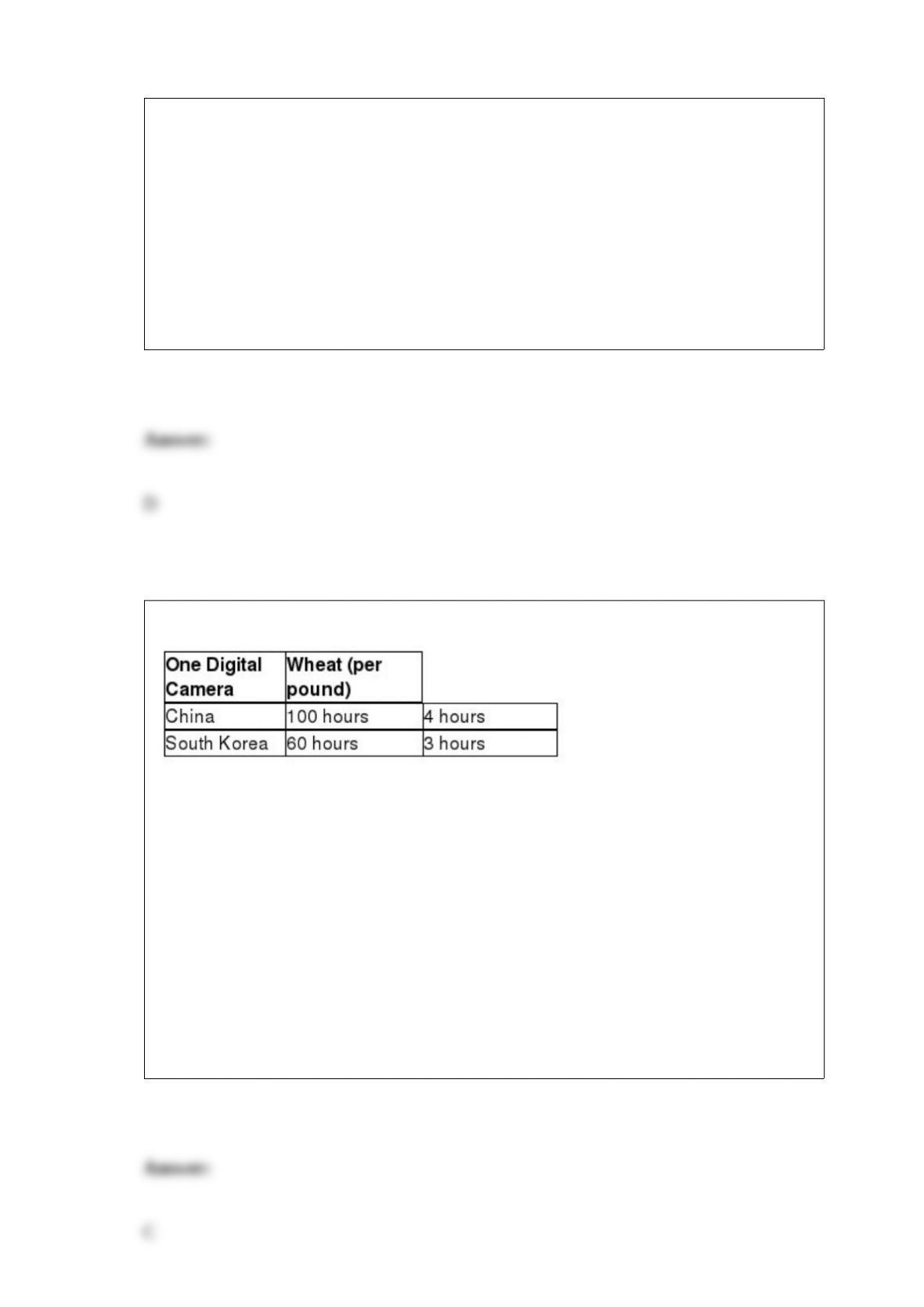
Table 2-11
Table 2-11 shows the number of labor hours required to produce a digital camera and a
pound of wheat in China and South Korea.
Does either China or South Korea have an absolute advantage and if so, in what
product?
A) South Korea has an absolute advantage in wheat.
B) China has an absolute advantage in wheat.
C) South Korea has an absolute advantage in both products.
D) China has an absolute advantage in digital cameras.