
1) The market system does not produce public goods because:
A.there is no need or demand for such goods.
B.private firms cannot stop consumers who are unwilling to pay for such goods from
benefiting from them.
C.public enterprises can produce such goods at lower cost than can private enterprises.
D.their production seriously distorts the distribution of income.
2) (Last Word) The U.S. sugar program has:
A.improved the world allocation of agricultural resources.
B.caused the world price of sugar to rise above its domestic price.
C.increased domestic sugar production.
D.lowered the incomes of U.S. sugar growers.
3) The Overnight Construction Company has just signed a collective bargaining
contract in which it agrees that all workers it hires must be union members in good
standing at the time they are hired. This provision reflects:
A.preferential hiring.
B.a maintenance-of-membership shop.
C.a union shop.
D.a closed shop.
4)
refer to the above data. the average total cost of producing 3 units of output is:
a.$14.
b.$12.
c.$13.50.
d.$16.

5) Melanie and Oli are competing Pacific Halibut fishers. Both have been allocated
ITQs that limit their catch to 1,000 tons of Pacific Halibut each. Melanie’s cost per ton
is $20; Oli’s cost per ton is $28.
Refer to the information above. If the market price of Pacific Halibut is $40 per ton, and
Melanie and Oli both catch their quota, their combined profit will be:
A.$12,000.
B.$22,000.
C.$25,000.
D.$32,000
6) the price elasticity of demand for widgets is 0.80. assuming no change in the demand
curve for widgets, a 16 percent increase in sales implies a:
a.1 percent reduction in price.
b.12 percent reduction in price.
c.40 percent reduction in price.
d.20 percent reduction in price.
7) Critics of supply-side economics:
A.argue that a tax cut will increase aggregate supply by more than it increases
aggregate demand.
B.contend that the relationship between tax rates and economic incentives is small and
of uncertain direction.
C.believe that a decline in tax rates will increase tax revenues.
D.point out that tax cuts enable households to “buy more leisure” by working less.
8) The demand for farmland will increase if:
A.the demand for food decreases.
B.technological advances make land more productive.
C.the price of farm labor increases and the output effect exceeds the substitution effect.
D.the supply of farmland increases.
9) the european union (eu) comprises a group of european nations that have:
a.abolished tariffs among one another and established a system of common tariffs with
respect to nonmember nations.
b.fully integrated their economies by establishing a central bank, a common currency,
and a coordinated set of governmental budgetary policies.
c.agreed to trade only among one another.
d.eliminated all tariffs and trade barriers with nonmember nations.
10) in the resource market:
a.businesses borrow financial capital from households.
b.businesses sell services to households.
c.households sell resources to businesses.
d.firms sell raw materials to households.
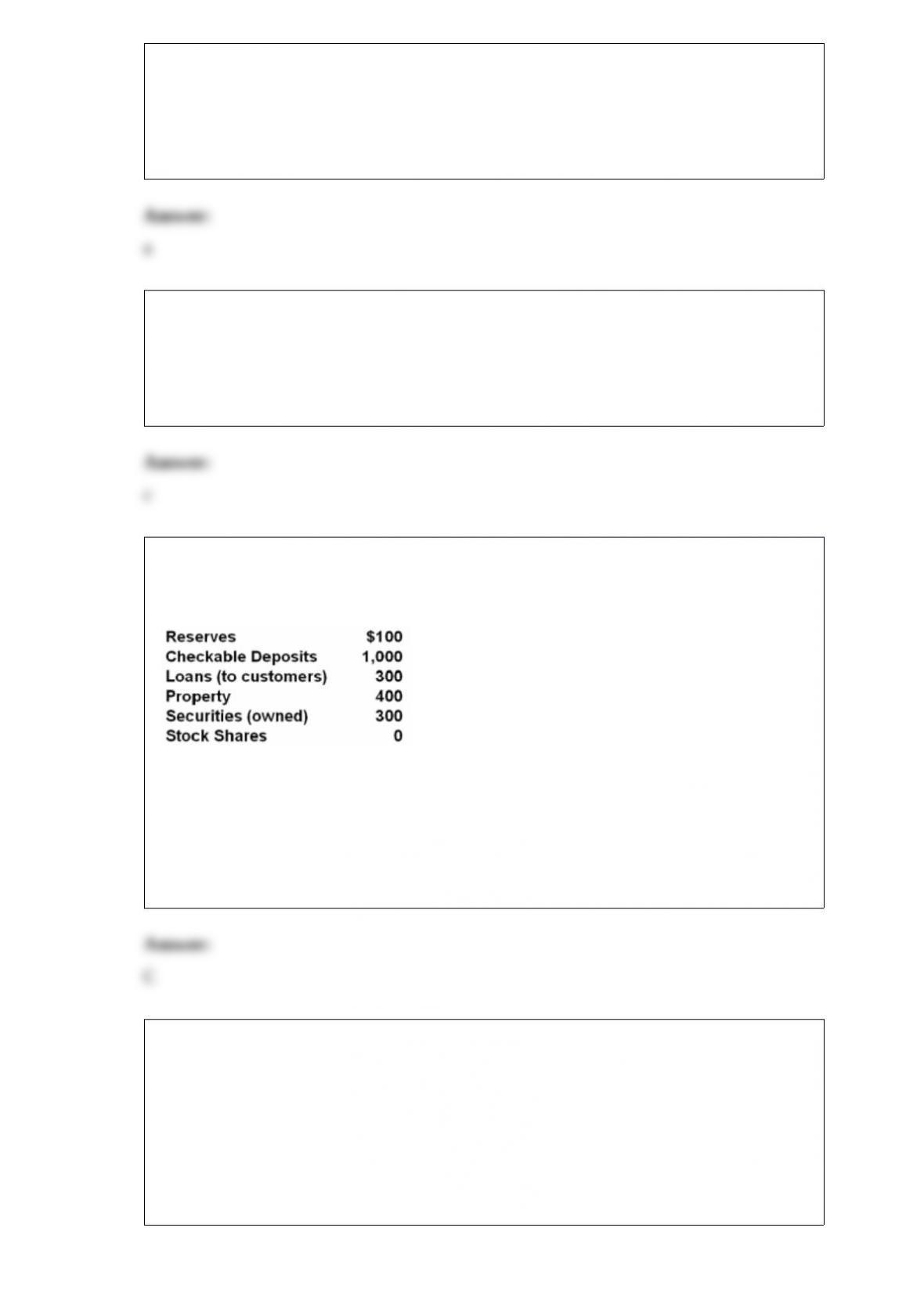
11) The following information for the Moolah Bank.
Refer to the above information. If Moolah Bank is legally “loaned up,” the banking
system’s monetary multiplier must be:
A.5.
B.8.
C.10.
D.20.
12) In the tables below are the demands for labor and the levels of domestic output that
can be produced at each level of employment in two countries.
(a)What would the wage rates be if employment was 200 in country X and 140 in
country Y?
(b)What would total wages paid and business incomes be in each country given
employment conditions in (a)?
(c)If 20 workers migrate from country Y to country X, what will happen to wage rates,
output, business incomes, and total wages?
13) The commercial success of a new product depends on:
A.its price only.
B.its marginal utility only.
C.both its price and its marginal utility.
D.neither its price nor its marginal utility.
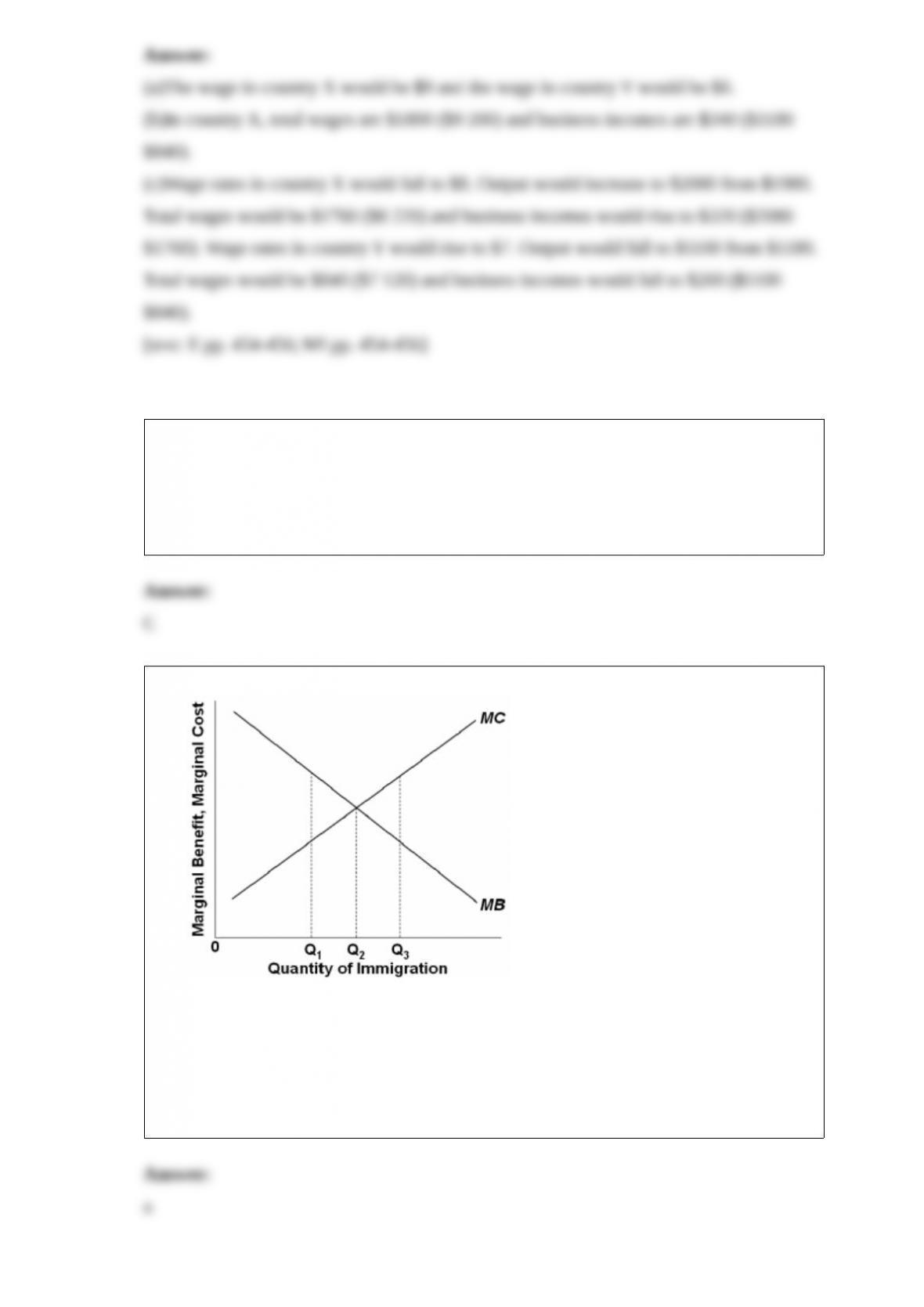
14)
refer to the above figure. a weaker economy, characterized by higher unemployment
rates, will:
a.reduce mb and increase mc, lowering the optimal quantity of immigrants.
b.increase mb and reduce mc, raising the optimal quantity of immigrants.
c.increase both mb and mc, and the effect on the optimal quantity is uncertain.
d.reduce both mb and mc, and the effect on the optimal quantity is uncertain.

15) which of the following constitute the types of unemployment occurring at the
natural rate of unemployment?
a.frictional and cyclical unemployment.
b.structural and frictional unemployment.
c.cyclical and structural unemployment.
d.frictional, structural, and cyclical unemployment.
16) studies show that the demand for gasoline is:
a.price inelastic in the short run, but elastic in the long run.
b.price inelastic in both the short and long run.
c.price elastic in the short run, but inelastic in the long run.
d.price elastic in both the short and long run.
17) which of the following best describes the invisible-hand concept?
a.the desires of resource suppliers and producers to further their own self-interest will
automatically further the public interest.
b.the nonsubstitutability of resources creates a conflict between private and public
interests and calls for government intervention.
c.the market system is the best system for overcoming the scarce resources-unlimited
wants problem.
d.central direction by the government will improve resource allocation in a capitalistic
economy.
18) which of the following is not one of the five fundamental questions?
a.what prices will be charged for goods and services?
b.who will get the goods and services?
c.what goods and services will be produced?
d.how will the system promote progress?