
Which of the following is most likely to affect the supply of labor in any particular
industry?
a. the size of the available working population
b. the nonmonetary attractiveness of the job
c. the amount of ability and training necessary to enter the job
d. all of the above
Under the Bretton Woods system, devaluation was:
a. normal
b. routine
c. rare
d. a last resort
Figure 5-13
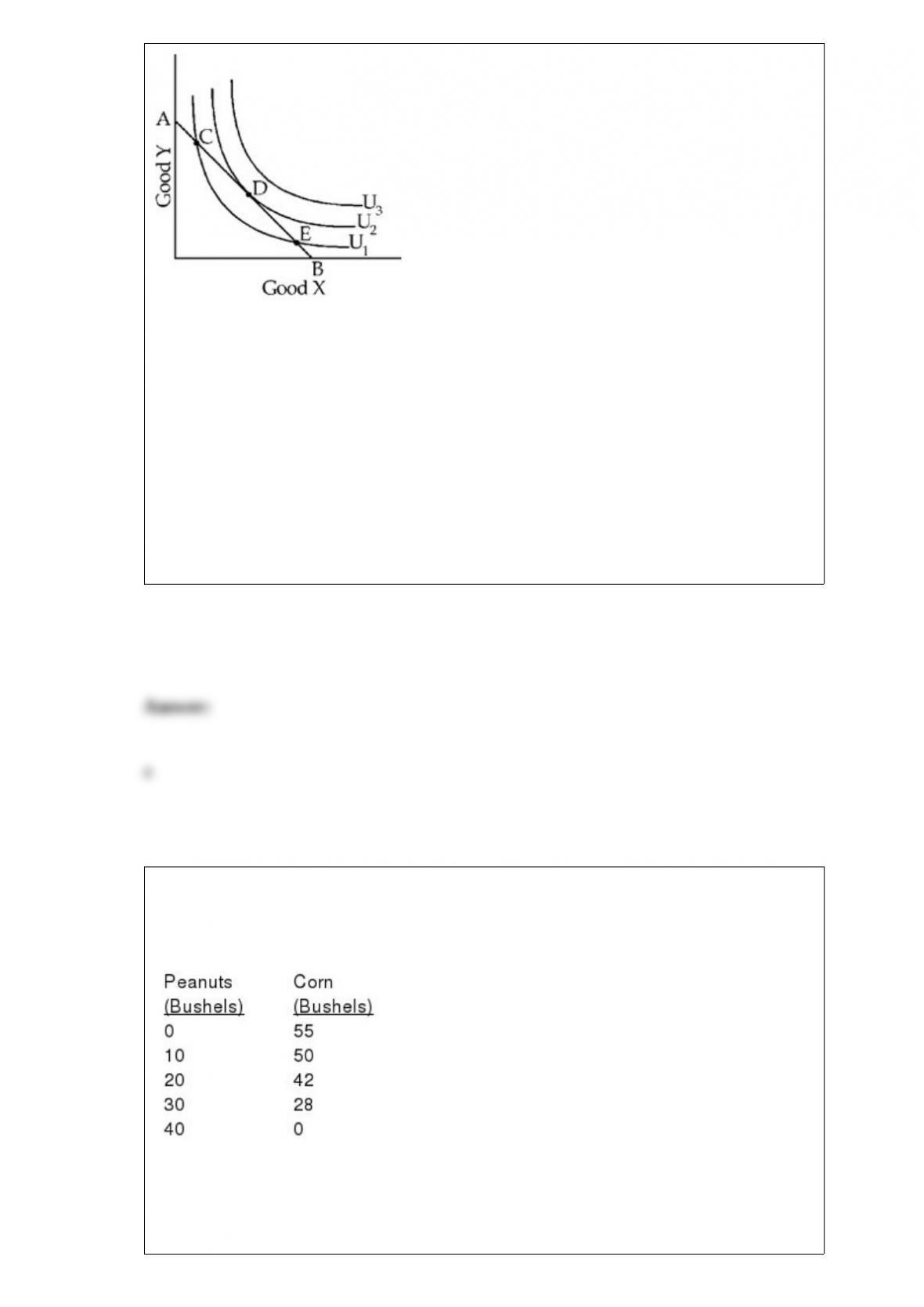
In Figure 5-13, the slope of the budget line (dropping all minus signs) equals
a. price of good X/price of good Y.
b. price of good Y/price of good X.
c. the minimum number of units of good Y the consumer would have to receive to make
him willing to give up one unit of good X.
d. the minimum number of units of good X the consumer would have to receive to
make him willing to give up one unit of good Y.
Table 3-1
Suppose a farmer produces 50 bushels of corn and 10 bushels of peanuts. According to
Table 3-1, the opportunity cost of 10 more bushels of peanuts is

a. 8 bushels of corn.
b. 42 bushels of corn.
c. 50 bushels of corn.
d. impossible to determine from the information given.
The quantity of goods exchanged in a market will be below the equilibrium quantity
a. when the price is either held above or below the equilibrium price.
b. only when the price is held above the equilibrium price.
c. only when the price is held below the equilibrium price.
d. only when the price is rising.
In order for a natural monopoly to develop, it
a. is important that the firm be very large.
b. is important that the firm prices its product below cost.
c. is not the absolute size of the firm but its size relative to the total market demand that
is important.

d. must be in the presence of government intervention.
Official data may overstate the extent of poverty because
a. poverty is a relative as opposed to an absolute concept.
b. it does not add “in-kind” transfers to the incomes of the poor.
c. it overstates the taxes paid by the poor.
d. it overestimates the amount the poor earn in the “underground economy.”
Aggregate demand is the total demand for
a. all intermediate and final goods.
b. all monetary investments.
c. real and financial investments.
d. all final goods and services.

Gross Domestic Product is calculated by adding together
a. the number of goods and services produced in the economy.
b. money value of final goods and services.
c. number of workers employed in national production.
d. all commodities but not services produced in the economy.
Many fear that cheap foreign labor will destroy American jobs; in reality, wages in
a. the United States have risen spectacularly in the last 33 years as trade grew.
b. countries that export to the United States are very low relative to the United States
and show no sign of rising.
c. countries that export to the United States have risen spectacularly in the last 33 years.
d. United States export industries are very low relative to wages in the same industry in
other countries.
e. All of the above are correct.

According to the excess capacity theorem, if every firm under monopolistic competition
expanded its output,
a. cost per unit of output would rise.
b. social benefits would increase.
c. cost per unit of output would decrease.
d. MC and AC would remain unchanged.
Unemployment and inflation are important determinants of short-run material welfare,
whereas productivity growth is an important determinant of long-run material
well-being.
a. True
b. False
A price cut will increase the revenue a firm receives if the demand for its product is
a. elastic.
b. inelastic.
c. of unit elasticity.
d. straight elastic.
A firm will tend to follow competitors when they increase spending on R&D, but will
not follow them when they decrease such spending.
a. True
b. False
Which of the following were not actions taken by the Federal Reserve in order to
stimulate the economy during the recession of 2007-2009?
a. decreasing the discount rate
b. suspending trading on the major stock exchanges
c. massive lending to banks
d. open market purchases of assets other than Treasury bills
Moral hazard
a. makes a free market in insurance hard to operate.
b. is the tendency of insurance to encourage the source of risk.
c. tends to make the cost of insurance higher and the market for insurance less efficient.
d. All of the above are correct.
Tariffs and quotas are effective in protecting industry
a. but at very high cost per job saved.
b. and at very low cost per job saved.
c. but have not saved any jobs in the industries.
d. and do not distort the economy in the process.
A successful cartel may end up charging the ____ price and obtaining ____ profits.
a. monopolistic competition; zero economic
b. oligopoly; monopoly
c. monopoly; zero economic
d. monopoly; monopoly
The law of diminishing marginal utility holds that at some point consumption of
additional units of a commodity adds less to total utility.
a. True
b. False
When the Fed wishes to decrease the money supply it can
a. ask people to buy more bonds.
b. turn additional funds over to the Treasury.
c. increase the required reserve ratio.
d. decrease the required reserve ratio.

The local symphony recently raised its price for tickets to their summer concerts in the
park. At the end of the summer season, the symphony was surprised to see that total
revenue had actually decreased. The reason was that the elasticity of demand for tickets
was
a. unit elastic.
b. inelastic.
c. elastic.
d. Not enough information is given.
A less advanced country can improve its productivity by:
a. repurposing
b. imitating
c. reusing
d. redeveloping
Union leaders who focus on increasing the size of their union will be aggressive in
demanding higher wages.
a. True
b. False
If polluters are forced to pay for their pollution, they will reduce pollution toward a
socially optimal amount.
a. True
b. False
In regulated industries, the optimal regulation is to set price such that MC=P.
a. True
b. False
Define the following terms and explain their importance to the study of economics.
a. maximin criterion
b. Nash equilibrium
c. Dominant Strategy
d. Zero-sum game
e. Credible threat
Opportunity cost is the
a. cost incurred when one fails to take advantage of an opportunity.
b. cost incurred in order to increase the availability of attractive opportunities.
c. cost of the best option forgone as a result of choosing an alternative.
d. drudgery of the undesirable aspects of an option.
Resources are used to create goods and services.
a. True
b. False
In a capitalist market economy, recessions and inflation can occur because of
coordination failures.
a. True
b. False
The interest rate is the
a. rate of investment.
b. price of credit.
c. rate of return on investment in capital goods.
d. expected rate of inflation.
If the prices of both goods increase by 10 percent, the budget line
a. shifts to the right in parallel fashion.
b. shifts to the left in parallel fashion.
c. is unaffected since only relative price changes matter.
d. pivots on the axis of the more expensive good.
A country’s level of well being is determined primarily by its level of
a. population growth.
b. educational attainment.
c. capital stock growth.
d. natural resource growth.
Aggregate supply grows over time because of growing consumer and government
spending.
a. True
b. False