1) Using antitrust law to split up an unregulated natural monopoly into several
competing firms:
A.would reduce product price.
B.would increase product price.
C.might either increase product price or reduce product price.
D.will reduce average total cost.
2) in determining real gdp, economists adjust the nominal gdp by using the:
a.national productivity index.
b.wholesale (producers’) price index.
c.gdp price index.
d.consumer price index.
3) the concept of price elasticity of demand measures:
a.the slope of the demand curve.
b.the number of buyers in a market.
c.the extent to which the demand curve shifts as the result of a price decline.
d.the sensitivity of consumer purchases to price changes.
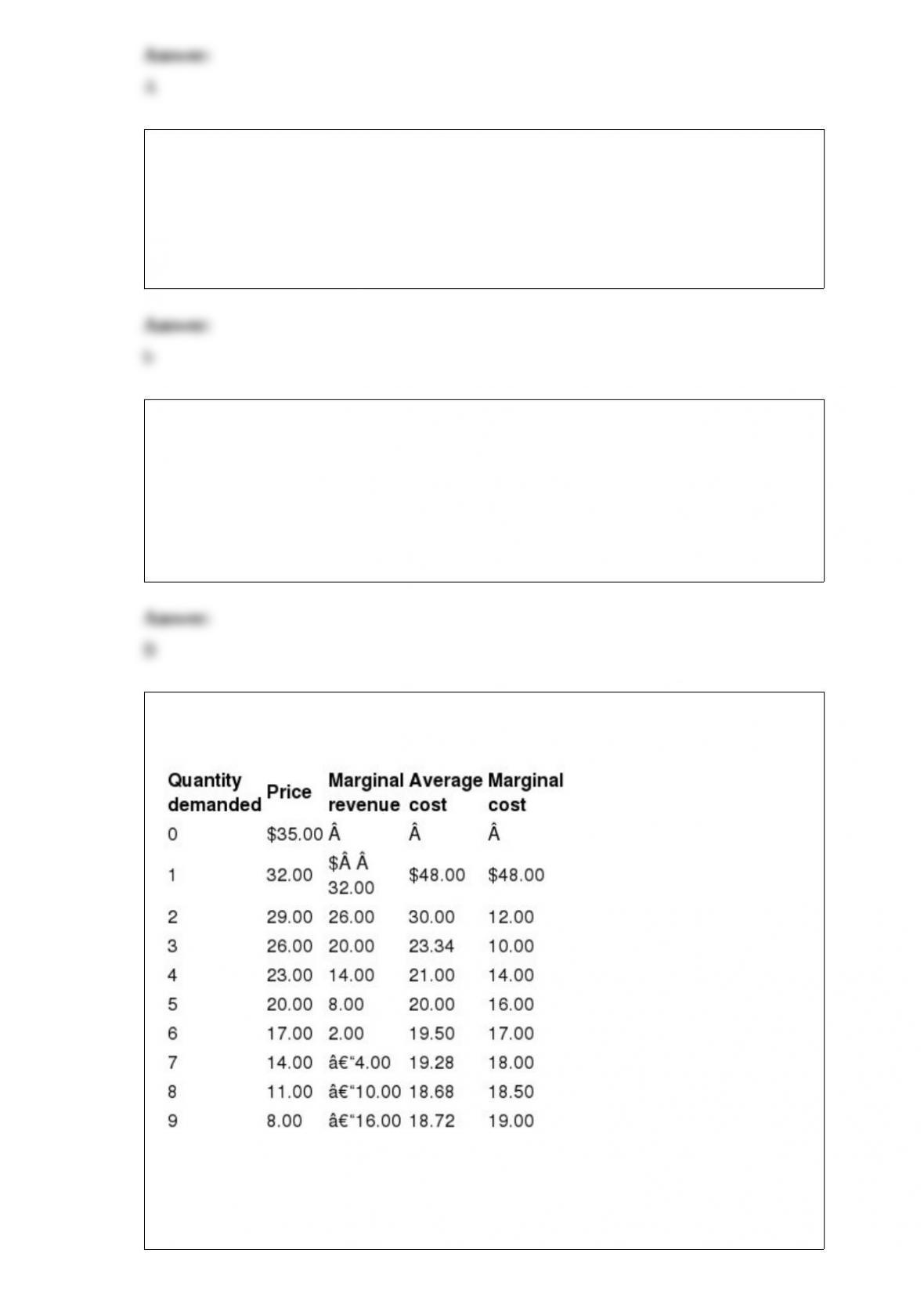
4)
Which two aggregate expenditure schedules AE in the above diagram for a private
closed economy have the same MPC, assuming investment is the same at each level of
income?
A.AE1 and AE2
B.AE2 and AE3
C.AE1 and AE4
D.AE3 and AE4
5) the agency responsible for compiling the national income product accounts for the
u.s. economy is the:
a.council of economic advisers
b.bureau of economic analysis
c.national bureau of economic research
d.bureau of labor statistics
6) The large trade deficit that the U.S. has with China persists in part because:
A.the U.S. economy has grown slowly in recent years.
B.China has fixed its exchange rate and not allowed the yuan to appreciate relative to
the U.S. dollar.
C.China has experienced rapid economic growth over the past decade.
D.China has recently imposed or increased tariffs on most goods imported from the
U.S.
7) In the table below are cost and demand data for a pure monopolist.
(a)What is the level of price, output, and amount of profit for an unregulated
monopolist?
(b)Using the data in the table, what are the price, output, and profit for a regulated
monopolist that sets price equal to marginal cost compared with an unregulated
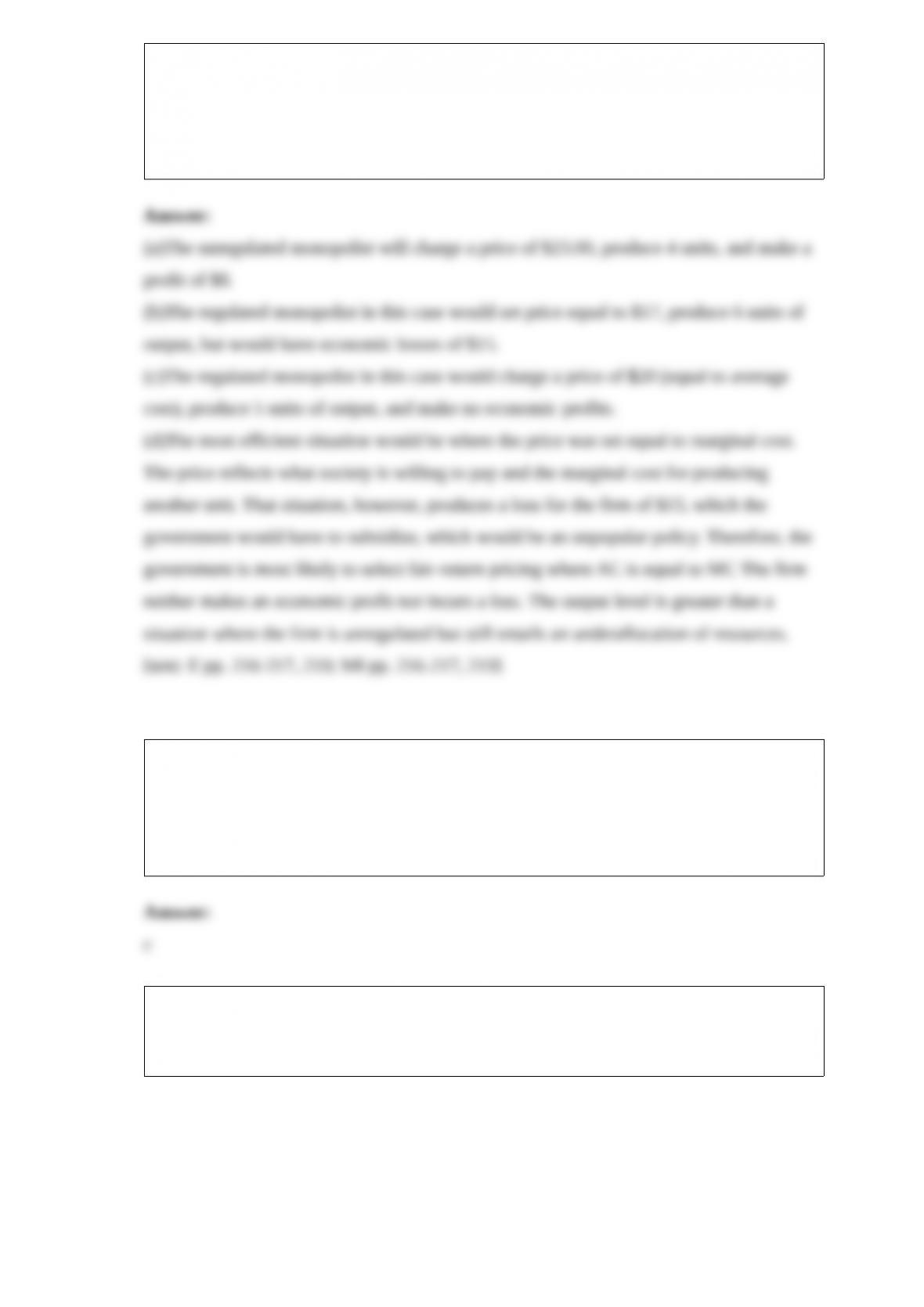
monopolist?
(c)Using the data in the table, what are the price, output, and profit for a regulated
monopolist that charges a fair-return price compared with an unregulated monopolist?
(d)Analyze the effect of regulation on the allocation of resources. Which situation is
most efficient? Which situation is most likely to be chosen by government? Why?
8) in the short run a purely competitive seller will shut down if product price:
a.equals average revenue.
b.is greater than mc.
c.is less than avc.
d.is less than atc.
9) the following output data for a firm. assume that the amounts of all non-labor
resources are fixed.
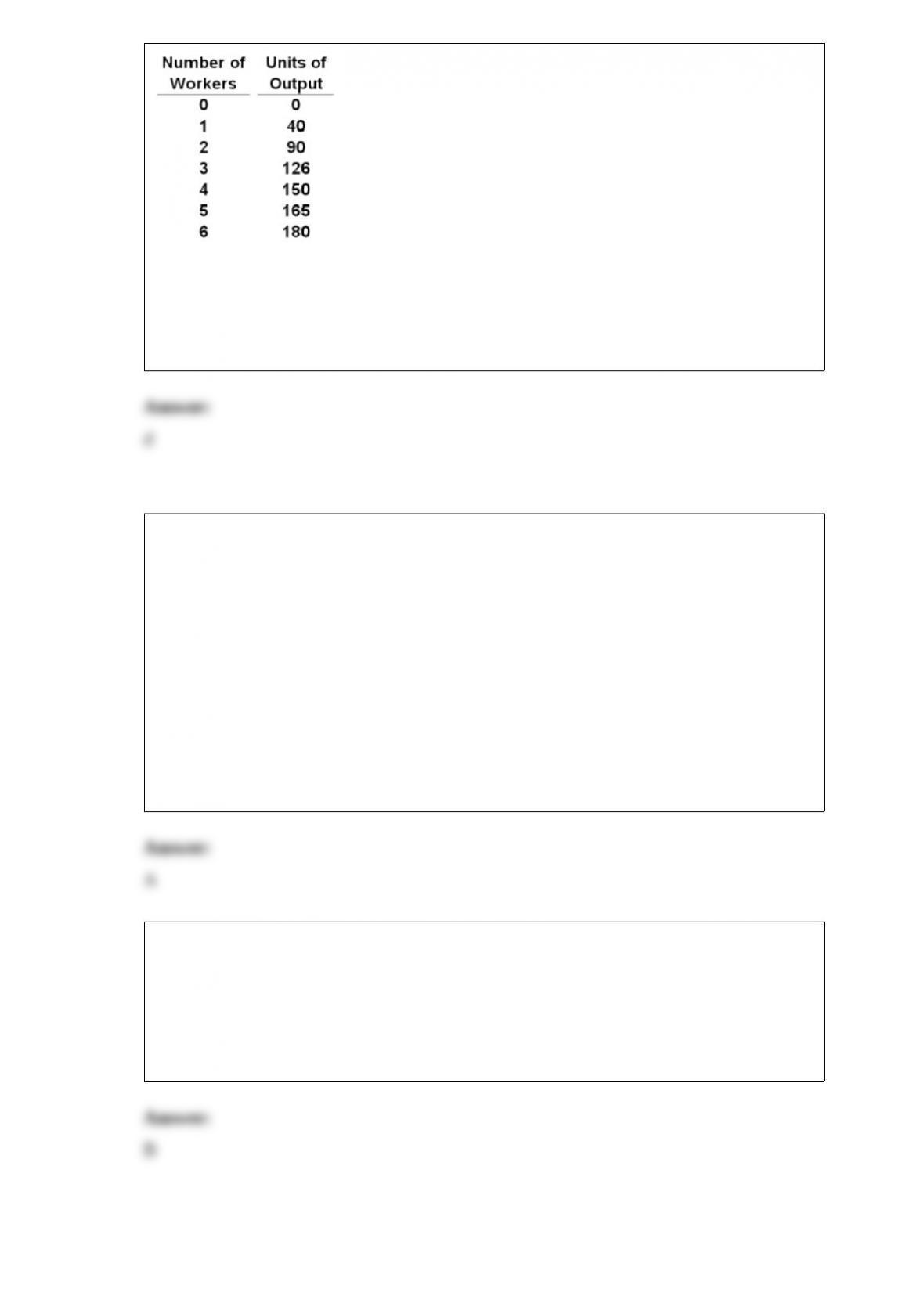
refer to the above data. average product is at a maximum when:
a.five workers are hired.
b.four workers are hired.
c.three workers are hired.
d.two workers are hired.
10) The following information for a hypothetical economy. All values are in nominal
terms.
M = $100
V = 2
Ca = $160
Xn = $10
G = $10
Refer to the above information. In equilibrium, Ig is:
A.$20.
B.$10.
C.$5.
D.$50.
11) Assume the price of capital falls relative to the price of labor and, as a result, the
demand for labor increases. Therefore:
A.capital is very highly substitutable for labor.
B.the output effect is greater than the substitution effect.
C.the income effect is greater than the output effect.
D.the substitution effect is greater than the output effect.
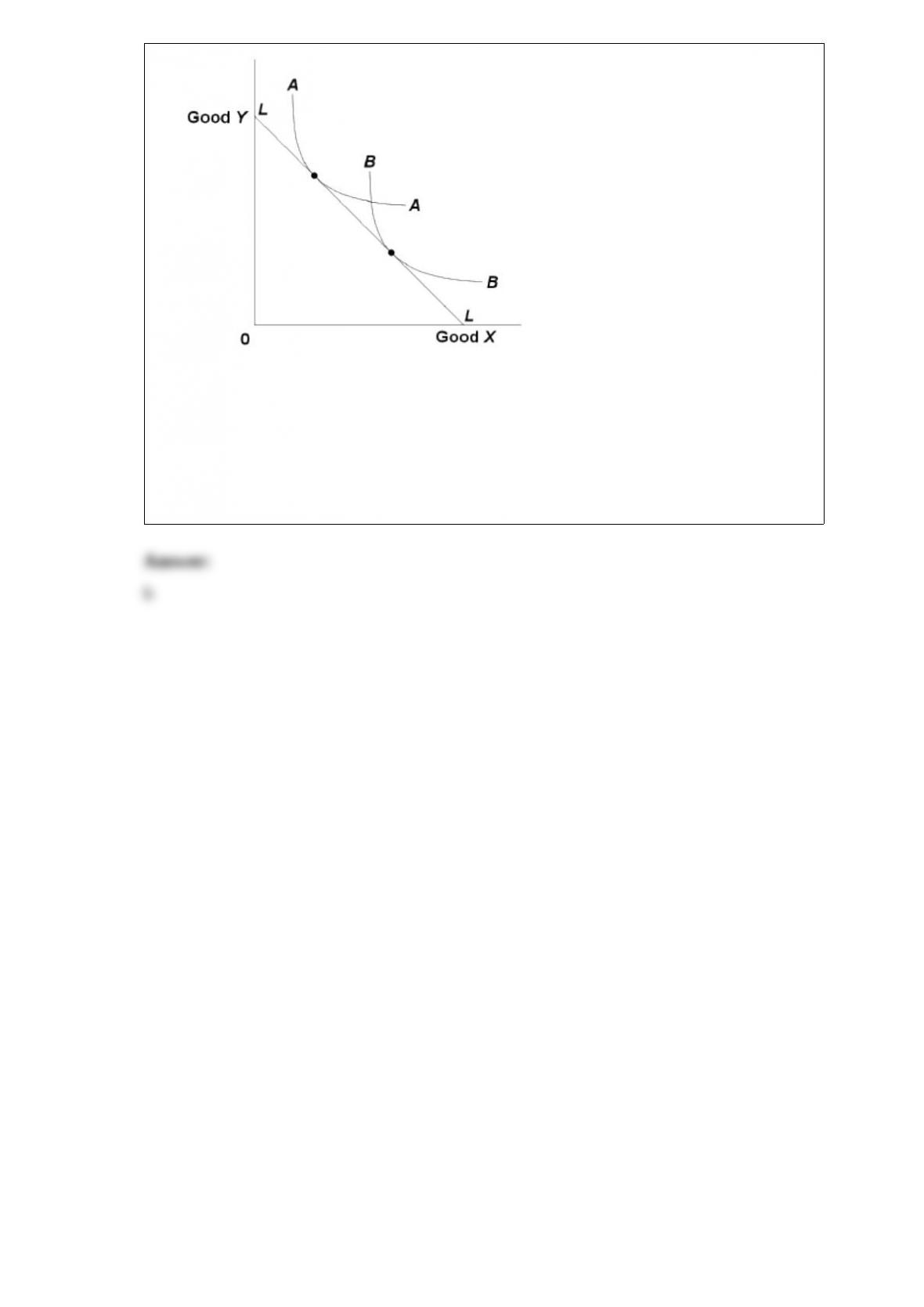
12)
aa is al’s indifference curve and bb is betty’s. al and betty have the same budget line, ll.
this information implies that:
a.al’s demand for x is stronger than betty’s.
b.al’s demand for y is stronger than betty’s.
c.al and betty have the same demand for both products.
d.al will buy some of x, but betty will not.