1) Scenario 9-1
The before-trade domestic price of peaches in the United States is $40 per bushel. The
world price of peaches is
$52 per bushel. The U.S. is a price-taker in the market for peaches.
If trade in peaches is allowed, U.S. producers of peaches
a.will be better off.
b.will be worse off.
c.will be unaffected.
d.will experience a decrease in their collective producer surplus.
2) Which of the following would be an example of capital for a computer software
firm?
(i)the firm’s computer programmers
(ii)the wages the firm pays to its computer programmers
(iii)computer equipment
a.(i) only
b.(ii) only
c.(iii) only
d.(i) and (iii) only
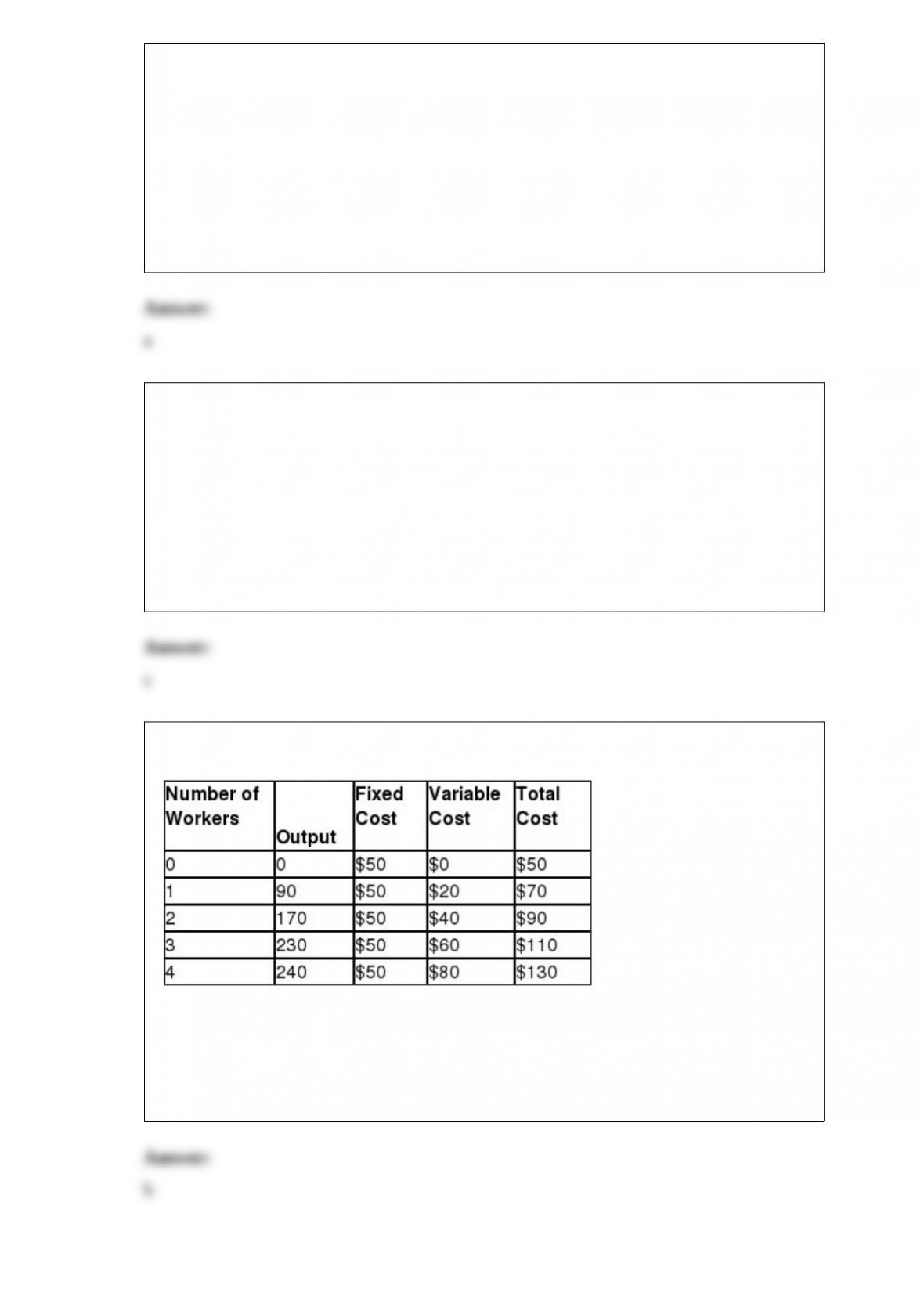
3) Table 13-3
At which number of workers does diminishing marginal product begin?
a.1
b.2
c.3
d.4
4) Policymakers often consider trade restrictions in order to protect domestic producers
from foreign competitors.
a.True
b.False
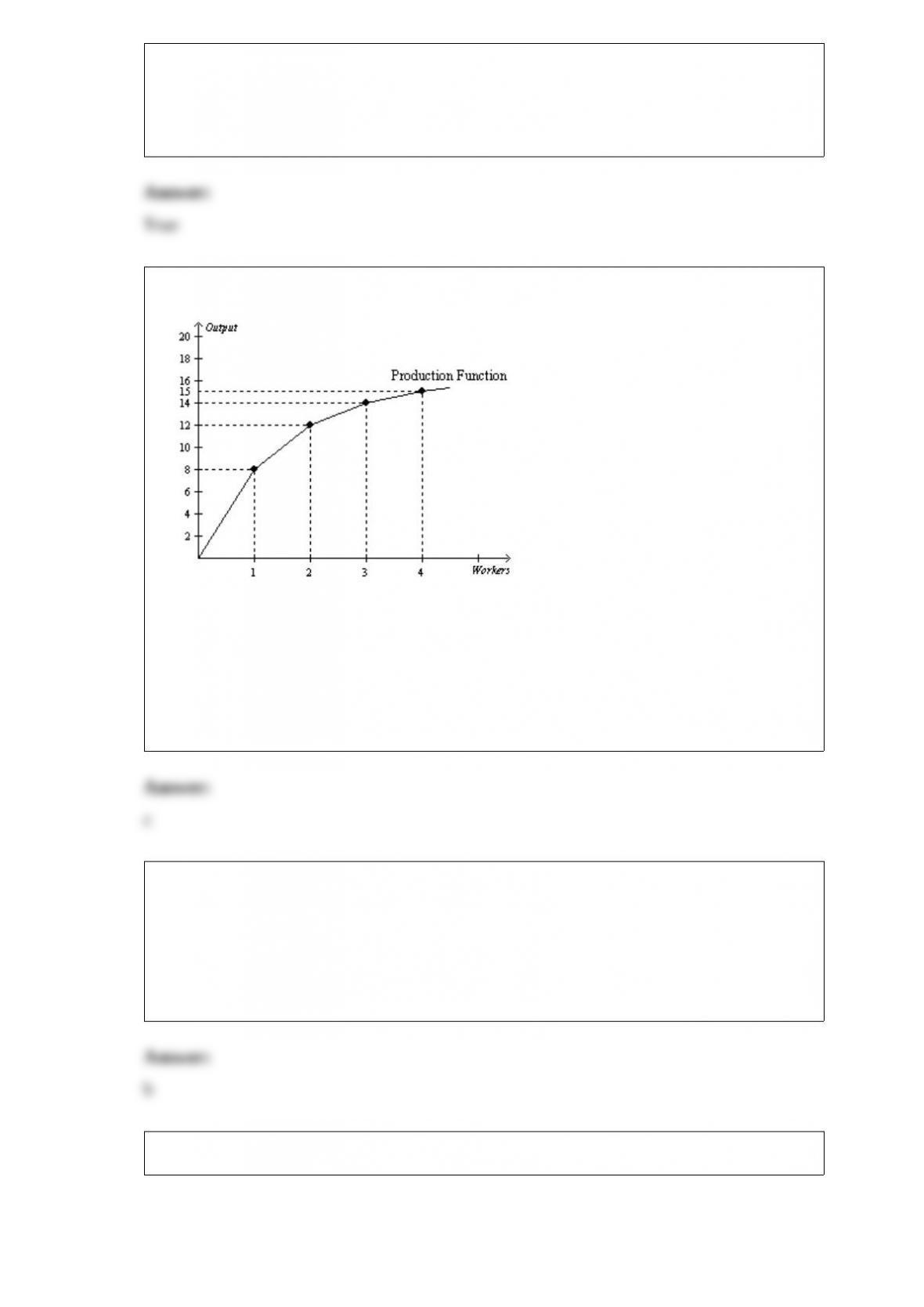
5) Figure 18-3
Refer to Figure 18-3. Suppose that the price of the output is $20. What is the value of
the marginal product of the second worker?
a.$4
b.$5
c.$80
d.$240
6) Whether or not policymakers should try to make our society more egalitarian is
largely a matter of
a.economic efficiency.
b.political philosophy.
c.egalitarian principles.
d.enhanced opportunity.
7) Figure 15-18
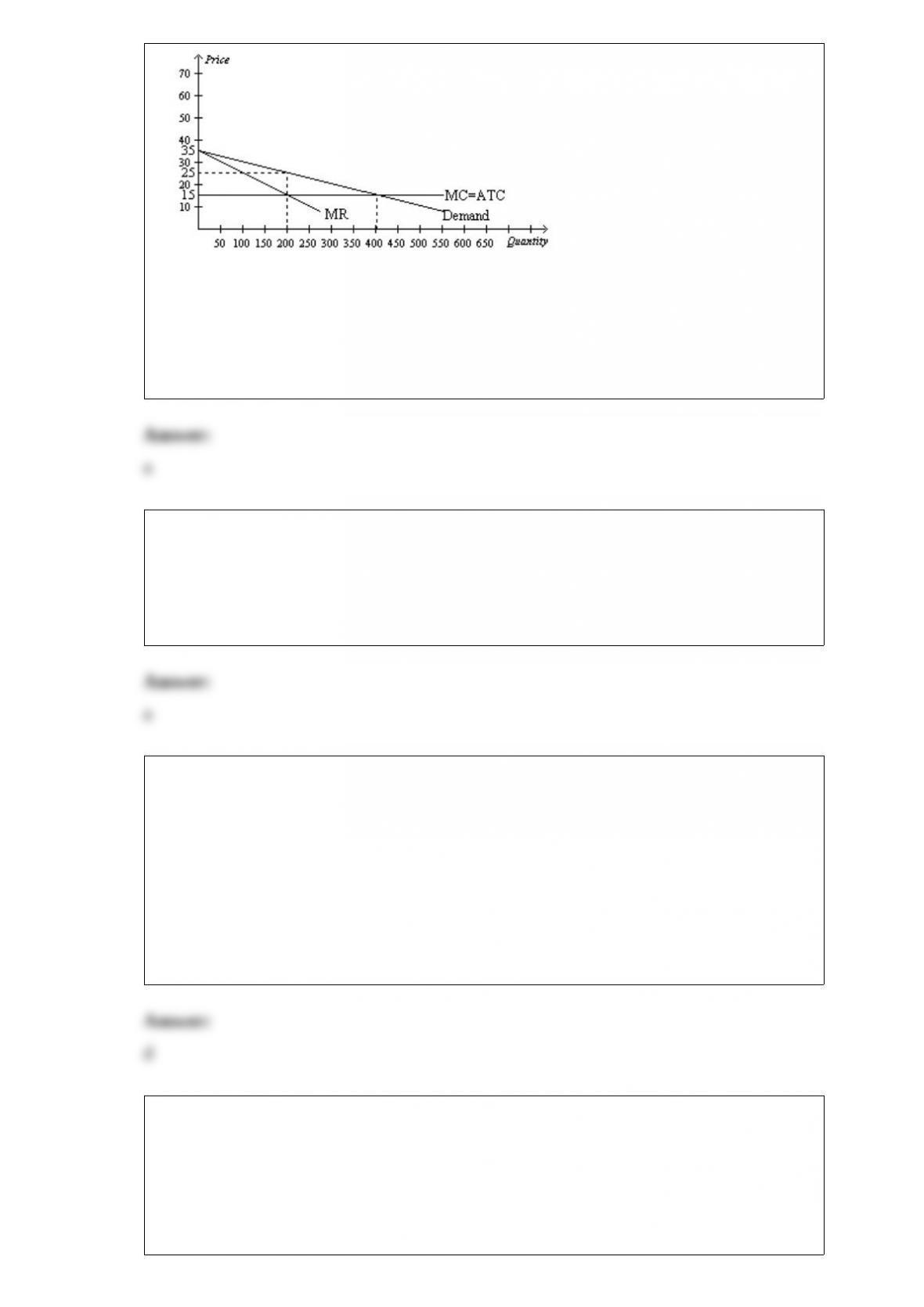
If the monopoly firm perfectly price discriminates, then the deadweight loss amounts to
a. $0.
b. $1,000.
c. $2,000.
d. $4,000.
8) The results of the ultimatum game illustrate the fact that
a.people’s behavior is often driven by an innate sense of fairness.
b.homo economicus is a good description of people’s behavior.
c.self-interest brings out the most efficient economic outcome.
d.Both b and c are correct.
9) A dentist shares an office building with a radio station. The electrical current from
the dentist’s drill causes static in the radio broadcast, causing the radio station to lose
$10,000 in profits. The radio station could put up a shield at a cost of $30,000; the
dentist could buy a new drill that causes less interference for $6,000. Either would
restore the radio station’s lost profits. What is the economically efficient outcome?
a.The radio station puts up a shield, which it pays for.
b.The radio station puts up a shield, which the dentist pays for.
c.Neither the radio station nor the dentist purchase additional equipment.
d.The dentist gets a new drill; it does not matter who pays for it.
10) Years ago, thousands of country music fans risked their lives by rushing to buy
tickets for a Willie Nelson concert at Carnegie Hall. This behavior indicates
a.the ticket price was above the equilibrium price.
b.the ticket price was below the equilibrium price.
c.the ticket price was at the equilibrium price.
d.nothing about the equilibrium price.
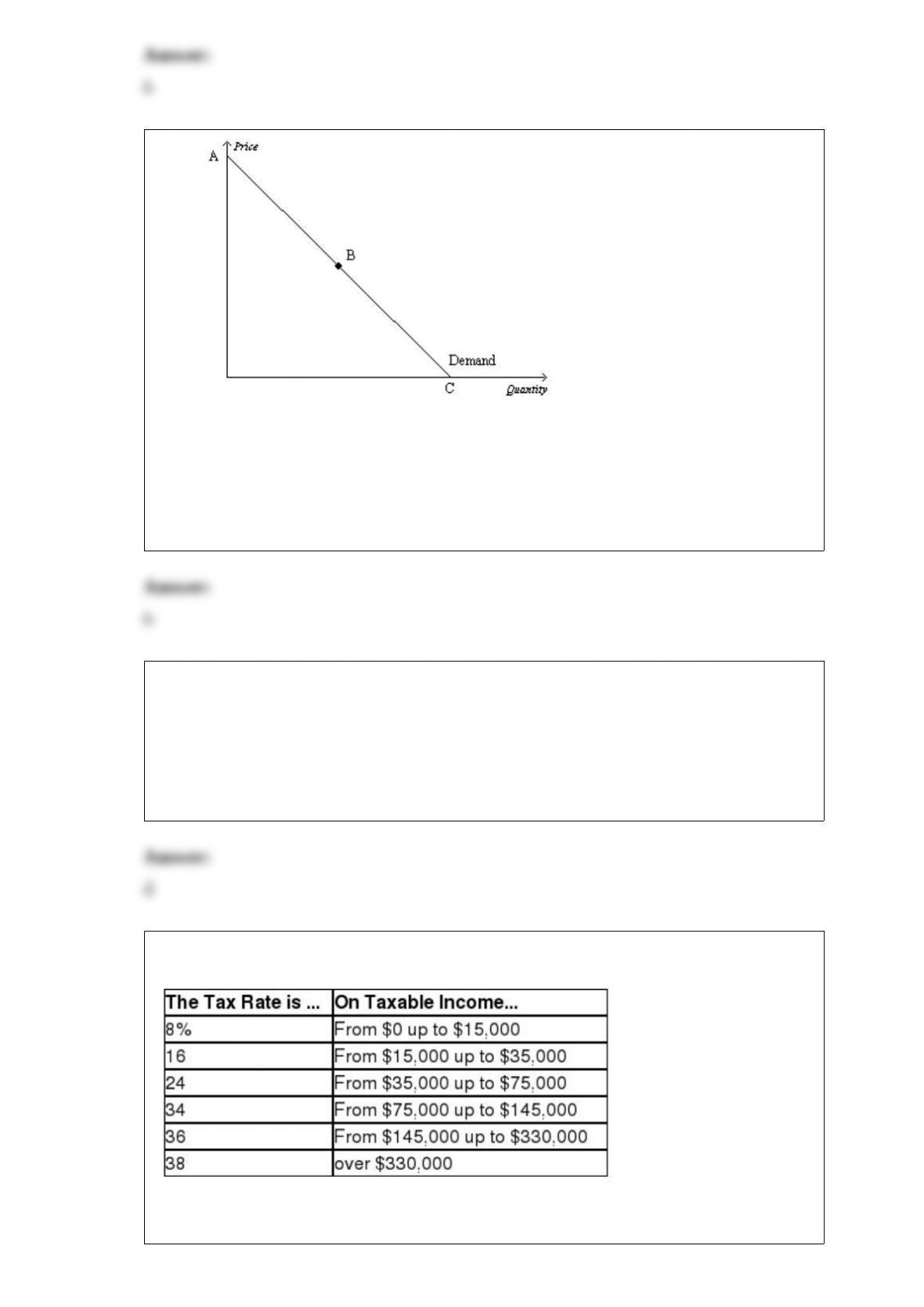
11)
The section of the demand curve from B to C represents the
a.elastic section of the demand curve.
b.inelastic section of the demand curve.
c.unit elastic section of the demand curve.
d.perfectly elastic section of the demand curve.
12) When a tax is levied on a good, the buyers and sellers of the good share the burden,
a.provided the tax is levied on the sellers.
b.provided the tax is levied on the buyers.
c.provided a portion of the tax is levied on the buyers, with the remaining portion levied
on the sellers.
d.regardless of how the tax is levied.
13) Table 12-11
If Peggy has taxable income of $43,000, her marginal tax rate is
a. 8%.

b.16%.
c.24%.
d.34%.
14) According to the Clayton Act,
a.lawyers are given an incentive to reduce the number of cases involving cooperative
arrangements.
b.individuals can sue to recover damages from illegal cooperative agreements.
c.the government was able to incarcerate the CEO of a firm for illegal pricing
arrangements.
d.private lawsuits are discouraged.
15) Which of the following is an example of a highly organized market?
a.the market for textbooks
b.the market for spa services
c.the market for soybeans
d.the market for ice cream
16) Adam Smith wrote that a person should never attempt to make at home what it will
cost him more to make than to buy.
a.True
b.False
17) Economists who study labor markets have documented
a.a general decline in the wages of college graduates over the last decade.
b.an increasing trend in U.S. labor markets for employers to pay all costs of education
and training.
c.a decrease in the earnings gap between low-skill and high-skill workers over the past
two decades.
d.an increase in the earnings gap between low-skill and high-skill workers over the past
two decades.

18) In a duopoly situation, the logic of self-interest results in a total output level that
a.equals the output level that would prevail in a competitive market.
b.equals the output level that would prevail in a monopoly.
c.exceeds the monopoly level of output, but falls short of the competitive level of
output.
d.falls short of the monopoly level of output.