
The classical dichotomy refers to the idea that the supply of money
a. is irrelevant for understanding the determinants of nominal and real variables.
b. determines nominal variables, but not real variables.
c. determines real variables, but not nominal variables.
d. is a determinant of both real and nominal variables.
Alfonso, a citizen of Italy, decides to purchase bonds issued by Ireland instead of ones
issued by the United States even though the Irish bonds have a higher risk of default.
An economic reason for his decision might be that
a. he dislikes U.S. foreign policy.
b. the Irish bonds pay a higher rate of interest.
c. the U.S. government is more stable than the Irish government.
d. None of the above provide an economic reason for buying the riskier bond.
Aggregate demand shifts right if
a. government purchases increase and shifts left if stock prices rise.
b. government purchases increase and shifts left if stock prices fall.

c. government purchases decrease and shifts left if stock prices rise.
d. government purchases decrease and shifts left is stock prices fall.
Other things the same, countries that offer more generous and longer-lasting
unemployment insurance benefits are likely to have higher unemployment rates.
a. True
b. False
The business cycle refers to fluctuations in economic activity such as employment and
production.
a. True
b. False

A survey of professional economists revealed that more than three-fourths of them
agreed with a number of statements, including which of the following?
a. Tariffs and import quotas usually reduce general economic welfare.
b. A large federal budget deficit has an adverse effect on the economy.
c. Minimum wage increases unemployment among young and unskilled workers.
d. All of the above are correct.
Equality means distributing society’s resources in the most efficient manner.
a. True
b. False
Real and nominal variables are highly intertwined, and changes in the money supply
change real GDP. Most economists would agree that this statement accurately describes
a. both the short run and the long run.
b. the short run, but not the long run.
c. the long run, but not the short run.

d. neither the long run nor the short run.
In the open-economy macroeconomic model, the supply of dollars in the market for
foreign-currency exchange comes from
a. national saving
b. domestic investment
c. net exports
d. net capital outflow
In 2009, the level of U.S. real GDP was close to four times its 1965 level.
a. True
b. False

Suppose a small closed economy has GDP of $5 billion, consumption of $3 billion, and
government expenditures of $1 billion. Then investment and national saving are both $1
billion.
a. True
b. False
When inflation rises, people will desire to hold
a. less money and will go to the bank less frequently.
b. less money and will go to the bank more frequently.
c. more money and will go to the bank less frequently.
d. more money and will go to the bank more frequently.
Economists at which of the following offices help formulate spending plans and
regulatory policies?
a. Office of Management and Budget
b. Department of the Treasury

c. Congressional Budget Office
d. The Federal Reserve
Figure 3-19
RefertoFigure3-19.Chile has a comparative advantage in the production of
a. coffee and Colombia has a comparative advantage in the production of soybeans.
b. soybeans and Colombia has a comparative advantage in the production of coffee.
c. both goods and Colombia has a comparative advantage in the production of neither
good.
d. neither good and Colombia has a comparative advantage in the production of both
goods.
Other things the same, which of the following could explain an increase in
productivity?
a. either an increase in human capital or an increase in physical capital
b. an increase in human capital but not an increase in physical capital
c. an increase in physical capital but not an increase in human capital

d. neither an increase in human capital nor an increase in physical capital
Which of the following shifts aggregate demand to the right?
a. The price level rises.
b. The price level falls.
c. The money supply falls.
d. None of the above is correct.
When government expenditures increase, the interest rate
a. increases, making the change in aggregate demand larger.
b. increases, making the change in aggregate demand smaller
c. decreases, making the change in aggregate demand larger.
d. decreases, making the change in aggregate demand smaller.

If Cara’s utility falls more by losing $600 than it rises by gaining $600, she has
a. increasing marginal utility of wealth and is risk averse.
b. increasing marginal utility of wealth but is not risk averse.
c. decreasing marginal utility of wealth and is risk averse.
d. decreasing marginal utility of wealth but is not risk averse.
If net exports fall $40 billion, the MPCis 9/11, and there is a multiplier effect but no
crowding out and no investment accelerator, then
a. aggregate demand falls by 2 x$40 billion.
b. aggregate demand falls by 11/2 x$40 billion.
c. aggregate demand falls by 11/9 x$40 billion.
d. aggregate demand falls by 9/11 x$40 billion.
Which of the following is included in M2 but not in M1?
a. currency
b. demand deposits
c. savings deposits
d. All of the above are included in both M1 and M2.
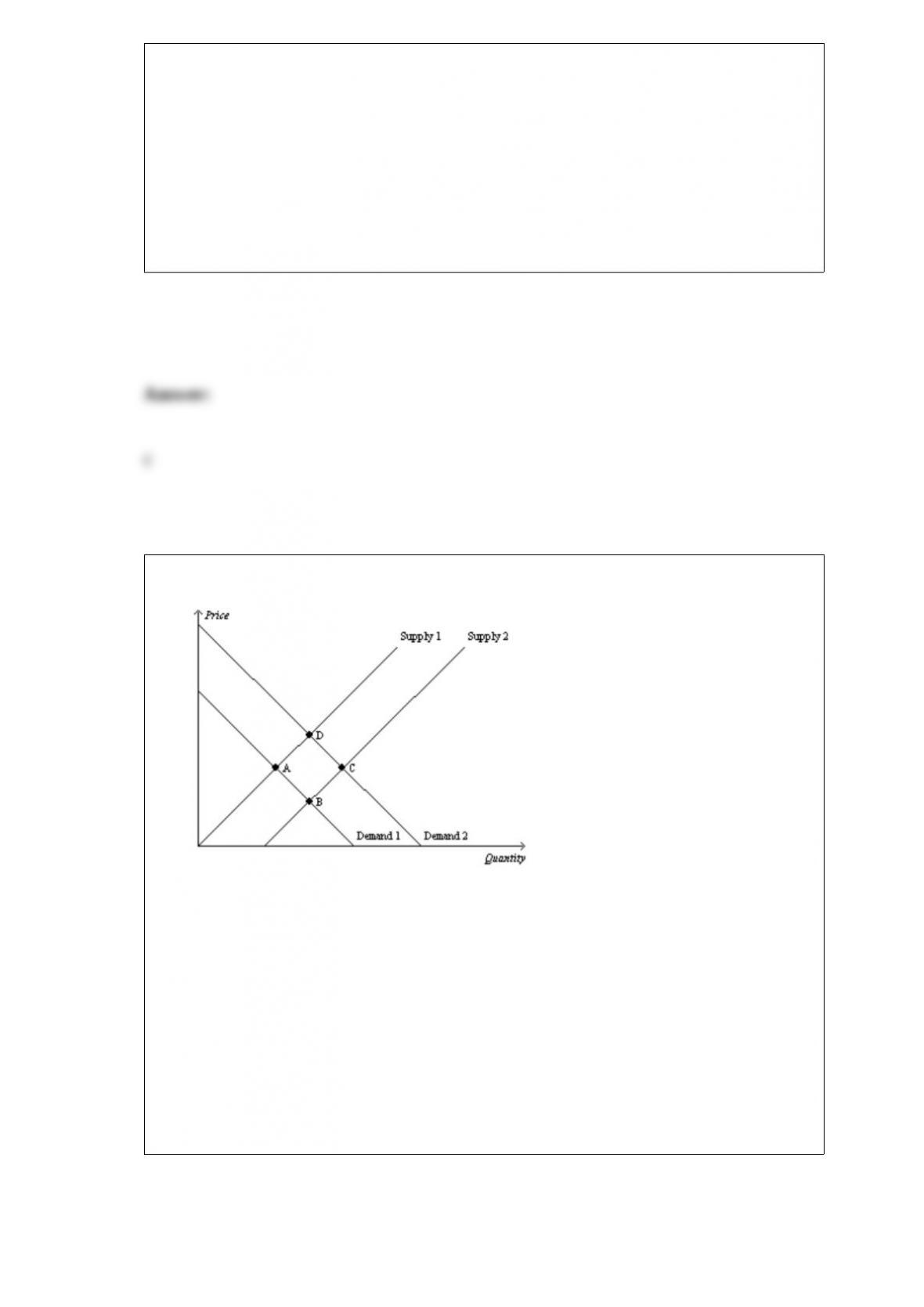
Figure 4-26
RefertoFigure4-26.Which of the following movements would illustrate the effect in the
market for chocolate chip cookies of an improved high-speed mixer that allows bakers
to produce cookies in less time?
a. Point A to Point B
b. Point C to Point B
c. Point C to Point D
d. Point A to Point D

Figure27-2. The figure shows a utility function for Britney.
RefertoFigure27-2. Suppose the vertical distance between the points (0, A) and (0, B)
is 5. If her wealth increased from $1,050 to $1,350, then
a. Britney’s subjective measure of her wellbeing would increase by less than 5 units.
b. Britney’s subjective measure of her wellbeing would increase by more than 5 units.
c. Britney would change from being a risk-averse person into a person who is not risk
averse.
d. Britney would change from being a person who is not risk averse into a risk-averse
person.
Which of the following would we notexpect if government policy moves the economy
up along a given short-run Phillips curve?
a. Mark gets an increase in his nominal wage.
b. Bob gets more job offers.
c. Susan reduces prices at her pizza restaurant.
d. Tom reads that the central bank recently raised the money supply
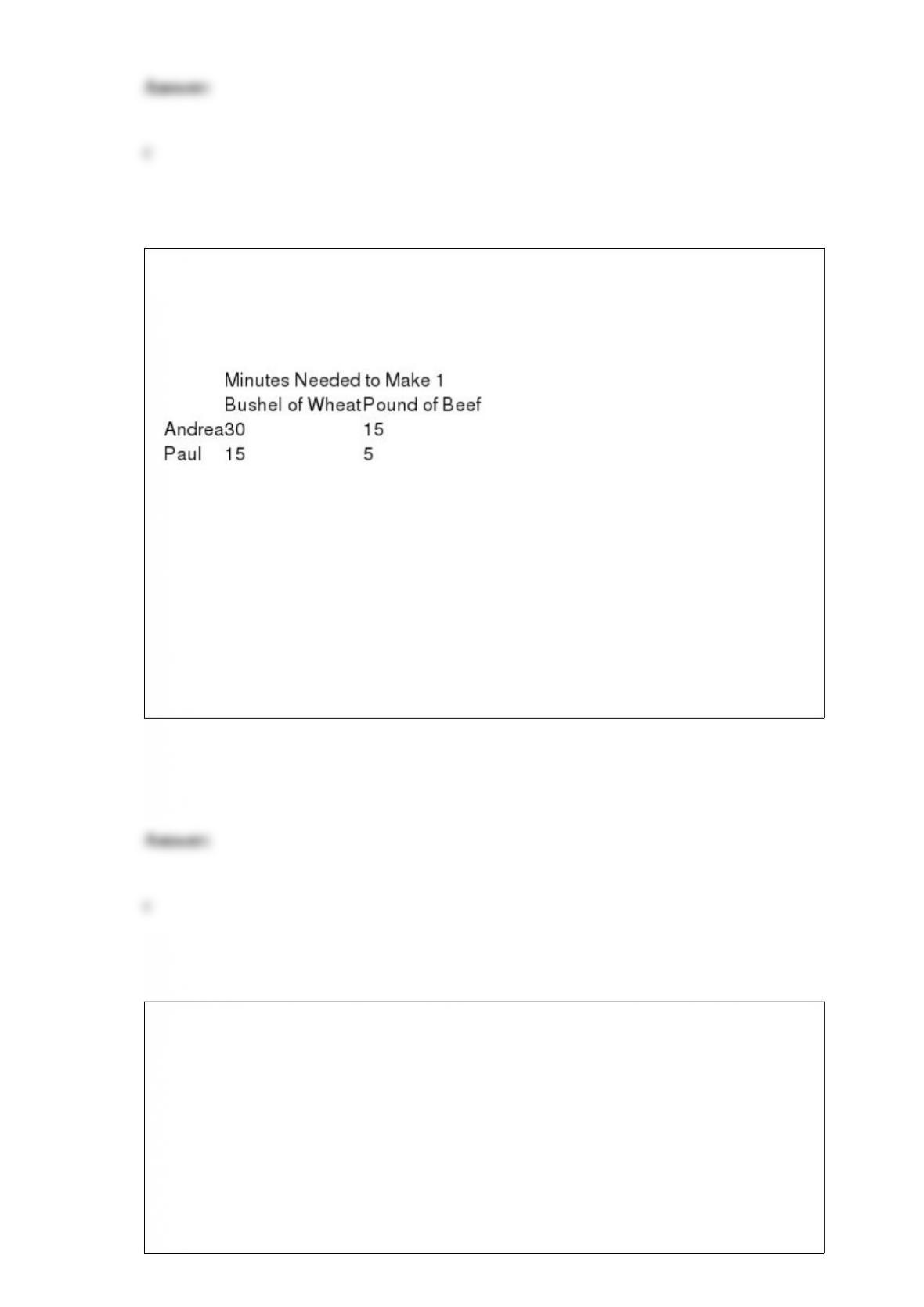
Table 3-4
Assume that Andrea and Paul can switch between producing wheat and producing beef
at a constant rate.
Refer to Table3-4. Which of the following combinations of wheat and beef could
Andrea produce in one 8-hour day?
a. 16 bushels of wheat and 32 pounds of beef
b. 9 bushels of wheat and 25 pounds of beef
c. 7 bushels of wheat and 15 pounds of beef
d. 10 bushels of wheat and 13 pounds of beef
A U.S.-owned car factory in Mexico produces $5 million of cars. $2.5 million of these
cars are sold in Mexico and the other $2.5 million are sold in the U.S. In both cases $1
million of the value of the cars was due to U.S-owned equipment located in Mexico and
U.S. managers working in Mexico. How much did this production contribute to U.S.
GDP?
a. $0
b. $1 million

c. $2 million
d. None of the above are correct
Paul Volcker, former chair of the Fed, implemented
a. contractionary policy which increased the popularity of the U.S. president who had
appointed him.
b. contractionary policy which decreased the popularity of the U.S. president who had
appointed him.
c. expansionary policy which increased the popularity of the U.S. president who had
appointed him.
d. expansionary policy which decreased the popularity of the U.S. president who had
appointed him.
Which of the following did not happen during the onset of the Great Depression?
a. The money supply fell as households took money out of bank deposits.
b. The Fed conducted expansionary monetary policy.
c. Stock prices fell about 90 percent.
d. Disruption of the banking system made it difficult for some firms to obtain funds for
investment.

When inflation rises, the nominal interest rate
a. rises, and people desire to hold more money.
b. rises, and people desire to hold less money.
c. falls, and people desire to hold more money.
d. falls, and people desire to hold less money
Which of the following shifts long-run aggregate supply right?
a. an increase in either technology or the human capital stock.
b. an increase in human capital but not technology.
c. an increase in technology, but not the human capital stock.
d. neither an increase in technology nor the human capital stock.

Suppose you put $350 into a bank account today. Interest is paid annually and the
annual interest rate is 6 percent. The future value of the $350 after 4 years is
a. $414.09.
b. $434.00.
c. $441.87.
d. $481.24.
Economists at the Department of the Treasury
a. design U.S. currency and coins.
b. provide Congress with the annual budget.
c. enforce the U.S. antitrust laws.
d. provide advice on tax policy to the President.
What does purchasing-power parity imply about the real exchange rate? Explain what
this means.
What is the difference between monetary policy and fiscal policy?
Figure 3-26
RefertoFigure3-26.What is Mary’s opportunity cost of one muffin?
Scenario 27-2
Suppose Dave has a utility function where Wis his wealth in millions of
dollars and Uis the utility he obtains.
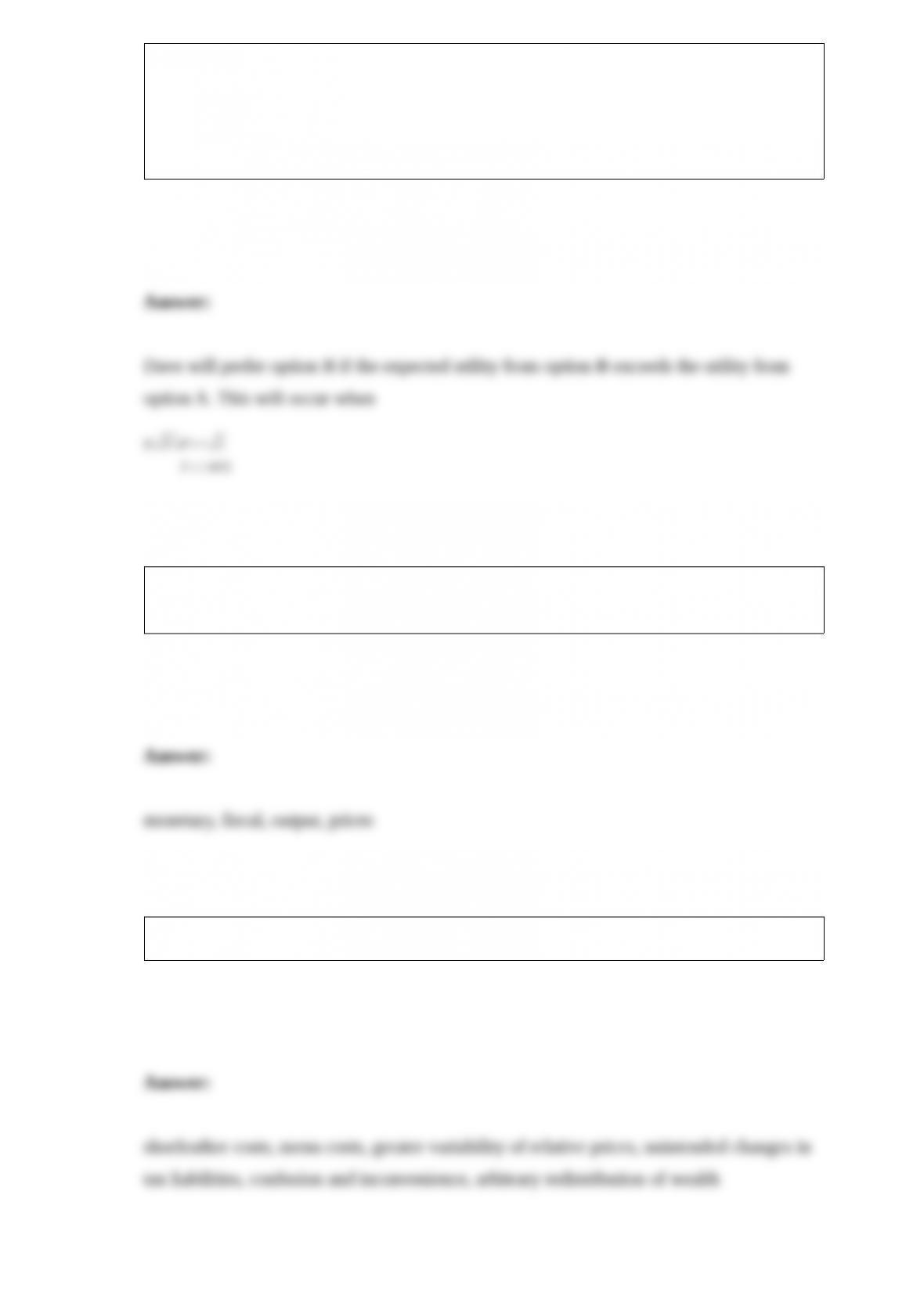
RefetoScenario27-2.Suppose Dave is faced with a choice between two options. With
option A Dave receives a guaranteed $2 million. With option B Dave faces a lottery that
pays $10 million with probability Pand pays $0 with probability (1-P). Given Dave’s
utility function, how high does Pneed to be before he will prefer option B over option
A?
Policymakers use _____ policy and _____ policy to stabilize _____ and _____ in the
short run.
List two costs of inflation.

If a country’s government moves from a budget deficit to a budget surplus, which curve
in the market for loanable funds shifts and which direction does it shift? What happens
to the interest rate?
Suppose goods A and B are complements. If the price of good A increases, will the
demand for good B increase or decrease?
If the exchange rate rises, foreign residents want to purchase ______ domestic goods
and domestic residents want to purchase _____ foreign goods. In the market for
foreign-currency exchange, these changes are shown as a _______ in the quantity of
dollars ______.
Suppose that Venezuela produces beef and oil and it can switch production between

each at a constant rate. If the most beef it can produce is 300 million pounds and the
most oil it can produce is 50 million barrels, then what is the opportunity cost of a
pound of beef and what is the opportunity cost of a barrel of oil?
The inflation tax alters people’s behavior and creates a deadweight loss. Explain.
Scenario 1-3
It costs a company $35,000 to produce 700 graphing calculators. The company’s cost
will be $35,070 if it produces an additional graphing calculator. The company is
currently producing 700 graphing calculators.
RefertoScenario1-3.What is the company’s average cost?
You are a financial advisor and a client tells you he is concerned about the amount of
risk in his portfolio. Assuming your client hasn”t already done them, what two things
can you suggest to reduce your client’s risk? What additional information about
reducing risk should you provide?
What happens to domestic investment as the real interest rate rises? Explain your
answer.
Table 23-12
A country produces only ice cream and cake in the quantities and prices listed below.
Use 2011 as the base year.
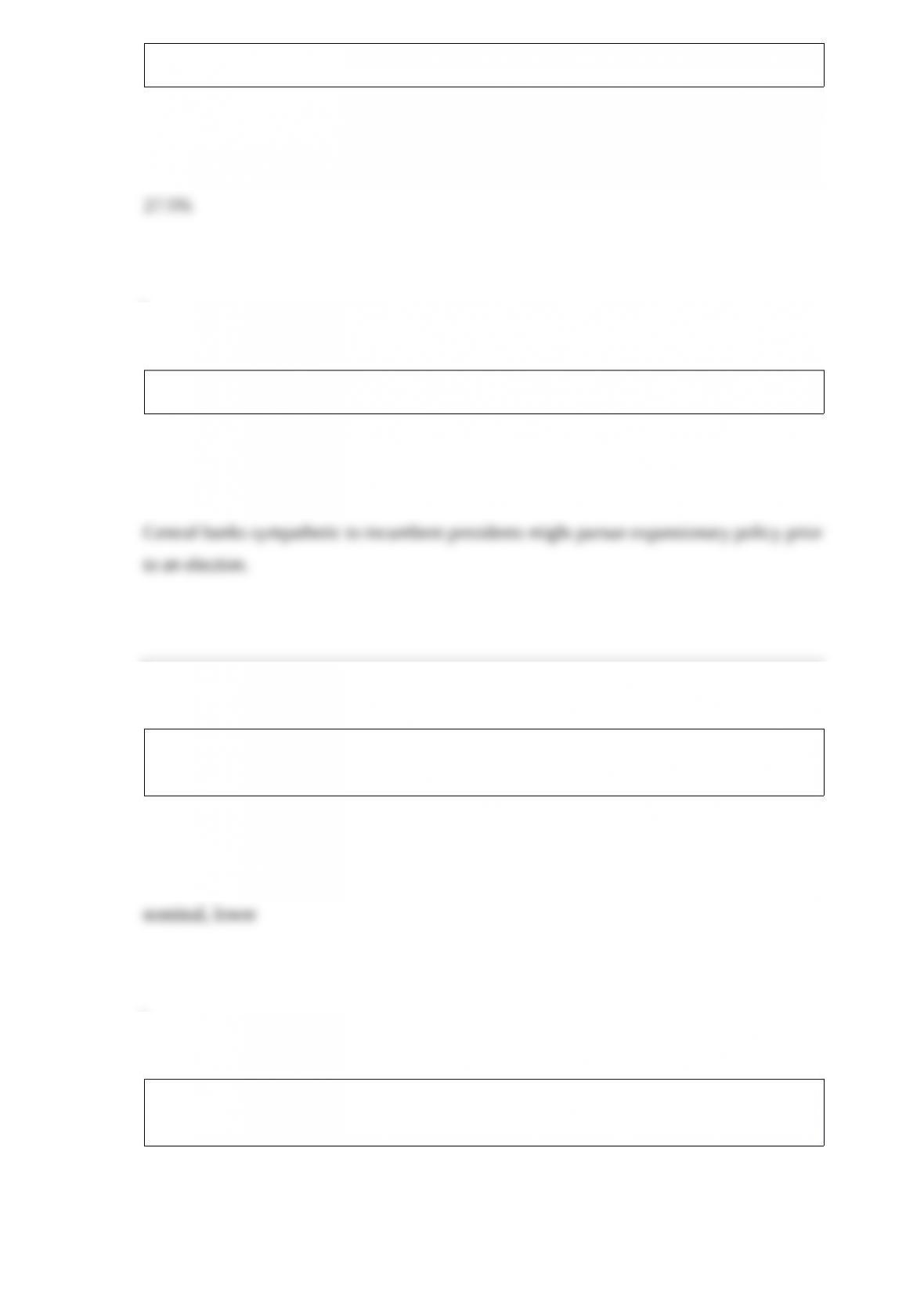
RefertoTable23-12. Calculate the rate of inflation for 2012.
What is meant by the political business cycle?
In the U.S., taxes are paid on one’s _____ gains/returns. Therefore, a _____ inflation
rate encourages more saving.
You believe the dollars you have today will be accepted in the future in exchange for
goods and services. Which function of money does this illustrate?
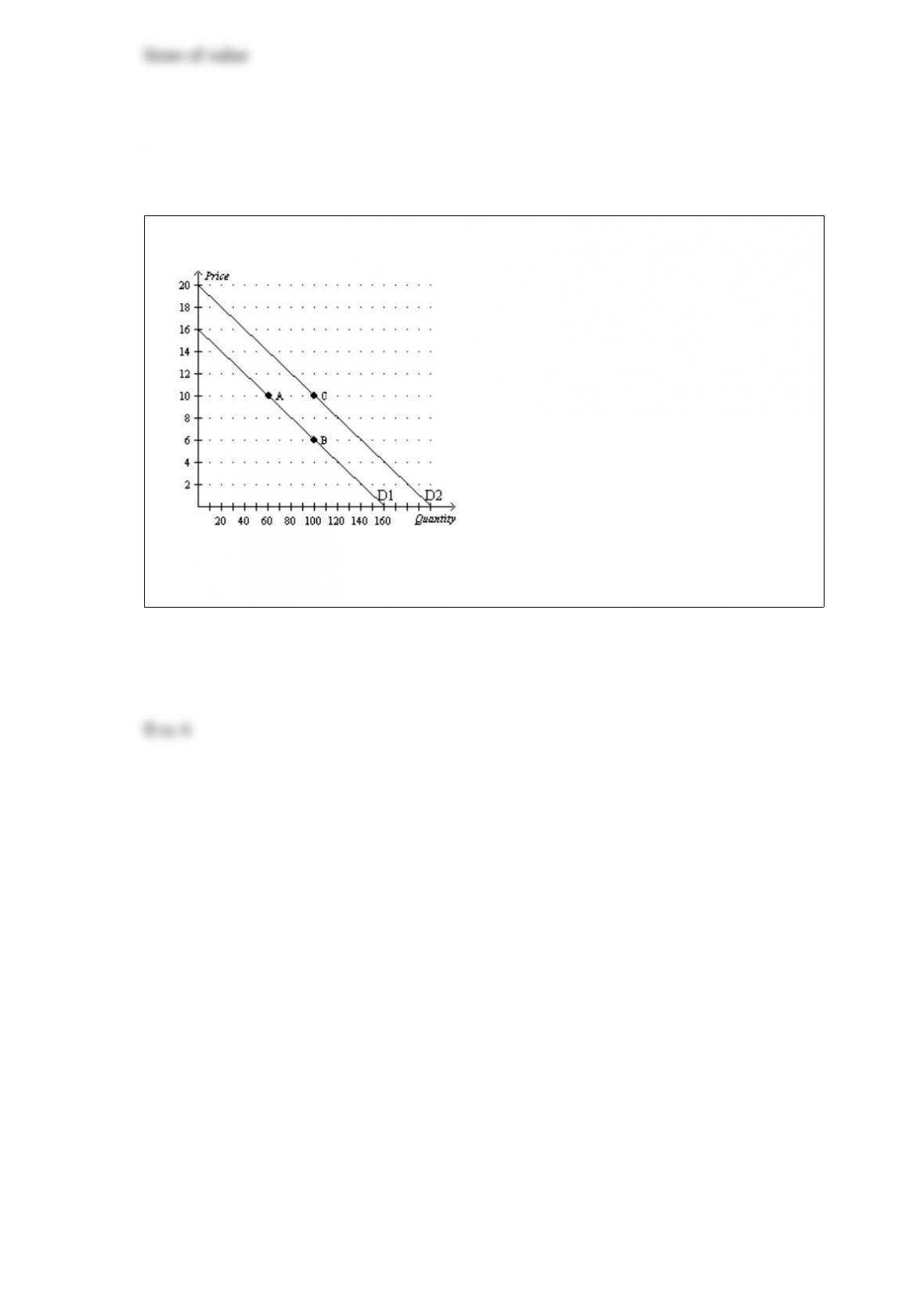
Figure 4-28
RefertoFigure4-28.Using the points on the figure, describe the change that would
occur if the price of this good increases.