
What does the phrase “internalizing an external cost” mean?
A) limiting the extent to which domestic firms can outsource production
B) prohibiting economic activities that create externalities
C) forcing producers to factor into their production costs the cost of the externalities
created in the production of their output
D) finding a way to address cross-border pollution
Consider the following hypothetical scenarios:
Scenario A: You are about to purchase a pair of 7 for All Mankind jeans for $175 and a
t-shirt for $45. The sales attendant at the store tells you that the pair of jeans you wish
to buy is on sale for $160 at another store, located about a 20-minute drive away.
Scenario B: You are about to purchase a pair of 7 for All Mankind jeans for $175 and a
t-shirt for $45. The sales attendant at the store tells you that the t-shirt you wish to buy
is on sale for $30 at another store, located about a 20-minute drive away. Based on
standard economic theory, under which scenario would you make the 20-minute trip to
the other store?
A) Scenario A because the pair of jeans is a very expensive item and $15 saving is quite
substantial
B) Scenario B because a $15 saving amounts to a substantial discount (about 33
percent)
C) in either scenario if I think a $15 savings is worth the 20-minute trip
D) in none of these scenarios if I think the $15 saving is not worth the 20-minute trip
E) C and D are correct answers.

A perfectly competitive industry achieves allocative efficiency in the long run. What
does allocative efficiency mean?
A) Each firm produces up to the point where the price of the good equals the marginal
cost of producing the last unit.
B) Each firm produces up to the point where all scale economies are exhausted.
C) Production occurs at the lowest average total cost.
D) Firms use an input combination that minimizes cost and maximizes output.
Erin and Deidre, two residents of Ithaca, New York, are planning a trip to Boston. Erin,
the sales manager for a large retailer, has to attend a business meeting. Deidre, a college
student on vacation, is planning a leisurely trip to visit friends and relatives. Which of
the following statements is true?
A) An airline that price discriminates will charge Erin a higher price.
B) An airline that price discriminates will charge Deidre a higher price.
C) Since there is no difference in the cost of producing air travel, airlines will not
charge different prices to Erin and Deidre.
D) An airline cannot price discriminate because buyers can resell their tickets through
the Internet.

If you pay $2,000 in taxes on an income of $20,000, and a tax of $3,500 on an income
of $30,000, then over this range of income the tax is
A) regressive.
B) proportional.
C) progressive.
D) There is insufficient information to answer the question.
Between 1950 and 2013 the number of acres devoted to wheat production in the United
States ________ and the price of wheat ________.
A) declined; decreased
B) more than doubled; increased by about 50 percent
C) declined; more than doubled
D) increased; more than doubled
Macroeconomic equilibrium occurs when
A) aggregate expenditure = GDP.
B) aggregate expenditure = C+ I + G + net transfers.
C) aggregate income = planned inventories.

D) aggregate expenditure = planned inventories.
If the purchasing power of a dollar is greater than the purchasing power of the yen,
purchasing power parity would predict that
A) in the short run, exchange rates will move to equalize the purchasing power of the
dollar and the yen.
B) in the long run, exchange rates will move to equalize the purchasing power of the
dollar and the yen.
C) in the long run, interest rates will move to equalize the purchasing power of the
dollar and the yen.
D) in the short run, interest rates will move to equalize the purchasing power of the
dollar and the yen.
Which of the following is most liquid?
A) a mutual fund share
B) a government bond
C) a corporate bond
D) a dollar bill
All of the following are reasons why the wages of workers and the prices of inputs rise
more slowly than the prices of final goods and services except
A) unions are successful in pushing up wages.
B) firms are often slow to adjust wages.
C) contracts make prices and wages ‘sticky.”
D) menu costs make some prices sticky.
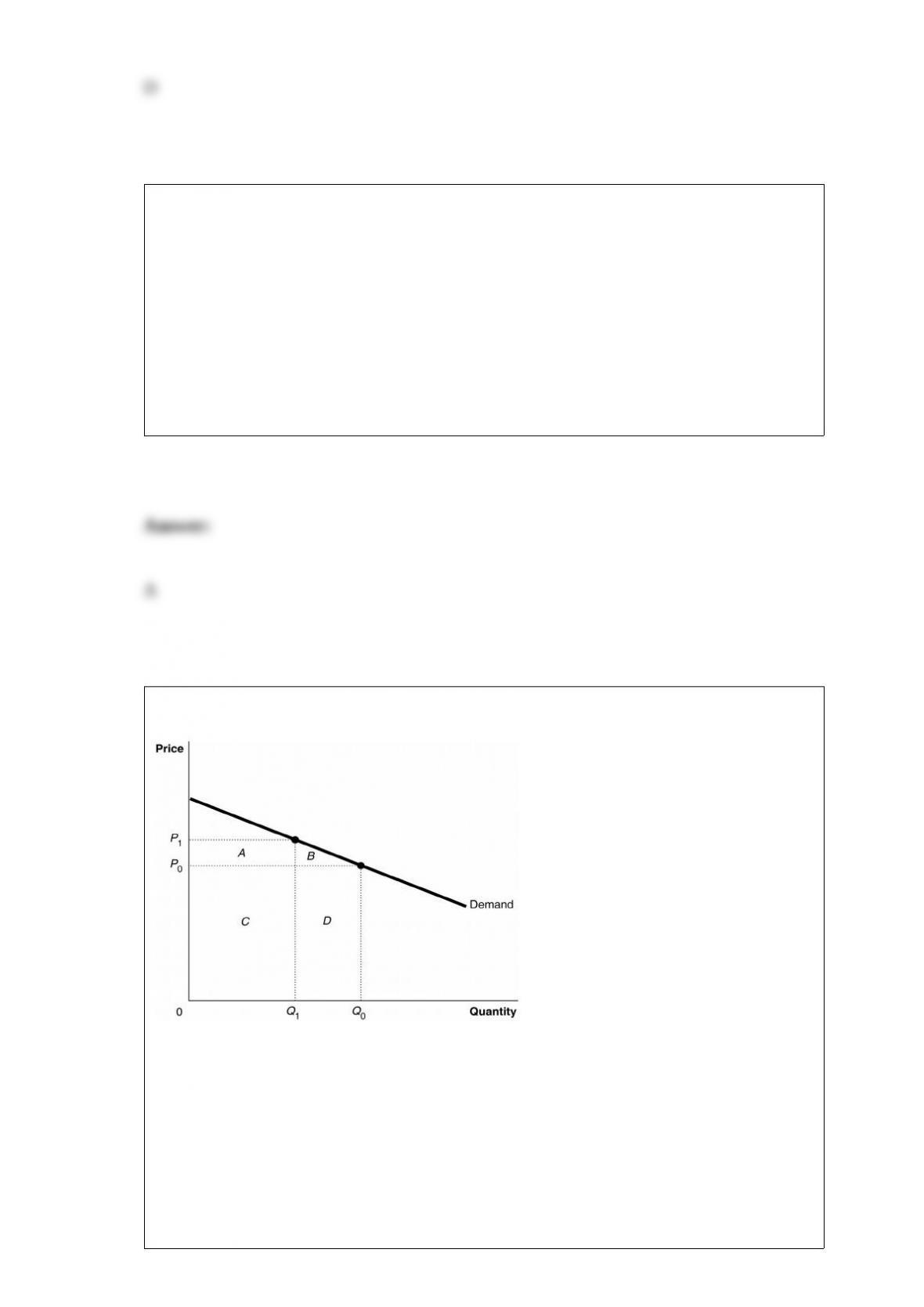
Figure 13-1
The marginal revenue from the increase in price from P0 to P1 equals
A) the area A.
B) the area (B + D – A).
C) the area (A – D).

D) the area (C – B).
Destabilizing speculation refers to
A) actions taken by the International Monetary Fund that increase lending to countries
who have pegged their currencies against the dollar.
B) actions taken by currency traders to sell a currency that is undervalued.
C) actions taken by investors who sell a country’s currency in anticipation of buying it
back later at a lower price.
D) any depreciation of a country’s currency as a result of long-run adjustments to
purchasing power parity.